How to Match TR90 & TPEE Kids Optical Frame Size to Pupillary Distance & Avoid Mismatch?

Matching TR90 & TPEE kids optical frame size to pupillary distance is where most fit complaints begin with our factory samples. Durable frames that decenter lenses still strain young eyes.
Match TR90 & TPEE kids optical frame size to pupillary distance by adding lens width and bridge width to get the frame PD, then keeping it within 2–3 mm per eye of the child’s measured PD, while confirming bridge fit, temple length, and pupil position on the actual face.
That is the short version. The rest of this article shows you how to measure PD, how to read frame numbers, what goes wrong when they do not line up, and how to lock the fit in with your factory before you commit to a run.
How do I measure my child's pupillary distance accurately before choosing a frame size?
During a sample check in our Taizhou workshop last year, two rulers gave two different PDs for the same demo head. That gap taught us to standardize.
Measure a child's pupillary distance with a digital pupillometer when possible, or a millimeter ruler at eye level while the child looks at a distant target, take three readings, record monocular values for each eye, and accept the result only when repeats agree within 1 mm.
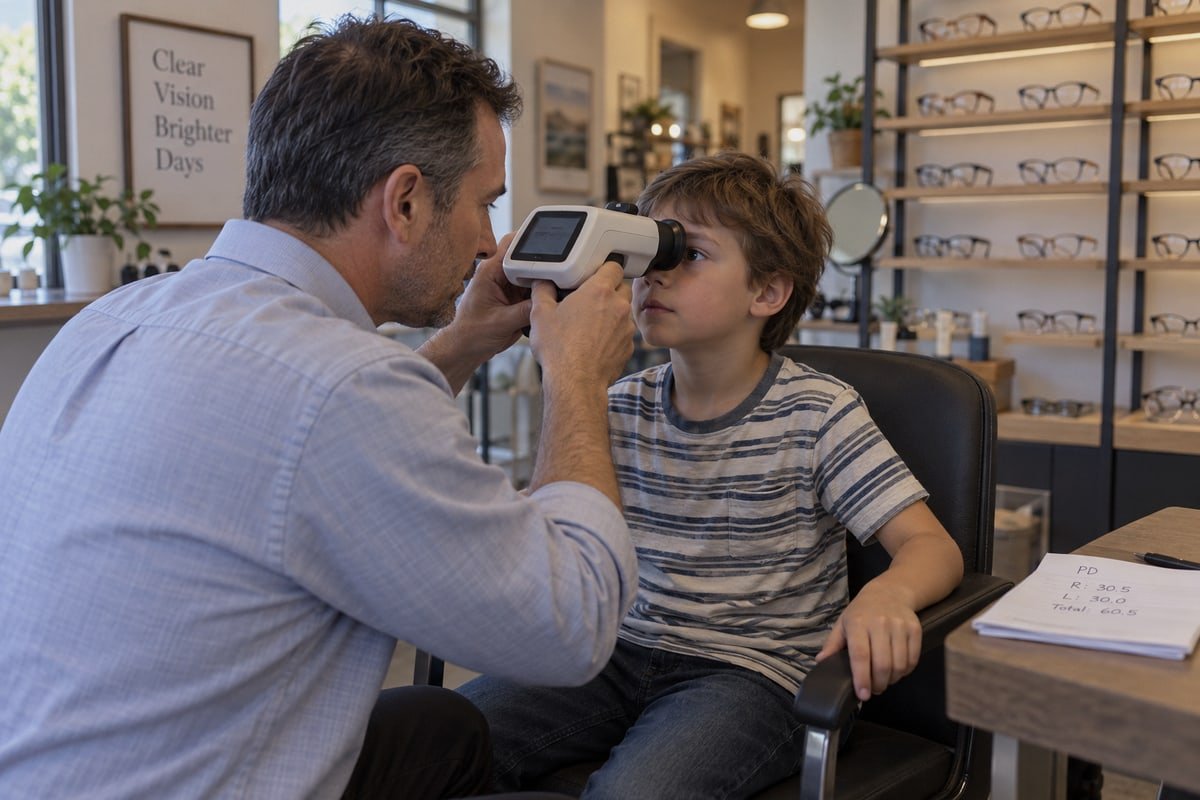
Pupillary distance, or PD, is the distance between the centers of the two pupils. It tells you where the optical center of each lens should sit. Everything else in pediatric eyewear fitting builds on this one number. If the number is wrong, the frame choice will be wrong too, no matter how good the frame is.
Why the ruler often reads too narrow
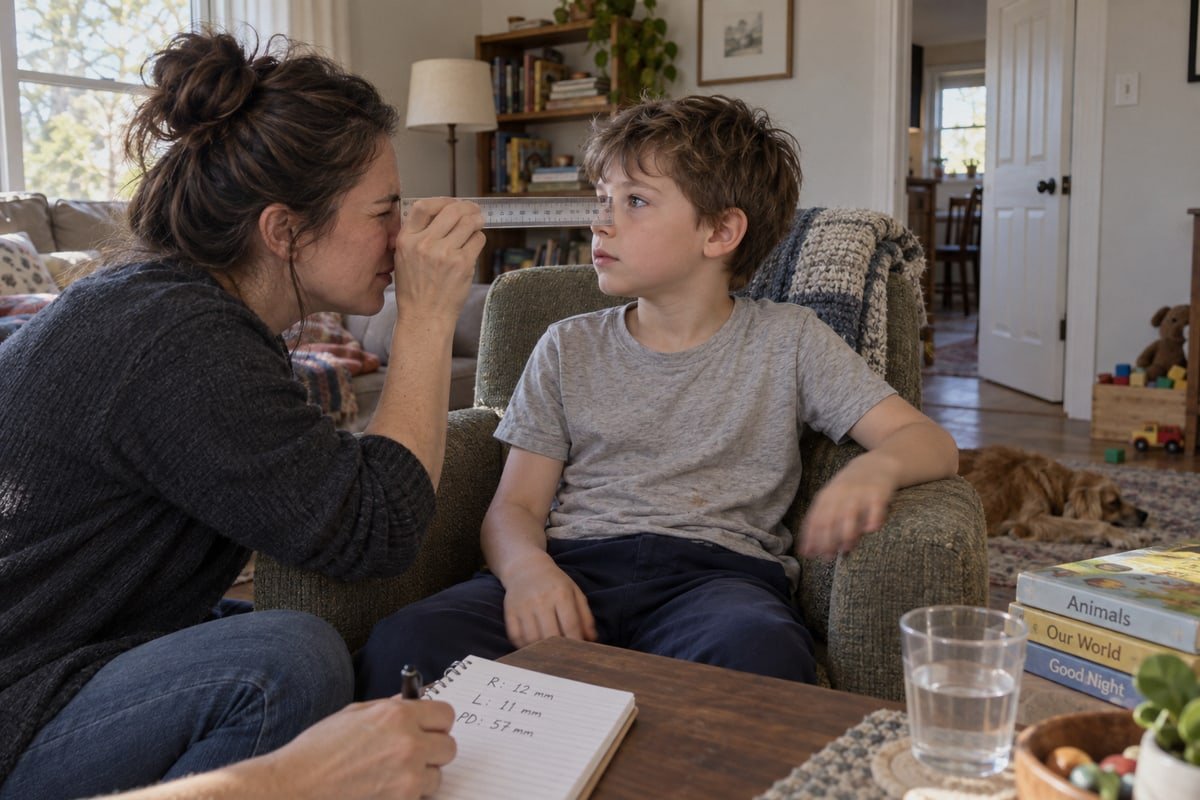
Children look at whatever is closest. When a parent holds a ruler a few centimeters from a child's face, the child focuses on the ruler or on the parent's nose. The eyes turn inward. This is called proximal convergence. The reading comes out narrower than the child's true distance PD. A digital pupillometer avoids this because it gives the child a far-focus target 1 inside the device. In our experience, a ruler reading and a pupillometer reading on the same child can disagree by more than the 2 mm error that guides warn will noticeably affect vision and comfort.
A simple process that works at home or in store
- Seat the child and sit at the same eye level.
- Ask the child to look at something far away, past your shoulder.
- Rest the millimeter ruler on the bridge of the nose.
- Close your right eye and line up the zero mark with the center of the child's right pupil.
- Close your left eye and read the mark at the center of the child's left pupil.
- Repeat three times. Keep the result only if the readings agree closely.
- Write down the total PD and, if you can, the distance from the nose center to each pupil.
| Method | Tool needed | Best for | Main risk |
|---|---|---|---|
| Millimeter ruler | Plastic PD ruler | Quick home checks, first estimate | Proximal convergence gives a falsely narrow PD |
| Digital pupillometer | Handheld optical device | Final measurement before ordering | Cost, and the child must hold still |
| Phone app | Smartphone camera and a reference card | Online shopping when nothing else is available | Scale errors and head tilt |
Monocular PD matters for kids
Many children are not perfectly symmetrical. If the child has an eye turn, or if the two half-distances look uneven, record the monocular PD for each eye. Pediatric dispensing guidance stresses this because each eye may need separate attention when the lenses are cut. One total number hides that detail.
Facial measurements change fast
A PD measured at age four will not fit at age seven. Growing faces shift the pupils outward, and the nose bridge rises. We recommend that brands remind parents to recheck PD at every prescription visit and at least once a year in between. A good frame that fit last year can decenter the lenses this year.
Which TR90 & TPEE frame size ranges work best for different children's PD measurements?
The trade-off we weigh on every kids' style is simple: a wider lens gives more field of view, but it pushes the frame PD away from small faces.
TR90 & TPEE kids optical frame sizes work best when lens width plus bridge width lands within 2–3 mm per eye of the child's PD: roughly 39–43 mm lenses for toddlers, 44–46 mm for ages 5–8, 47–50 mm for ages 9–12, and 50–54 mm for teens.
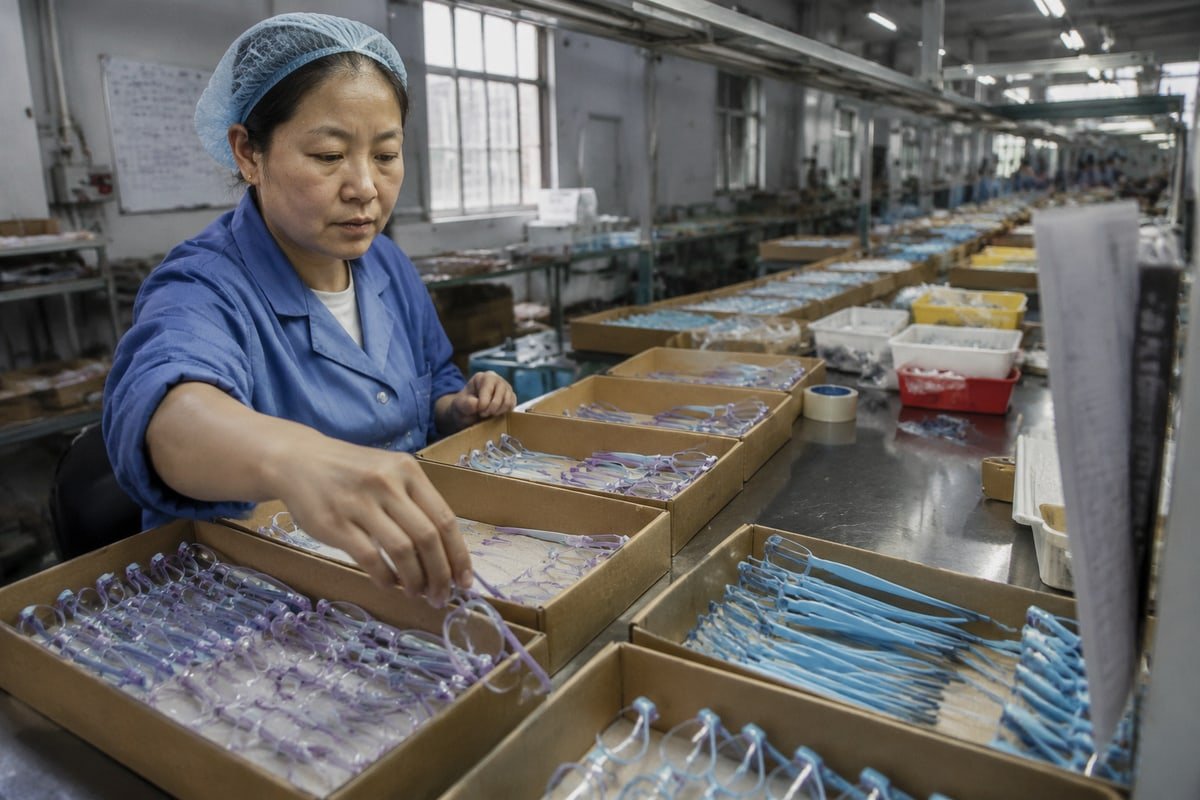
Start with the chart below, then move quickly to real numbers. The age bands come from current sizing guides. The right-hand columns show what you must confirm before you trust the band.
| Age group | Lens width heuristic | What to confirm | Why it matters |
|---|---|---|---|
| Toddlers (about 1–4) | 39–43 mm | Frame bridge width and nose bridge fit | Flat, low bridges let frames slide and drop the optical centers 2 |
| Ages 5–8 | 44–46 mm | Frame PD versus measured PD | Decentration should stay within 2–3 mm per eye |
| Ages 9–12 | 47–50 mm | Temple length and face width | Temples should run straight back to the ear point |
| Teens | 50–54 mm | Prescription strength and lens design | Higher powers need tighter lens centration |
The boxing system formula
Every optical frame carries two key numbers. The first is the lens width, often called the A measurement. The second is the bridge width, the distance between the lenses. Add them together and you get the frame PD. This is the boxing system formula 3 that opticians use.
Frame PD = lens width + bridge width.
Now compare frame PD to the child's measured PD. Divide the difference by two, and you get the decentration per eye. Consumer guides accept up to 3–4 mm per eye, or a frame PD no more than 8 mm wider than the child's PD. Professional dispensing guidance is stricter and aims for 2–3 mm per eye. We side with the stricter number for any prescription above a mild one. The looser number is a starting point for buyers, not a target for children who wear glasses all day.
Bridge first, lens second
Children have flatter nasal bridges than adults. A frame that fits the lens width but floats on the nose will slide down. When it slides, the optical centers drop below the pupils, and the careful PD work is lost. So we ask buyers to check the frame bridge width before they debate lens width. On our TR90 fronts 4, a snug nose bridge fit with a soft contact area does more for lens centration than a millimeter of lens width ever will.
Which material for which prescription
TR90 is a flexible memory plastic, but it is stiffer than TPEE. For higher prescriptions, we recommend TR90 fronts, because the rigid rim holds the lens's optical axis in place. TPEE is softer. When a child wears a full-TPEE frame, the front can stretch slightly across the face. We call this TPEE splay. It widens the effective bridge gap and pushes the optical centers outward. For that reason our most popular kids' optical construction is a TR90 front with TPEE temples 5: a stable rim for the lenses and a soft, flexible temple for comfort. If the lab uses high-index aspheric lenses with a TR90 front, the flatter base curve suits the flatter injection-molded rim, and the optical center alignment stays consistent across the lens.
Do not size up for growth
Parents often ask for one size larger so the frame lasts longer. This backfires. An oversized frame widens the frame PD, increases decentration, and adds peripheral distortion that a developing visual system 6 may struggle to fuse. It is better to choose the right size now and replace it later.
What problems can I avoid by matching frame size to pupillary distance correctly?
A procurement manager from Australia once asked us why her bestselling frame drew complaints about headaches. The frame was fine. The lens centers were 4 mm out.
Matching frame size to pupillary distance correctly prevents unwanted prism effect, headaches, peripheral distortion, thick uneven lens edges, slipping frames, and poor visual development, because each lens's optical center sits in front of the pupil instead of forcing the child to look through off-axis lens zones.
A frame that is too wide or a PD that is wrong makes the child look through the wrong part of the lens. That sounds small. In practice it changes the prescription the child actually experiences. Here are the signs we tell brand partners to look for, and what usually sits behind each one.
| Symptom you can see | Likely cause | What to check first |
|---|---|---|
| Red marks or pressure lines on the nose | Bridge too narrow or too high for the nose bridge fit | Frame bridge width and pad contact |
| Frame slides down during play | Bridge too wide or temple length too long | Bridge fit, then temple curve behind the ear |
| Pupils sit inside or outside the lens center | Frame PD much wider than measured PD | Boxing system calculation |
| One lens edge thicker than the other | Uneven monocular PD or decentered lens cutting | Monocular PD values on the order |
| Child complains of headaches or tilts head | Induced prism effect from decentration | Decentration per eye against a 2–3 mm limit |
| Child pushes glasses up all day | Temples splayed by a face that is too wide for the frame | Overall frame width and temple angle |
The prism effect in plain words
A lens bends light. The optical center is the one point where light passes straight through. Move the pupil away from that point, and the lens acts like a small prism. The image shifts. The two eyes receive images that are not where they should be. The child's brain works to pull them together. That extra work shows up as eye strain, headaches, or a dislike of wearing the glasses. Keep decentration under 2–3 mm per eye and this effect stays small.
Flexible does not mean forgiving
Buyers sometimes assume that impact-resistant materials solve fit problems. They do not. TPEE and TR90 give you frames that bend instead of snap. So-called unbreakable frames survive being sat on. That is a real benefit for active kids. But a frame that flexes back into shape can still hold the lenses 4 mm off center every single day. Durability protects the frame. PD matching protects the vision.
There is also a shape question. Round and oval lenses are often better for high prescriptions because they keep edge thickness even. A rectangular lens may look more modern, like the translucent rounded-rectangle fronts many of our buyers choose. Both can work. The frame still has to fit the face, and the frame PD still has to sit close to the child's PD.
Test the fit in motion
Because TPEE has no metal core, an optician cannot bend it to correct the fit. The frame's wrap-around tension is the main thing holding the lenses in place. So we ask buyers to run a dynamic fit test. Watch the child walk, run, and look down at a book. The frame should stay put, the pupils should remain on or just above the horizontal center line, and they should sit just inside the vertical center line of each lens. If the frame drops or the temples flare, the centering will not survive a school day.
How can I work with my manufacturer to customize frame sizing for accurate PD fit?
Fifteen years of molding kids' frames taught us one lesson: fix the frame PD on paper before the tool is cut, because steel does not stretch.
Work with your manufacturer by sharing your target PD ranges, asking for frame PD, bridge width, and temple length on every spec sheet, selecting from existing molds first, requesting wear-test samples on real children, and setting a decentration tolerance before approving colors, logos, or packaging.
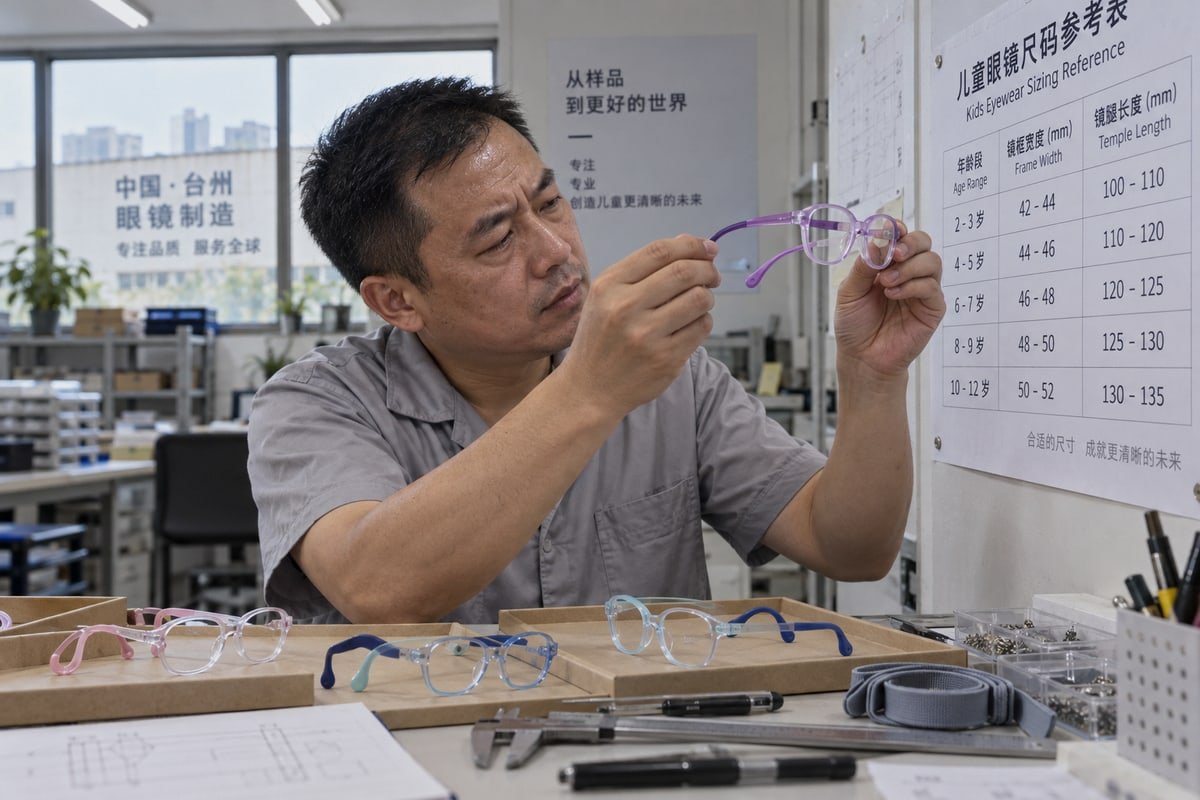
Most sizing mistakes happen before production starts. A buyer picks a style from a photo, approves a color, and only later learns that the frame PD is 8 mm wider than the children it is meant for. You can avoid this with a short, disciplined process. Here is the one we use with our OEM and ODM partners.
A five-step sizing workflow
- Define your child. Tell us the age range, the market, and whether you sell for prescription lenses or plano demo lenses. A kids' optical brand in Japan and an outdoor brand in Europe rarely need the same bridge.
- Share PD targets. Give us the PD range you want each size to cover. We then shortlist styles from our library of roughly 800 existing molds whose lens width plus bridge width falls within 2–3 mm per eye of that range. This lets a new brand launch without paying for a fresh tool.
- Read the spec sheet, not the render. Every quotation we send lists lens width, bridge width, frame PD, temple length, and lens height. Ask any factory for the same.
- Wear-test samples. Put samples on real children in your target age band. Check nose bridge fit, temple length, pupil position, and the dynamic fit test from the previous section. Send us photos. Our engineers adjust the bridge or temple curve at the sample stage, when changes are still cheap.
- Approve the fit, then the look. Colors, logos, lens tints, and packaging come after the geometry is signed off. Fit first, decoration second.
| Spec sheet field | Why you need it | Typical action if it is off |
|---|---|---|
| Lens width (A) | Half of the frame PD calculation | Choose a neighboring size in the same style family |
| Bridge width (DBL) | Controls nose bridge fit and the other half of frame PD | Request a bridge variant or a different mold |
| Frame PD (A + DBL) | Direct comparison with measured PD | Reject if decentration exceeds your tolerance |
| Temple length | Keeps the frame anchored behind the ear | Adjust the TPEE temple length or hook shape |
| Lens height (B) | Sets vertical pupil position | Confirm pupils sit in the upper part of the lens |
| Material of front and temple | TR90 rigidity for lens stability, TPEE softness for comfort | Specify TR90 front with TPEE temples for higher prescriptions |
Small customizations that protect the fit
Full custom molds are not always necessary. Within an existing style, we can often offer a second bridge width, a shorter temple, or a different ear hook. The looped ear hooks on many of our toddler styles, for example, hold a frame in place without extra tension on the nose. Custom colors, gradient temples, and logo placement do not change the geometry, so they never affect PD. Custom lens curves might, so we discuss base curve with your lab before cutting.
Helping parents who buy online
Online sales push parents to self-measure, while clinical sources urge a professional recheck. Both sides have a point. We resolve this for brand partners by adding a PD measurement card and a simple fit checklist inside the retail packaging. The parent gets a clear method, and the card reminds them to confirm PD with an optician before ordering prescription lenses. It costs very little and cuts returns.
Quality control you can verify
Our workshop runs under 5S management with about 120 workers, and we check frame PD against the drawing at incoming inspection, after molding, and before packing. TR90 and TPEE both carry hypoallergenic properties and are environmentally friendly materials, but we still test every new color batch for surface finish and flex recovery. Ask your factory how they hold these tolerances. A partner who cannot answer will struggle to keep your second order identical to the first.
Conclusion
Durable TR90 & TPEE frames survive rough play, but only correct PD matching protects a child's vision. Measure, calculate frame PD, test on real faces, then order.
Interested in sourcing the products mentioned in this article? See details and request a quote here:
Footnotes
1. Professional guidance on using a digital pupillometer to provide a far-focus target for accurate measurements. ↩︎
2. Scientific overview of how lens decentration and shifting optical centers create unwanted prism effects. ↩︎
3. International standards for the boxing system formula used to calculate frame dimensions. ↩︎
4. Technical details on the Grilamid TR-90 material used in high-quality eyewear fronts. ↩︎
5. Technical properties of thermoplastic polyester elastomers used in flexible TPEE temples. ↩︎
6. Information on how proper vision correction supports a healthy developing visual system in children. ↩︎
More Articles You Might Like



Looking for a Reliable Kids Eyewear Partner?
Explore 800+ ready styles and full OEM/ODM support tailored to your brand.
Get in Touch English
 Español de México
 Deutsch
 Français
 日本語
 العربية
 Português do Brasil