Which Standards Must TR90 Kids Optical Frames Meet: GB/T 14214 vs ISO 12870?

Buyers often ask us which standards TR90 kids optical frames must meet before shipping. Guess wrong, and a container can stall at customs. Here is what our Taizhou line follows.
TR90 kids optical frames sold in China must meet GB/T 14214-2019, the national spectacle frame standard implemented January 1, 2022. Frames exported to Europe and global markets must meet ISO 12870 (or EN ISO 12870). GB/T 14214 was modified from ISO 12870, so the two overlap but are not identical.
That short answer hides a lot of detail. The two standards share a skeleton but differ in specific clauses. And the material name TR90 tells you nothing about whether a finished frame passes. Below, I walk through what each standard demands, how to verify a supplier’s claims, which standard fits which market, and what paperwork you should hold before a bulk order.
What exactly do GB/T 14214 and ISO 12870 require for children's optical frames?
Last spring our QC team pulled a batch of sky-blue temple frames after one hinge loosened during a routine endurance check. That failure showed new staff what these standards test.
Both standards set spectacle frame requirements for unglazed frames: dimensional stability at 55°C, bridge deformation limits, lens retention, 500-cycle temple endurance, resistance to perspiration, nickel release for metal parts, and marking. Neither is a kids-only standard; children's frames pass the same base tests plus any market-specific child safety rules.
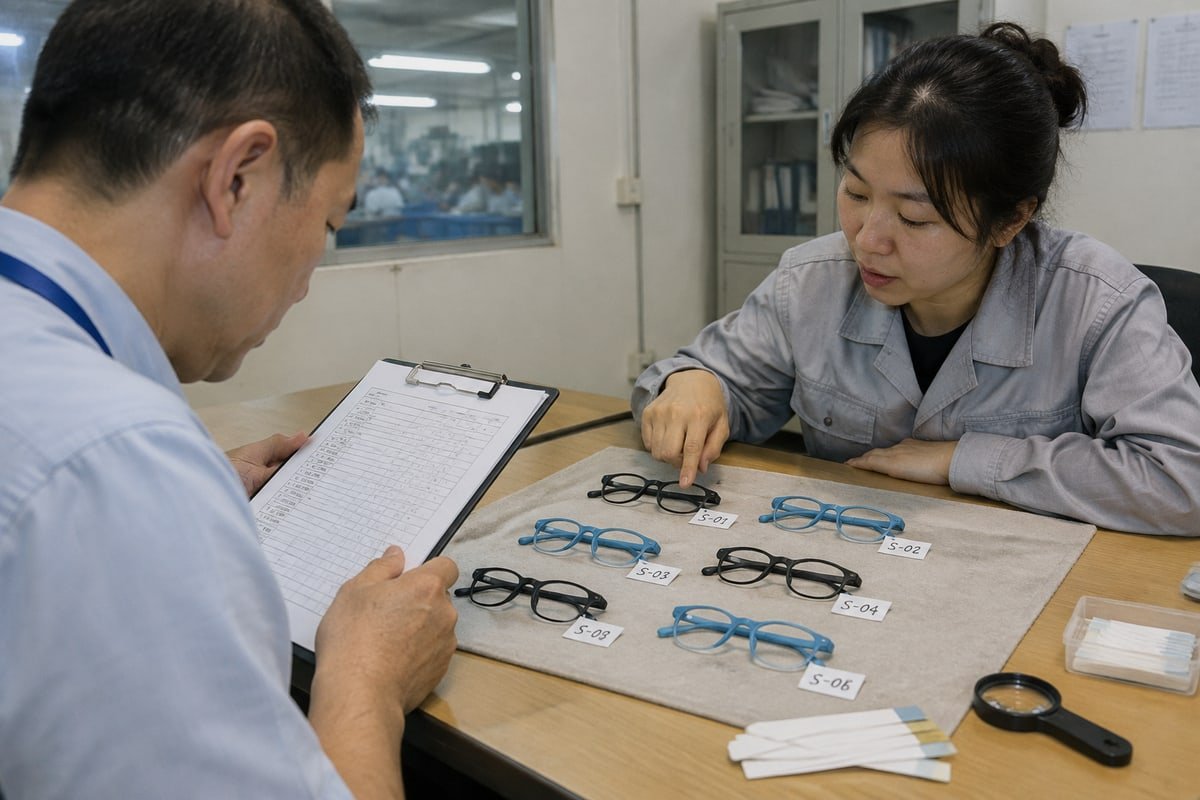
Here is the side-by-side view I give new clients before we talk about colors or packaging.
| Point | GB/T 14214-2019 | ISO 12870:2024 |
|---|---|---|
| Status | Chinese national standard, issued December 31, 2019, implemented January 1, 2022 | Current international edition |
| Replaced | GB/T 14214-2003 (now obsolete) | ISO 12870:2016 |
| Relationship | Modified from ISO 12870:2016 | Base reference for many national adoptions, including EN ISO 12870 |
| Scope | Spectacle frames: requirements, sampling, pretreatment, tests, inspection, conformity, marking | Unglazed frames for prescription lenses at point of sale; all mass-produced types including rimless, semi-rimless, and folding |
| Excludes | Follows ISO logic on scope | Eye protection products and sunglasses with afocal filters |
| Kids-specific? | No | No |
The shared test skeleton
Both documents belong to the field of ophthalmic optics 1, and both judge the finished frame, not the raw resin. The core themes are mechanical strength 2, deformation and endurance, sweat corrosion, surface durability, and marking. In practice a lab will heat the frame to check dimensional stability, load the bridge to measure bridge distortion, cycle the temples open and closed, expose the frame to artificial perspiration, and check that lenses stay in the rim.
Where the Chinese standard departs from ISO
This is where a common buyer objection appears. Some importers tell me: "GB/T 14214 is modified from ISO 12870, so one report should cover both." I understand the logic, but I push back. GB/T 14214-2019 adds or changes clauses rather than translating ISO word for word. The known differences sit in corrosion testing, nickel release, light resistance, and some mechanical and material test details. So an ISO report gives you export credibility. It does not automatically satisfy China customs, retail chains, or local procurement when GB/T 14214 is the named requirement. We treat them as two related but separate compliance targets, and we plan sampling for both when a client sells in both regions.
How do I know if my TR90 supplier's frames actually pass these safety standards?
Every season we weigh one trade-off: run only the 500-cycle endurance test the standard requires, or push sample temples to 2,000 cycles. The second costs time but tells the truth.
You know a TR90 supplier's frames pass when they show a third-party test report tied to the exact standard edition, listing sample identification, pretreatment, and pass/fail for each clause: endurance, bridge deformation, lens retention, perspiration, nickel release, and dimensional stability. Material data sheets alone prove nothing about the finished frame.

I want to separate two things that suppliers often blur together: the material and the product.
Grilamid properties are a starting point, not a certificate
TR90 is a trade name for a polyamide resin, and Grilamid properties like low density, high flexibility, and good impact resistance are real benefits for a child's face. Those traits are why we build most of our optical range in TR90, often paired with softer TPEE temples. But here is the second buyer objection I hear: "TR90 is a quality badge, so we can skip lab testing." No. Wall thickness, hinge design, screw choice, and coating chemistry 3 decide whether a frame passes. A thin TR90 rim can fail lens retention. A poorly anchored metal hinge can fail nickel release testing. The resin cannot rescue a weak design.
What a lab actually does to a kids frame
| Test | What the lab does | Why it matters for children |
|---|---|---|
| Dimensional stability | Holds the frame at about 55°C | Frames left on a hot car dashboard must not warp |
| Bridge deformation | Loads the bridge and measures permanent set | Rough play bends frames; the bridge must return to shape |
| Lens retention | Checks lenses stay seated under load | Popped lenses are a hazard during active play |
| Endurance testing | Opens and closes temples 500 cycles | Kids fold and unfold glasses many times a day |
| Resistance to perspiration | Exposes the frame to artificial sweat | Children sweat heavily during sport |
| Nickel release testing | Measures nickel migration from metal parts | Skin contact at hinges and nose pads |
| Coating adhesion | Tests painted or decorative layers | Spray-painted TR90 fronts must not flake into a child's eyes |
Reading the report like an inspector
I look for four things. First, the standard edition printed on the cover, not just "ISO 12870" in general. Second, the sample identification, including model number and color code. Third, the pretreatment steps, because skipping conditioning can flatter results. Fourth, the actual measured values, not only a "PASS" stamp.
One more point on mechanical strength. The 500-cycle baseline is the legal floor. For school-year durability, we sometimes run selected samples well beyond that so the "memory" of the material does not turn into permanent deformation. And if your brand fits myopia management lenses such as DIMS or HALT designs, ask how the bridge is stabilized. Those lenses need steady vertex distance and pantoscopic tilt, and TR90's flexibility can work against that unless the bridge is reinforced with an internal metal or high-modulus insert.
Which standard should I ask for if I'm selling to Europe versus China or Southeast Asia?
An Australian distributor asked me why her Singapore partner wanted a different report from her European one. Same frame, same mold, two paperwork paths. That call shaped our client briefings.
Ask for EN ISO 12870 when selling in Europe, GB/T 14214-2019 when selling in mainland China, and ISO 12870 as the baseline for Southeast Asia, where most markets accept the international standard. Export-focused buyers often request both reports so one frame can serve multiple markets.

Compliance discussions have become more market-specific in the last few years. Chinese buyers name GB/T 14214. European buyers name EN ISO 12870. Buyers elsewhere usually name plain ISO 12870 or a local adoption of it. So the question is never "which standard is better." It is "which standard does my destination market, retailer, or tender document actually cite."
Quick market guide
| Destination | Standard to request | Notes from our export work |
|---|---|---|
| Mainland China | GB/T 14214-2019 | National standard since January 1, 2022; do not accept an ISO-only report if a Chinese chain or tender names GB/T |
| European Union and UK | EN ISO 12870 | European adoption of ISO 12870; pair it with your own regional product-safety and chemical checks |
| Australia and Japan | ISO 12870 as baseline | Confirm whether the importer or optical chain cites a local equivalent |
| Southeast Asia | ISO 12870 | Many importers accept the international edition; some also ask for GB/T because they source from China |
| Multi-market brands | Both GB/T 14214-2019 and ISO 12870 | One tooling, two reports, fewer surprises later |
A simple decision process
- Write down every country where the frame will be sold, not just where it ships first.
- Ask each distributor or retailer which standard and edition their purchasing documents cite.
- Check whether the product is an optical frame or a sunglass. ISO 12870:2024 covers unglazed frames for prescription lenses and excludes sunglasses with afocal filters and eye protection. Since we also make UV400 and polarized kids sunglasses, we brief clients on this boundary early.
- Request the report that matches each market, and request both when the list spans China and export markets.
- Confirm the report edition is current. GB/T 14214-2003 is obsolete, and ISO 12870:2024 is the current international edition.
One nuance deserves honesty. ISO 12870 applies at point of sale, which means the frame the customer buys must match the frame that was tested. If you change a color or a hinge supplier after testing, the earlier report may no longer describe your product. That is why the next section is about documents, not just standards.
What certification documents should I request from my manufacturer to prove compliance?
Years ago a buyer rejected our valid test report because the sample number did not match the production color code. That lesson pushed paperwork discipline into our 5S workshop rules.
Request a third-party test report naming the exact standard edition (GB/T 14214-2019 or ISO 12870:2024), a material declaration for the TR90 resin, nickel release results for any metal parts, a coating adhesion result, sample photos matching production, and, for premium kids lines, ISO 10993 biocompatibility data.
The industry trend is clear. Buyers no longer accept "passed quality test" in an email. They want standard-specific reports from an independent lab, and they want those reports tied to the exact item in the carton.
The document checklist we prepare for OEM and ODM clients
| Document | What it proves | Red flag if missing or vague |
|---|---|---|
| Third-party test report | Finished frame passed the named standard edition | No edition number, or a "PASS" summary without measured values |
| Sample identification sheet | Tested model and color match production | Sample photo shows a different color or hinge |
| TR90 material declaration | Resin grade and supplier are traceable | Generic "nylon" description with no grade |
| Nickel release results | Metal hinges, screws, or pads are safe for skin contact | Report skips metal components on a mixed-material frame |
| Coating adhesion result | Spray-painted or decorative layers will not flake | Frame is painted but report tests only bare resin |
| Marking and traceability | Frame carries required markings for the market | Markings differ between sample and bulk |
| Biocompatibility data | Skin-contact safety beyond the frame standard | Marketing claims of "medical-grade" without ISO 10993 reference |
Why biocompatibility is moving beyond the frame standards
GB/T 14214 and ISO 12870 focus on mechanical strength, corrosion, and dimensional stability. They do not fully cover chemical migration 4 from the resin itself. Two shifts make that gap matter for children. First, castor-oil-based "Bio-TR90" is entering the market, and its leaching behavior is not explicitly addressed by either current standard, so green claims deserve a secondary biocompatibility audit. Second, toddlers chew frames. "Food-grade" marketing language sounds reassuring, but premium pediatric brands increasingly ask for ISO 10993 medical-grade biocompatibility data to address that specific chew-testing risk. When a client asks us for this, we treat it as a separate test scope, not a line on the frame report.
How this fits an OEM or ODM project
With roughly 800 existing styles in our range, a new brand can select a frame that already has a testing history, then customize colors, logos, lenses, and packaging. But every custom colorway on a TR90 kids optical frame introduces a new coating, so I recommend budgeting a coating adhesion and perspiration recheck for each new finish rather than leaning on the base model's report. It is a small cost compared with a recall.
Conclusion
TR90 alone never makes a child's frame compliant. Match GB/T 14214-2019 or ISO 12870 to your market, demand edition-specific reports, and partner with a factory that tests before you ask.
Interested in sourcing the products mentioned in this article? See details and request a quote here:
Footnotes
1. ISO technical committee responsible for international standards in the ophthalmic optics sector. ↩︎
2. Official ISO standard page for spectacle frame requirements and testing methods. ↩︎
3. European Chemicals Agency page detailing restrictions on chemicals in consumer product coatings. ↩︎
4. Authoritative ISO standard for the biological evaluation of medical devices and materials. ↩︎
More Articles You Might Like



Looking for a Reliable Kids Eyewear Partner?
Explore 800+ ready styles and full OEM/ODM support tailored to your brand.
Get in Touch English
 Español de México
 Deutsch
 Français
 日本語
 العربية
 Português do Brasil