Como Combinar o Tamanho da Armação de Óculos Infantil TR90 e TPEE com a Distância Pupilar e Evitar Erros?

Combinar o tamanho da armação de óculos infantil TR90 e TPEE com a distância pupilar é onde a maioria das reclamações de ajuste começa com nossas amostras de fábrica. Armações duráveis que descentralizam as lentes ainda forçam os olhos dos jovens.
Combine o tamanho da armação de óculos infantil TR90 e TPEE com a distância pupilar adicionando a largura da lente e a largura da ponte para obter a DP da armação, mantendo-a dentro de 2–3 mm por olho da DP medida da criança, enquanto confirma o ajuste da ponte, o comprimento da haste e a posição da pupila no rosto real.
Essa é a versão curta. O restante deste artigo mostra como medir a DP, como ler os números da armação, o que dá errado quando eles não se alinham e como travar o ajuste com sua fábrica antes de se comprometer com uma produção.
Como meço a distância pupilar do meu filho com precisão antes de escolher o tamanho da armação?
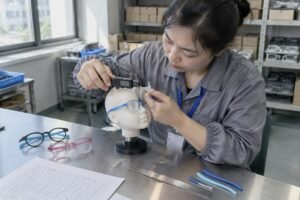
Durante uma verificação de amostra em nossa oficina em Taizhou no ano passado, duas réguas deram duas DPs diferentes para a mesma cabeça de demonstração. Essa diferença nos ensinou a padronizar.
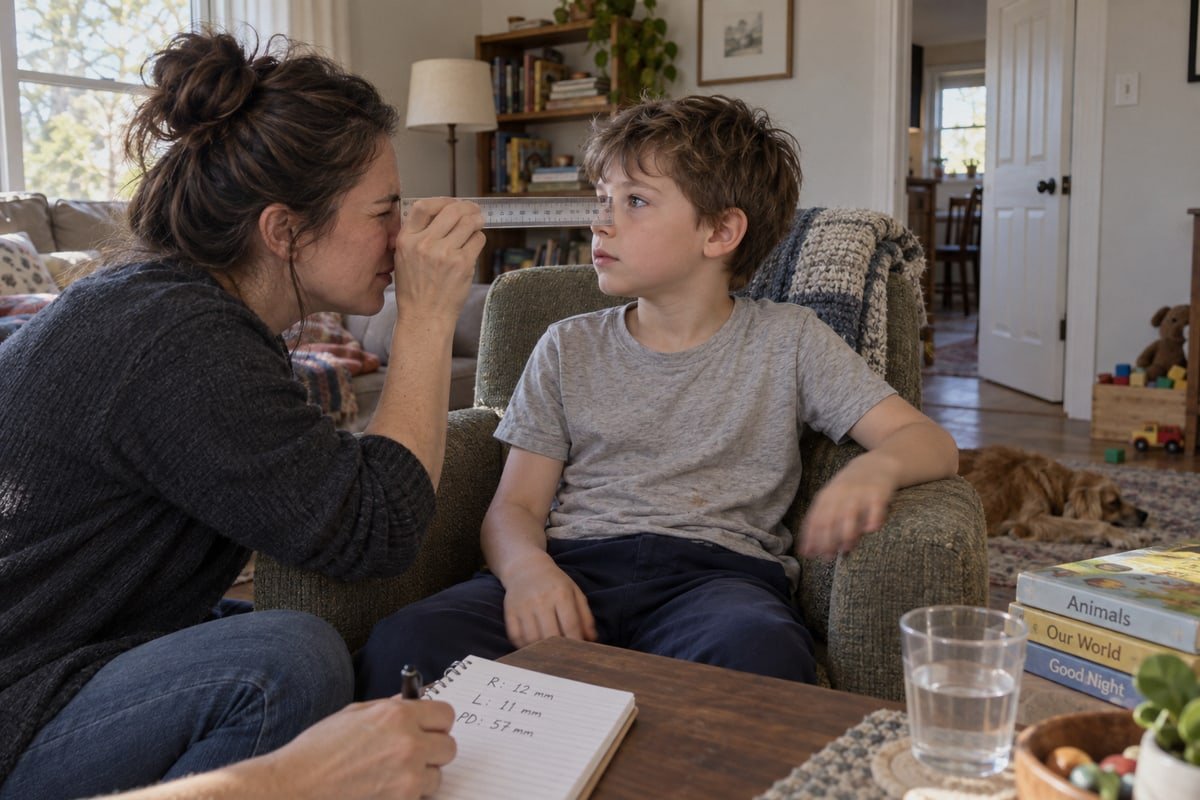
Meça a distância pupilar de uma criança com um pupilômetro digital quando possível, ou uma régua milimétrica ao nível dos olhos enquanto a criança olha para um alvo distante, tire três leituras, registre os valores monoculares para cada olho e aceite o resultado apenas quando as repetições concordarem em até 1 mm.
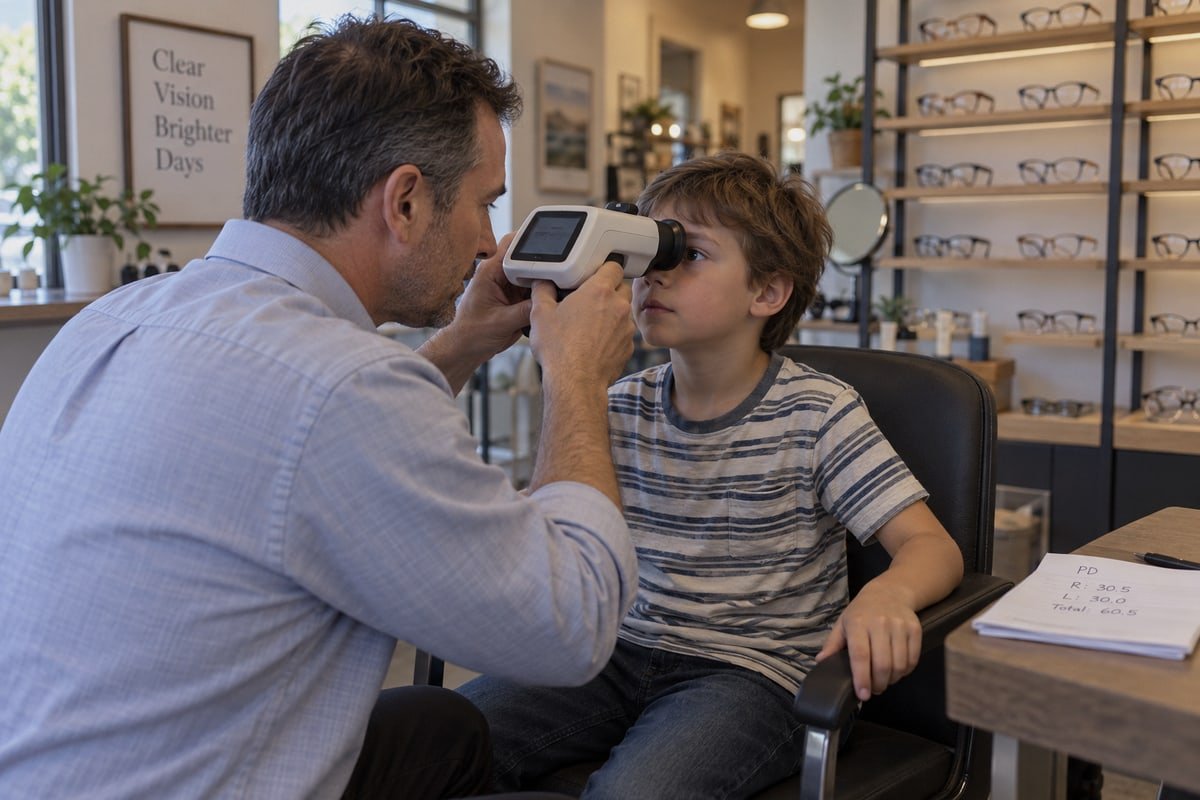
Distância pupilar, ou DP, é a distância entre os centros das duas pupilas. Ela informa onde o centro óptico de cada lente deve ficar. Todo o resto no ajuste de óculos pediátricos se baseia nesse único número. Se o número estiver errado, a escolha da armação também estará errada, não importa quão boa seja a armação.
Por que a régua muitas vezes lê muito estreita
As crianças olham para o que estiver mais perto. Quando um pai segura uma régua a alguns centímetros do rosto de uma criança, a criança foca na régua ou no nariz do pai. Os olhos se viram para dentro. Isso é chamado de convergência proximal. A leitura sai mais estreita do que a DP de distância real da criança. Um pupillômetro digital evita isso porque dá à criança um alvo de foco distante 1 dentro do dispositivo. Em nossa experiência, uma leitura de régua e uma leitura de pupillômetro na mesma criança podem diferir em mais do que o erro de 2 mm que os guias alertam que afetará notavelmente a visão e o conforto.
Um processo simples que funciona em casa ou na loja
- Sente a criança e sente-se no mesmo nível dos olhos.
- Peça à criança para olhar para algo distante, além do seu ombro.
- Apoie a régua milimétrica na ponte do nariz.
- Feche seu olho direito e alinhe a marca zero com o centro da pupila direita da criança.
- Feche seu olho esquerdo e leia a marca no centro da pupila esquerda da criança.
- Repita três vezes. Mantenha o resultado apenas se as leituras concordarem de perto.
- Anote a DP total e, se puder, a distância do centro do nariz para cada pupila.
| Método | Ferramenta necessária | Melhor para | Risco principal |
|---|---|---|---|
| Régua milimétrica | Régua de DP de plástico | Verificações rápidas em casa, primeira estimativa | Convergência proximal dá uma DP falsamente estreita |
| Pupillômetro digital | Dispositivo óptico portátil | Medição final antes de encomendar | Custo, e a criança deve ficar parada |
| Aplicativo de telefone | Câmera de smartphone e um cartão de referência | Compras online quando nada mais está disponível | Erros de escala e inclinação da cabeça |
DP monocular é importante para crianças
Muitas crianças não são perfeitamente simétricas. Se a criança tem um desvio ocular, ou se as duas meias-distâncias parecem desiguais, anote a DP monocular para cada olho. A orientação de dispensação pediátrica enfatiza isso porque cada olho pode precisar de atenção separada quando as lentes são cortadas. Um número total esconde esse detalhe.
Medidas faciais mudam rápido
Uma DP medida aos quatro anos não servirá aos sete. Rostos em crescimento movem as pupilas para fora e a ponte do nariz se eleva. Recomendamos que as marcas lembrem os pais de verificar novamente a DP a cada visita de prescrição e pelo menos uma vez por ano entre elas. Uma boa armação que serviu no ano passado pode descentralizar as lentes este ano.
Quais faixas de tamanho de armação TR90 e TPEE funcionam melhor para diferentes medições de DP de crianças?
O compromisso que pesamos em cada estilo infantil é simples: uma lente mais larga oferece um campo de visão maior, mas empurra o a distância interpupilar da armação para longe de rostos pequenos.
Os tamanhos de armação de óculos infantil TR90 e TPEE funcionam melhor quando a largura da lente mais a largura da ponte ficam dentro de 2–3 mm por olho da DP da criança: aproximadamente lentes de 39–43 mm para crianças pequenas, 44–46 mm para idades de 5–8 anos, 47–50 mm para idades de 9–12 anos e 50–54 mm para adolescentes.
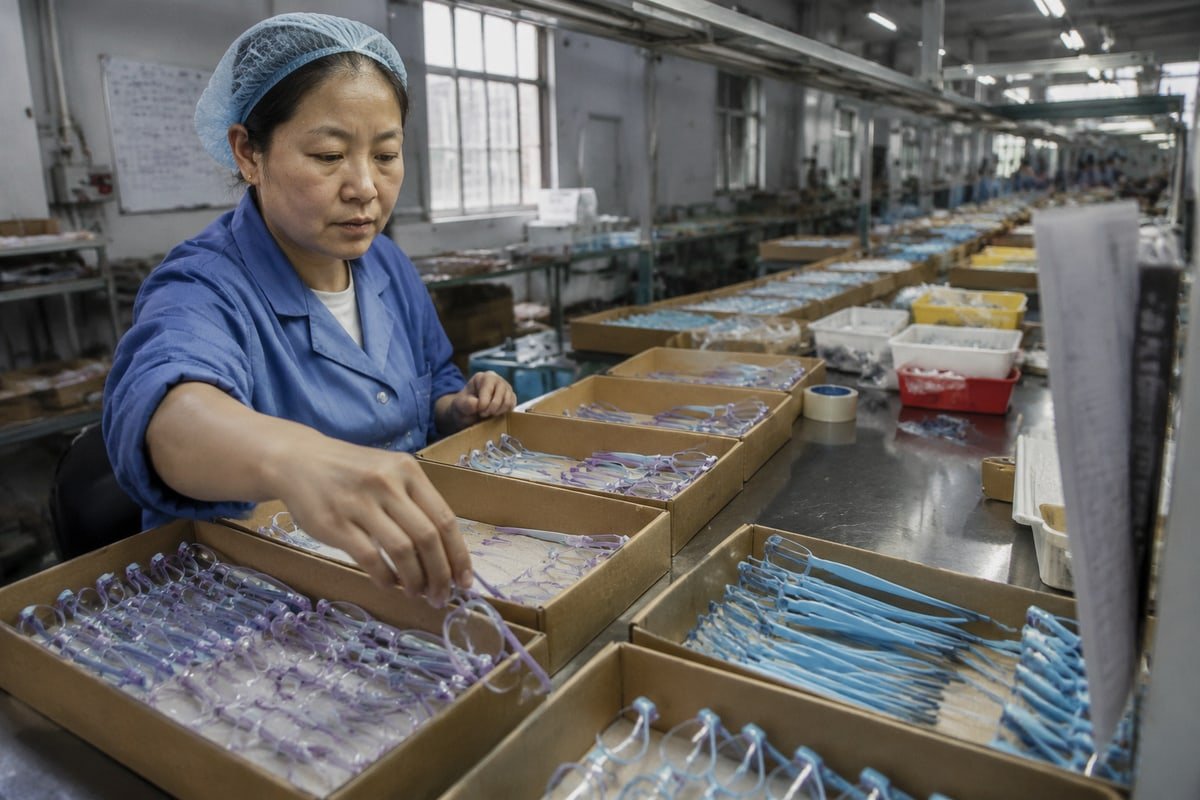
Comece com o gráfico abaixo, depois passe rapidamente para números reais. As faixas etárias vêm de guias de dimensionamento atuais. As colunas da direita mostram o que você deve confirmar antes de confiar na faixa.
| Faixa etária | Heurística de largura de lente | O que confirmar | Por que importa |
|---|---|---|---|
| Toddlers (about 1–4) | 39–43 mm | Frame bridge width and nose bridge fit | Flat, low bridges let frames slide and drop the centros ópticos 2 |
| Ages 5–8 | 44–46 mm | Frame PD versus measured PD | Decentration should stay within 2–3 mm per eye |
| Ages 9–12 | 47–50 mm | Temple length and face width | Temples should run straight back to the ear point |
| Adolescentes | 50–54 mm | Prescription strength and lens design | Higher powers need tighter lens centration |
The boxing system formula
Every optical frame carries two key numbers. The first is the lens width, often called the A measurement. The second is the bridge width, the distance between the lenses. Add them together and you get the frame PD. This is the boxing system formula 3 that opticians use.
Frame PD = lens width + bridge width.
Now compare frame PD to the child's measured PD. Divide the difference by two, and you get the decentration per eye. Consumer guides accept up to 3–4 mm per eye, or a frame PD no more than 8 mm wider than the child's PD. Professional dispensing guidance is stricter and aims for 2–3 mm per eye. We side with the stricter number for any prescription above a mild one. The looser number is a starting point for buyers, not a target for children who wear glasses all day.
Bridge first, lens second
Children have flatter nasal bridges than adults. A frame that fits the lens width but floats on the nose will slide down. When it slides, the optical centers drop below the pupils, and the careful PD work is lost. So we ask buyers to check the frame bridge width before they debate lens width. On our Frentes de TR90 4, a snug nose bridge fit with a soft contact area does more for lens centration than a millimeter of lens width ever will.
Which material for which prescription
TR90 is a flexible memory plastic, but it is stiffer than TPEE. For higher prescriptions, we recommend TR90 fronts, because the rigid rim holds the lens's optical axis in place. TPEE is softer. When a child wears a full-TPEE frame, the front can stretch slightly across the face. We call this TPEE splay. It widens the effective bridge gap and pushes the optical centers outward. For that reason our most popular kids' optical construction is a TR90 front with TPEE templados 5: a stable rim for the lenses and a soft, flexible temple for comfort. If the lab uses high-index aspheric lenses with a TR90 front, the flatter base curve suits the flatter injection-molded rim, and the optical center alignment stays consistent across the lens.
Do not size up for growth
Parents often ask for one size larger so the frame lasts longer. This backfires. An oversized frame widens the frame PD, increases decentration, and adds peripheral distortion that a developing visual system 6 may struggle to fuse. It is better to choose the right size now and replace it later.
Que problemas posso evitar ao ajustar corretamente o tamanho da armação à distância pupilar?
A procurement manager from Australia once asked us why her bestselling frame drew complaints about headaches. The frame was fine. The lens centers were 4 mm out.
Combinar corretamente o tamanho da armação com a distância pupilar evita efeitos prismáticos indesejados, dores de cabeça, distorção periférica, bordas de lentes grossas e irregulares, armações escorregadias e desenvolvimento visual deficiente, pois o centro óptico de cada lente fica em frente à pupila em vez de forçar a criança a olhar através de zonas de lente fora do eixo.
A frame that is too wide or a PD that is wrong makes the child look through the wrong part of the lens. That sounds small. In practice it changes the prescription the child actually experiences. Here are the signs we tell brand partners to look for, and what usually sits behind each one.
| Symptom you can see | Causa provável | O que verificar primeiro |
|---|---|---|
| Red marks or pressure lines on the nose | Bridge too narrow or too high for the nose bridge fit | Frame bridge width and pad contact |
| A armação escorrega durante a brincadeira | Bridge too wide or temple length too long | Bridge fit, then temple curve behind the ear |
| Pupils sit inside or outside the lens center | Frame PD much wider than measured PD | Boxing system calculation |
| One lens edge thicker than the other | Uneven monocular PD or decentered lens cutting | Monocular PD values on the order |
| Child complains of headaches or tilts head | Induced prism effect from decentration | Decentration per eye against a 2–3 mm limit |
| Child pushes glasses up all day | Temples splayed by a face that is too wide for the frame | Overall frame width and temple angle |
The prism effect in plain words
A lens bends light. The optical center is the one point where light passes straight through. Move the pupil away from that point, and the lens acts like a small prism. The image shifts. The two eyes receive images that are not where they should be. The child's brain works to pull them together. That extra work shows up as eye strain, headaches, or a dislike of wearing the glasses. Keep decentration under 2–3 mm per eye and this effect stays small.
Flexible does not mean forgiving
Buyers sometimes assume that impact-resistant materials solve fit problems. They do not. TPEE and TR90 give you frames that bend instead of snap. So-called unbreakable frames survive being sat on. That is a real benefit for active kids. But a frame that flexes back into shape can still hold the lenses 4 mm off center every single day. Durability protects the frame. PD matching protects the vision.
There is also a shape question. Round and oval lenses are often better for high prescriptions because they keep edge thickness even. A rectangular lens may look more modern, like the translucent rounded-rectangle fronts many of our buyers choose. Both can work. The frame still has to fit the face, and the frame PD still has to sit close to the child's PD.
Test the fit in motion
Because TPEE has no metal core, an optician cannot bend it to correct the fit. The frame's wrap-around tension is the main thing holding the lenses in place. So we ask buyers to run a dynamic fit test. Watch the child walk, run, and look down at a book. The frame should stay put, the pupils should remain on or just above the horizontal center line, and they should sit just inside the vertical center line of each lens. If the frame drops or the temples flare, the centering will not survive a school day.
Como posso trabalhar com meu fabricante para personalizar o tamanho da armação para um ajuste preciso de DNP?
Fifteen years of molding kids' frames taught us one lesson: fix the frame PD on paper before the tool is cut, because steel does not stretch.
Trabalhe com seu fabricante compartilhando suas faixas de DP alvo, solicitando DP da armação, largura da ponte e comprimento da haste em todas as folhas de especificações, selecionando primeiro entre moldes existentes, solicitando amostras de teste de uso em crianças reais e definindo uma tolerância de descentração antes de aprovar cores, logotipos ou embalagens.
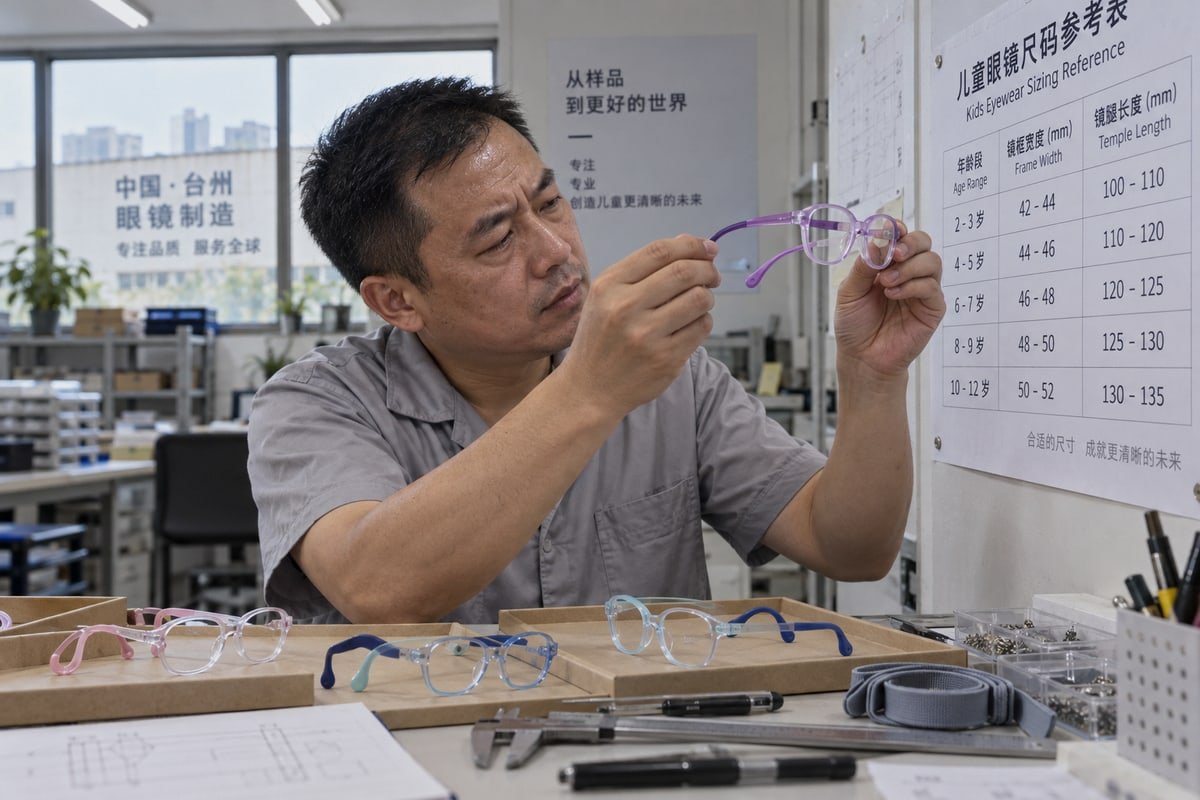
Most sizing mistakes happen before production starts. A buyer picks a style from a photo, approves a color, and only later learns that the frame PD is 8 mm wider than the children it is meant for. You can avoid this with a short, disciplined process. Here is the one we use with our OEM and ODM partners.
A five-step sizing workflow
- Define your child. Tell us the age range, the market, and whether you sell for prescription lenses or plano demo lenses. A kids' optical brand in Japan and an outdoor brand in Europe rarely need the same bridge.
- Share PD targets. Give us the PD range you want each size to cover. We then shortlist styles from our library of roughly 800 existing molds whose lens width plus bridge width falls within 2–3 mm per eye of that range. This lets a new brand launch without paying for a fresh tool.
- Read the spec sheet, not the render. Every quotation we send lists lens width, bridge width, frame PD, temple length, and lens height. Ask any factory for the same.
- Wear-test samples. Put samples on real children in your target age band. Check nose bridge fit, temple length, pupil position, and the dynamic fit test from the previous section. Send us photos. Our engineers adjust the bridge or temple curve at the sample stage, when changes are still cheap.
- Approve the fit, then the look. Colors, logos, lens tints, and packaging come after the geometry is signed off. Fit first, decoration second.
| Spec sheet field | Why you need it | Typical action if it is off |
|---|---|---|
| Largura da lente (A) | Half of the frame PD calculation | Choose a neighboring size in the same style family |
| Largura da ponte (DBL) | Controls nose bridge fit and the other half of frame PD | Request a bridge variant or a different mold |
| Frame PD (A + DBL) | Direct comparison with measured PD | Reject if decentration exceeds your tolerance |
| Comprimento da haste | Keeps the frame anchored behind the ear | Adjust the TPEE temple length or hook shape |
| Lens height (B) | Sets vertical pupil position | Confirm pupils sit in the upper part of the lens |
| Material of front and temple | TR90 rigidity for lens stability, TPEE softness for comfort | Specify TR90 front with TPEE temples for higher prescriptions |
Small customizations that protect the fit
Full custom molds are not always necessary. Within an existing style, we can often offer a second bridge width, a shorter temple, or a different ear hook. The looped ear hooks on many of our toddler styles, for example, hold a frame in place without extra tension on the nose. Custom colors, gradient temples, and logo placement do not change the geometry, so they never affect PD. Custom lens curves might, so we discuss base curve with your lab before cutting.
Helping parents who buy online
Online sales push parents to self-measure, while clinical sources urge a professional recheck. Both sides have a point. We resolve this for brand partners by adding a PD measurement card and a simple fit checklist inside the retail packaging. The parent gets a clear method, and the card reminds them to confirm PD with an optician before ordering prescription lenses. It costs very little and cuts returns.
Quality control you can verify
Our workshop runs under 5S management with about 120 workers, and we check frame PD against the drawing at incoming inspection, after molding, and before packing. TR90 and TPEE both carry hypoallergenic properties and are environmentally friendly materials, but we still test every new color batch for surface finish and flex recovery. Ask your factory how they hold these tolerances. A partner who cannot answer will struggle to keep your second order identical to the first.
Conclusão
Durable TR90 & TPEE frames survive rough play, but only correct PD matching protects a child's vision. Measure, calculate frame PD, test on real faces, then order.
Interessado em adquirir os produtos mencionados neste artigo? Veja detalhes e solicite um orçamento aqui:
Notas de rodapé
1. Professional guidance on using a digital pupillometer to provide a far-focus target for accurate measurements. ↩︎
2. Scientific overview of how lens decentration and shifting optical centers create unwanted prism effects. ↩︎
3. International standards for the boxing system formula used to calculate frame dimensions. ↩︎
4. Technical details on the Grilamid TR-90 material used in high-quality eyewear fronts. ↩︎
5. Technical properties of thermoplastic polyester elastomers used in flexible TPEE temples. ↩︎
6. Information on how proper vision correction supports a healthy developing visual system in children. ↩︎
Mais Artigos que Você Pode Gostar

27 de outubro de 2026
Como os varejistas devem estocar armações ópticas infantis TR90 por tendências de idade e gênero?

26 de outubro de 2026
O que os pais priorizam em armações ópticas infantis TR90?
25 de outubro de 2026
Como Escolher Armações Ópticas Infantis TR90 por Formato do Rosto e Ponte Nasal?
Procurando um Parceiro Confiável em Óculos Infantis?
Explore mais de 800 estilos prontos e suporte completo OEM/ODM adaptado à sua marca.
Entre em Contato English
 Español de México
 Deutsch
 Français
 日本語
 العربية
 Português do Brasil