How to Measure Face Width and Pupillary Distance for Kids’ TR90 Sunglasses Sizing?
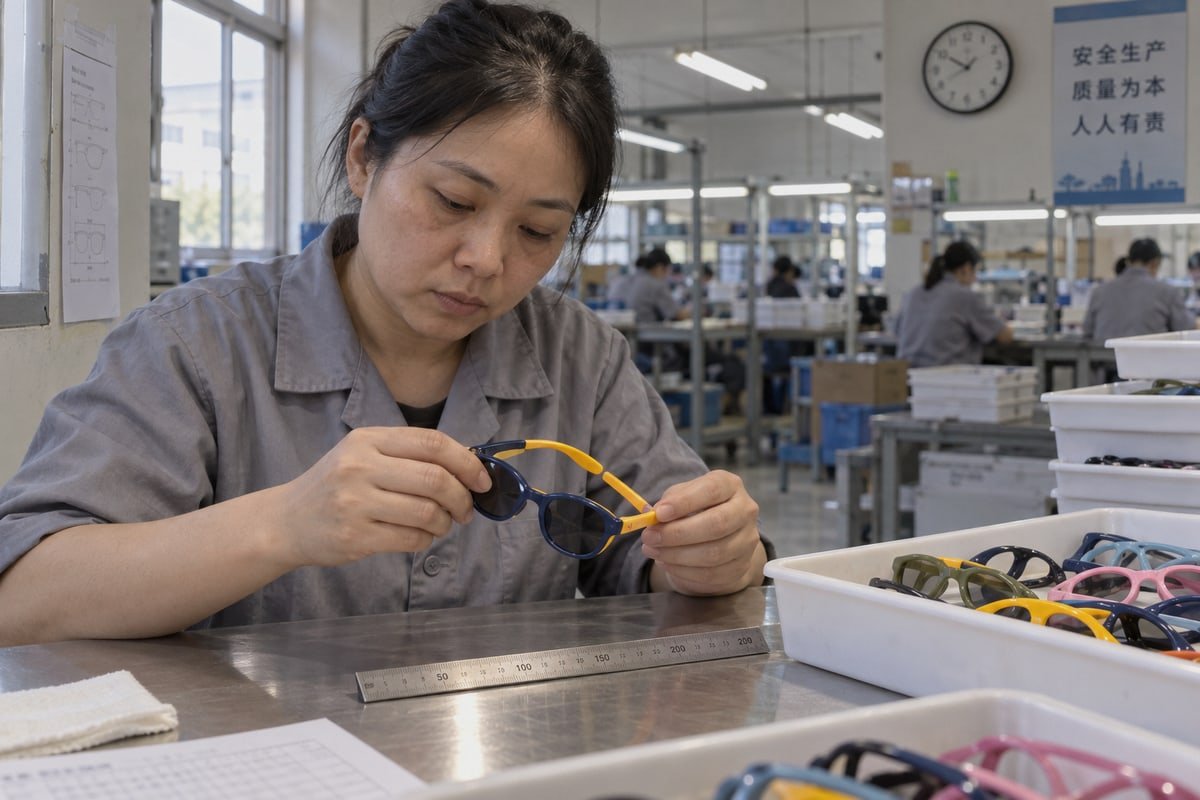
Face width and pupillary distance 1 for kids’ TR90 sunglasses sizing confuse many buyers who visit our Taizhou factory. Guess wrong, and returns pile up. Measuring first fixes that.
To size kids’ TR90 sunglasses, measure face width temple-to-temple with a rigid millimeter ruler, then measure pupillary distance from pupil center to pupil center while the child looks straight ahead. Compare both numbers to the frame’s lens width, bridge width, and total width, using TR90 flex for small tolerance.
Two numbers do most of the work. This guide shows you how to get both, how to read a size chart, and where [bulk orders](https://okayeyewear.com/how-size-kids-sunglasses-age-head-circumference-to/) usually go wrong.
How do I measure my child's face width accurately at home before ordering sunglasses?
During a QC round, I watched our inspector check a youth wayfarer on a head form. It passed, but the buyer's chart had confused lens width with face width.
Measure your child's face width by holding a rigid millimeter ruler level across the face at the widest point, from temple to temple, just in front of the ears. Keep it snug without pressing into the skin, repeat three times, and record the average in millimeters.
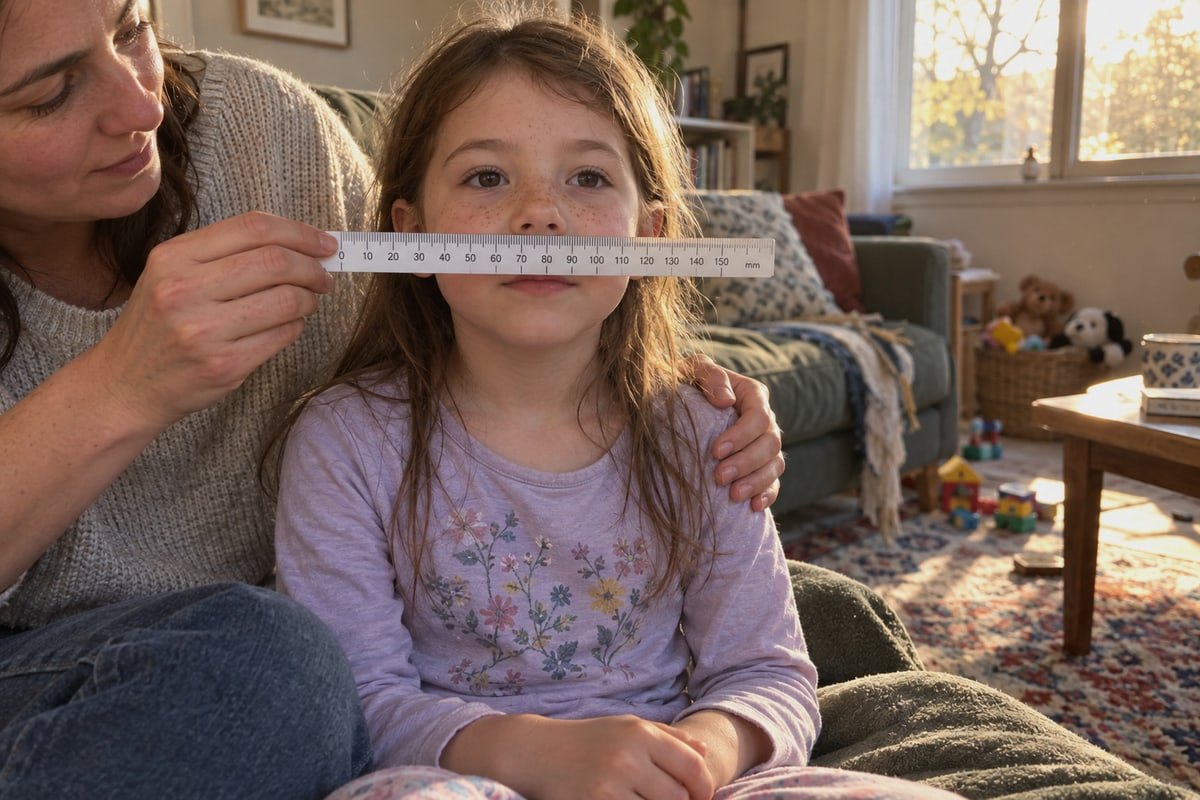
Face width is the number most parents skip. They look at age on the box and hope. In our experience, that hope is where most fit complaints begin. So let me break the measurement down into plain steps.
What face width actually means for sunglasses
Face width is the temple-to-temple distance. It is the horizontal line across the widest part of the face, roughly level with the eyes and just in front of the ears. This number should match the total frame width 2 of the sunglasses. It is not the lens width. A frame with a 45 mm lens can easily be 120 mm wide once you add the bridge and the end pieces. That gap is why so many charts mislead people.
A simple step-by-step method
- Sit the child in good light, facing you.
- Hold a rigid millimeter ruler 3 level across the face at the temples.
- Keep the ruler snug against the skin. Do not press in.
- Read the number where the ruler meets the far temple.
- Repeat two or three times and average the results.
A soft sewing tape bends around the face. That curve adds several millimeters. A stiff ruler stays straight, so it reads the true frame dimensions the child needs.
Three ways to get the number
| Method | What you need | Accuracy | Best for |
|---|---|---|---|
| Rigid ruler at the temples | Millimeter ruler, good light | High | Most children aged 4 and up |
| Existing well-fitting glasses | A pair that already fits | High | Kids who already wear eyewear |
| Photo with a coin for scale | Phone camera, coin | Medium | Very young or restless toddlers |
The second method is one I recommend to brand buyers all the time. If a child already owns a pair that sits well, measure that frame from hinge to hinge. That number is your target total width. It removes guesswork.
One more point. Children between ages 3 and 8 grow fast. A face width taken in spring may be off by autumn. Re-measure every 6 to 12 months. Our TR90 frames, made from a flexible thermoplastic material, will stretch a little to cover that growth, but they cannot cover a full size jump.
What tools do I need to measure pupillary distance for kids' TR90 frames?
Choosing between a plain millimeter ruler and a phone app is a trade-off I weigh with our brand buyers often. The ruler costs nothing, but a wiggling four-year-old tests patience.
You need a rigid millimeter ruler or printed PD ruler, a mirror or a helper, good lighting, and a fixed focus point across the room. Optional tools include a smartphone PD app calibrated with a credit card or a digital PD meter from an optician.
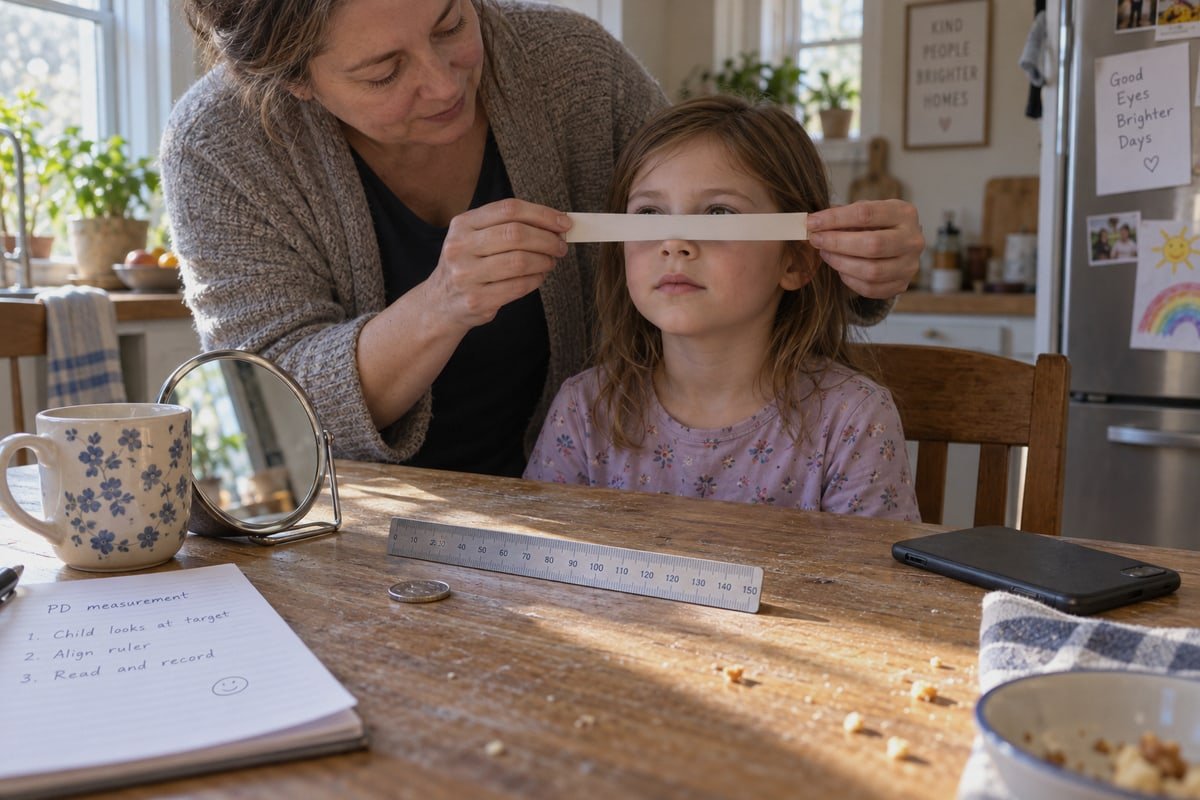
Pupillary distance, or PD, is the distance between the centers of the two pupils. It is always written in millimeters. When we lay out lens positions on a new TR90 mold, this is the number we design around. It decides whether the optical center 4 of each lens lands over the eye.
The basic toolkit
| Tool | Cost | Notes |
|---|---|---|
| Rigid millimeter ruler | Very low | The standard. Any straight ruler with mm marks works. |
| Printed PD ruler | Free | Print at 100% scale and check against a real ruler. |
| Mirror | Usually at home | For the self-measure method on older kids. |
| Helper | Free | The most useful tool for young children. |
| Smartphone PD app | Free to low | Uses a credit card or coin for scale calibration. |
| Digital PD meter | Optician only | Very accurate, but not needed for non-prescription sunglasses. |
The helper method, step by step
I prefer this method for anyone under about eight years old.
- Have the child sit and look at a fixed point across the room. A picture on the wall works well.
- Stand in front of the child and hold the ruler flat across the bridge of the nose.
- Line up the zero mark with the center of the right pupil.
- Without moving the ruler, read the mark at the center of the left pupil.
- Repeat the reading 2 to 4 times and average them.
Children fidget. Averaging smooths out those small shifts. If the child keeps looking at you instead of the wall, ask a second adult to hold up a toy behind your shoulder.
The mirror method for older kids
An older child can do this alone. They hold the ruler against the bridge of their nose, look into a mirror, close the right eye, and line zero up with the left pupil. Then they open the right eye, close the left, and read the mark at the right pupil. It takes practice. I still suggest a helper for a check.
What numbers to expect
Retailer guides commonly place children's PD between 43 and 58 mm. Some charts narrow that to 42 to 54 mm for younger kids. A toddler often sits in the low 40s. A ten-year-old may be near 55 mm. The exact number depends on head size, not just age.
Does PD really matter for sunglasses without prescription?
Some buyers push back here. They tell me PD only matters for optical lenses. I understand the point, but I disagree in practice. Poor optical center alignment on tinted lenses 5 means the child sees more frame edge and less lens. The sunglasses feel off, and kids take off things that feel off. Comfort and coverage matter as much as strict optics, and PD serves both.
How do I match my child's measurements to the right TR90 sunglasses size chart?
A procurement manager from Australia once emailed me a child's face width and PD and asked which of our 800 styles would fit. A size chart answered her.
Match measurements by reading the frame's size code as lens width–bridge width–temple length, doubling lens width and adding bridge width to estimate total frame width, then choosing the age band whose total width sits within a few millimeters of face width and whose lens centers align with PD.
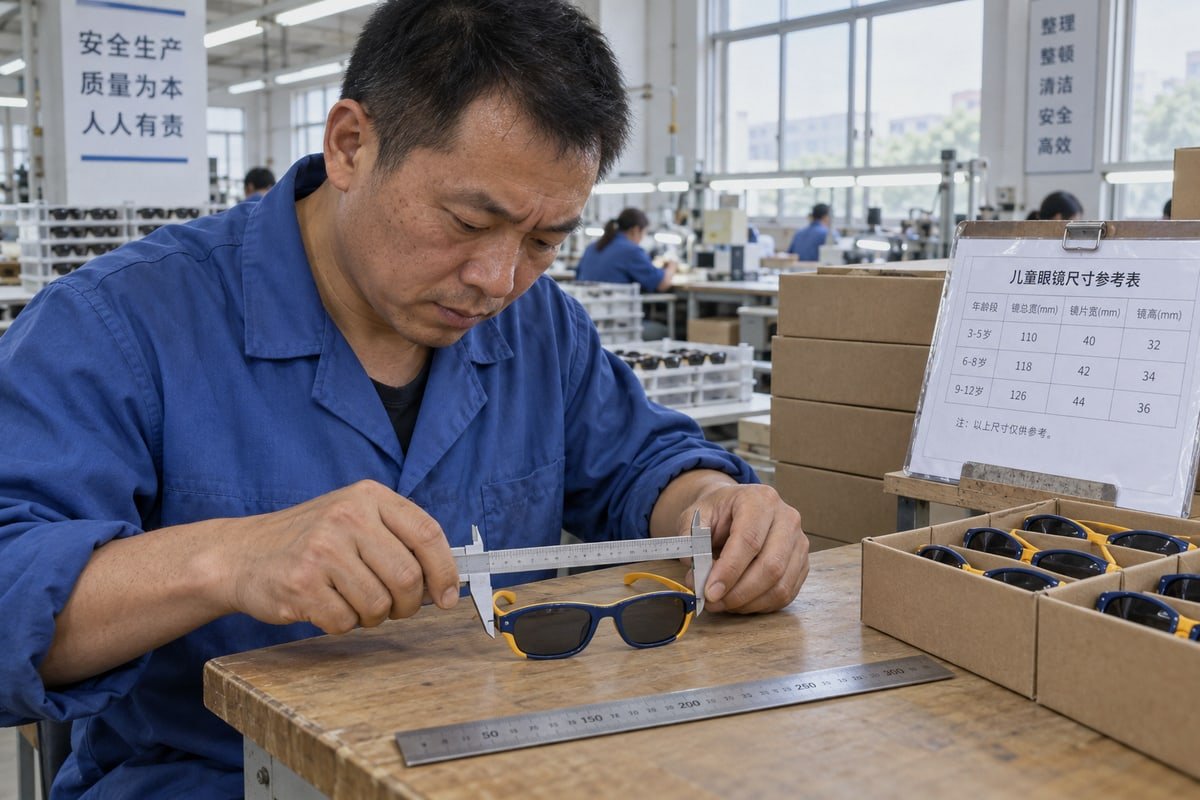
Once you have face width and pupillary distance, the chart does the rest. The trick is knowing what each number on the chart means. Here is how we explain it to new brand partners.
Decoding a size code like 49-16-130
Most kids' TR90 frames carry a three-part code. Take 49-16-130.
- 49 is the lens width in millimeters.
- 16 is the bridge width, the gap between the lenses at the nose.
- 130 is the temple length, from hinge to the tip behind the ear.
A smaller frame might read 45-16-125. Same bridge, smaller lens, shorter temple. Some listings add a fourth number for lens height, which matters for coverage on round toddler faces.
Two quick calculations
First, estimate frame PD. Add lens width and bridge width. For 49-16-130, that is 65 mm. Hmm, that seems large for a child, and it is. It tells you this frame suits an older youth with a PD in the mid-50s to high-50s, because a few millimeters of tolerance is normal. For 45-16-125, frame PD is 61 mm, closer to a child in the low 50s.
Second, estimate total frame width. Double the lens width, add the bridge, then add roughly 6 to 10 mm for the two end pieces. For 45-16-125, that gives about 106 to 116 mm. Compare that to the child's temple-to-temple distance.
A working kids' TR90 sizing chart
| Age band | Lens width | Bridge width | Temple length | Typical PD range |
|---|---|---|---|---|
| Toddler (approx. 1–3) | 40–44 mm | 12–14 mm | 105–115 mm | 42–47 mm |
| Kids (approx. 4–7) | 44–48 mm | 14–16 mm | 115–125 mm | 46–52 mm |
| Junior (approx. 8–10) | 48–52 mm | 15–17 mm | 125–135 mm | 50–55 mm |
| Youth (approx. 11+) | 52–56 mm | 16–18 mm | 130–140 mm | 53–58 mm |
Treat the age labels as loose guides. The face width and PD columns are the ones that decide the sale. A large five-year-old may sit in the junior row. A small nine-year-old may sit in the kids row. Age is a rough proxy. Measurements are the real answer.
When the numbers fall between sizes
This happens often. My advice is simple. Choose the smaller size if the child's PD is closer to that frame's PD. Choose the larger size if the face width is more than 5 mm over the smaller frame's total width. TR90 bends outward a little at the temples. Our frames with TPEE temples flex even more. That flex gives you a few millimeters of grace, not a full size.
Bridge width deserves its own check
Bridge width often gets ignored. A bridge that is too wide lets the frame slide down the nose. The lenses then sit low, and the child looks over the top. Compare the middle number in the code to the child's nose. If an existing pair fits well at the nose, copy its bridge number.
What sizing mistakes should I avoid when ordering kids' TR90 sunglasses in bulk?
One lesson fifteen years of eyewear production taught our team: bulk sizing errors multiply. A single wrong chart on a container order becomes a container of returns.
Avoid confusing lens width with total frame width, sizing by age alone, using a soft tape instead of a rigid ruler, ignoring bridge width, skipping temple length, trusting TR90 flex to fix a poor baseline fit, and ordering one size for a wide age range without sample testing.
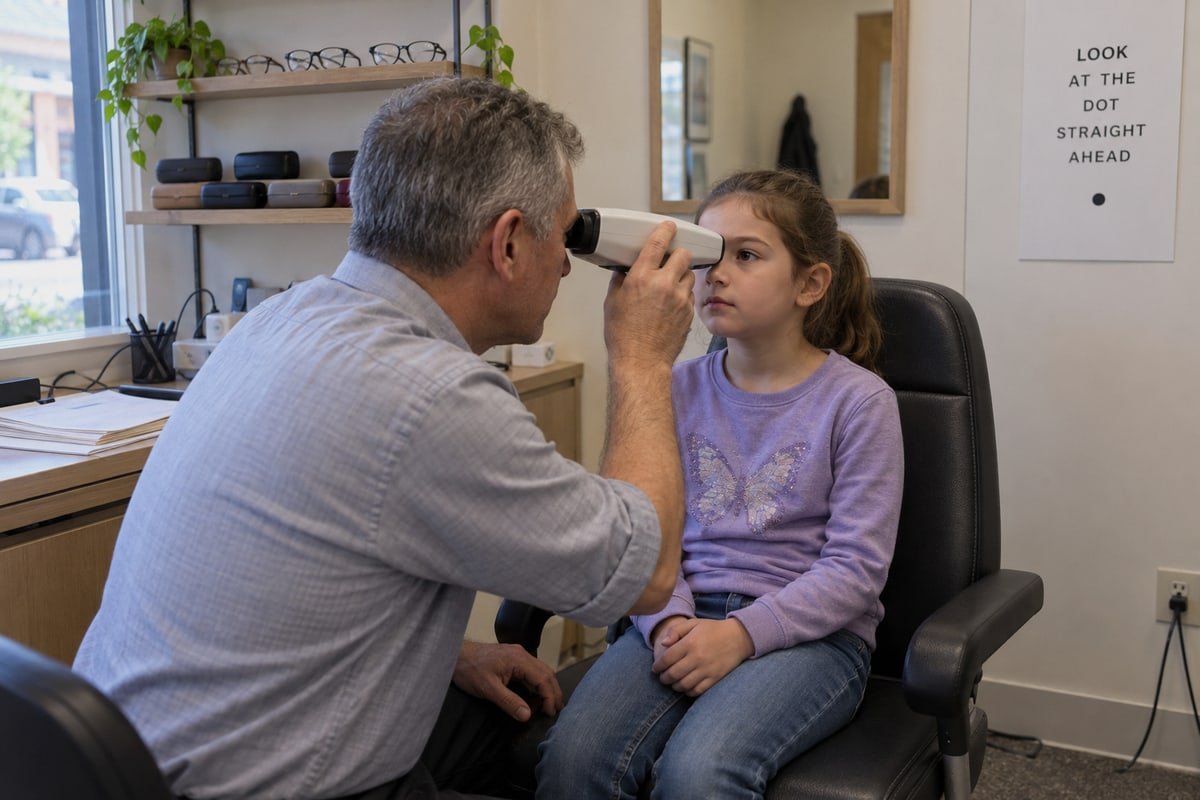
Bulk buying changes the math. A parent who mis-measures loses one pair. A brand that mis-sizes loses a whole run. Here are the mistakes I see most, and what we do on our production line to help buyers avoid them.
The mistakes that cost the most
| Mistake | Why it hurts | Fix |
|---|---|---|
| Reading lens width as frame width | Frames arrive 20–30 mm wider than expected | Always calculate total width from the full size code |
| Sizing by age only | Same-age kids vary by 10 mm or more in face width | Build your chart around face width and PD |
| Ignoring bridge width | Frame slides down, lenses sit low | Match the middle number to nose width |
| Skipping temple length | Temples too short pinch; too long slip | Check the third number against ear-to-hinge distance |
| Relying on "flex-fit" | Flex hides a few mm, not a full size | Set a baseline fit first, then let TR90 add tolerance |
| No sample test | Errors are found after the container lands | Test samples on real children before mass production |
The flex-fit objection, answered
Buyers sometimes tell me that TR90 is flexible, so exact sizing is less important. There is some truth in that. TR90 is a flexible thermoplastic material with strong impact resistance 6 and hypoallergenic properties, and it does give a wider fit window than rigid acetate. But flex is a cushion, not a cure. A frame 15 mm too wide will still slide off a small face, no matter how well it bends. Use the flex to cover growth and small variance. Do not use it to skip measuring.
The warm fit test
Here is a simple check we suggest before any brand finalizes a size range. Have a child wear the sample for five to ten minutes. TR90 softens slightly with body heat and settles onto the face. After that time, look at three things. Do the lenses sit centered over the eyes? Do the temples touch the head without leaving marks? Does the frame stay put when the child looks down? If all three pass, the size is right.
One size does not fit ages 3 to 12
A single "kids" size covering toddlers through pre-teens almost always fails at one end. Spread the range. Even two sizes, a kids and a junior, cut return rates sharply. With around 800 existing styles in our catalog, a brand can pick a toddler eyewear sizing chart, a kids band, and a youth band without paying for new molds. That keeps the first order low-risk.
A short pre-order checklist
- Confirm face width and pupillary distance ranges for each target age band.
- Decode every size code into lens width, bridge width, temple length, and total width.
- Request samples in each planned size, then run the warm fit test on real children.
- Ask your supplier for lens height, since round toddler faces need taller coverage.
- Confirm UV400 or polarized lens specs alongside the frame dimensions.
- Lock the size chart into the packaging artwork so retail shoppers measure before buying.
Conclusion
Guessing sizes costs brands returns and trust. Measure face width and PD, match them to real frame dimensions, and let TR90 flex handle the rest. We can help.
Interested in sourcing the products mentioned in this article? See details and request a quote here:
Footnotes
1. Official American Academy of Ophthalmology guide on measuring PD. ↩︎
2. Detailed explanation of eyeglass frame components and sizing dimensions. ↩︎
3. NIST official reference for SI length units including millimeters. ↩︎
4. Technical definition of the optical center within a lens system. ↩︎
5. Professional explanation of lens types and their impact on visual performance and protection. ↩︎
6. International standard for sunglasses safety and impact performance requirements. ↩︎
More Articles You Might Like



Looking for a Reliable Kids Eyewear Partner?
Explore 800+ ready styles and full OEM/ODM support tailored to your brand.
Get in Touch English
 Español de México
 Deutsch
 Français
 日本語
 العربية
 Português do Brasil