What Weight Is Ideal for TR90 & TPEE Kids Optical Frames, and Why Avoid Too Light?

Parents return kids’ glasses that slide, snap, or pinch. On our Taizhou production line, we learned the ideal weight for TR90 and TPEE kids optical frames prevents most of that.
The ideal weight for TR90 and TPEE kids optical frames is 12–20 grams, frame only. Smaller full-rim frames for toddlers can sit near 10–15 grams. Going below 10 grams usually thins the frame walls, weakens lens retention, and lets the glasses slide, so avoid ultra-light designs.
That range is a starting point, not a rule. Below, I break it down by age, explain why “too light” fails in real use, show what each material contributes, and give you a simple way to check a supplier’s numbers before you commit to a bulk order.
How do I determine the right frame weight for different children's age groups?
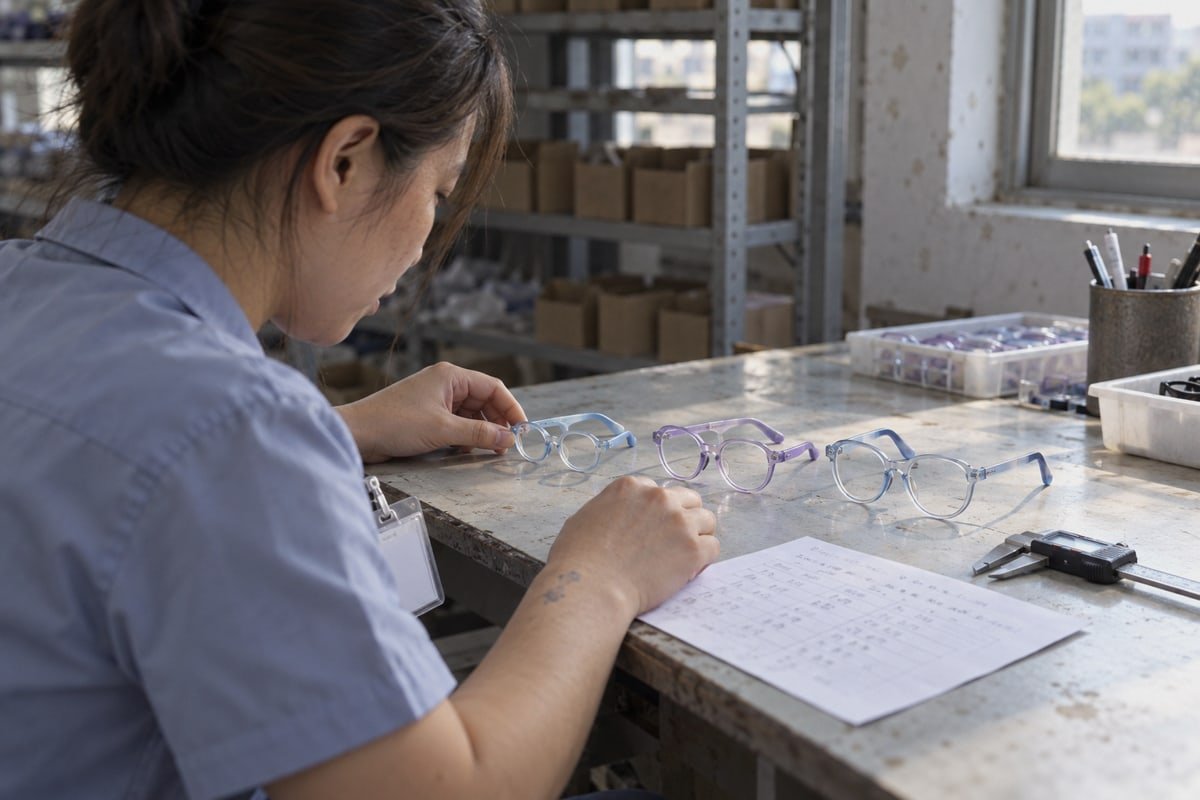
Last season our QC team weighed every sample from a new toddler series before approving the mold. The scale told a clearer story than the drawings did.
Match frame weight to age and face size. Toddlers aged 1–3 do best with 10–14 gram frames, children aged 4–8 with 12–17 grams, and older kids aged 9–14 with 15–20 grams. Larger or feature-rich frames may reach 22 grams if the bridge and temples fit well.
Start with the face, not the scale
Pediatric facial development moves fast. A two-year-old has a low, soft nasal bridge 1 and almost no bone support behind it. Bridge pressure shows up quickly on that face. By age nine, the bridge is higher and firmer, and the child can carry more weight without marks or headaches. So the ideal weight for TR90 and TPEE kids optical frames is really a set of ranges that follow the face.
Here is the working guide we use when we sort our catalog of roughly 800 styles for buyers:
| Age group | Typical lens width | Target frame-only weight | Design notes |
|---|---|---|---|
| 1–3 years | 38–42 mm | 10–14 g | Low bridge, looped or wraparound temple tips, maximum flex |
| 4–8 years | 42–46 mm | 12–17 g | TR90 front with TPEE temples, everyday school wear |
| 9–14 years | 46–50 mm | 15–20 g | Approaches the adult TR90 range of 18–22 g |
These numbers are frame only, without lenses. That distinction matters, and I return to it in the last section.
Account for lens weight
The frame is only half the story. Prescription lenses add mass, and lens thickness 2 grows with the prescription. A 12 gram frame fitted with thick lenses can end up heavier on the face than an 18 gram frame fitted with thin ones. When a buyer tells us their optical partners see many higher prescriptions, we steer them toward a slightly sturdier front. The extra grams in the rim hold the heavier lens steady and keep optical alignment where the optician set it.
Anatomical fit decides how weight feels
Two frames can weigh the same and feel completely different. A frame with a bridge that matches the child’s nose spreads its weight across a wider area. A frame with the wrong bridge concentrates the same weight on two small points. That is why we check anatomical fit on a range of head forms before we sign off on a style, not just the reading on the scale. The goal is simple: light enough to forget, but not so light that it feels flimsy.
Why might an ultra-lightweight frame actually compromise durability and safety for kids?
Every gram we remove from a TR90 front is a gram taken from the rim wall. We weigh that trade-off on every new style before it reaches our 800-style catalog.
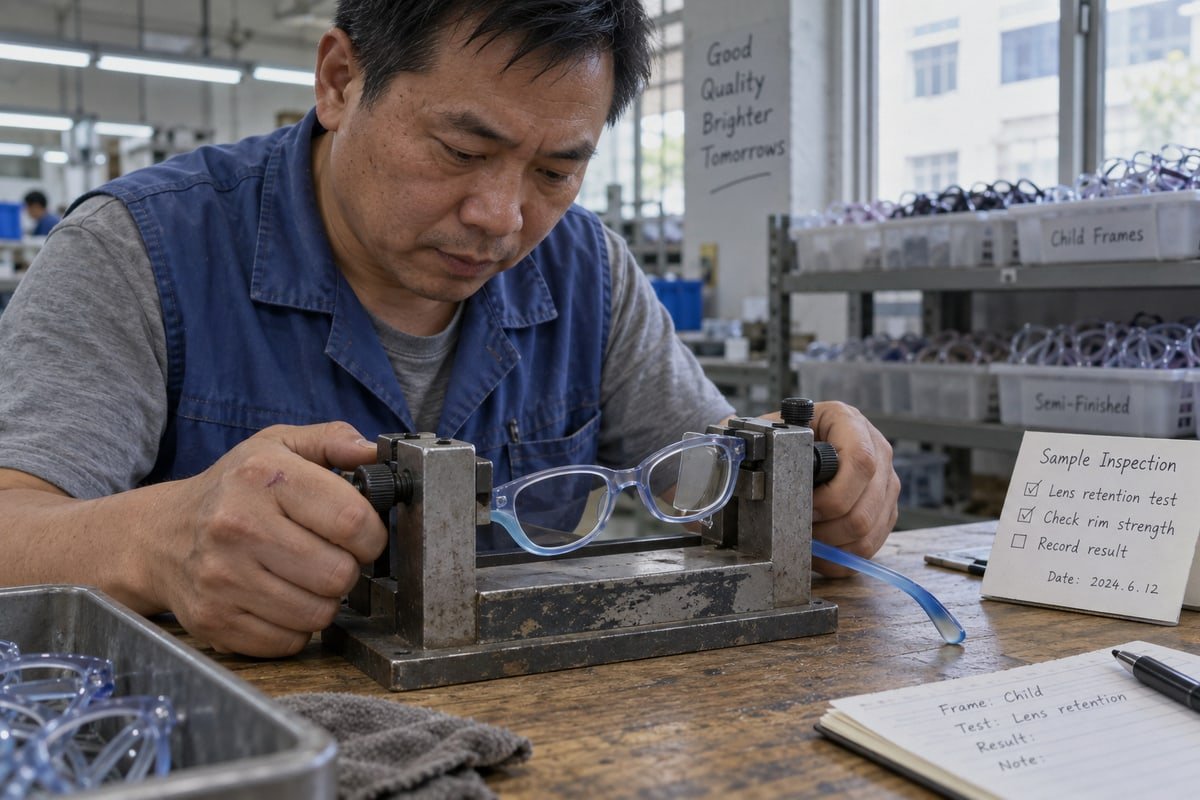
Ultra-light frames compromise kids' eyewear because cutting weight means cutting wall thickness. Thin rims lose lens bevel tension, so lenses pop out on impact. Very light fronts also become lens-heavy, slide down the nose, shift vertex distance, and give children too little tactile feedback to protect their glasses.
The objection: isn't lighter always better?
Many buyers arrive with this belief. Manufacturer marketing supports it, and the comfort argument is real. Less weight means less bridge pressure and fewer red marks. I agree with that part. But the argument stops too early. It treats weight as the only variable. In practice, weight is a result of design choices, and each choice has a cost. Here are the five failure modes we see when a frame is pushed too far below the ideal weight for TR90 and TPEE kids optical frames.
Five ways "too light" fails in the field
- Lenses pop out. A rim needs enough wall thickness to hold bevel tension around the lens. When a designer shaves the rim to save weight, that tension drops. Lenses then work loose during thermal expansion on a hot day or after a knock on the playground.
- The frame goes front-heavy. Lenses do not get lighter when the frame does. A very light front paired with normal lenses shifts the frame balance forward. The temples lift off the ears and the glasses slide down the nose all day.
- Vertex distance drifts. Optical alignment depends on the lens sitting a consistent distance from the eye. Overly light frames tend to float on skin perspiration and shift position. Small shifts change the focal point and cause visual distortion.
- The child forgets the glasses are there. Some mass gives the tactile feedback 3, or proprioception, that keeps a child aware of the frame. Without it, glasses get left on benches, sat on, or knocked off without notice.
- Micro-bounce increases. During running and jumping, a frame with a little mass and a resilient TPEE temple acts as a dampener. A frame with almost no mass vibrates more, and that vibrating field of vision causes fatigue.
Where the real fix lives
None of these problems is solved by adding weight for its own sake. They are solved by keeping enough wall thickness, choosing the right temple tension, and matching the front to the lens. A 10 gram kids frame does exist on the market. It can work for a tiny toddler face with thin lenses. It is not a target for a school-age child.
What role do TR90 and TPEE materials play in balancing comfort with structural strength?
A buyer from Australia once asked us to make a toddler frame entirely in TPEE. We explained why we pair a TR90 front with TPEE temples instead.
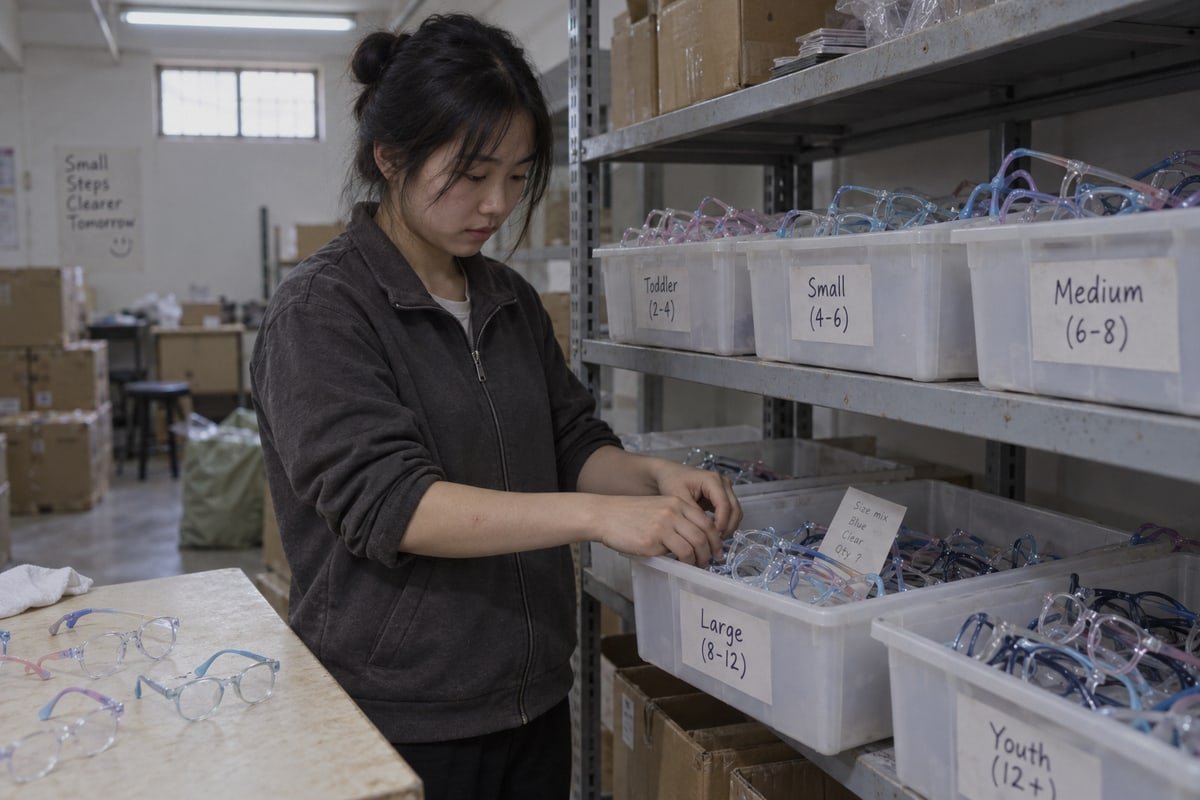
TR90 gives the frame front its structural strength. It is a shape memory polymer that bends and returns, holds lens bevel tension, and stays stiff enough for optical alignment. TPEE gives the temples rubber-like flexibility and grip. Together they deliver a light, shatterproof frame that stays comfortable all day.
TR90 and TPEE side by side
| Property | TR90 | TPEE |
|---|---|---|
| Material type | Swiss-developed thermoplastic, shape memory polymer 4 | Thermoplastic polyester elastomer |
| Feel | Firm but flexible, returns to shape | Soft, rubber-like, high stretch |
| Best use in kids frames | Fronts, full-rim optical frames | Temples, ear hooks, toddler and sports frames |
| Typical frame weight | 18–22 g adult optical; 12–15 g kids versions | Varies widely; one kids sunglass example is 18.8 g |
| Impact resistance | High, resists snapping | Very high, absorbs and dampens impact |
| Safety profile | Hypoallergenic, BPA-free, non-toxic | Hypoallergenic, BPA-free, non-toxic |
Why we split the job between two materials
The two materials solve different problems. TR90 is often marketed as about 30% lighter than traditional plastic frame materials. More important for us, it is stiff enough to hold a lens in place and keep optical alignment while still bending under a child's grip. That combination is why we use it for the front on most of our kids optical styles.
TPEE is softer. On its own it does not hold a lens firmly enough for an optical frame with a real prescription. But on the temples, that softness becomes a strength. The looped ear hooks on our translucent kids frames wrap around the ear and stay put without pinching. The perforations we mold into some temple arms add flex without adding weight. The TPEE also acts as that mechanical dampener I mentioned earlier, soaking up bounce during play.
Safety on a child's face and in a child's mouth
Both materials have the hypoallergenic properties 5 buyers in Europe and Japan ask about first. Both are non-toxic materials that are BPA-free and safe for long skin contact. Toddlers chew their glasses. We accept that reality and choose materials accordingly. The combination also gives real impact resistance. The frame bends instead of snapping, so there are no sharp broken edges near a child's eye. That is what shatterproof eyewear means in practice.
Weight varies more than the material name suggests
One TPEE kids sunglass listing comes in at 18.8 grams. Another TPEE kids product, with a bulkier wraparound structure, weighs close to 50 grams. Same material, very different frame. So the material tells you about flexibility and safety. It does not tell you the weight. Only the design and the scale do that.
How can I verify a supplier's weight specifications before placing a bulk order?
We learned this lesson early in our 15 years of making eyewear: a weight on a product page means nothing until you know what was on the scale.
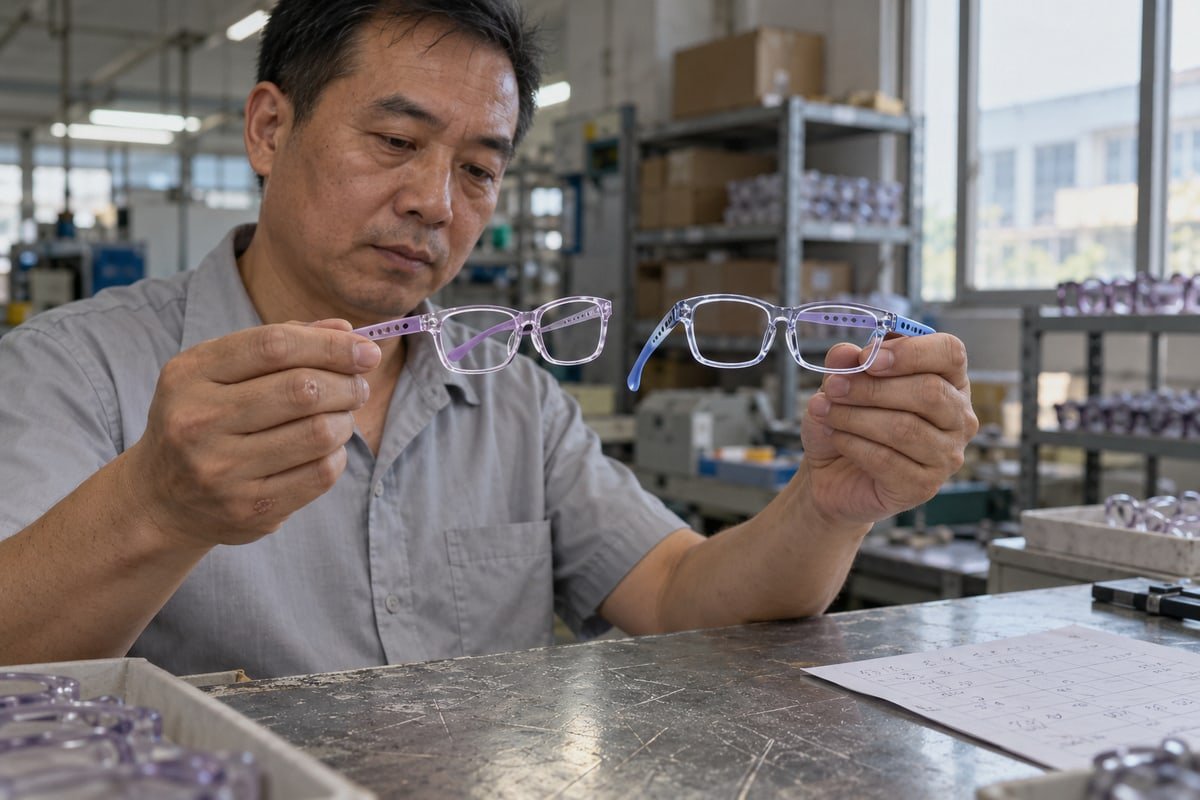
Ask the supplier to state whether the figure is frame-only, frame with demo lenses, or packaged weight. Request physical samples and weigh them yourself on a 0.1 gram scale. Compare at least three units for consistency. Then write the agreed weight and tolerance into the purchase order.
Why listed weights are not comparable
Product pages rarely say what the number includes. One factory lists the bare front. Another lists the frame with demo lenses fitted. A third lists the shipping weight with a case and cloth. The gap can be several grams, which is a huge share of a 15 gram frame.
| What the number may include | Effect on a typical kids frame | What to ask |
|---|---|---|
| Frame only, no lenses | The true design weight | "Is this frame-only?" |
| Frame with demo lenses | Adds roughly 2–4 g depending on lens thickness | "Were demo lenses fitted?" |
| Frame in retail packaging | Can double the figure | "Does this include case or box?" |
A simple five-step verification process
- Request the basis in writing. Ask the supplier to confirm frame-only weight and to name the lens type, if any, used in their measurement.
- Order physical samples. Get at least three units of the same size and color. Molded parts vary slightly, so one sample is not enough.
- Weigh them yourself. A basic 0.1 gram jewelry scale is enough. Remove any demo lenses first. Record each unit.
- Check the distribution, not just the total. Hold the frame by the temple tips and see whether the front dips. Front-heavy samples will slide on a child's face no matter what the total reads.
- Fix the spec in the order. Write the agreed frame-only weight, the acceptable variation, and the reference sample number into the purchase order or QC sheet.
What we do on our side
In our 5S-managed workshop, we weigh approval samples and keep a signed reference sample for every custom OEM/ODM project. When a buyer's inspector visits or receives a pre-shipment sample, they compare against that reference. This is routine for us because the buyers we serve across 20 or more countries rarely ask for the cheapest frame. They ask for the same frame every time.
Conclusion
Sliding, snapping frames cost brands returns and trust. Aim for 12–20 gram TR90 and TPEE kids frames, verify the number yourself, and partner with a factory that weighs every sample.
Interested in sourcing the products mentioned in this article? See details and request a quote here:
Footnotes
1. Authoritative medical database for information on pediatric anatomy and facial development. ↩︎
2. Scientific resource explaining how lens thickness affects the total weight of eyewear. ↩︎
3. Engineering resource defining tactile feedback and its role in user awareness. ↩︎
4. Technical definition of the shape memory polymer class used in TR90 eyewear. ↩︎
5. Official government source for health and safety standards regarding hypoallergenic materials. ↩︎
More Articles You Might Like



Looking for a Reliable Kids Eyewear Partner?
Explore 800+ ready styles and full OEM/ODM support tailored to your brand.
Get in Touch English
 Español de México
 Deutsch
 Français
 日本語
 العربية
 Português do Brasil