How Are TR90 & TPEE Combined in Kids Optical Frames, and Will They Separate?
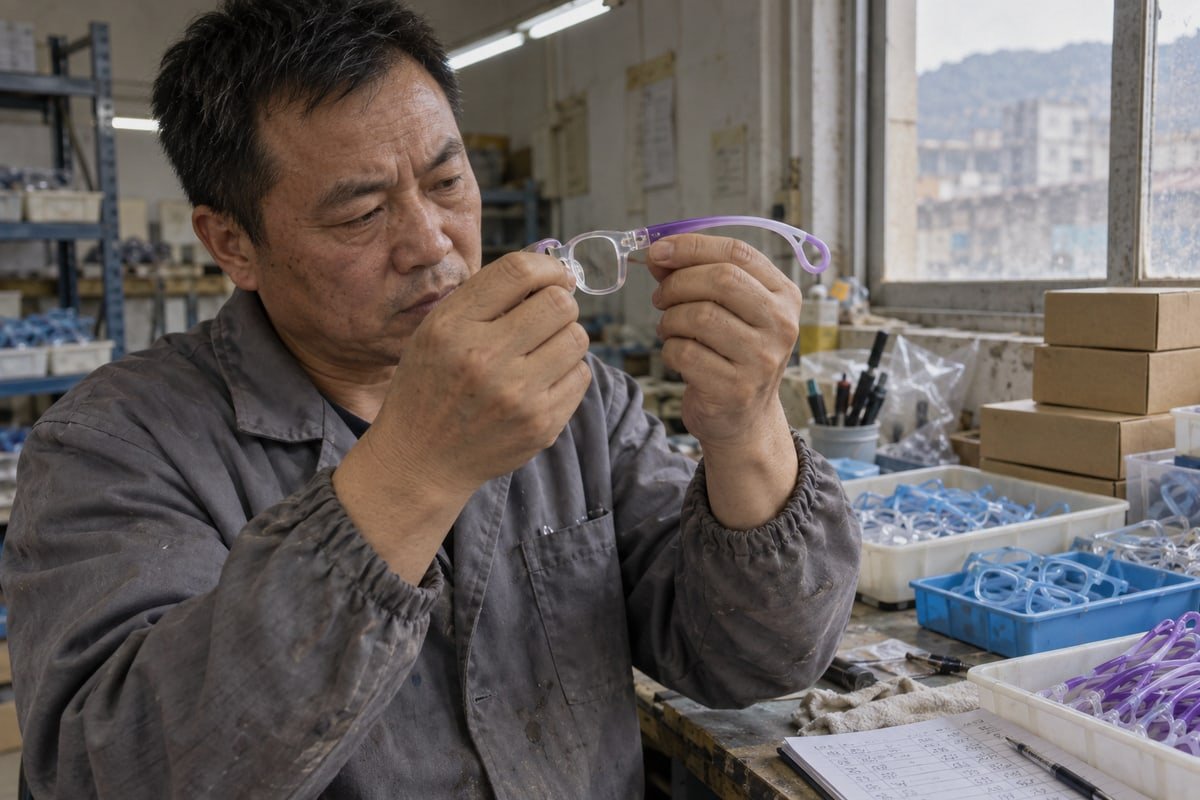
Buyers ask me how TR90 and TPEE are combined in kids optical frames. A temple that splits ruins a brand’s reputation fast. Our Taizhou line relies on process, not glue.
TR90 and TPEE are combined in kids optical frames by double injection overmolding or a mechanical hinge joint, with the TR90 front giving structure and TPEE temples giving flex. Well-made frames use interlocking undercuts and controlled melt temperatures, so they should not separate under normal daily wear.
That is the short answer. The long answer is about how the joint is built, how it fails, and what you can check before you place an order. Let me walk you through each part.
How does the manufacturing process bond TR90 fronts with TPEE temples so they don't come apart?
Last spring we ran a two-shot mold for a translucent front with lavender temples. The first samples looked perfect, but our engineer rejected them because the melt temperature 1 was low.
Manufacturers bond TR90 fronts with TPEE temples using double injection molding, where TPEE is injected over a pre-molded TR90 base so the surfaces fuse. Interlocking undercuts add a mechanical lock, and for hinged designs, a screwless or metal hinge joins the two parts.
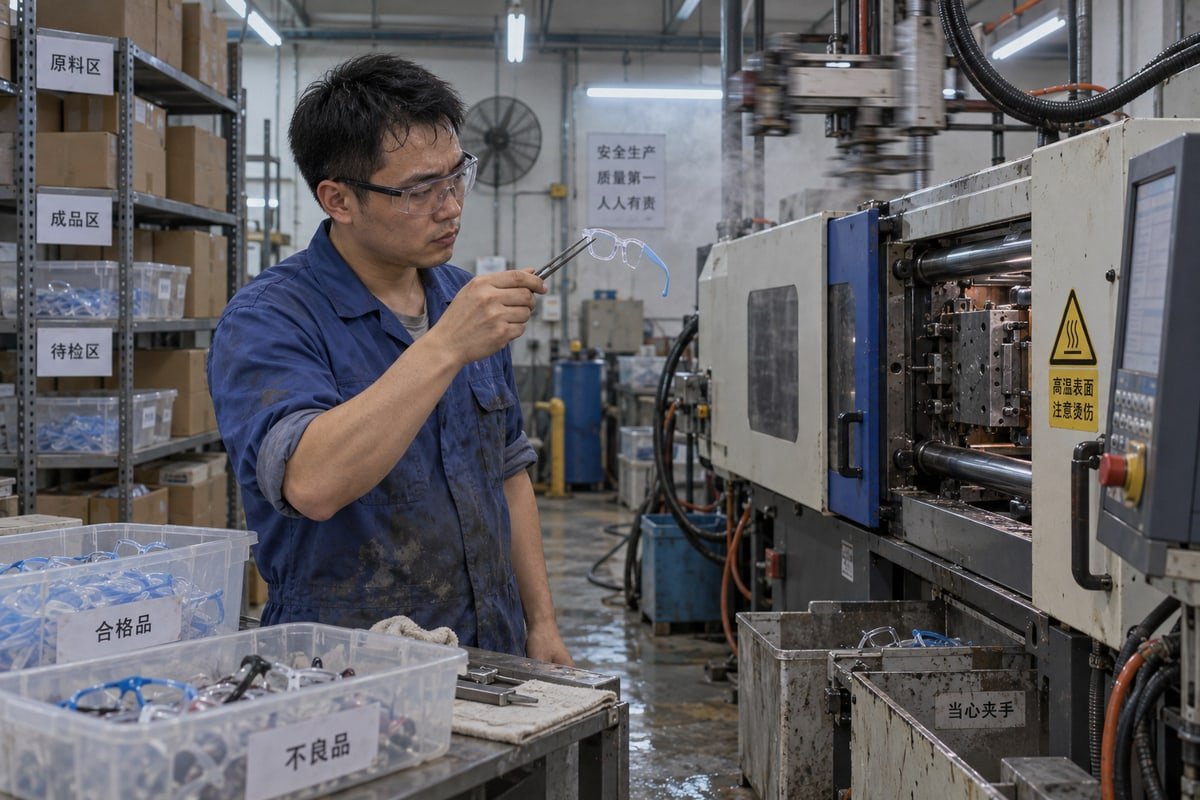
That rejected batch taught our newer technicians something important. A hybrid frame can look finished and still be weak inside. The bond lives at the interface, and you cannot see it with your eyes.
Two ways the parts come together
Not every hybrid frame is built the same way. In our Taizhou workshop we use two routes. The choice depends on the style.
| Joining route | How it works | Where we use it |
|---|---|---|
| Double injection molding (two-shot) | TR90 is molded first, then TPEE is injected over it in the same machine cycle | Soft inner temple layers, nose pads, overmolded temple grips |
| Mechanical hinge joint | Separate TR90 front and full TPEE temple joined by a screwless snap pin or a metal hinge | Full TPEE temples with looped ear hooks, styles that need easy temple replacement |
Inside the double injection cycle
- Mold the TR90 base. Grilamid TR90 is a nylon-based thermoplastic with strong shape memory 2. It forms the front rim or the rigid core of a temple. Think of it as the skeleton.
- Index the mold. The TR90 part rotates or slides into a second cavity while it is still warm.
- Inject the TPEE. Thermoplastic polyester elastomer 3 flows over the TR90 surface. If the melt temperature is high enough, the TR90 surface re-softens slightly. Polymer chains from both materials interdiffuse and lock at the interface. This creates a molecular bond, not just surface contact. Both materials are thermoplastics with compatible melting points, so thermal fusion is possible. If the second shot runs too cold, the TPEE only sits on top of the TR90. That is the sample we rejected.
- Cool under control. TR90 and TPEE shrink at different rates. If the mold cooling cycle is not calibrated, internal stress builds up between the layers. That stress can show up months later as edge lifting along the seam.
The mechanical fail-safe
Overmolding technology alone is not enough for children's eyewear. Our engineers cut undercuts and interlocking grooves into the TR90 base before the second shot. The TPEE flows into those grooves and hardens in place. Even if the chemical bond 4 weakens after years of use, the physical interlock still holds the layer down. We treat the fusion as the primary bond and the groove as the backup.
When the temple is a separate part
Many of our kids' optical styles use a fully TPEE temple attached to a TR90 front through a hinge. Here the connection is mechanical. Screwless frame construction uses a molded pin that snaps into the front. It removes the tiny screws that can loosen or be swallowed. Other styles use a metal barrel hinge. Either way, the strength depends on hinge geometry and the thickness of TR90 around the hinge, not on any adhesive. Glue plays no role in our hybrid frames.
Can I trust these joints to hold up under daily wear and tear from active kids?
A procurement manager from Australia once sent us a competitor's frame with a temple peeled halfway off. She asked one question: could ours do the same?
Yes, a properly engineered TR90 and TPEE joint holds up under daily wear from active kids, because thermal fusion and mechanical undercuts share the load. Failure usually comes from poor molding, weak hinges, chemical exposure, or twisting beyond the design range, not from the materials themselves.
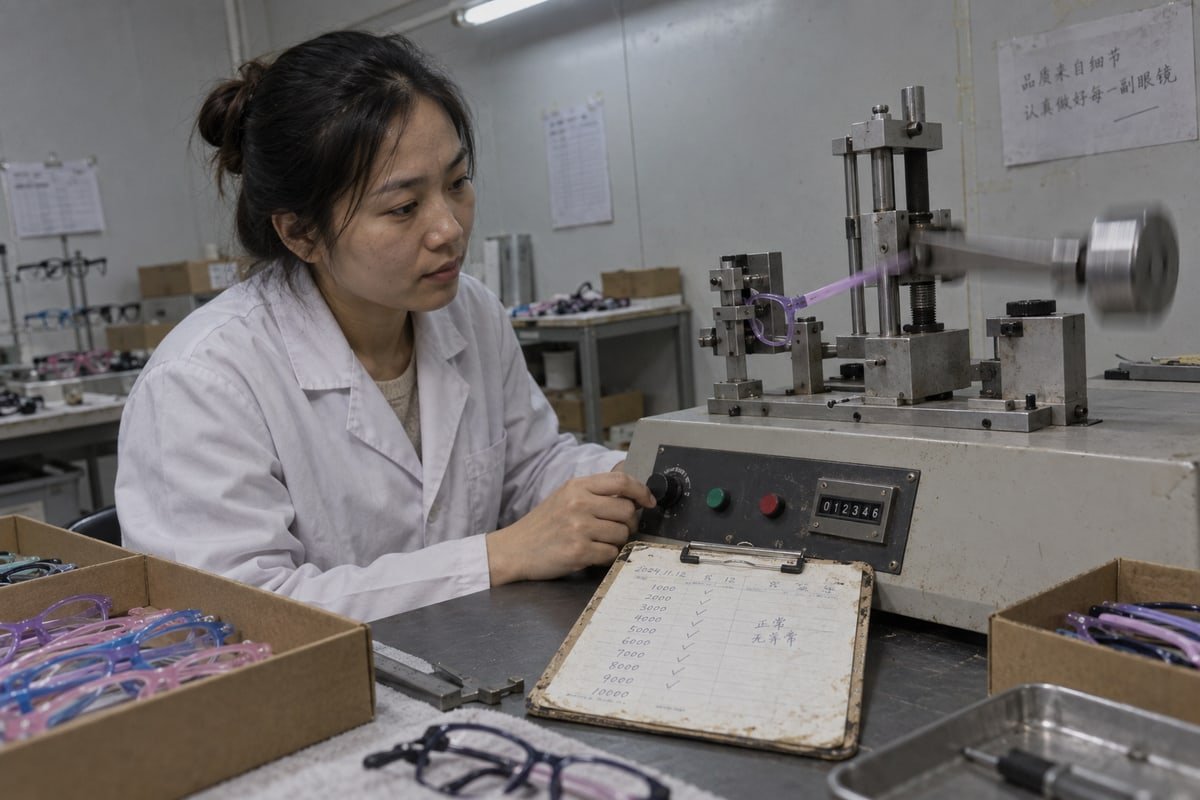
My honest answer to her was this. Yes, any frame can fail if you push it far enough. No, a frame built with a hot second shot and proper undercuts should not peel like the one she sent. The difference is not the material. It is the process behind it.
The "unbreakable" objection
Many listings call TR90 and TPEE frames "unbreakable." I understand why brands like that word. I also refuse to print it on our packaging. These materials are highly flexible and have strong impact resistance. They bend where acetate would snap. But no frame is failure-proof under enough force. If a brand promises "unbreakable," the first returned pair becomes a trust problem. I prefer "bendable" and "built for active kids." Those claims we can stand behind.
What the joint actually experiences
A child does not treat glasses gently. In our experience, the joint sees four kinds of stress.
| Stress type | Real-world example | What protects the joint |
|---|---|---|
| Repeated bending | Pulling temples wide to put glasses on one-handed | TPEE elasticity, flex zones like perforated dots along the temple |
| Twisting | Sitting on the frame, stuffing it in a backpack | Undercuts, hinge geometry, shape memory of TR90 |
| Impact | Playground falls, balls to the face | Lens retention in the TR90 rim, energy absorbed by the softer TPEE |
| Chemical and thermal exposure | Sunscreen, skin-care oils, hot car dashboards, ultrasonic cleaning | Correct fusion at the interface, material grade selection |
Where material delamination really comes from
When we open a failed hybrid frame, we almost always find one of these causes.
- Low melt temperature on the second shot, so the TPEE only sat on the TR90 instead of fusing with it.
- No undercuts, so the chemical bond was the only bond.
- Cooling cycle not calibrated, leaving internal stress that turned into edge lifting.
- Thin TR90 around the hinge, so the pin or barrel worked loose.
- Interfacial fatigue after years of high-frequency ultrasonic cleaning or heavy contact with skin-care oils. The seam degrades slowly and can start to peel.
Notice the pattern. None of these is an inherent incompatibility between TR90 and TPEE. Material delamination is a design-and-quality-control issue. A softer temple is great, but flexibility alone will not save a weak front-to-temple connection. That is why our engineers judge the joint first and the material second.
What I told the Australian buyer
We sent her our own version of the same style. Our version used a full TPEE temple with a looped ear hook and a screwless snap hinge into a thicker TR90 front. She twisted it, bent it, and left it in her car for a week. It went back to shape. That was the answer she needed, and it was the answer the process gave her.
What quality control checks should I ask my supplier about to confirm the bond is durable?
Fifteen years ago I approved a batch on looks alone. A few pairs later showed edge lifting at the seam. Since then, every hybrid order gets a written QC checklist.
Ask your supplier for bond-related checks: pull and peel tests at the seam, repeated temple flex tests, hinge torque checks, thermal cycling, and visual inspection for edge lifting. Also request records of melt temperature, mold cooling settings, and lens retention checks after cold glaze mounting.
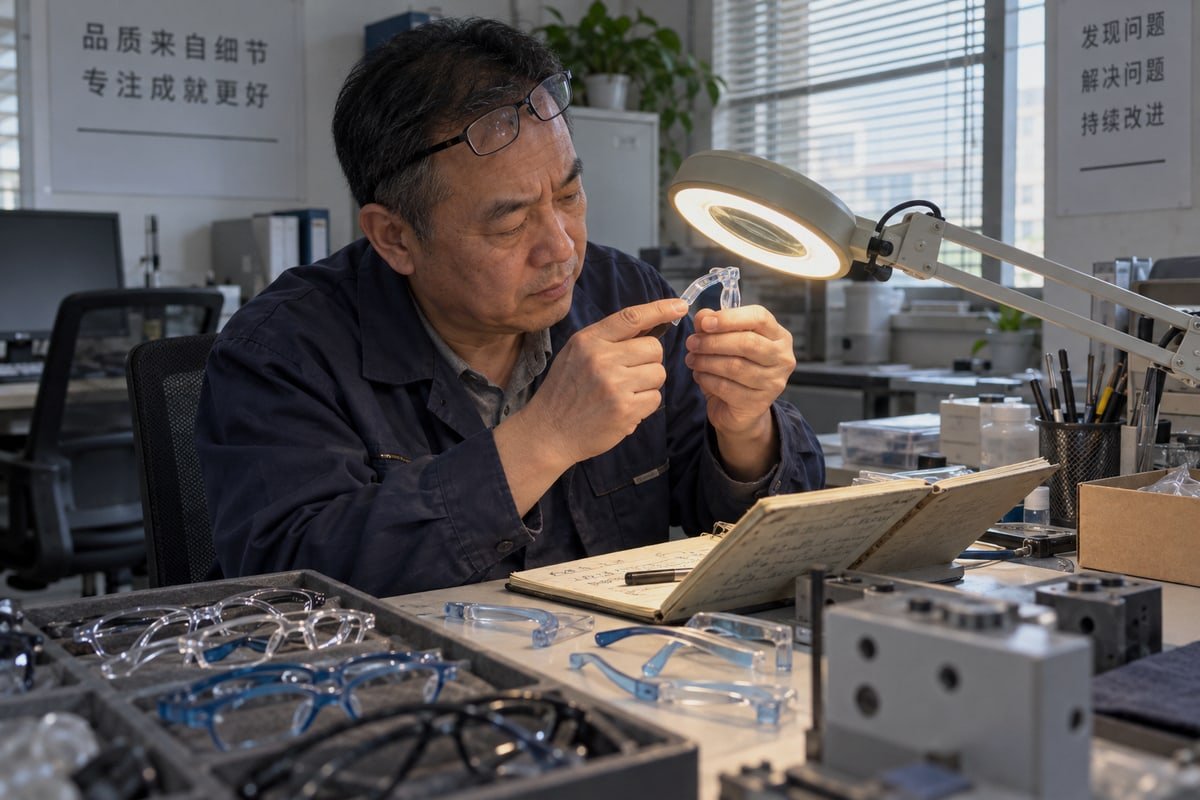
That early mistake shaped how our 5S-managed workshop runs today. Roughly 120 people work on our floor, and the QC team does not sign off on a hybrid frame based on appearance. They sign off on records. Here is what I suggest you ask any supplier for, including us.
The checks that expose a weak bond
| QC check | What it reveals | What to ask your supplier |
|---|---|---|
| Pull and peel test at the seam | Whether TPEE fused to TR90 or only sits on it | "Do you test the overmold bond, and how is a fail defined?" |
| Repeated temple flex test | Fatigue at the hinge and flex zones | "How many cycles, and does the temple return to shape?" |
| Hinge torque check | Loose pins, thin TR90 around the hinge | "Is torque checked on every batch or only on samples?" |
| Thermal cycling | Differential shrinkage stress, edge lifting | "Do you test hot and cold exposure before shipping?" |
| Visual seam inspection | Gaps, lifting, flash at the interface | "Is this 100% inspection or sampled?" |
| Lens retention check | Whether lenses stay in on impact | "Is the groove designed for the lens, and is retention verified after mounting?" |
Process records matter as much as tests
A test tells you the batch passed today. A process record tells you why it will pass next time. In our experience, the two settings that decide the bond are the melt temperature of the second injection and the mold cooling cycle. If a supplier cannot explain how they control those two settings, the bond is a lottery. Ask to see the parameter sheet for your style. A real factory will have one.
Lens mounting is part of the bond story
Compliance pages for children's eyewear emphasize that frame material affects impact performance 5 and lens retention. That is why we treat the lens groove as part of the structure. Our optical fronts use cold glaze mounting, where the lens is pressed into the TR90 groove without heat that could stress the overmolded TPEE nearby. The groove depth and rim thickness are checked before the temples are ever attached. A front that holds its lens on impact protects both the eye and the joint.
Material documentation
Bond durability also depends on the material grade. Ask for the material data sheet for both the TR90 and the TPEE. Ask whether the grades are suitable for BPA-free eyewear 6 and whether hypoallergenic properties are documented, not just claimed. Some listings make broad safety claims without any test data behind them. Your job as a buyer is to separate promotional language from tested performance. A supplier who is proud of their process will show you the paperwork without being pushed.
Why do brands choose this TR90 and TPEE combination over single-material kids' frames?
Every new style forces a trade-off on our design bench. A full-TPEE frame flexes beautifully but can twist lenses loose. A full-TR90 frame holds shape but feels stiffer on toddlers.
Brands choose TR90 and TPEE combined in kids optical frames because the pairing gives lens stability and shape memory from Grilamid TR90 plus soft, rubber-like flex from TPEE temples. The result is lighter, more comfortable, and more impact resistant than most single-material kids' frames.
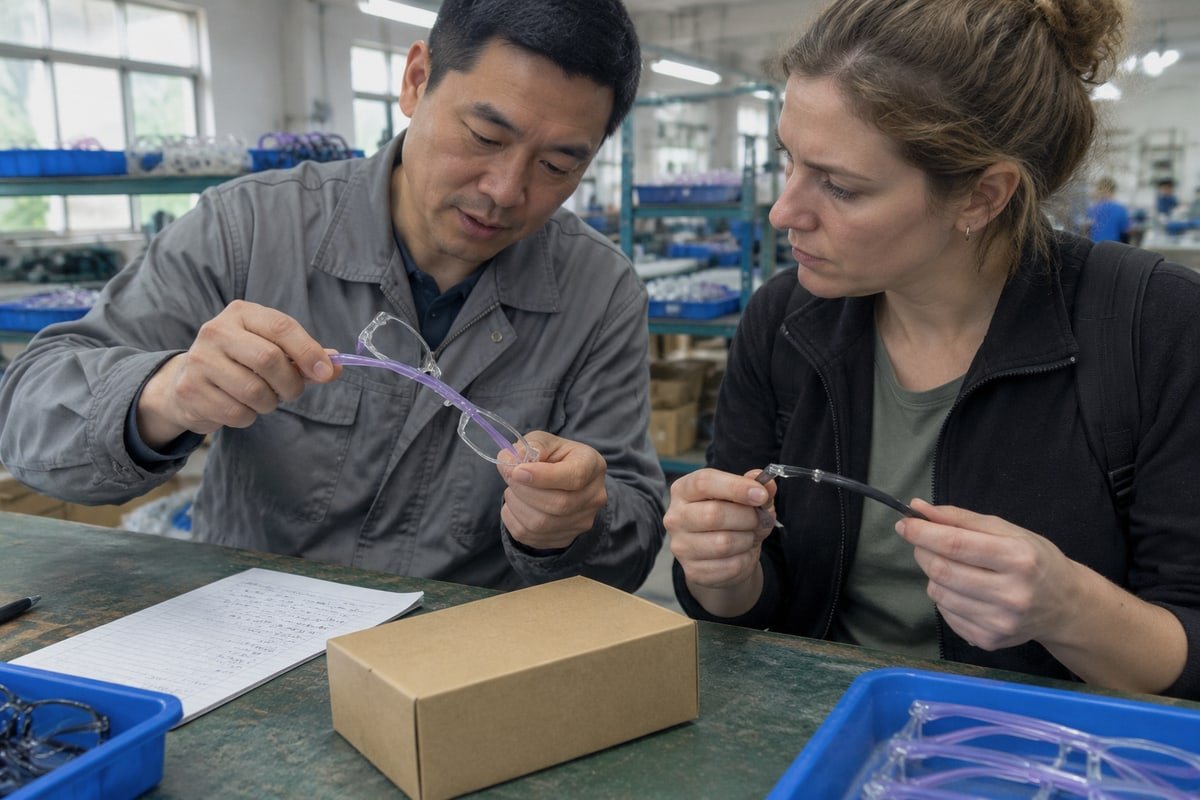
The hybrid is not a compromise. It is a way to put each material where it does its best work. Here is how the three options compare when we sit down with a brand to develop a new range.
| Property | Full TR90 frame | Full TPEE frame | TR90 front + TPEE temples |
|---|---|---|---|
| Lens shape and alignment | Excellent | Fair, can twist | Excellent |
| Temple flexibility | Good | Excellent | Excellent |
| Weight | Very light | Light | Very light |
| Skin feel | Smooth, slightly firm | Soft, rubber-like | Firm front, soft temples |
| Impact resistance | High | High | High, with better lens retention |
| Typical age fit | School age and up | Toddlers and preschool | Toddlers through school age |
Why the front is TR90
The front has one job. It must hold the lens in position so the optical center stays where the optometrist put it. Grilamid TR90 does this well. It is light, has shape memory, and is far less likely to crack than acetate. It also accepts translucent and crystal-clear finishes that brands love for a modern, minimalist look.
Why the temples are TPEE
Temples take the abuse. Children pull them open with one hand, push glasses up by the corner, and sleep on them. Thermoplastic polyester elastomer bends repeatedly without snapping. It is softer against the skin behind the ear. It also molds well into looped ear hooks and rubberized tips that keep the frame in place during play. In our two-shot designs, TPEE is also applied to the inner temple and nose pad areas. That improves comfort on sensitive skin and adds slip resistance.
Age-based choices we discuss with brands
- Toddlers and preschool: Softer full-TPEE frames are often preferred, because the child is small and the frame gets bent constantly.
- Early school age: The TR90 front with TPEE temples is the sweet spot. The lens stays stable for reading, and the temples still forgive rough handling.
- Older children: Full TR90 becomes practical, since the child is more careful and wants a more structured shape.
The business reason
There is also a practical reason brands come to us for this combination. Developing a two-shot mold from scratch is expensive. We already hold around 800 existing styles, many of them TR90 fronts with TPEE temples. A new brand can pick from those, add custom colors and a logo, choose UV400 or polarized lenses, and launch with retail-ready packaging without heavy mold investment. That lowers the risk of testing a market. It is the difference between buying cheap sunglasses and building a children's eyewear line you can stand behind.
Conclusion
A split temple costs a brand trust it cannot buy back. TR90 and TPEE combined in kids optical frames stay together when the process is controlled. Ask for the checks.
Interested in sourcing the products mentioned in this article? See details and request a quote here:
Footnotes
1. Technical resource explaining the importance of melt temperature in thermoplastic overmolding processes. ↩︎
2. Official manufacturer documentation for Grilamid TR90, highlighting its shape memory and durability. ↩︎
3. Authoritative product page for high-performance thermoplastic polyester elastomers used in flexible components. ↩︎
4. Scientific overview of chemical bonding principles relevant to material fusion in manufacturing. ↩︎
5. International standard for ophthalmic optics, specifying requirements and test methods for spectacle frames. ↩︎
6. Official FDA resource for medical device safety and material compliance standards. ↩︎
More Articles You Might Like

Looking for a Reliable Kids Eyewear Partner?
Explore 800+ ready styles and full OEM/ODM support tailored to your brand.
Get in Touch English
 Español de México
 Deutsch
 Français
 日本語
 العربية
 Português do Brasil