What Are TR90’s Properties and Why Is It Ideal for Kids’ Optical Frames?

Kids’ optical frames keep snapping at the bridge, and every return costs your brand trust. That is why our Taizhou production line studied TR90’s properties so closely years ago.
TR90’s properties are lightweight construction, shape memory flexibility, strong impact resistance, heat and moisture stability, and a hypoallergenic, BPA-free profile. This thermoplastic polyamide bends instead of snapping, weighs little on a child’s nose, and resists sweat and warping, making it ideal for kids’ optical frames that face rough use.
In this article I will explain what TR90 is, how it behaves under real stress, whether it is safe for young skin, and how it compares with TPEE. I will also point out where the marketing claims go too far.
What Makes TR90 Different From Regular Plastic Frame Materials?
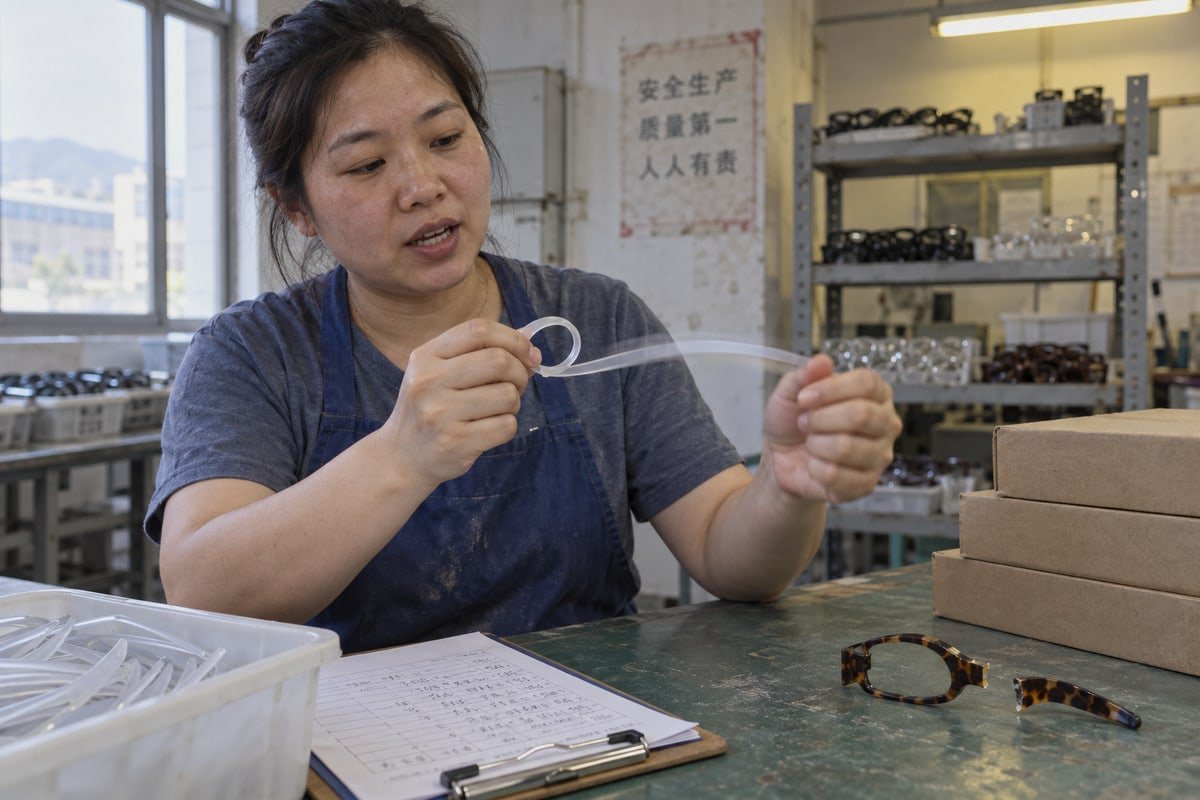
During an incoming-material check last spring, one of our technicians bent a TR90 temple blank double and let it go. It sprang straight. Acetate would have cracked.
TR90 differs from regular plastic frame materials because it is a thermoplastic polyamide, Grilamid TR 90, from Swiss maker EMS-Grivory. It offers shape memory, density near 1.00 g/cm³, low water absorption, and high heat resistance, so it bends and recovers where acetate or cheap PC cracks or warps.
A Memory Plastic in Plain English
TR90 is the trade name for Grilamid TR 90. It is a transparent polyamide resin 1 developed with Swiss technology by EMS-Grivory. In simple terms, it belongs to the nylon family. It is a thermoplastic material, which means we can melt it, inject it into a mold, and it holds a stable structure once it cools.
The polymer chains 2 inside TR90 are long and flexible. When a child bends a temple, those chains slide and stretch. When the child lets go, the chains pull back to their resting position. That is why the trade calls it memory plastic. Regular injection plastics used in cheap frames do not have this recovery behavior. They either stay bent or they snap.
How TR90 Compares With Common Frame Materials
| Property | TR90 | Cellulose acetate | Basic polycarbonate | Metal alloy |
|---|---|---|---|---|
| Density | About 1.00 g/cm³ | Heavier | Heavier | Heaviest |
| Bend behavior | Flexes and recovers | Cracks under sharp bending | Stiff, can stress-whiten | Bends and stays bent |
| Heat resistance | High, resists warping | Can warp in a hot car | Moderate | High |
| Water absorption | Very low | Absorbs moisture over time | Low | None, but can corrode |
| Color method | Molecular dyeing through the resin | Laminated sheet | Often surface coating | Plating |
| Allergy risk | Low, nickel-free | Low, but plasticizers vary | Low | Nickel is a known trigger |
Color That Goes All the Way Through
One difference buyers rarely notice until a frame is scratched is how the color is applied. Surface-painted frames show a contrasting base color when the coating chips. TR90 uses molecular dyeing. The pigment is mixed into the resin before molding, so a deep scratch shows the same color underneath.
This is why our crystal-clear fronts and gradient purple-to-lavender temples keep their look after a school year of abuse. In our workshop, we check color consistency between resin batches before we release a run, because a gradient temple exposes any color drift immediately.
One honest note: some online sources quote extreme temperature limits or exact frame weights as universal facts. I treat those as manufacturer claims. The material data that matters is the resin sheet, and finished frame behavior always depends on wall thickness and design.
Why Should I Trust TR90's Flexibility and Durability for Active Kids?
Every frame design forces a choice between stiffness and flexibility. We could make TR90 fronts thinner to save weight, but then the lens groove loses grip. We test each thickness.
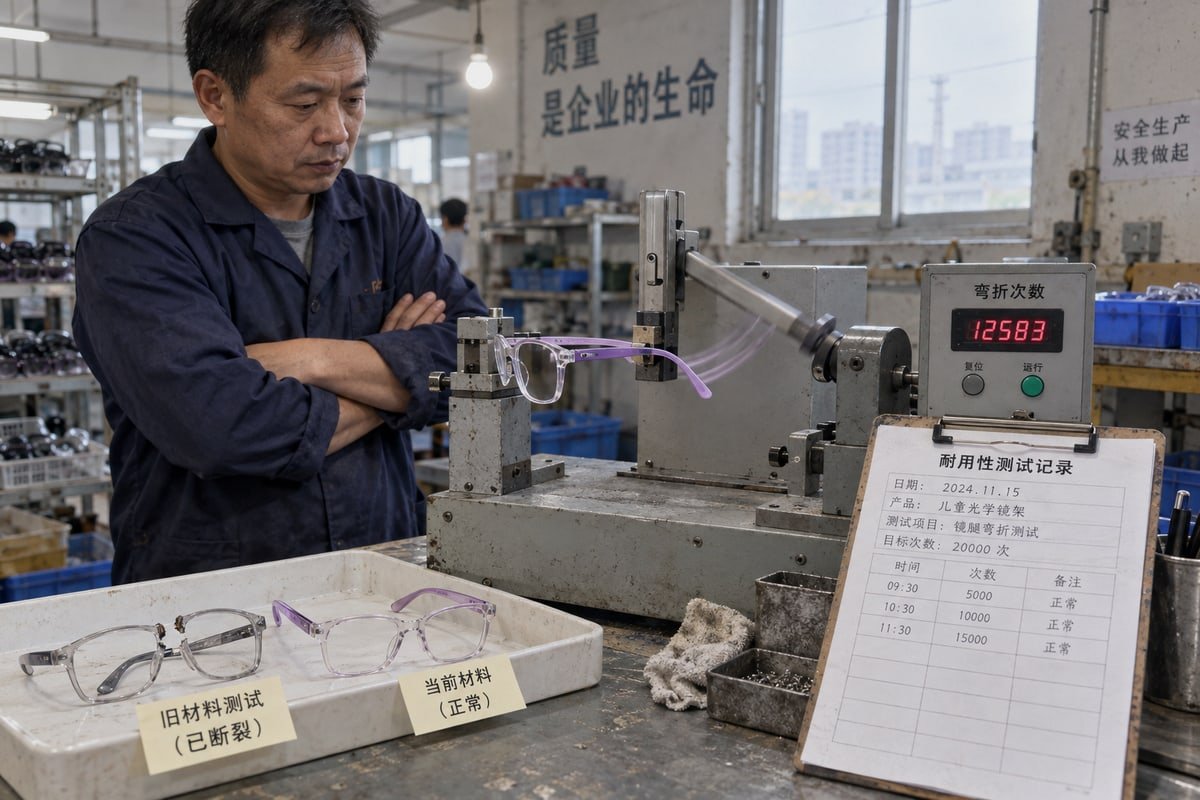
You can trust TR90's flexibility and durability because the memory plastic bends far past normal stress and returns to shape, rather than snapping. Its impact resistance means it flexes on drops and twists instead of shattering. Still, it is not indestructible; hinge quality, frame design, and lens fit decide lifespan.
What Happens When a Child Sits on the Frame
Here is the sequence I explain to buyers who visit our factory:
- The child's weight lands on the front and temples at once.
- TR90's elastic modulus lets the front spread outward instead of concentrating the load at the bridge.
- The energy is absorbed across the whole frame, not at one weak point.
- The child stands up and the load disappears.
- The polymer chains pull the frame back toward its original shape.
This cycle can repeat many times. A brittle frame fails at step two. That is the practical meaning of impact resistance for a parent.
Real Stress Scenarios We Design For
| Scenario | Brittle frame result | TR90 behavior | Design detail we add |
|---|---|---|---|
| Dropped on tile | Cracks at bridge or lens corner | Flexes, absorbs the shock | Rounded corners, no sharp angles |
| Twisted while pulling off | Hinge rips or temple snaps | Temple bends and recovers | Perforated dot pattern along temple for extra flex |
| Stuffed in a backpack | Permanent warp | Returns to shape | Thicker front for lens retention |
| Ball impact during sport | Shatters, injury risk | Flexes away from face | Looped ear hooks keep frame in place |
| Toddler chews temple tip | Tip cracks | Holds up, though softer TPEE tips do better | TPEE temple tips on hybrid styles |
Where Durability Actually Fails
TR90 has good tensile strength 3, so the material itself is rarely the weak link. Failures we see in returns come from three places: cheap screws, poorly aligned hinges, and lenses forced into a groove that is too tight. The last point matters for optical frames. Rigid materials squeeze the lens, and over months that pressure causes stress crazing in the prescription lens. TR90's elasticity allows tension-free lens mounting, so the lens sits without being crushed.
The polymer also dampens vibration. During running or jumping, micro-shocks travel through the frame. A material that absorbs them reduces the small jolts a child feels around the eyes. I would not call this a medical benefit, but our fitters do notice that kids complain less about "bouncing" glasses in TR90.
"Virtually shatterproof" is a phrase I use carefully. The frame flexes, yes. The lens is a separate question. For active kids we always recommend polycarbonate or similar impact-rated lenses with TR90 fronts.
Is TR90 Safe and Comfortable Enough for My Children's Eyewear Line?
A procurement manager from Australia once asked me a blunt question: will this frame give a toddler a rash? I told her what we know and what we do not.
Yes, TR90 is safe and comfortable enough for a children's eyewear line. It is nickel-free, a BPA-free material, and widely regarded as hypoallergenic, so skin reactions are rare. Finished frames often weigh around 15–20 g, easing nose and ear pressure. Treat hypoallergenic as lower risk, not a guarantee.

Hypoallergenic Properties, Explained Honestly
Most eyewear skin reactions come from two sources: nickel in metal alloys 4 and additives in low-grade plastics. TR90 removes both. It contains no nickel, and it is a BPA-free material. The resin is chemically stable, so it does not leach plasticizers onto the skin the way some soft plastics do. This stability is what people mean when they talk about the biocompatibility of TR90.
Still, I never tell a buyer that a material is "100% hypoallergenic 5." No material is. A small number of children react to almost anything. What I can say is that in fifteen years of making children's eyewear, TR90 and TPEE have given us the fewest skin complaints of any materials we have used. We also support buyers in meeting the testing requirements of their own markets, whether that is Australia, Japan, or Europe.
Weight and Why Compliance Follows
A child's nose bridge is still developing. Heavy frames press on soft tissue and leave marks. Several sources claim TR90 frames weigh up to 50% less than comparable acetate or metal frames. I would not promise that exact figure for every design, but the direction is right. Our finished TR90 kids optical frames typically land in the 15–20 g range, depending on size and lens.
Weight is not just comfort. It is compliance. Children who forget they are wearing glasses keep them on. Children who feel pressure take them off at recess and lose them. Lightweight construction solves a behavioral problem, not just a physical one.
Heat, Sweat, and Humidity
| Condition | Risk to ordinary plastic | TR90 behavior | Our note |
|---|---|---|---|
| Hot car dashboard | Warps and loses fit | Heat deflection temperature roughly 115–135°C by test load; short-term tolerance around 120°C | Resin data, not a promise for every frame shape |
| Sweat, skin oils, sunscreen | Becomes sticky, brittle, or discolored | Resists these chemicals | We test tips against sunscreen residue |
| Humidity and saliva | Swells, loosens lenses | Very low water absorption, holds shape | Important for toddlers who mouth their temples |
| Cold weather | Becomes brittle | Stays flexible | Relevant for European winter markets |
Some sellers claim TR90 survives extreme heat with zero deformation. The resin data supports high heat resistance, but a thin temple left on a black dashboard in summer can still move. I prefer to give buyers the tested ranges and let them design with margin.
How Do I Choose Between TR90 and TPEE for My Kids' Optical Frames?
One lesson took us years to learn: the front and the temples do not need the same material. Many of our 800 styles now pair TR90 fronts with TPEE temples.
Choose TR90 for kids' optical frames when you need a rigid-enough front that holds prescription lenses securely, stays lightweight, and resists heat. Choose TPEE when you want softer, rubber-like temples that wrap around small ears. For most optical lines, a TR90 front with TPEE temples gives the best balance.
| Factor | TR90 | TPEE |
|---|---|---|
| Material type | Polyamide thermoplastic | Thermoplastic polyester elastomer |
| Feel in hand | Firm but flexible, glossy | Soft, rubbery, often matte |
| Best use | Fronts and full optical frames | Temples, ear tips, baby sunglasses |
| Prescription lens retention | Excellent | Moderate; front can be too soft for heavy Rx |
| Heat resistance | High | Good, but softer at high heat |
| Weight | Very light | Very light |
| Ear comfort | Good | Excellent, grips without pressure |
| Look | Translucent, crystal finishes possible | Solid, matte colors |
A Simple Decision Checklist
- Age group. Under three, I lean toward more TPEE. School age, TR90 fronts.
- Lens type. Real prescriptions need a TR90 front to hold the lens groove. Plano or sun lenses can go softer.
- Activity level. Sports-heavy kids benefit from TPEE temples with looped ear hooks that stay put.
- Aesthetic. If your brand wants a crystal-clear or translucent front, that is TR90. Matte pastel temples are TPEE.
- Mold budget. If you are a new brand, start from an existing style and change colors before you invest in tooling.
The Hybrid Route We Recommend Most
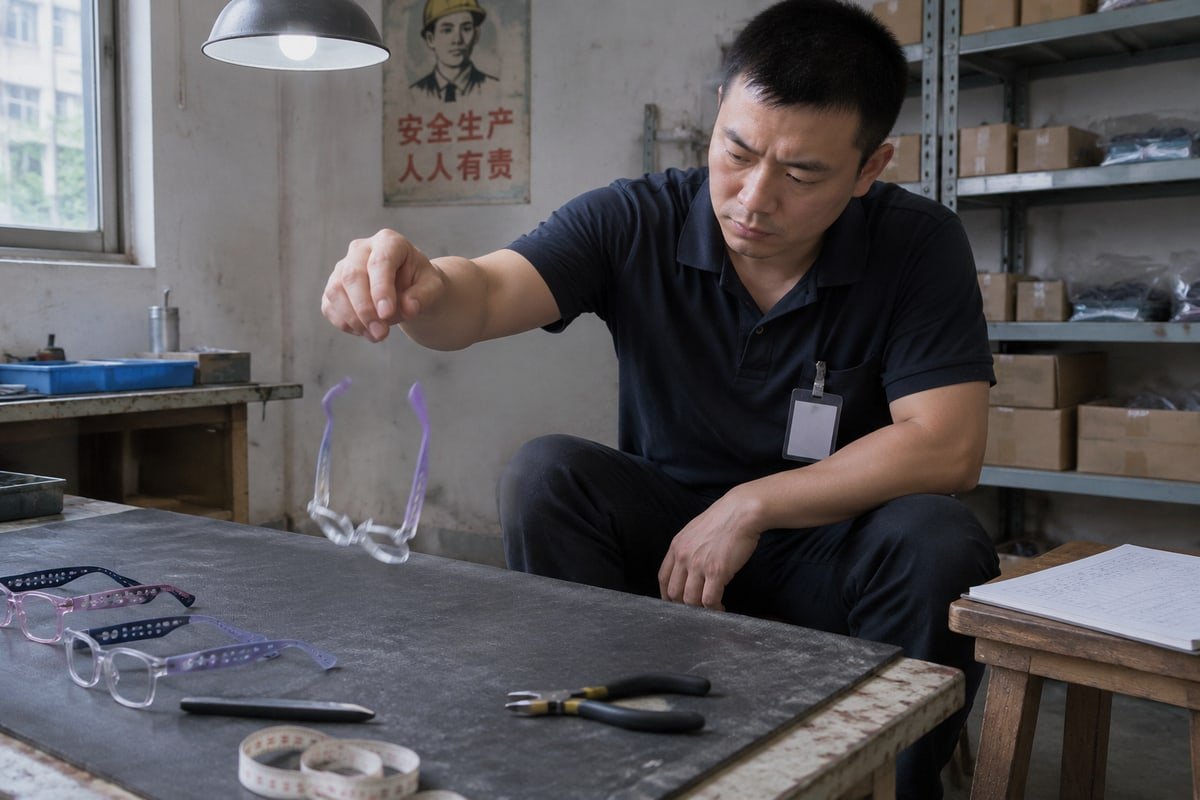
Look at two of our current styles. The first has a translucent crystal TR90 front with rounded rectangular lenses. Its temples fade from white at the hinge to solid purple at the tips, with a perforated dot pattern for flex and looped ear hooks in soft TPEE. The second has a light blue semi-transparent front and matte opaque blue temples with rubberized tips. In both, the TR90 front does the structural work and the TPEE temple does the comfort work.
This hybrid is why we can offer around 800 existing styles without asking a new importer to fund molds. A buyer picks a frame, we adjust colors, add a logo, choose UV400 or polarized lenses where needed, and design retail-ready packaging. Our workshop runs on 5S principles with about 120 workers, so the same frame looks the same in the tenth shipment as in the first. That consistency is what our buyers across more than twenty countries actually pay for.
When Another Material Still Wins
I will be direct. Acetate still has a premium hand feel that some teen fashion lines want, and metal suits certain narrow fits. TR90 is strongest when the priority is lightweight durability for children. If your line is for kids who run, fall, and sit on their glasses, TR90 with TPEE temples is the sweet spot. If your line is a fashion statement for older teens, we can talk about other options.
Conclusion
Broken kids' optical frames cost brands returns and trust. TR90's properties—light, flexible, heat-stable, skin-friendly—solve that. Pair it with TPEE temples and a partner who knows both.
Interested in sourcing the products mentioned in this article? See details and request a quote here:
Footnotes
1. Official technical documentation from the manufacturer of Grilamid TR 90, the original TR90 material. ↩︎
2. Scientific overview of polymer structures that provide the flexibility and shape memory found in TR90. ↩︎
3. International standard (ISO 527-1) for determining the tensile properties and mechanical strength of plastics. ↩︎
4. Medical research from the NIH database detailing nickel allergy as a primary cause of contact dermatitis. ↩︎
5. Updated FDA URL (pluralized ‘cosmetics’) explaining that there are no federal standards for the term. ↩︎
More Articles You Might Like



Looking for a Reliable Kids Eyewear Partner?
Explore 800+ ready styles and full OEM/ODM support tailored to your brand.
Get in Touch English
 Español de México
 Deutsch
 Français
 日本語
 العربية
 Português do Brasil