What Dangerous Behaviors Should Kids Avoid When Wearing Eyewear?

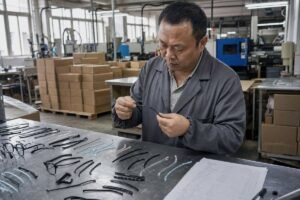
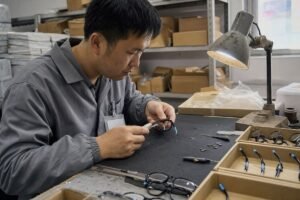
Dangerous behaviors 1 kids show while wearing eyewear worry every parent and every buyer I meet. On our production line in Taizhou, broken sample frames 2 tell the same story: children play hard, fall often, and treat glasses like toys. When a rigid frame snaps at face level, the eyewear itself 3 becomes the hazard. That is why our team designs every kids’ frame around one question: what will a child actually do with it?
Kids wearing eyewear should avoid rough face-level play, playing impact sports in regular glasses instead of sports safety goggles, staring at the sun or lasers, wearing bent or ill-fitting frames, using non-breakaway straps, and removing prescribed eyewear during risky activities like yard work or science projects.
These behaviors matter to parents. But they matter just as much to anyone building a children’s eyewear brand. Design, materials, and standards decide how forgiving a frame is when a child ignores the rules. Let me walk you through what we have learned.
What safety risks should I know about before choosing frame materials for my kids' eyewear line?
A buyer from Australia once sent us a competitor's frame that had cracked into two sharp halves after a playground fall. Our engineers still keep it on the sample shelf as a reminder.
The main material risks are brittle fracture creating sharp edges, rigid frames transferring impact force to the face, allergenic or non-compliant plastics irritating skin, weak hinge points snapping under twisting, and lens materials that shatter instead of flexing on impact.
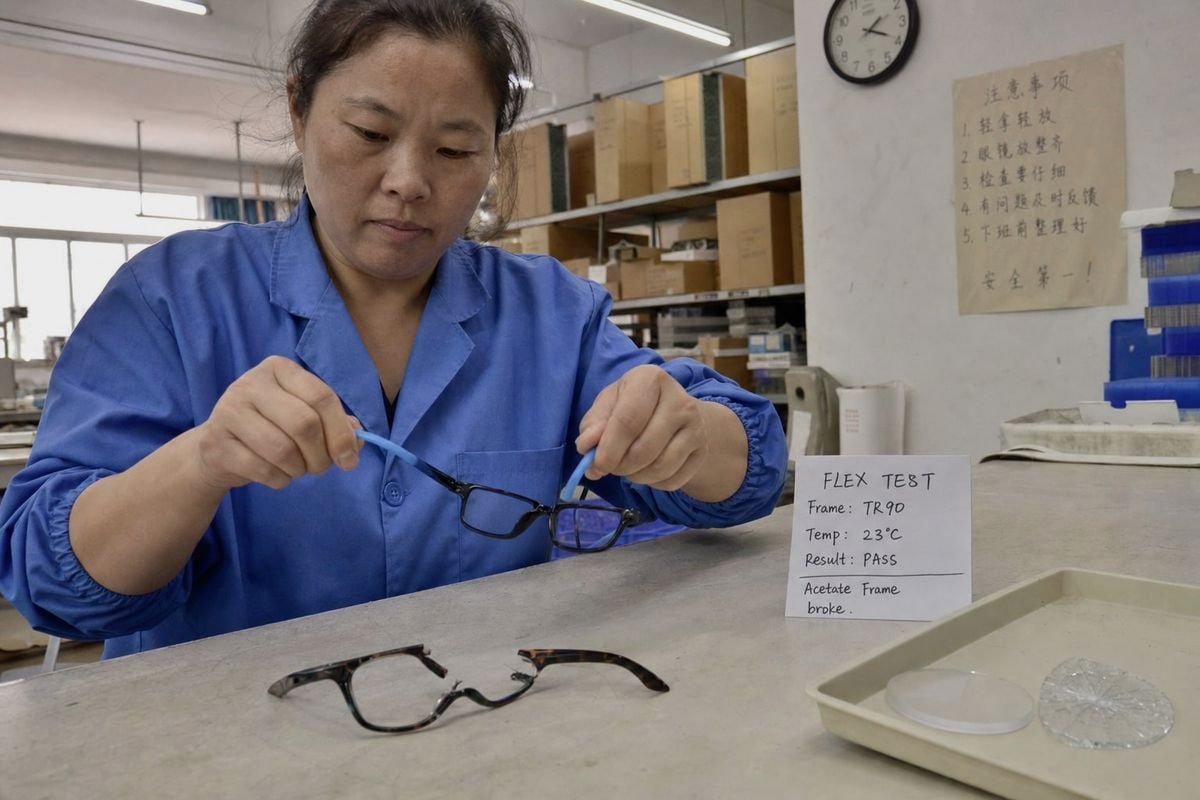
Material choice is the first safety decision, and it happens long before a child ever behaves badly with a pair of glasses. In our fifteen years of making children's frames, almost every field failure we have analyzed traces back to one of three causes: a brittle plastic, a stressed hinge, or a lens that was never impact-rated.
The brittleness problem
Cheap acetate and generic injection plastics 4 look fine in a photo. But they age, dry out, and turn brittle. When a child sits on them or takes a ball to the face, they do not bend. They snap. And a snapped frame at eye level means sharp edges near the cornea. This is the single biggest eye injury prevention issue in low-cost kids' eyewear.
Lens material matters as much as the frame
Polycarbonate lenses are the industry baseline for children because they are shatterproof materials 5 by design. Standard CR-39 or glass lenses have no place in an active child's daily frame. When we spec a kids' optical frame, we assume the lens will take hits.
| Material | Impact behavior | Typical risk for kids | Our verdict |
|---|---|---|---|
| Generic PC injection frame | Cracks under stress | Sharp fracture edges | Avoid for toddlers |
| Acetate | Brittle with age | Snapping at the bridge | Use with caution |
| TR90 | Flexes and returns | Low fracture risk | Strong choice |
| TPEE | Bends almost flat | Very low injury risk | Best for young kids |
| Silicone components | Soft, grippy | Minimal | Ideal for temple tips |
Also check chemical safety. Frames touch a child's skin for hours daily. We only use environmentally friendly, skin-safe compounds, and we advise every buyer to demand material test reports, not just verbal promises.
How can I design my products to prevent common accidents like snapping or lens popping during active play?
There is a trade-off we weigh on every new style: the more decorative and angular a frame is, the more stress points we build into it. Safety usually wins that argument in our design room.
Prevent snapping and lens popping by using flexible hinge frames, deep lens grooves with secure bevel retention, reinforced bridge geometry, soft rounded edges, breakaway straps instead of rigid lanyards, and impact-resistant frames that flex under load rather than concentrating stress at weak points.
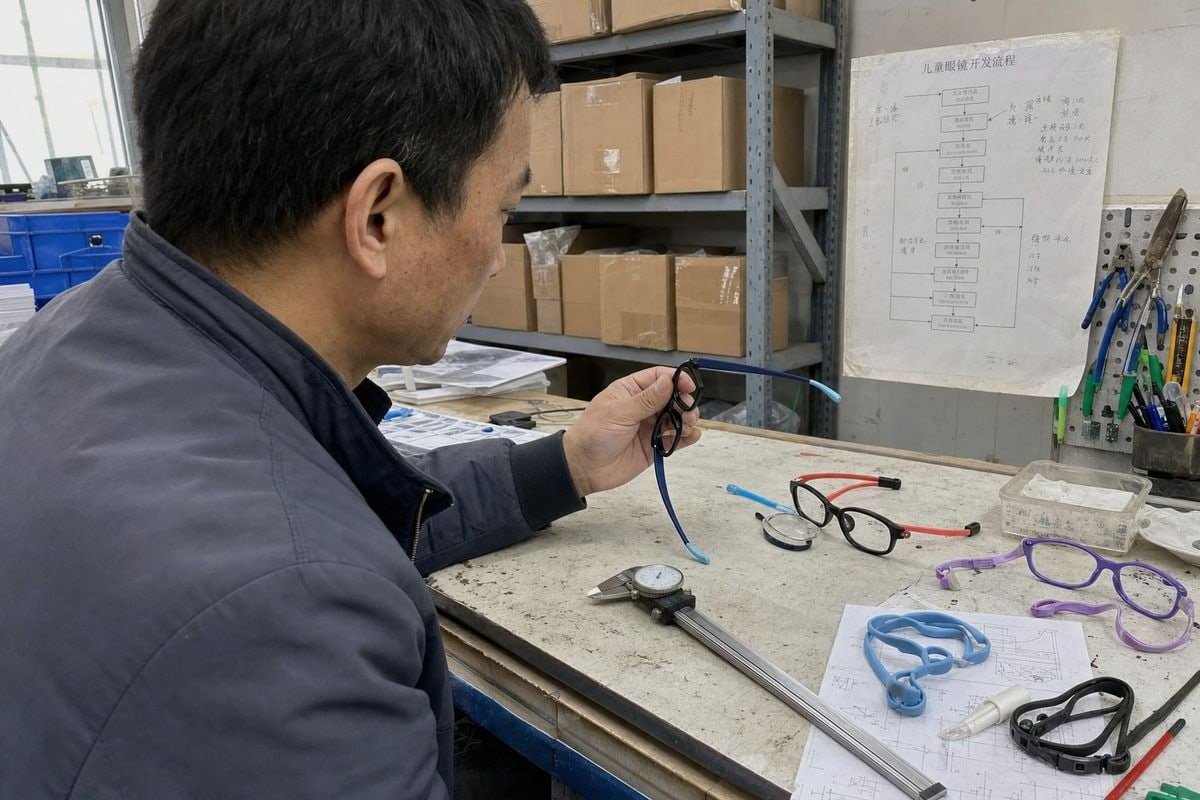
Design is where behavior meets engineering. You cannot stop a seven-year-old from wrestling with a sibling. But you can design a frame that survives it. Here is the process we follow when developing a new children's style, whether it is a wayfarer-style optical frame with two-tone silicone temples or a wraparound sports shield.
- Map the failure points first. Bridge, hinge, and lens groove. Almost all breakage happens at these three spots. We reinforce the bridge cross-section and avoid sharp internal corners where cracks start.
- Choose flex over stiffness. Flexible hinge frames absorb twisting when a child pulls the glasses off with one hand. Rigid metal hinges on kids' frames loosen, then fail.
- Lock the lens in properly. Lens popping usually comes from shallow grooves or loose tolerances. We cut a deeper bevel groove and control tolerance tightly so lenses stay seated even when the frame flexes.
- Round every edge. No sharp corners on temple tips, no exposed screw ends near the skin. Proper frame fit also means temples that grip gently without pressure points, because ill-fitting frames slide, and sliding frames get grabbed, bent, and broken.
- Rethink the strap. Non-breakaway lanyards are a genuine snagging and strangulation risk on playgrounds. If a style needs retention, we specify breakaway designs.
One more design detail buyers overlook: scratched lens hazards. A child who sets glasses lens-down every day ends up looking through haze, which causes eye strain and slower reactions. Hard coatings and a simple case included in retail-ready packaging quietly solve a real safety problem.
What certifications or safety standards should I look for when sourcing children's eyewear from a manufacturer?
Early in my export career, a European client rejected an otherwise perfect shipment over missing documentation. That lesson shaped how our factory handles compliance today: paperwork travels with the product, always.
Look for CE and EN ISO 12312-1 for sunglasses in Europe, ANSI Z80.3 and FDA impact requirements for the US, ASTM F803 standards for sports safety goggles, UV400 lens verification, and chemical safety testing on frame materials that contact children's skin.
Certifications are not decoration. They are the dividing line between eyewear that protects and eyewear that merely covers the eyes. And they map directly to the dangerous behaviors we discussed above. A child staring at bright sunlight in toy sunglasses with dark tint but no certified UV filter is actually worse off, because dilated pupils let more harmful rays reach the retina.
Match the standard to the intended use
This is the most common sourcing mistake we see. A regular optical frame, however well made, is not contact sports protection. Sports with balls, bats, or sticks 6 require eyewear built and tested to ASTM F803 standards. Telling parents that glasses on equals protection on is simply wrong, and your product labeling should never imply it.
| Product type | Key standards to verify | What it protects against |
|---|---|---|
| Kids' sunglasses | EN ISO 12312-1, CE, UV400 verification | UV retinal exposure, basic durability |
| Kids' optical frames | ANSI Z80.3, FDA impact rules, skin-safety tests | Everyday impact, chemical contact |
| Sports safety goggles | ASTM F803 | Ball and racket sports impacts |
| Safety glasses for chores or labs | ANSI Z87.1 class equivalents | Flying debris, splashes |
Verify the factory, not just the certificate
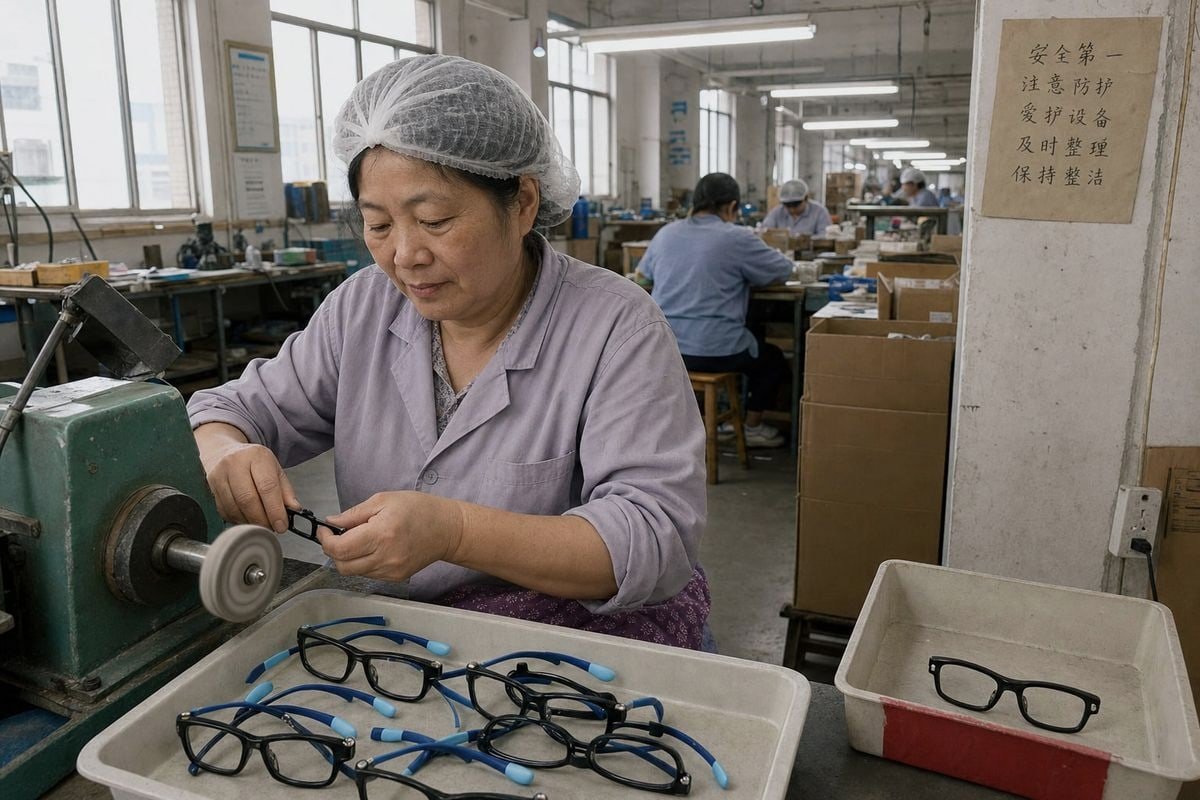
Ask for recent third-party test reports tied to the actual production batch. Visit or audit the workshop if you can. Our 5S-managed facility runs incoming material checks and in-line QC precisely because a certificate from two years ago says nothing about the frames shipping to you next month. A serious partner will welcome those questions.
Can flexible materials like TPEE and TR90 really reduce injury risks compared to rigid frames?
Skeptical buyers ask us this often, usually while bending one of our sample temples into a near-circle across the meeting table. Watching the temple spring back answers half the question on its own.
Yes. TPEE and TR90 flex and absorb impact energy instead of fracturing, which prevents the sharp broken edges rigid frames produce. They return to shape after bending, resist snapping during rough play, and stay comfortable, so children actually keep their glasses on.
Let me address the honest objection first: flexibility alone does not make dangerous behavior safe. A child in a flexible frame should still avoid roughhousing, projectile toys, and staring at lasers. Eyewear is protection, not permission. But when accidents happen anyway, and with kids they will, the material determines whether the frame bends or becomes a hazard.
How flexible materials change the physics
A rigid frame hit by a ball transfers force in two bad ways. It concentrates stress until the plastic fractures, and it presses hard edges into the child's face. TR90, a thermoplastic memory material, deforms under that same load and springs back. TPEE goes further; it can fold nearly flat. In our drop and flex testing, this is the difference between a frame you pick up and a frame you throw away with a wince.
| Behavior scenario | Rigid frame outcome | TR90/TPEE frame outcome |
|---|---|---|
| Child sits on glasses | Bridge snaps | Frame flexes, recovers |
| Ball impact at play | Fracture, sharp edges | Deformation, no shards |
| One-hand pull-off | Hinge cracks over time | Temple flexes safely |
| Sibling grabs frame | Temple breaks | Frame bends, returns |
Comfort is a hidden safety feature
Here is the point buyers underestimate. The most dangerous behavior of all is a child refusing to wear needed glasses, often because of teasing or discomfort. Lightweight, flexible frames with soft silicone tips, like our TR90 fronts 7 paired with TPEE temples, remove the discomfort excuse. A frame kids forget they are wearing is a frame that keeps protecting their vision and their development. That is why our whole catalog of roughly 800 existing styles is built on these materials, and why we let brands customize colors and finishes kids genuinely want to wear.
Conclusion
Kids will roughhouse, drop frames, and forget the rules. Smart material choices, protective design, and verified standards turn those dangerous behaviors into survivable moments. Our team is here to help you build that safety in.
Footnotes
1. Expert advice on protecting eyes from UV radiation. ↩︎
2. CDC resource on preventing vision loss and eye injuries. ↩︎
3. General information on the structure and materials of eyeglass frames. ↩︎
4. Technical overview of the injection molding process used for plastic frames. ↩︎
5. AAO recommendations for protective eyewear in children. ↩︎
6. Authoritative guide on sports eye safety and recommended protective gear. ↩︎
7. Information on Nylon 12, the base material for TR90 eyewear. ↩︎
More Articles You Might Like
Looking for a Reliable Kids Eyewear Partner?
Explore 800+ ready styles and full OEM/ODM support tailored to your brand.
Get in Touch English
 Español de México
 Deutsch
 Français
 日本語
 العربية
 Português do Brasil