How Can Outgrown Kids Eyewear Be Recycled or Repurposed?
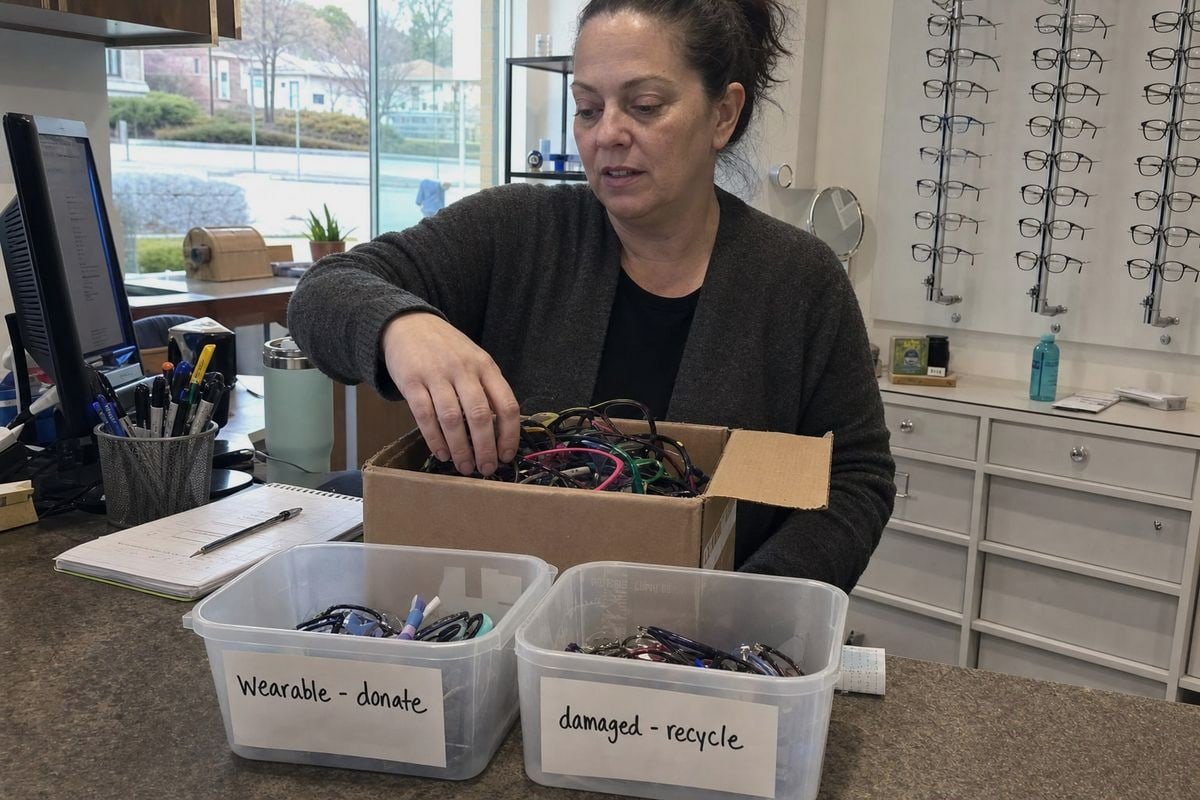
Outgrown kids eyewear piles up fast — our Taizhou factory hears this from buyers constantly OneSight EssilorLuxottica Foundation 1. Children replace frames yearly, and most of those frames end up in landfills unnecessarily.
Outgrown kids eyewear can be donated for reuse through programs like Lions Club Recycle For Sight, recycled by material via take-back or mail-in recycling programs, or repurposed into spare pairs, crafts, and salvaged parts. Wearable frames should be donated first; damaged frames should be recycled or upcycled.
Let me walk you through the practical options, from material-level recycling to brand-level take-back programs. Each path has real value for parents and for the brands that serve them.
What Materials Are Safe to Recycle in TPEE and TR90 Kids Eyewear?
During a recent material audit in our 5S-managed workshop, we mapped exactly which components of our TPEE and TR90 kids frames can re-enter a recycling stream. The answer surprised even some of our own team.
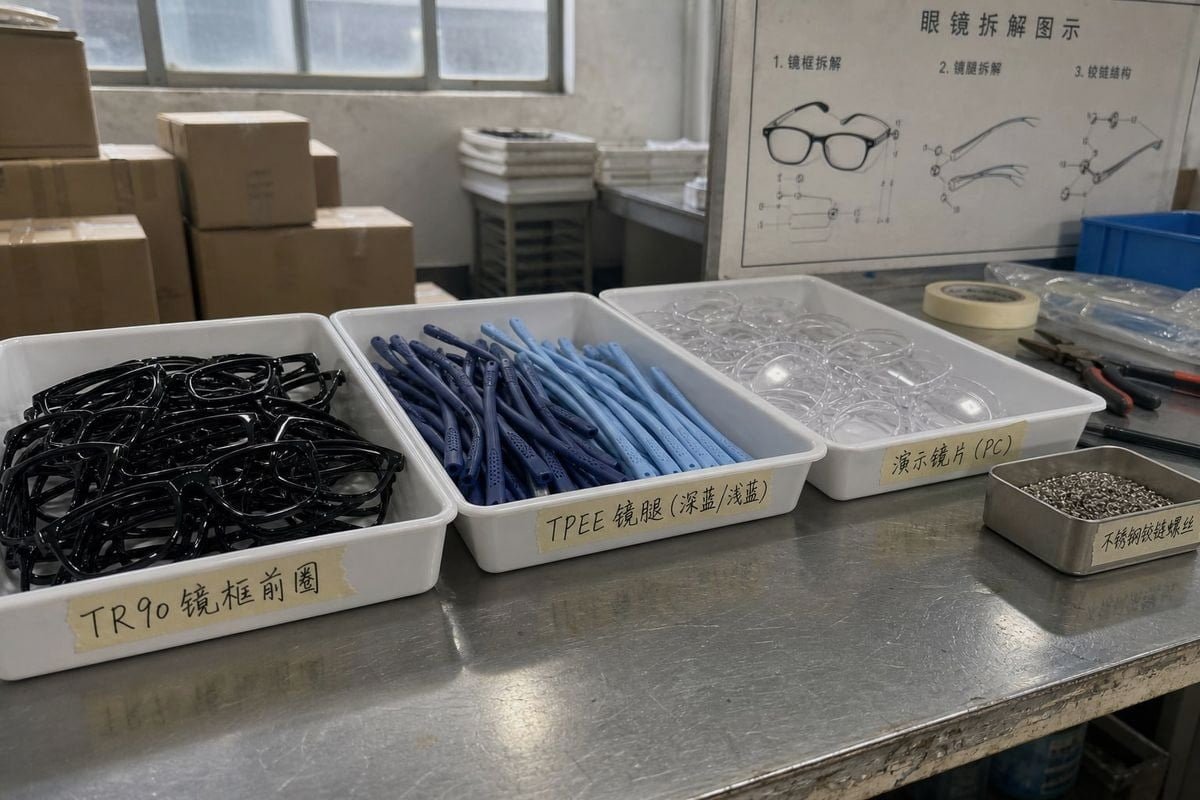
TR90 (a thermoplastic polyamide) and TPEE (a thermoplastic elastomer) are both remeltable thermoplastics, making frame fronts and temples safe to recycle where facilities accept engineering plastics. Lenses, metal hinges, and screws must be separated first, because mixed-material eyewear cannot go into curbside bins.
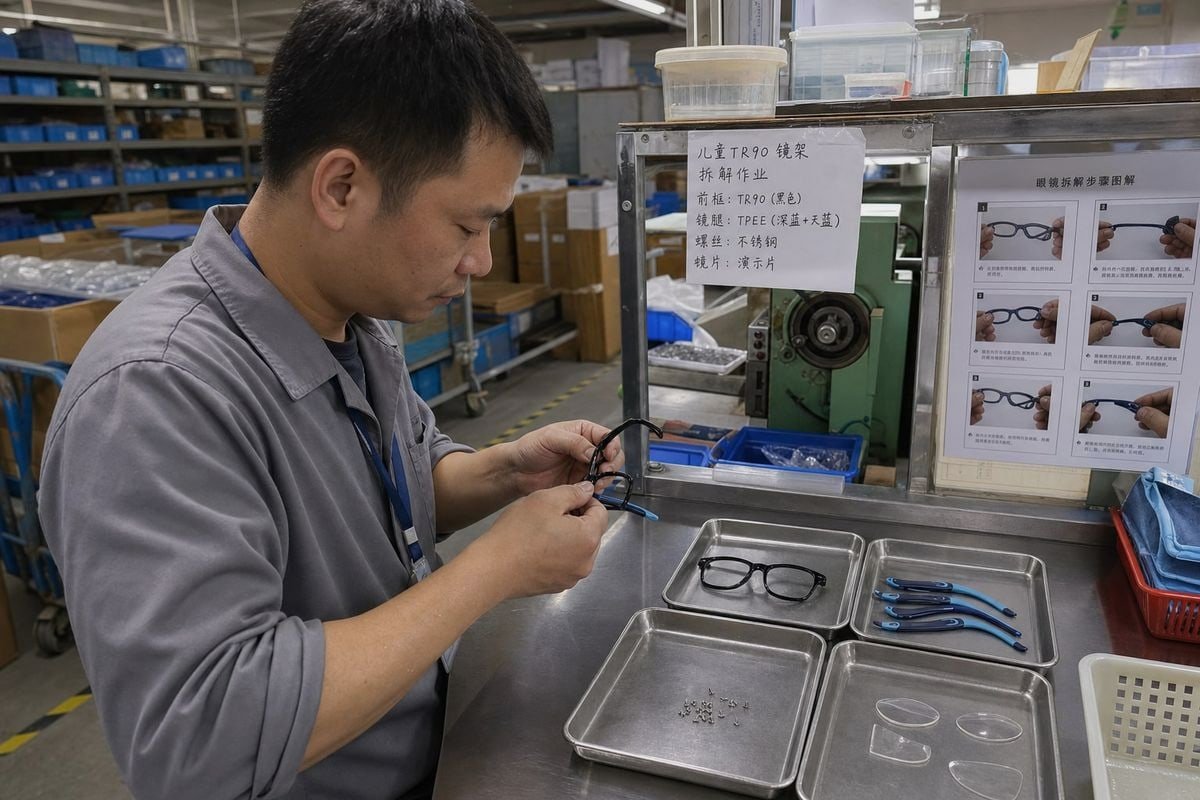
The key concept here is that eyewear is a composite product. A single pair of children's glasses contains at least three material streams: the plastic frame, the lenses, and small metal hardware. Recycling only works when those streams are separated. In our experience developing frames with TR90 fronts and TPEE temples, we deliberately keep metal content low — partly for child safety, and partly because fewer metal parts make end-of-life disassembly simpler.
How Each Component Behaves in Recycling
TR90 and TPEE are both thermoplastics. That means they can be melted down and reformed, unlike thermoset plastics 2 that burn instead of remelting. However, acceptance still depends on local facilities. Most curbside programs sort only common packaging plastics, so specialty plastics need mail-in recycling programs or manufacturer take-back channels.
Lenses are the difficult part. Polycarbonate lens recycling 3 is technically possible, but coatings, tints, and prescription surfacing complicate it. Many opticians offer prescription lens removal before donating or recycling a frame, which keeps privacy intact and cleans up the material stream.
| Component | Typical Material | Recyclable? | Best Route |
|---|---|---|---|
| Frame front | TR90 | Yes, as thermoplastic | Take-back or specialty recycler |
| Temple arms | TPEE or TR90 | Yes, as thermoplastic | Take-back or specialty recycler |
| Lenses | Polycarbonate or CR-39 | Difficult | Optician removal, specialty program |
| Hinges/screws | Stainless steel | Yes | Scrap-metal stream |
| Nose pads | Silicone | Rarely | Reuse as spare parts |
One important warning we always share with buyers: never tell customers to drop whole glasses into household recycling. Sustainable eyewear disposal starts with disassembly, not with a bin.
How Can I Set Up a Take-Back or Trade-In Program with My Manufacturer?
A European buyer once asked us during a sampling call whether returned frames could be ground back into raw material. That conversation turned into one of the most productive product-planning sessions we have had.
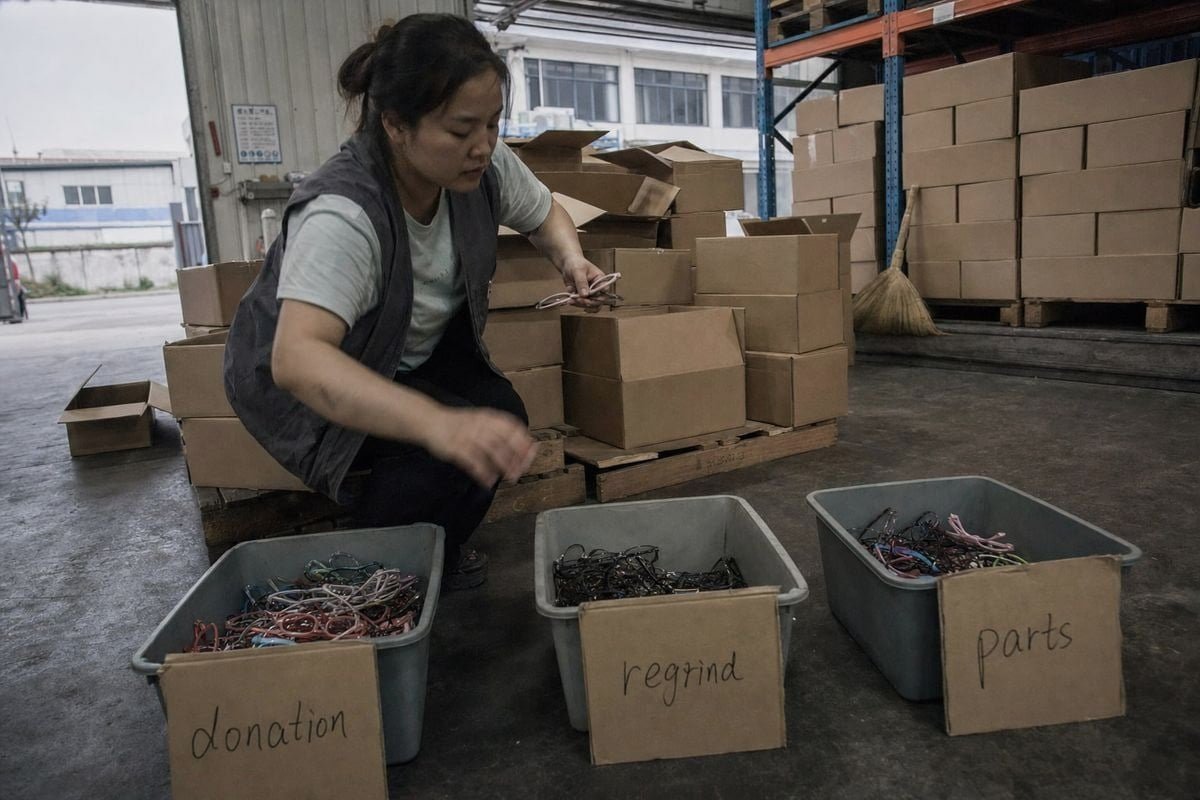
Start by asking your manufacturer to confirm material composition, design frames for easy disassembly, and agree on a return logistics route. Then structure the program as trade-in credit for customers, with collected frames sorted into donation, regrind, or parts-salvage streams.
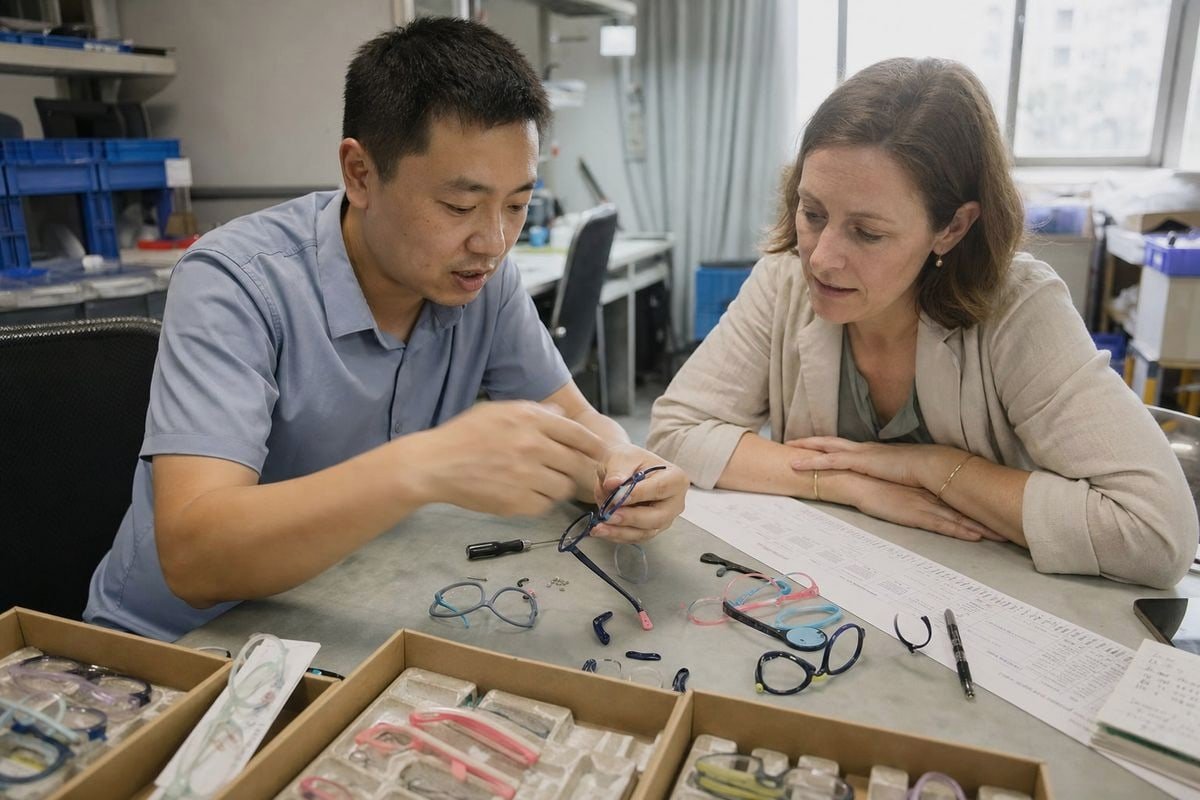
A take-back program sounds complicated, but it breaks down into a clear sequence. From our side of the production line, here is the process we recommend to brands who source from our 800-style catalog.
A Five-Step Setup Process
- Confirm the material spec. Get written confirmation of frame materials from your supplier. A program built on TR90 and TPEE is simpler than one built on mixed acetate-and-metal frames.
- Design for disassembly. Ask for frames where lenses pop out cleanly and hinges use standard screws. We can adjust hinge and lens-groove details during OEM development so a returned frame comes apart in under a minute.
- Choose the collection route. In-store drop bins work for retail brands. Prepaid mail-back envelopes work for e-commerce brands. Both can feed the same sorting point.
- Define the sorting rules. Wearable frames go to donation partners such as New Eyes for the Needy 5 or local optician donation bins. Damaged frames go to regrind or parts salvage.
- Close the loop with incentives. Offer a small trade-in discount on the next size up. Children outgrow frames roughly every 12 to 24 months, so the incentive lands at exactly the right moment.
What the Collected Frames Become
Returned frames have three exits: redistribution to developing countries vision care programs, material regrind for non-optical products, and salvage of spring hinges, micro-screws, and temple tips as repair stock. Independent optical workshops focused on repair increasingly want that hardware, and school health offices welcome cleaned loaner pairs. The economics rarely pay for themselves directly. The payoff comes in repeat purchases and customer trust, which is exactly what a growing kids brand needs.
Can Recycling Programs Help Strengthen My Brand's Sustainability Story?
The trade-off we weigh most often with brand clients is this: sustainability messaging costs credibility if it is vague, but earns loyalty when it is specific. A recycling program gives you the specifics.
Yes. A visible recycling or donation program turns an abstract sustainability claim into a concrete, verifiable action. Parents trust brands that solve the outgrown-glasses problem, and take-back schemes generate repeat contact, trade-in sales, and authentic content for marketing.
Parents buying children's eyewear are unusually receptive to sustainability messaging, because the waste problem is visible in their own homes. A drawer of outgrown kids eyewear is a reminder every time it opens. When your brand offers the answer, you occupy a position competitors cannot easily copy with a lower price.
Some buyers push back: "Donation and recycling send mixed messages — which one do we promote?" Our answer is to promote a hierarchy, not a single action. Reuse preserves the most value, so donation comes first. Recycling is the honest fallback for damaged frames. Upcycling old frames into crafts, costume props, or ornaments is the creative last resort. Publishing that hierarchy openly makes your brand look thoughtful rather than opportunistic.
Proof Points Parents Recognize
Anchor your story to known programs. Lions Club Recycle For Sight 6, VSP Global Eyes of Hope, and OneSight are names that already carry trust. Retailers like Warby Parker accept wearable glasses in store and route them to Lions Club recycling centers — evidence that this model works commercially at scale.
| Program Element | Sustainability Value | Brand Value |
|---|---|---|
| Donation partnership | Highest — full reuse | Association with trusted charities |
| Trade-in credit | High — extends product life | Repeat purchase trigger |
| Material recycling | Medium — recovers raw material | Concrete circularity claim circular economy 7 |
| Upcycling content | Low volume, high visibility | Social media engagement |
| Frame swap events | Community reuse | Local brand presence |
One more angle worth stealing from grassroots initiatives: neighborhood frame swaps and eyewear lending libraries. A brand that sponsors or hosts these builds community goodwill for almost no cost.
What Should I Ask My Supplier About Recyclable Packaging and Materials?
Fifteen years of exporting kids eyewear to buyers in more than twenty countries taught us one lesson early: the packaging conversation reveals more about a supplier than the frame samples do.
Ask your supplier to document frame material composition, confirm mono-material or recyclable packaging options, remove plastic laminates and mixed-material blister packs, and provide disassembly guidance. Request written answers so claims can support your own sustainability communication.
Packaging is often the least sustainable part of an eyewear order, even when the frames themselves are made from environmentally friendly TPEE and TR90. When we develop OEM packaging for clients, we walk through a fixed checklist. You can use the same questions with any supplier.
The Supplier Question Checklist
| Question to Ask | Why It Matters | A Good Answer Looks Like |
|---|---|---|
| What exactly are the frame and temple materials? | You cannot plan recycling without this | Named polymers in writing, e.g., TR90 front, TPEE temples |
| Is the packaging mono-material? | Mixed paper-plastic laminates block recycling | Uncoated cardboard boxes, paper sleeves |
| Can you remove plastic windows and blisters? | These are the most common contaminants | Yes, with die-cut or printed alternatives |
| Are cases and pouches recyclable or reusable? | Cases outlive the glasses | Fabric pouches or cases designed for long reuse |
| Can inserts carry end-of-life instructions? | Educates parents at the point of unboxing | Printed guidance pointing to local optician donation bins or mail-in recycling programs |
| Do you support smaller, lighter packaging? | Less material, lower freight emissions | Right-sized retail-ready boxes |
Turning Answers into Retail-Ready Assets
The best move we have seen is printing a short "when your child outgrows these" note inside the box. It costs almost nothing during our packaging run, and it directs families toward donation, prescription lens removal at their optician, or your own trade-in program. That single insert connects your sourcing decisions to your brand story on the shelf. A supplier who resists these questions is telling you something. A supplier who answers them in writing is a partner you can build a circular program with.
Conclusion
Outgrown kids eyewear is not trash. Donate wearable pairs first, recycle damaged ones by material, and upcycle the rest — then build those choices into your brand and supplier relationships.
Footnotes
1. Official website for the merged OneSight and EssilorLuxottica Foundation. ↩︎
2. Explains the contrast material property mentioned when describing remeltable thermoplastics. ↩︎
3. Background on the lens material discussed as difficult to recycle due to coatings. ↩︎
4. General background concept on the recycling process central to the article’s material discussion. ↩︎
5. Named donation partner organization referenced for redistributing wearable glasses. ↩︎
6. Primary donation program repeatedly referenced as the trusted reuse channel for old eyewear. ↩︎
7. EU environmental resource on circularity concepts underlying take-back and recycling programs. ↩︎
More Articles You Might Like
Looking for a Reliable Kids Eyewear Partner?
Explore 800+ ready styles and full OEM/ODM support tailored to your brand.
Get in Touch English
  Español de México
  Deutsch
  Français
  日本語
日本語  العربية
  Português do Brasil