Can Kids Eyewear with Sticky or Deformed Silicone Parts Still Be Used?
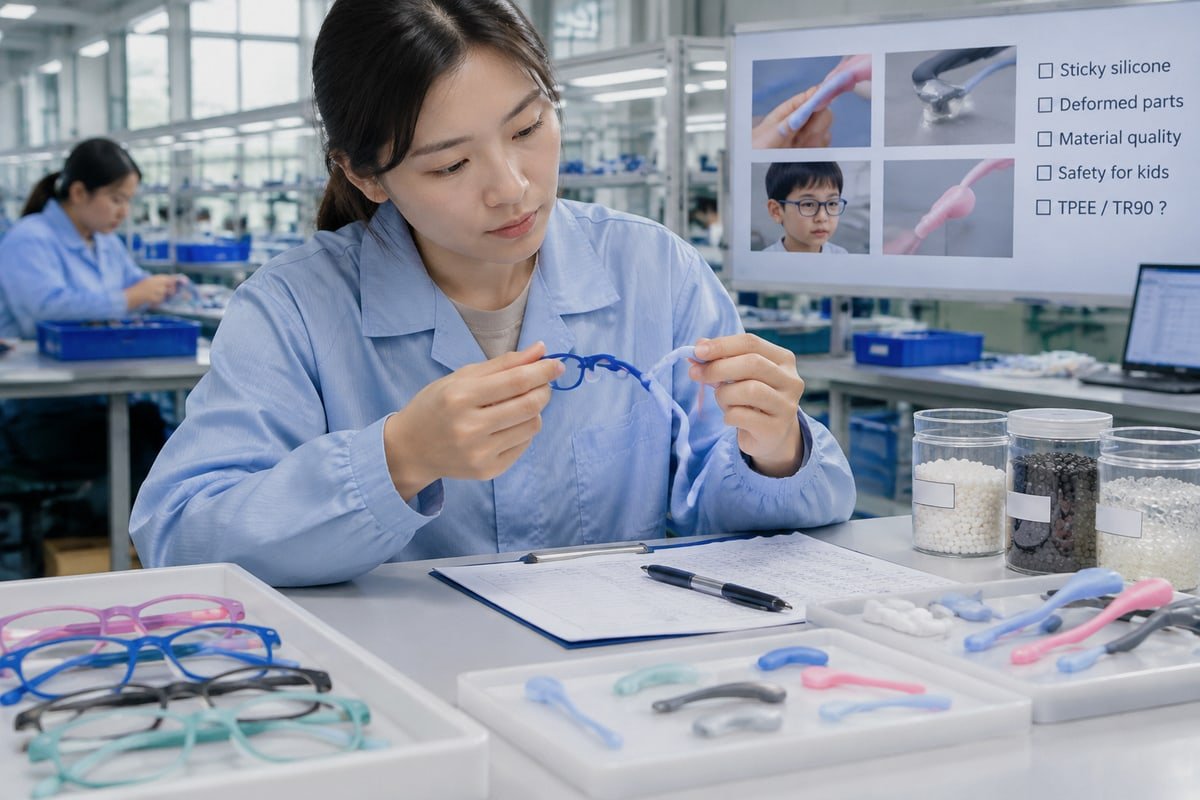
Kids eyewear with sticky or deformed silicone parts lands on our QC bench more often than buyers expect. Ignore it, and returns pile up. Here is how we judge it.
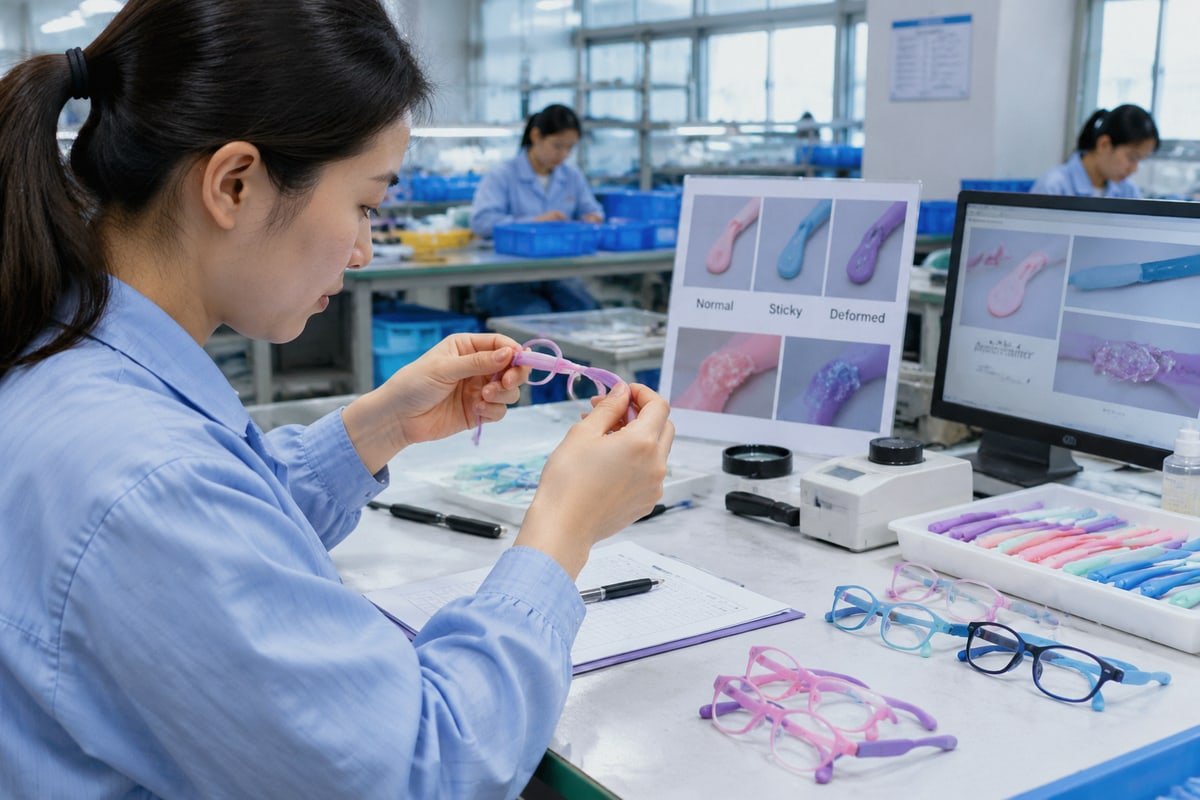
Usually no. Kids eyewear with sticky or deformed silicone parts should not be worn or sold. Tackiness signals material degradation, not dirt. Deformed pads and temple tips shift lens alignment and can irritate skin. Clean first, but if stickiness or warping remains, replace the part or the frame.
That is the short version. The longer version matters if you buy in bulk. Below, I walk through how we decide, why silicone fails, how to check a supplier, and when to change materials.
How do I know if sticky or deformed silicone parts make my kids' eyewear unsafe to sell?
Last spring, a distributor in Australia sent us photos of returned frames with gummy temple tips. She asked one thing: can I still sell the rest of the batch?
Treat sticky or deformed silicone parts as a stop-sale condition. If cleaning with mild soap does not remove tackiness, or if pads and tips fail to spring back, the material has degraded. Degraded parts risk skin irritation, poor fit, and loose pieces, so the product is unsafe to sell.
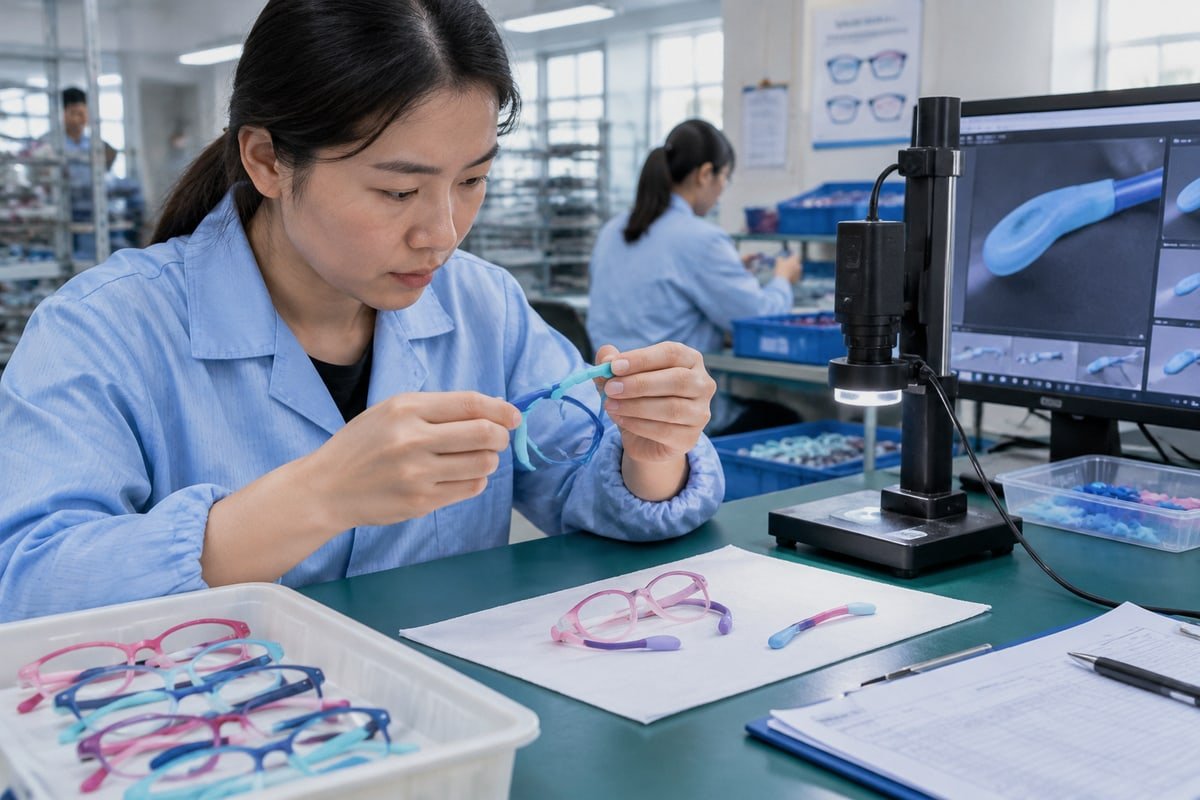
My answer to that distributor was not a guess. We pulled retained samples from the same lot and ran the same checks we use on every production run. Here is the logic we follow.
Normal flexing is not the same as material failure
Some retailers argue that flexible frames are fine as long as they are not broken. The material is meant to bend, so a little softness is expected. I understand the thinking. But it misses a key point. A healthy elastomer bends and returns. It stays dry to the touch. A sticky or warped part does neither. Tackiness means the polymer surface has broken down. Warping means the part has lost its shape memory. These are distinct failure modes. They are not "normal wear," and we never sign them off as such.
Why a tacky surface is more than a cosmetic issue
A sticky surface acts like an adhesive. It collects dust, pet dander 1, and pollutants from the environment. That grime then sits against a child's skin all day. Skin irritation from glasses is the most common result, and in some children it becomes contact dermatitis. Degraded silicone also develops microscopic fissures. Those tiny cracks hold bacteria. We have seen returns where a child had recurring redness on the bridge of the nose, and the nose pads were the cause.
Why deformation affects vision, not just comfort
Deformed nose pads or eyeglass temple tips change how the frame sits. Even small shifts can move prescription lenses 2 away from the child's optimal focal point. Opticians call this a prism effect. In kids, it shows up as headaches, eye strain, or a sudden refusal to wear the glasses. Parents rarely link that behaviour to a bent pad.
Our stop-sale checklist
| Sign on the silicone part | What it usually means | Our action |
|---|---|---|
| Light grime, wipes off with mild soap | Surface dirt only | Clean, re-inspect, release |
| Tacky or gummy after cleaning | Reversion, irreversible | Stop sale, replace part or frame |
| Warped, does not spring back | Lost shape memory | Stop sale, check lens alignment |
| Chemical or sour smell | Leaching additives | Stop sale, quarantine lot |
| Cracks, flaking, or soft touch coating peeling | Advanced material degradation | Stop sale, discard |
| Loose pad, tip, or strap loop | Bond failure | Stop sale, choking-hazard review |
For a batch to remain sellable, every silicone part must be smooth, non-sticky, shape-stable, odour-free, and firmly attached. If one condition fails, the batch does not ship under our name.
What causes silicone components in children's glasses to degrade or become tacky over time?
During an incoming-material check two years ago, our line supervisor pulled a tray of sample nose pads that felt tacky straight from the supplier's bag. That lot never reached assembly.
Silicone in children's glasses turns tacky through reversion, a chemical breakdown triggered by skin oils, sweat, UV light, and heat. Under-cured or low-grade silicone breaks down faster because unreacted plasticizers and stabilizers leach out. Harsh cleaners like alcohol or acetone accelerate the process.
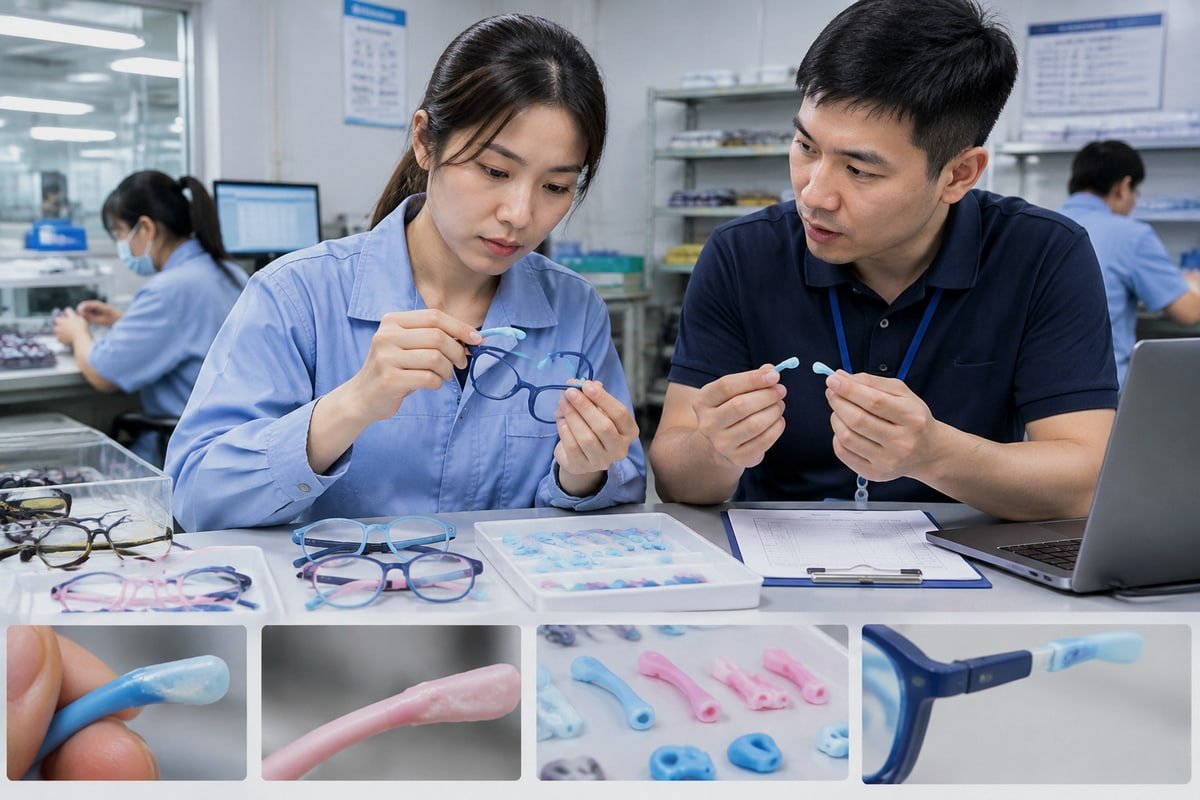
That tacky lot taught our team something. Silicone can fail before a child ever wears it. But most failures happen in use, and kids create the worst conditions for it.
Reversion in plain terms
Silicone is a cross-linked polymer. Curing builds the links that give it strength and a dry surface. Reversion is the reverse. The links break, the surface softens, and the part becomes gummy. Skin oils and sweat soak into the material and speed this up. UV light and heat add more energy to the reaction. A child who wears sunglasses outdoors all summer exposes the frame to all three at once.
Why low-grade silicone fails first
Not all silicone is equal. Cheap or under-cured silicone still contains unreacted plasticizers and stabilizers. Over time these leach to the surface. That leaching is what many people feel as stickiness. It also raises a health concern. Children have thinner dermal layers than adults, so leached additives are absorbed more easily. That is why we insist on cured optical grade silicone when we source pads or accessories, and why hypoallergenic frame materials are a baseline for us, not a premium option.
The label problem
Many parts sold as "silicone" are actually TPE or another elastomer. The name on the spec sheet does not tell you how the part will behave. I have seen genuine silicone that lasted years and "silicone" that went soft in one season. Condition and composition matter more than the marketing word.
How cleaning habits make it worse
Well-meaning parents often try cleaning sticky glasses frames with alcohol wipes or nail polish remover. Both solvents attack silicone and speed up the breakdown. Acetone can also strip lens coatings. Mild dish soap and warm water is the only cleaning method we recommend in our care cards.
| Cause | What happens to the silicone | How to reduce it |
|---|---|---|
| Skin oils and sweat | Absorbed into polymer, softens surface | Wipe daily with mild soap and water |
| UV exposure | Breaks cross-links, dries then gums | Store in a case when not worn |
| Heat (car dashboard, beach bag) | Accelerates reversion | Avoid hot enclosed storage |
| Alcohol or acetone cleaners | Dissolve surface, damage coatings | Never use solvents |
| Under-cured, low-grade material | Additives leach out | Specify cured, medical-grade silicone |
| Age past 6–12 months of daily wear | Normal end of life for a consumable | Plan silicone nose pad replacement |
Silicone parts are consumables
Even good silicone has a service life. Nose pads, temple tips, and strap loops on kids' frames should be treated as replaceable parts, usually every 6 to 12 months of daily wear. Pediatric frame maintenance works best when the brand plans for that. We supply spare pads and simple frame repair kits with some programs so retailers can offer replacements instead of returns.
How can I evaluate a supplier's material quality before placing a bulk order for kids' eyewear?
One lesson from fifteen years of eyewear work: a material spec sheet tells you what a supplier intends to use. Only samples and audits tell you what actually ships.
Evaluate material quality by requesting production samples, not showroom pieces, and stress-testing them yourself: flex, heat, sweat, and UV exposure. Ask for the exact elastomer name, compliance documents for your market, and factory evidence like workshop photos or a video audit. Then confirm consistency with a small trial order.
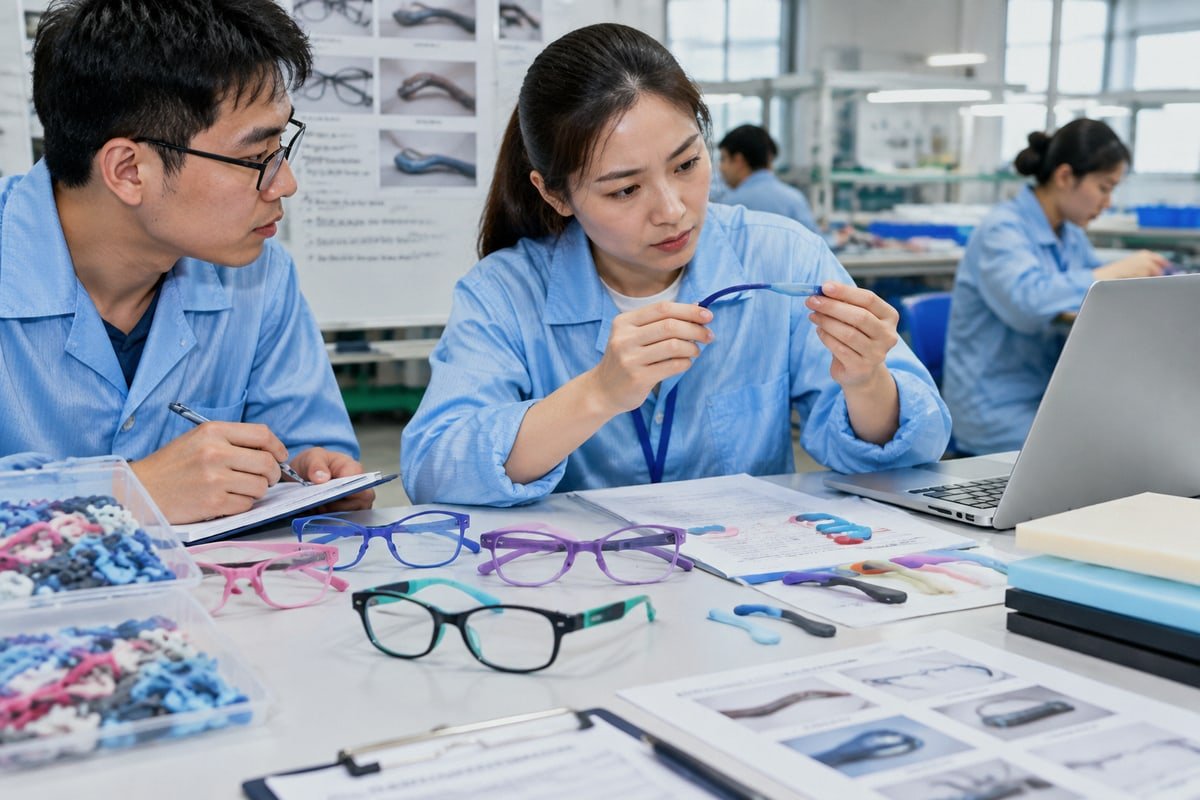
Buyers who come to us from a bad experience usually skipped one of the steps below. None of them is complicated. Together they filter out most of the risk before money moves.
A five-step evaluation process
- Ask for the real material name. Not "silicone." Not "rubber." You want the polymer family and grade: cured optical grade silicone, TPE, TPEE, or TR90. If the answer is vague, that is your first red flag.
- Request production-run samples. Showroom samples are often hand-finished. Ask for pieces pulled from a recent bulk order. Check that the nose pads, temple tips, and any strap loop ends feel dry and spring back cleanly.
- Run your own abuse test. Leave one sample in a hot car 3 for a weekend. Wipe another with sunscreen daily for two weeks. Flex the temples a few hundred times. Then compare against an untouched sample. Tackiness or warping after this short test tells you what year one will look like.
- Check compliance for your market. For children's products, ask for documentation covering BPA-free eyewear components 4, phthalate-free and lead-free material, and the relevant child-product testing for your region. Ask when the tests were done and on which material batch.
- Verify the factory is real. Ask for a live video walk-through of the workshop and the QC area. A trading company cannot show you the injection machines, the 5S floor markings, or the incoming-material inspection station. We host these calls regularly from our Taizhou factory, and buyers can see our 120 workers on the line.
Questions that separate good suppliers from risky ones
| Question to ask | Good answer | Red flag |
|---|---|---|
| Which elastomer is this part? | Specific grade and supplier named | "It's silicone" |
| Can I see bulk-run samples? | Sent within days, lot number marked | Only polished showroom pieces |
| What is your incoming-material check? | Tactile, dimensional, and odour checks per lot | "We trust our supplier" |
| Do you offer spare pads or tips? | Yes, as part of the order | No aftercare parts |
| Can I test the market before tooling? | Existing styles available for small runs | Mold investment required first |
Use trial orders as the final test
The last point in that table matters for new brands. We keep around 800 existing styles on file. A buyer can pick a few, add their logo and colours, and run a small trial order without paying for molds. That first shipment is your best material audit. Hold samples back, wear-test them, and re-inspect them after a few months. If the silicone parts are still dry and shape-stable, you have proof. If not, you have lost a small order instead of a season.
Do not forget the accessories. A case with a rubberized appliqué, a cord strap with rubber loop ends, or an elastic head strap with silicone grips all sit in the same child's bag. They deserve the same tactile inspection as the frame.
Should I switch to TPEE or TR90 materials to avoid silicone degradation issues in my product line?
Every material choice trades something away. Silicone gives the softest touch. TPEE gives resilience and stable surfaces. On our development bench, we weigh that balance for each age group.
For most children's lines, yes. TPEE temples and TR90 fronts resist reversion, hold shape, and stay non-tacky longer than low-grade silicone. Keep true optical grade silicone only where maximum softness matters, such as infant frames or nose pads, and source it as cured, medical-grade material from a verified supplier.
Switching materials is a product decision, not just a purchasing one. So let me start with a direct comparison, then explain how we apply it.
| Material | Softness on skin | Resistance to tackiness | Shape memory | Best use in kids' eyewear |
|---|---|---|---|---|
| Liquid or low-grade silicone | Very high | Low | Fair | Avoid for structural parts |
| Cured medical-grade silicone | Very high | Medium to high | Good | Infant frames, nose pads, strap loops |
| TPE | High | Medium | Good | Soft temple tips, grips |
| TPEE | Medium to high | High | Very good | Temples on active-kids frames |
| TR90 | Medium | Very high | Excellent | Frame fronts, older children |
Where silicone still earns its place
Babies and toddlers mouth their frames and fall on them. For that age group, a soft full-silicone or silicone-heavy frame is still a reasonable choice. The condition is that it must be cured, medical-grade silicone from a supplier who can prove it. The industry is moving away from cheap liquid silicone toward properly cured grades and thermoplastic elastomers 5 for exactly this reason. Both offer far better resistance to chemical reversion.
Why our core range uses TR90 with TPEE temples
For children from about preschool age upward, we build most frames with a TR90 front and TPEE temples. TR90 holds lens alignment through rough play. It also makes adjusting children's spectacles easier for an optician, because the front stays true. TPEE temples flex around the ear, then return, and their surface does not go gummy with sweat and sunscreen the way low-grade silicone does. The soft touch coating peeling we sometimes see on painted plastics is not an issue with self-coloured TPEE either. We found this combination cut material-related returns in a way that surprised even our own QC team.
The honest trade-off
TPEE is not as pillow-soft as silicone. For a very small child, that difference is noticeable. So we do not push every buyer to drop silicone. We push them to drop unverified silicone. If your line covers ages six and up, a full switch to TR90 and TPEE removes most degradation risk. If it covers infants, keep cured silicone for those styles, and spec TPEE for everything else. Both material families are environmentally friendly, lightweight, and available across our existing styles, so the switch rarely requires new tooling.
Conclusion
Sticky or deformed silicone is a failed part, not normal wear. Left unchecked, it costs returns and trust. Choose stable materials, verify suppliers, and replace consumables on schedule.
Interested in sourcing the products mentioned in this article? See details and request a quote here:
Footnotes
1. Authoritative source on indoor air pollutants that can accumulate on sticky surfaces. ↩︎
2. Professional guidance on how lens positioning affects vision and eye health. ↩︎
3. Government safety information regarding extreme temperatures in vehicles, relevant to material stress testing. ↩︎
4. Official FDA information on BPA, a key safety standard for children’s product components. ↩︎
5. Technical overview of the material properties and applications of thermoplastic elastomers in manufacturing. ↩︎
More Articles You Might Like

September 29, 2026
How to Interpret Material, Age, and Warning Info on Kids' Eyewear Hang Tags?
September 29, 2026
How to Recycle Discarded Kids' Eyewear Accessories: Can Silicone and Plastic Parts Be Sorted?
September 29, 2026
How Recyclable Are Kids' Eyewear Materials, and What Are Eco-Friendly Alternatives?
Looking for a Reliable Kids Eyewear Partner?
Explore 800+ ready styles and full OEM/ODM support tailored to your brand.
Get in Touch English
 Español de México
 Deutsch
 Français
 日本語
 العربية
 Português do Brasil