How to Recycle Discarded Kids’ Eyewear Accessories: Can Silicone and Plastic Parts Be Sorted?
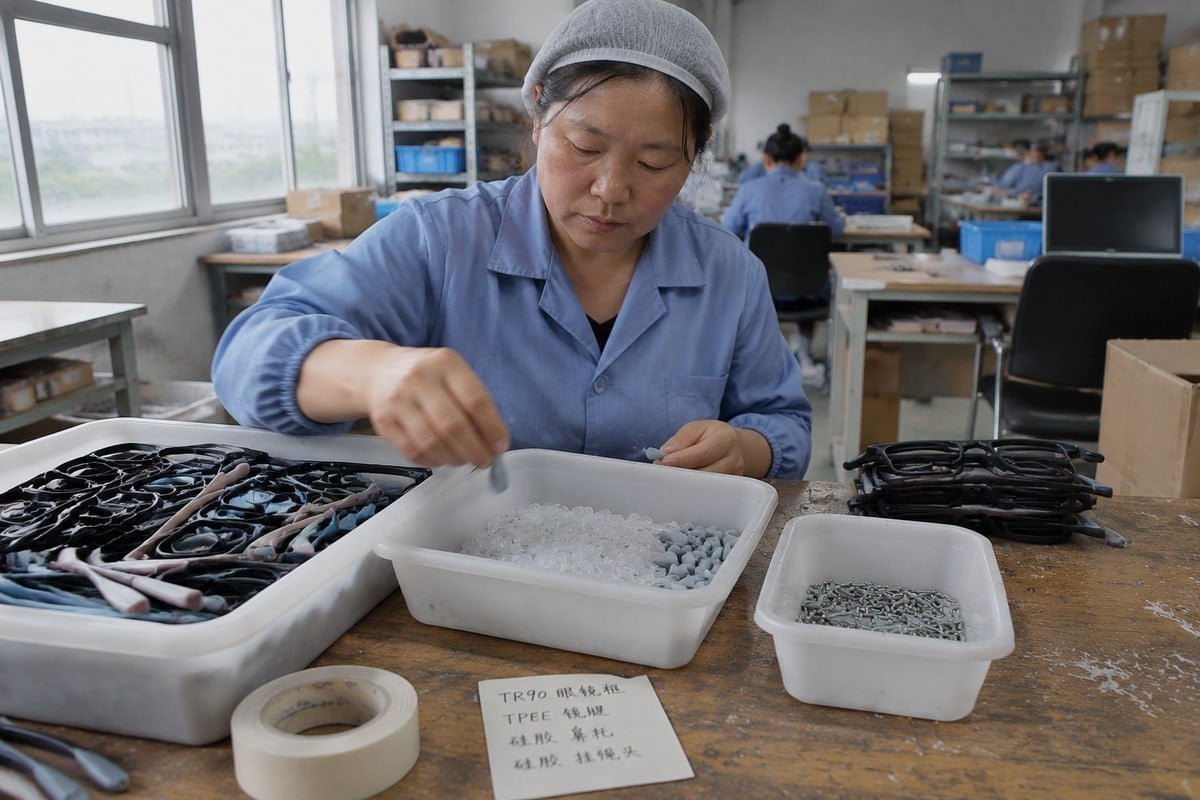
Buyers of our Taizhou-made frames keep asking how to recycle discarded kids’ eyewear accessories, because guessing wrong sends silicone into the wrong bin and whole batches into landfill.
To recycle discarded kids’ eyewear accessories, first separate parts by material. Rigid plastic cases and clips can go to curbside recycling only if your local program accepts them. Silicone straps, nose pads, and temple tips are thermoset and need specialty take-back, reuse, or donation instead.
That short answer hides a lot of detail. The next four sections walk through the materials, the separation steps, the design choices, and the programs that make it work.
What Materials Are Used in My Kids' Eyewear That Affect How I Can Recycle Them?
Last spring our incoming-material inspectors rejected a batch of strap loop ends because the supplier had swapped TPEE for silicone without telling us. Same look, different end of life.
Kids' eyewear typically combines TR90 nylon frames, TPEE thermoplastic elastomer temples, polycarbonate lenses, silicone nose pads or strap ends, EVA or hard plastic cases, and polyester microfiber cloths. TR90, TPEE, and polycarbonate can be remelted; silicone is a thermoset and cannot, so each material needs its own recycling route.
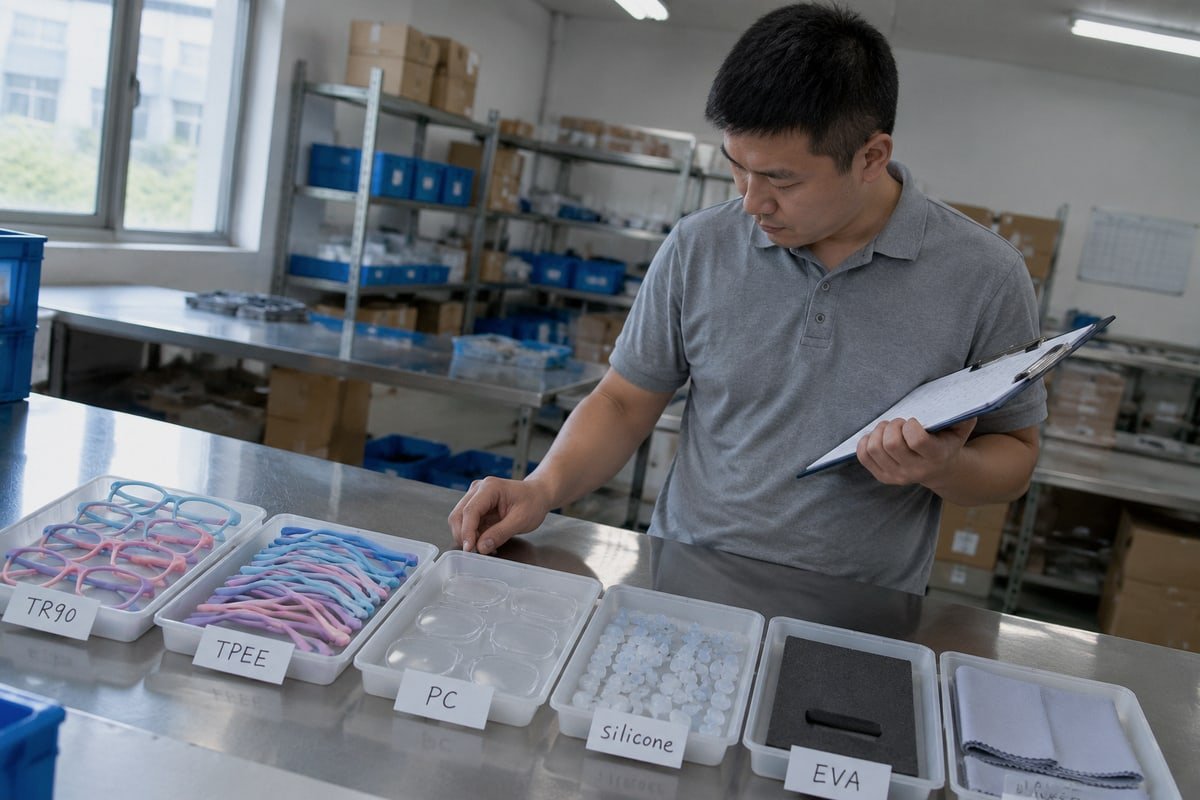
Most people see a small pair of glasses and think "plastic." In practice, a single kids' set can contain five or six different polymers. Each one behaves differently once it reaches a sorting line. Here is how the optical frame components we produce and pack break down.
| Component | Common material | Melts and reforms? | Realistic end-of-life route |
|---|---|---|---|
| Frame front | TR90 (nylon-based) | Yes | Industrial regrind, specialty mail-in |
| Temples | TPEE | Yes | Industrial regrind, specialty mail-in |
| Temple tips 1 / nose pads | Silicone | No | Specialty silicone processor, reuse, or landfill |
| Lenses | Polycarbonate 2 | Yes | Polycarbonate lens recycling via optical collectors |
| Hard-shell case | EVA foam over fabric | Partly | Reuse first; rarely curbside |
| Cord strap loop ends | Silicone or TPEE | Depends | Check with the supplier |
| Cleaning cloth | Polyester microfiber | Yes | Textile recycling, reuse |
Thermoplastic Versus Thermoset
This is the single most important idea in the whole topic. TR90, TPEE, and polycarbonate are thermoplastics. Heat softens them, and they can be reshaped. Silicone is a thermoset elastomer. Its chemical bonds are cross-linked during curing. Heat does not melt it. It needs specialized high-heat treatment or chemical processing. That is why silicone cannot ride along with PET or HDPE at a municipal facility.
Why Small Parts Fail Even When the Material Is Fine
Size matters as much as chemistry. Standard curbside sorting screens 3 are built for bottles and tubs. A nose pad or a temple tip falls straight through the screens or jams the machinery. On top of that, most plastic eyewear accessories carry no plastic resin identification codes. Without a code, the facility cannot confirm the resin, so the item becomes a "wish-cycling" contaminant.
A Note on Bio-Acetate
Some newer children's frames use bio-acetate. It is marketed as industrially compostable rather than recyclable. That changes the route again. Acetate frame recycling and composting are two different streams. If your brand mixes acetate styles with TR90 styles, label them clearly for your end customer.
How Do I Separate Silicone Temple Tips and TPEE Parts From Plastic Frames Before Recycling?
We weigh a real trade-off on every temple design: a bonded silicone tip feels softer on a child's ear, but a press-fit TPEE tip comes off cleanly for recycling.
Pull off push-fit silicone temple tips, unscrew hinges, and pop out lenses. Sort TR90 frames and TPEE temples into a thermoplastic pile, silicone into its own bag, and screws separately. Glued or overmolded silicone cannot be split at home and should go to a specialty program.
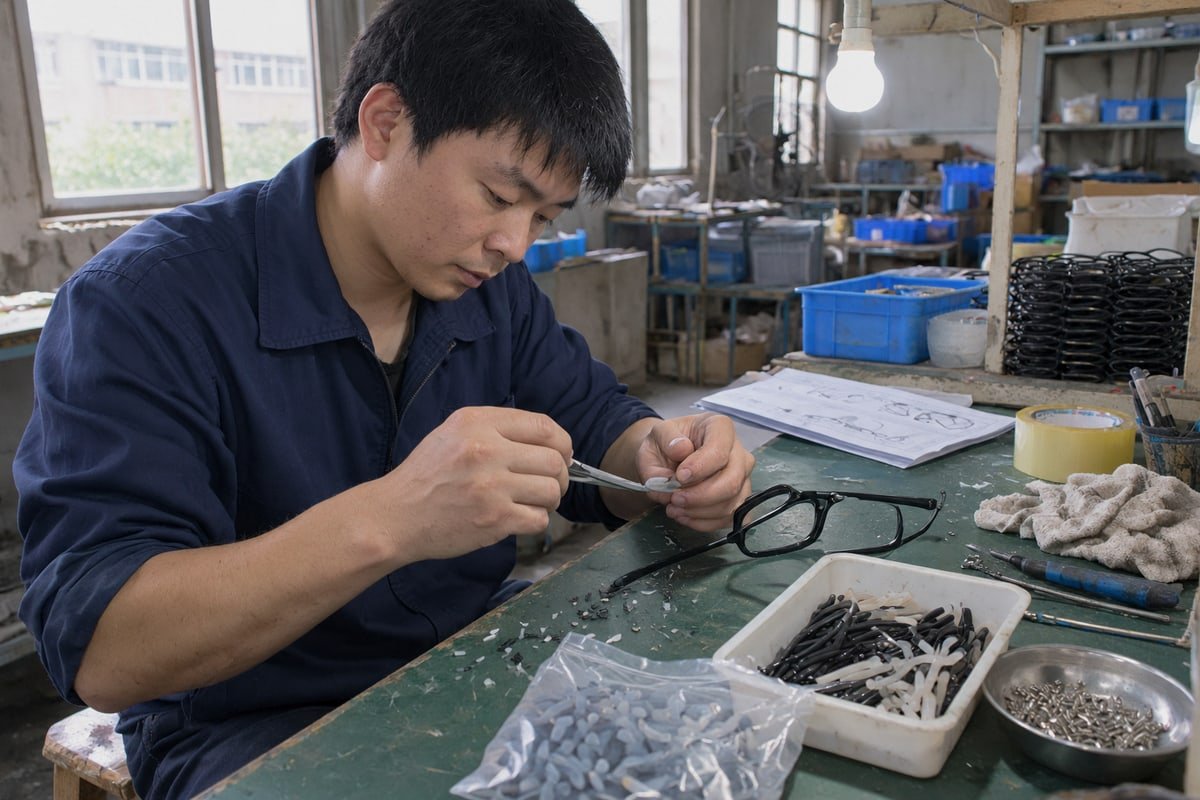
Separation is where good intentions usually break down. The good news is that most kids' frames come apart with simple tools. I will walk through the process we recommend to brands that run their own take-back boxes.
A Five-Step Disassembly Routine
- Clean everything first. Wipe frames and straps with soap and water. Every specialty program we have dealt with asks for clean material. Dirty silicone gets rejected.
- Remove the lenses. Flex the TR90 rim gently and pop the polycarbonate lenses out. Keep them in a separate bag for polycarbonate lens recycling.
- Unscrew the hinges. Use a small eyeglass screwdriver. Drop the screws into a metal tin. Metal is easy to recycle once it is isolated.
- Pull the temple tips. Push-fit silicone tips slide off the TPEE temple with a firm tug. If the tip does not move, it is glued or overmolded. Stop and set that temple aside.
- Sort into streams. You should now have four piles: TR90 fronts, TPEE temples, silicone bits, and screws.
What Goes Where
| Pile | Curbside? | Best route |
|---|---|---|
| TR90 fronts and TPEE temples | Rarely | Optician drop-off or mail-in program that regrinds thermoplastics |
| Silicone tips, nose pads, strap loop ends | No | Specialty silicone processor, brand take-back, or reuse |
| Screws and metal cores | Sometimes | Scrap metal or mixed-metal bin |
| Glued or overmolded temples | No | Specialty collector only |
But I Read That Silicone Can Be Recycled
I hear this objection a lot, and both sides are partly right. Silicone can be recycled in specialized systems. Cryogenic grinding, for example, freezes mixed silicone and plastic components 4 until they shatter, then separates them by density. That is impossible at room temperature. So yes, the technology exists. But that does not mean your customer can put a silicone nose pad in the blue bin. Silicone nose pad disposal at the household level still means reuse, a take-back envelope, or, as a last resort, the trash. The honest answer is that silicone is recyclable in theory and through specialty programs, but it is almost never curbside recyclable.
Reuse Before Recycling
Kids outgrow glasses before they wear them out. High-grade silicone ear hooks make good ergonomic grips for pencils or cutlery. Upcycling old spectacles this way is a small step, but it keeps silicone in use instead of in a landfill.
Can I Partner With My Manufacturer to Design Eyewear That's Easier to Recycle From the Start?
A procurement manager from a European baby brand once opened our sample review by asking one question: could every part on the table be taken apart without a knife?
Yes. A capable OEM/ODM partner can specify mono-material TPEE temples, snap-fit rather than glued tips, standard screws, resin codes molded into parts, and single-material cases and pouches. Choosing from an existing style library avoids new molds, so brands can adopt recyclable designs without heavy tooling cost.
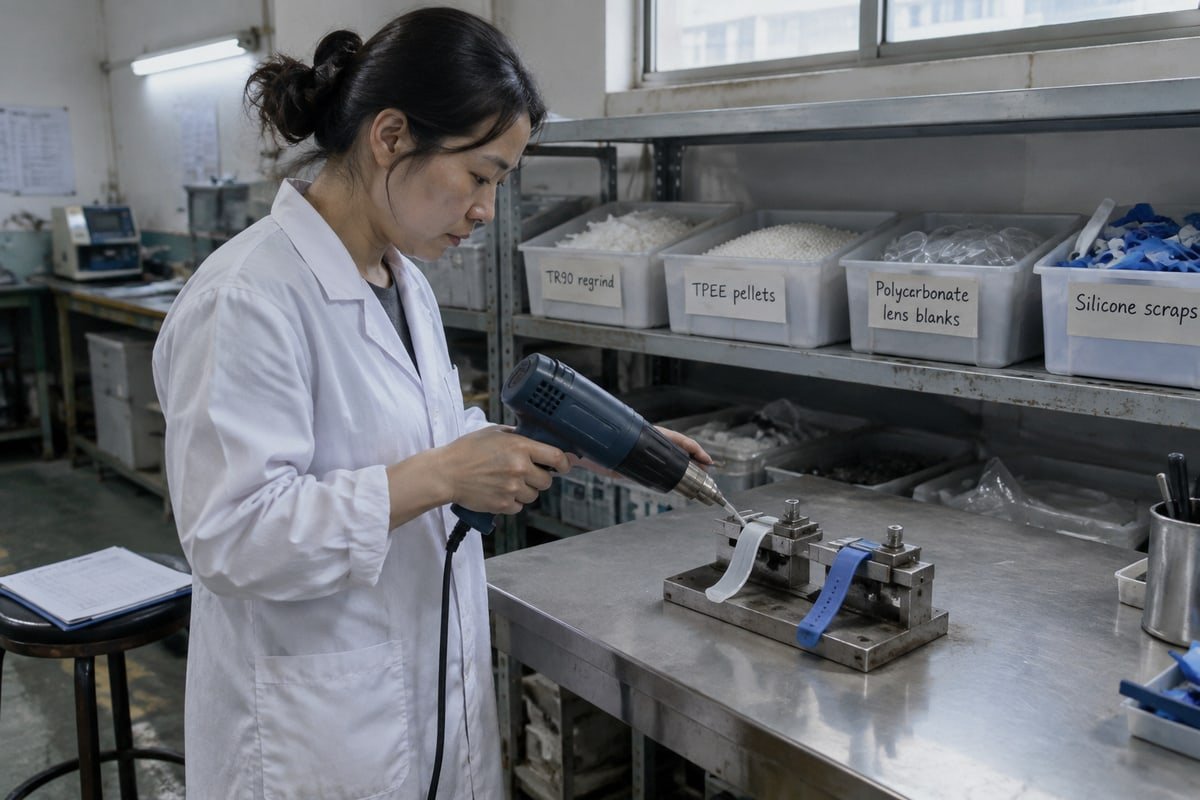
That buyer's question changed how I look at our own sample room. Recyclability is mostly decided at the design stage, not at the bin. The choices below are the ones we now discuss with brands before we open a purchase order.
Design Choices That Change the End of Life
| Design decision | Common default | Recycling-friendly alternative | Trade-off to weigh |
|---|---|---|---|
| Temple tip attachment | Glued silicone | Push-fit TPEE or removable silicone | Slightly less grip on very active kids |
| Temple material | Silicone overmold on TR90 | Full TPEE temple | TPEE is flexible but firmer than silicone |
| Resin marking | None | Code molded inside the temple | Small mold change on new styles |
| Hard-shell case | EVA foam laminated to fabric | Single-material shell or reusable case | Higher unit cost for mono-material |
| Cord strap loop ends | Silicone | TPEE or removable loops | Supplier must confirm the material |
| Cleaning cloth | Blended microfiber | 100 percent polyester | Very small cost difference |
Why Existing Styles Help
New brands often assume that recyclable design means new molds. It usually does not. With roughly 800 existing styles in our library, most of the structural choices above already exist in some form. A brand can pick a TR90 front with TPEE temples that already has push-fit tips, then customize color, logo, lens, and packaging. That lets a brand test the market with lower risk and still tell a credible sustainable eyewear materials story.
Accessories Deserve the Same Thinking
Our accessory sets include a glossy hard-shell case, a microfiber cloth, an elastic head strap with buckles, and a cord strap with rubber loop ends. Each item is usable long after the frame is outgrown. A well-made case should be designed to hold the next pair, not to be thrown out. The same goes for the padded EVA pencil case and the velvet drawstring pouch we produce for kids' lines. Designing them for a second life is the simplest form of circular economy in optics.
Where the Industry Is Heading
Molecular recycling, sometimes called depolymerization, is an emerging route. It breaks mixed plastic and silicone parts down into raw monomers that can be rebuilt into virgin-quality material. It is not widely available yet. But a brand that designs for clean separation today will be ready when those plants come online.
What Should I Look for in a Recycling Program or Partner for My Brand's Discarded Eyewear Accessories?
One lesson from fifteen years of eyewear work: a take-back scheme fails when nobody defines who cleans, sorts, and pays for shipping before the first box arrives.
Look for a program that accepts small mixed parts, publishes which materials it processes, and reports end destinations. Specialty collectors like TerraCycle handle complex eyewear streams, Lions Club programs reuse intact parts, and local opticians aggregate small volumes. Confirm cleaning rules, shipping costs, and minimum quantities before launch.

A recycling partner is a supplier like any other. It needs clear specs and clear responsibilities. When a brand asks us to help recycle discarded kids' eyewear accessories at scale, we walk through the four main options together.
Comparing the Main Program Types
| Program type | Accepts silicone? | Accepts small mixed parts? | Best for |
|---|---|---|---|
| Municipal curbside | No | No | Clean, coded rigid plastic only |
| Specialty collector (e.g., TerraCycle) | Yes, in dedicated streams | Yes | Brands with steady return volume |
| Charity reuse (e.g., Lions Club) | Intact parts only | As spare parts | Refurbishing donated glasses for low-income families |
| Optician or chain drop-off | Depends on the chain | Yes, aggregated for bulk | Brands with retail partners |
Questions to Ask Before You Sign
- Which materials do you process in-house, and which do you forward to another plant?
- Do you require parts to be cleaned and separated before shipping?
- Is there a minimum weight or a fee per box?
- Can you send an end-destination report we can share with customers?
- Do you accept polycarbonate lenses, or only frames and straps?
Local Rules Change Everything
Recycling rules differ by city, not just by country. A hard plastic case may be accepted in one municipality and rejected in the next. So the same accessory set sold in Australia, Japan, and Germany may need three different customer instructions. I recommend that brands check the municipal website for each major market and write the guidance into the packaging insert. This is basic optical waste management, but very few kids' brands do it.
Donation as a First Step
Eyeglass donation programs are often the best first stop for intact frames and accessories. Charitable groups pull usable parts from donated pairs to refurbish glasses for families who cannot afford them. A strap or a case that is still in good condition has more value there than in any recycling stream.
Conclusion
Mixed accessories stall in landfill when materials stay bonded. Separate silicone from TPEE and plastic, recycle only what local rules accept, and design for disassembly with us from day one.
Interested in sourcing the products mentioned in this article? See details and request a quote here:
Footnotes
1. Authoritative Wikipedia section explaining the recycling challenges for thermoset silicone materials used in eyewear components. ↩︎
2. Comprehensive overview of polycarbonate properties, including its classification as a recyclable thermoplastic. ↩︎
3. Authoritative government source explaining the limitations and processes of municipal recycling systems. ↩︎
4. Technical reference for silicone’s chemical structure and its distinction from standard thermoplastics. ↩︎
More Articles You Might Like

September 29, 2026
How to Interpret Material, Age, and Warning Info on Kids' Eyewear Hang Tags?
September 29, 2026
How Recyclable Are Kids' Eyewear Materials, and What Are Eco-Friendly Alternatives?

September 29, 2026
How to Prevent Kids Eyewear Accessories From Deforming During Shipping and Stacking?
Looking for a Reliable Kids Eyewear Partner?
Explore 800+ ready styles and full OEM/ODM support tailored to your brand.
Get in Touch English
 Español de México
 Deutsch
 Français
 日本語
 العربية
 Português do Brasil