How to Verify If TR90 Kids Optical Frames Are Genuine TR90 Material?
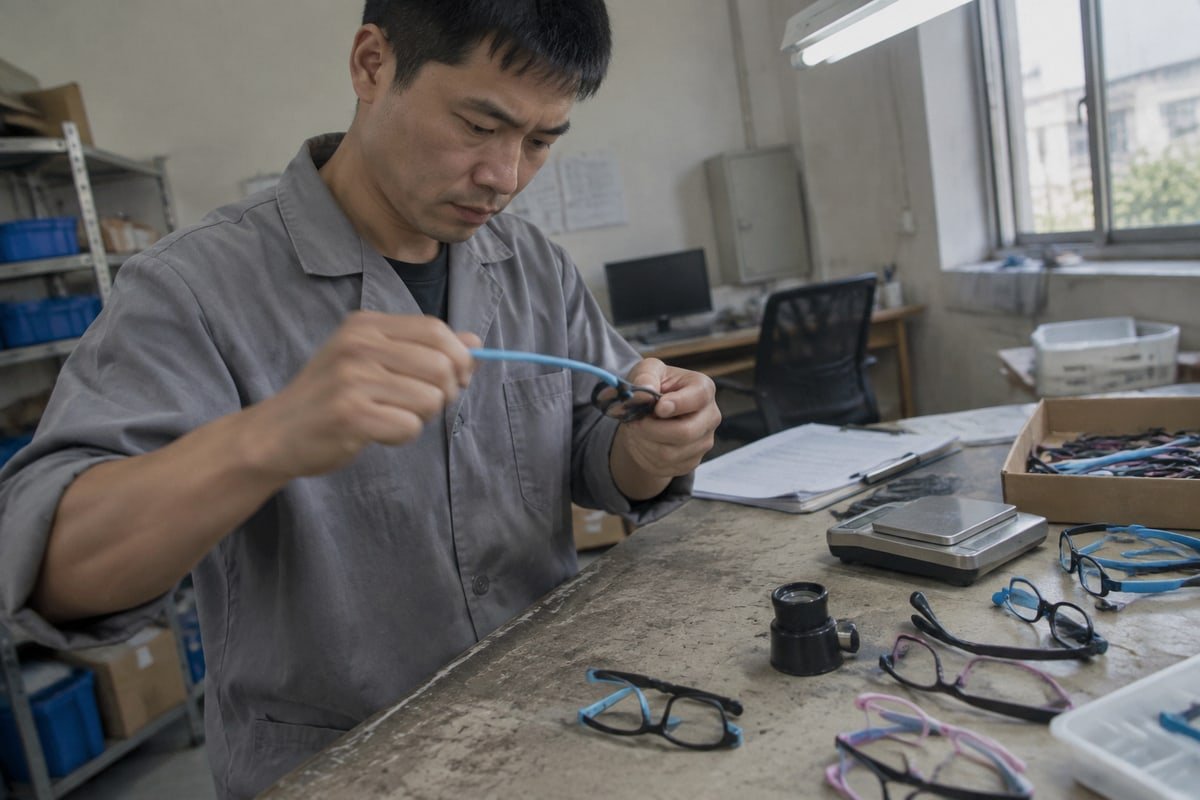
Every week, samples labeled TR90 kids optical frames reach our Taizhou factory, and some fail our bend test within seconds third-party lab reports 1. That label alone proves nothing, so I test everything.
You verify genuine TR90 kids optical frames by combining three layers: a material certificate naming Grilamid TR90 or an equivalent PA12 resin, batch-traceable third-party lab reports, and physical checks like fast shape recovery, low weight, acetone resistance, and molded-in color.
The rest of this guide walks through each layer medical device standard 2. I start with the hands-on tests you can run on a sample. Then I cover the paperwork, the reasons fakes exist, and how to pick a factory you can trust with children’s eyewear.
How can I test TR90 material quality before placing a bulk order?
On our 5S-managed line, inspectors bend every TR90 temple outward before packing. A frame that recovers slowly never leaves the workshop. You can run similar checks on samples.
Test TR90 sample quality with six screening checks: bend a temple and watch for instant rebound, weigh the frame, dab acetone on a hidden spot, tap it for a bright clink, inspect the molded parting line, and confirm color is not painted on. Then send samples for lab testing.
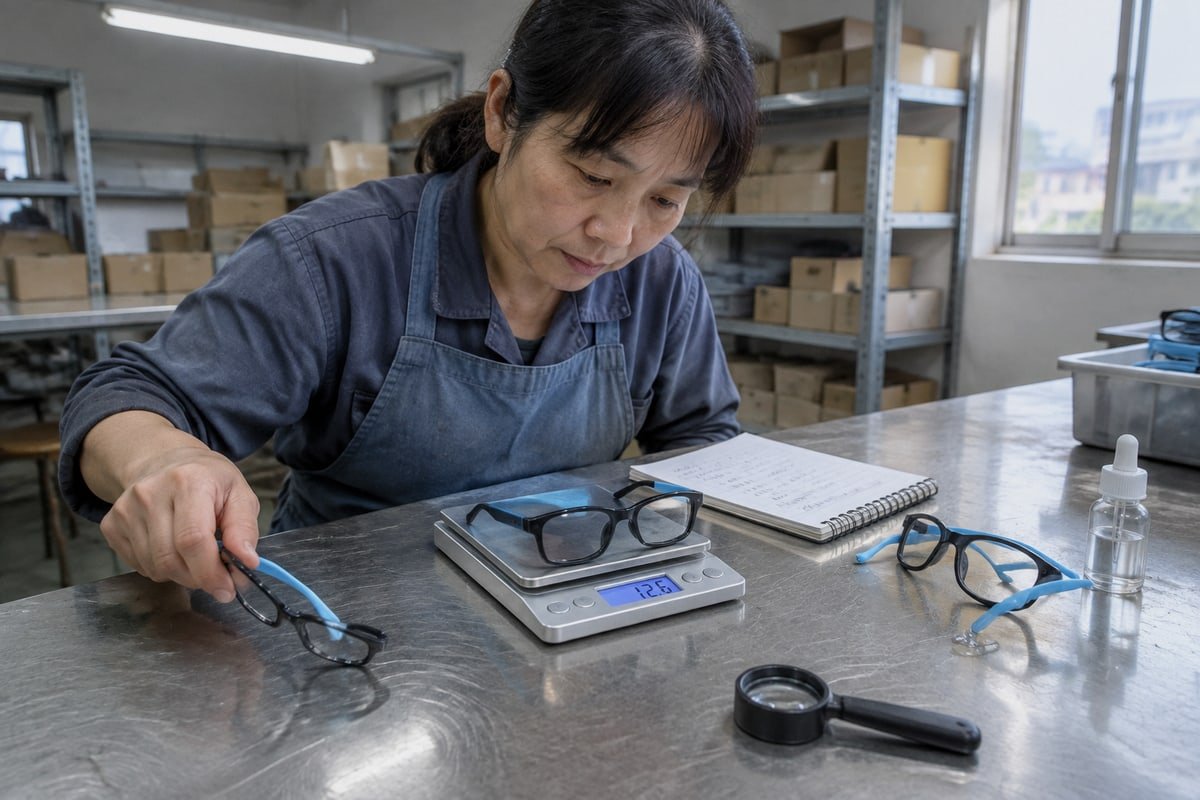
Physical tests are screening tools. They help you reject bad samples fast. They do not prove the exact resin grade. I want to be honest about that up front. A frame can pass every test below and still be a good generic nylon rather than Grilamid TR90 3. But a frame that fails any of them is almost certainly not what you were promised.
The shape memory test
TR90 is a thermoplastic polyamide 4, and it behaves like a shape memory plastic. Hold the frame front in one hand. Pull a temple outward well past its normal opening angle. Release it. A genuine TR90 temple snaps back to position instantly. It shows no permanent warping and no loss of hinge tension. Imitations often recover slowly, feel spongy, or stay slightly bent. Repeat the test five or six times. Fatigue shows up on the third or fourth cycle with cheap blends.
Weight and density
Genuine TR90 resin has a density around 1.14 to 1.15 g/cm³. In practice, a TR90 frame is roughly 20% to 25% lighter than an acetate frame of the same size. That difference matters on a child's nose bridge. If a sample feels oddly heavy, suspect fillers or a hybrid build. Still, weight varies with frame size, lens thickness, and metal hardware. Treat it as a clue, not a verdict.
Surface, sound, and chemical checks
The injection molding process leaves a fine, raised parting line along the frame edges. Acetate is cut from sheets and has no such seam, so this is a quick acetate vs TR90 tell. Color in real TR90 is blended into the pellets before molding, so it cannot chip or flake. A drop of acetone on a hidden spot will not cloud or soften genuine TR90. Tapping the frame on a hard surface gives a high-pitched clink rather than a dull thud. Water beads into tight spheres on the surface instead of spreading. If you hold the frame against a phone screen through polarized sunglasses, you will see rainbow stress patterns around the bridge and injection gates.
| Check | What a pass looks like | What it proves | What it does not prove |
|---|---|---|---|
| Temple rebound | Instant snap-back, no warping | Flexible polymer with good memory | Exact resin brand or grade |
| Weight | Light for its size | Low-density material | Absence of minor fillers |
| Acetone dab | No clouding or softening | Not acetate or acrylic | Not a different nylon |
| Parting line | Fine raised seam on edges | Injection molded part | Which resin was molded |
| Color scratch | No paint layer, color runs through | Pigment blended into pellets | Polymer identity |
| Tap sound | Bright, sharp clink | Dense, elastic structure | Certified source |
I skip the burn test. Some guides say you can judge a frame by its burn test residue and odor. In our workshop, we never do this. It is unsafe, it damages the sample, and a lab does the job better with a proper polymer scan.
What certificates or documents should I request to confirm genuine TR90 frames?
A procurement manager from Australia once asked me for the resin name before she asked for the price. That question is the right starting point for kids' eyewear.
Request a raw material certificate naming Grilamid TR90 from EMS-Grivory or an equivalent PA12 grade, the resin SDS, batch traceability records, third-party lab reports from SGS or TÜV covering mechanical and chemical safety, and the factory's ISO 9001 quality-system certificate.
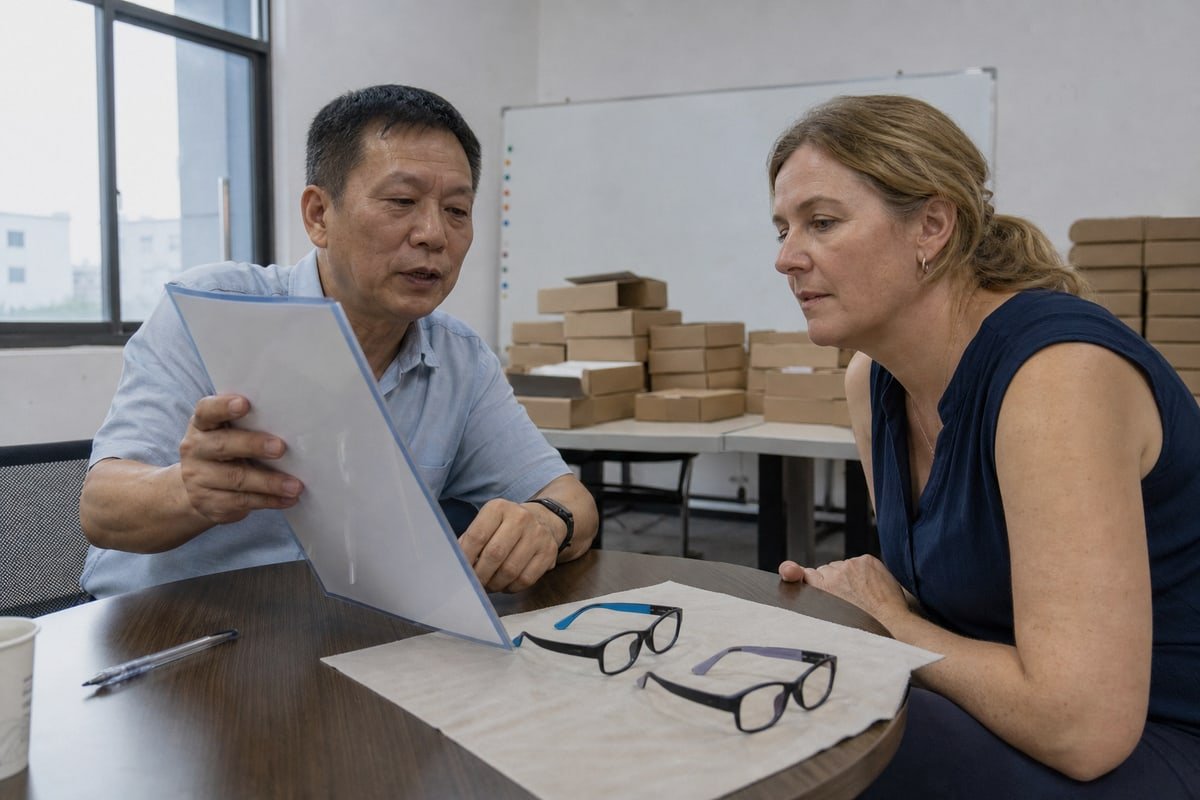
Documents beat visual inspection every time. A frame's appearance cannot tell you whether the polymer is true TR90 or a substitute. Paper can, as long as the paper connects to your actual order. I think of it as a chain of evidence with four links. If any link is missing, the chain is worthless.
The four-link chain of evidence
- Raw material source. Ask for the resin certificate or datasheet. It should name Grilamid TR90 by EMS-Grivory Switzerland, or clearly identify another PA12 grade. Vague wording like "TR90 nylon" or "TR90-style" is a warning sign. When we buy pellets, the supplier's documents travel with the order, and we share them with buyers who ask.
- Production batch. Request a batch or lot number tied to your purchase order. Traceability means the factory can link your frames to a specific bag of resin and a specific molding date.
- Test report. A third-party lab such as SGS or TÜV can test tensile strength, elongation at break, heat resistance, heavy metals, formaldehyde, and phthalates. For BPA free frames on a child's face, chemical safety tests matter as much as mechanical ones.
- Factory system. An ISO 9001 certificate shows the quality system is audited. Some optical factories also hold ISO 13485 5, which is the medical device standard. Neither proves a single frame is TR90, but both raise the odds that documents match reality.
What each document actually tells you
| Document | Who issues it | What it confirms | Red flag |
|---|---|---|---|
| Resin certificate or datasheet | Resin producer | Polymer identity and grade | No brand or grade named |
| SDS / MSDS | Resin producer | Chemical composition and handling | Generic "nylon" SDS |
| Batch record | Factory | Link between resin lot and your order | Cannot supply lot numbers |
| Third-party lab report | SGS, TÜV, or similar | Mechanical and chemical properties | Report is years old or for another product |
| ISO 9001 / ISO 13485 | Certification body | Audited quality system | Certificate expired or unverifiable |
One more point on hypoallergenic properties. TR90 is a biocompatible thermoplastic that is free of BPA and plasticizers. That is why so many brands choose it for TR90 kids optical frames. But a blended frame loses that guarantee. So ask for a report that covers your batch, not a marketing PDF. If a supplier hesitates, that hesitation is data too.
Why do some suppliers mix TR90 with cheaper materials, and how can I spot it?
Fifteen years in eyewear taught me one hard lesson: the cheapest quote usually hides a resin substitution. Genuine Grilamid pellets cost more than recycled nylon, and someone pays that gap.
Suppliers blend TR90 with recycled nylon, polycarbonate, or filler to cut resin cost, since the frame looks identical at first. Spot it through slow or spongy rebound, unusual weight, painted-on color that chips, surface softening under acetone, and a supplier who avoids naming the resin.
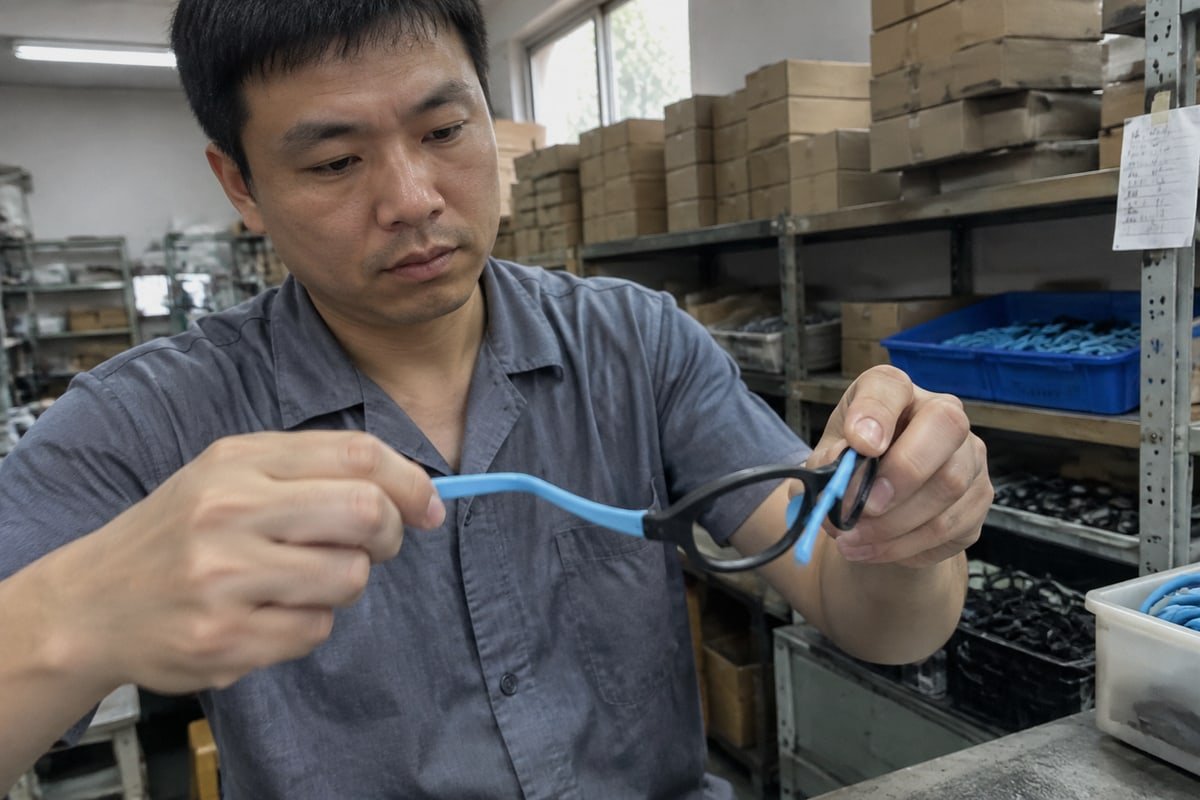
The motive is simple. Resin is one of the largest cost items in a molded frame. If a buyer pushes hard on price, a factory has three options. It can accept a thinner margin. It can walk away. Or it can quietly swap in cheaper material and keep the TR90 name on the invoice. The third option is common because nobody polices the term. TR90 is a trade name, not a regulated standard. A product page can say TR90 without anyone checking.
Why the fake can pass a casual look
A blended frame often looks fine out of the box. It may even bend acceptably on day one. The problems appear later. UV stability drops, so colors fade. Long-term shape retention suffers, so temples spread and the frame slides down a child's nose. Impact resistance falls, so a dropped frame cracks at the hinge instead of flexing. Heat resistance is another hidden gap. Genuine TR90 has a heat deflection temperature up to 135°C, which is why it survives a closed car in summer. Blends warp in that same car.
Behavior differences you can observe
| Behavior | Genuine TR90 | Blended or substitute |
|---|---|---|
| Rebound after bending | Instant, full recovery | Slow, spongy, or partial |
| Color | Molded through, cannot chip | Often surface-painted, chips at edges |
| Acetone contact | No change | Clouding or softening |
| Weight for size | Light, consistent across a batch | Heavier or inconsistent |
| Heat exposure | Holds shape | Warps or loses temple grip |
| Hardware | Stainless or titanium screws, bonded nose pads | Plastic-on-plastic hinges, glued pads |
Red flags in the conversation
I have learned to listen for language as much as I look at samples. Phrases like "TR90-like," "TR90 nylon," or "our own TR90 formula" usually mean a substitute. A supplier who cannot say who made the pellets does not know, or does not want you to know. A quote far below the market rate for TR90 kids optical frames should also make you pause. Someone is absorbing that cost, and it is rarely the factory.
One caution on DIY methods. Some forums suggest scraping a shaving and judging the burn test residue. We do not recommend this to buyers. The results are hard to read, the fumes are unpleasant, and the sample is ruined. A lab polymer scan settles the question properly and safely.
Which trusted manufacturers can I rely on for authentic TR90 kids optical frames?
Choosing between a slightly higher resin cost and a child's comfort is a trade-off we settle the same way every season at OKAY EYEWEAR: we buy the certified pellets.
Rely on real factories, not trading companies, that name their resin source, share batch documents, welcome third-party testing, and specialize in children's flexible eyewear. OKAY EYEWEAR in Taizhou, with 15 years of experience, around 800 TR90 and TPEE styles, and full OEM/ODM support, is one such partner.
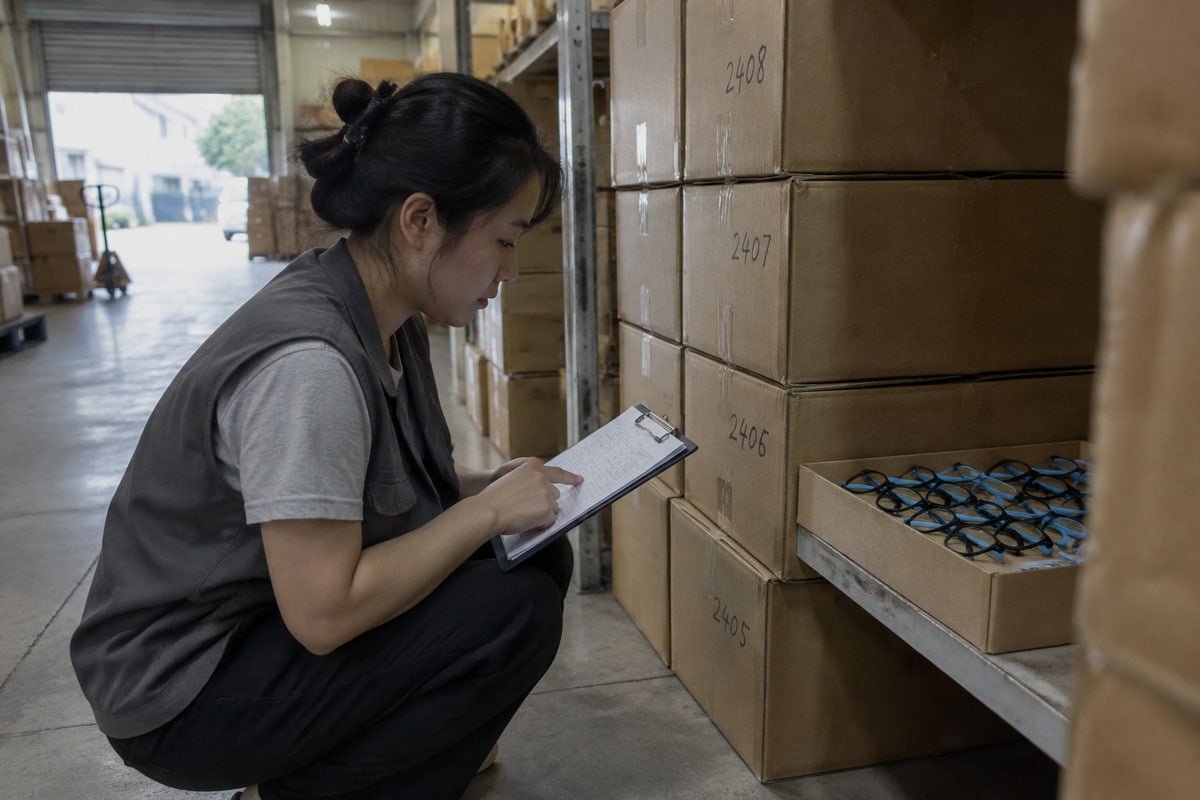
I will not pretend to be neutral in this section. But I can give you a fair framework, and then explain where we fit inside it. A trustworthy TR90 manufacturer shows a few consistent traits. It is a factory with its own molding and assembly lines, not a trading office reselling someone else's work. It names its resin source without hesitation. It can show you sealed pellet bags on a video call. It welcomes third-party testing instead of resisting it. And it understands children specifically, because kids' frames face abuse that adult frames never see.
A manufacturer scorecard
| Criterion | What to look for | Why it matters for kids' frames |
|---|---|---|
| Real factory | Own workshop, own workers, visible production | Direct control over material and process |
| Resin transparency | Names Grilamid TR90 or PA12 grade, shares datasheets | Removes the guessing game |
| Traceability | Batch numbers linked to your PO | Lets you audit any shipment |
| Flexible-material expertise | Works daily with TR90 and TPEE | Comfort and impact resistance on small faces |
| Existing style library | Many ready molds to choose from | Lower launch risk, no heavy tooling cost |
| OEM/ODM depth | Custom colors, logos, lenses, packaging | Retail-ready product, not a bare frame |
Where we stand
Our factory in Taizhou runs with about 120 workers under 5S management. We have made eyewear for 15 years and ship to buyers in more than 20 countries. Flexible materials are our specialty. Many of our children's styles pair a TR90 front with TPEE temples, because TPEE gives even softer flex behind the ears. Take the matte black round frame with sky-blue temples in our catalog. The two-tone look comes from molding, not paint, so the color cannot chip. The translucent pink gradient style works the same way, with the pigment running through the material and a keyhole bridge molded in one piece.
Because we hold roughly 800 existing styles, a new brand can launch TR90 kids optical frames without paying for molds. That lets a founder test a market with a small order first. When the range proves itself, our OEM/ODM team adds custom colors, logos, lens options such as anti-blue-light or UV400, and branded packaging. We share our resin supplier's documents on request, and we support buyers who want to send samples to SGS or TÜV before a bulk order.
We are not the lowest quote you will receive. We do not try to be. Our position is a long-term manufacturing partner for brands that care about child safety, consistent quality, and clear communication. If that describes your priorities, the verification steps in this article will feel natural when you work with us, because we already run them ourselves.
Conclusion
The TR90 label proves nothing by itself. Ask for the resin name, batch documents, and lab reports, run the bend test, and partner with a factory that welcomes scrutiny.
Interested in sourcing the products mentioned in this article? See details and request a quote here:
Footnotes
1. Global leader in inspection and testing services for consumer product safety and compliance. ↩︎
2. US regulatory body providing oversight and standards for medical devices including optical frames. ↩︎
3. Official manufacturer of the Grilamid TR90 resin mentioned in the article. ↩︎
4. Scientific classification of the polymer material used in TR90 eyewear frames. ↩︎
5. International standard for quality management systems specific to the medical device industry. ↩︎
More Articles You Might Like

Looking for a Reliable Kids Eyewear Partner?
Explore 800+ ready styles and full OEM/ODM support tailored to your brand.
Get in Touch English
 Español de México
 Deutsch
 Français
 日本語
 العربية
 Português do Brasil