How to Tell If Kids’ Sunglasses Are Genuine TR90 or Disguised PC/PP?
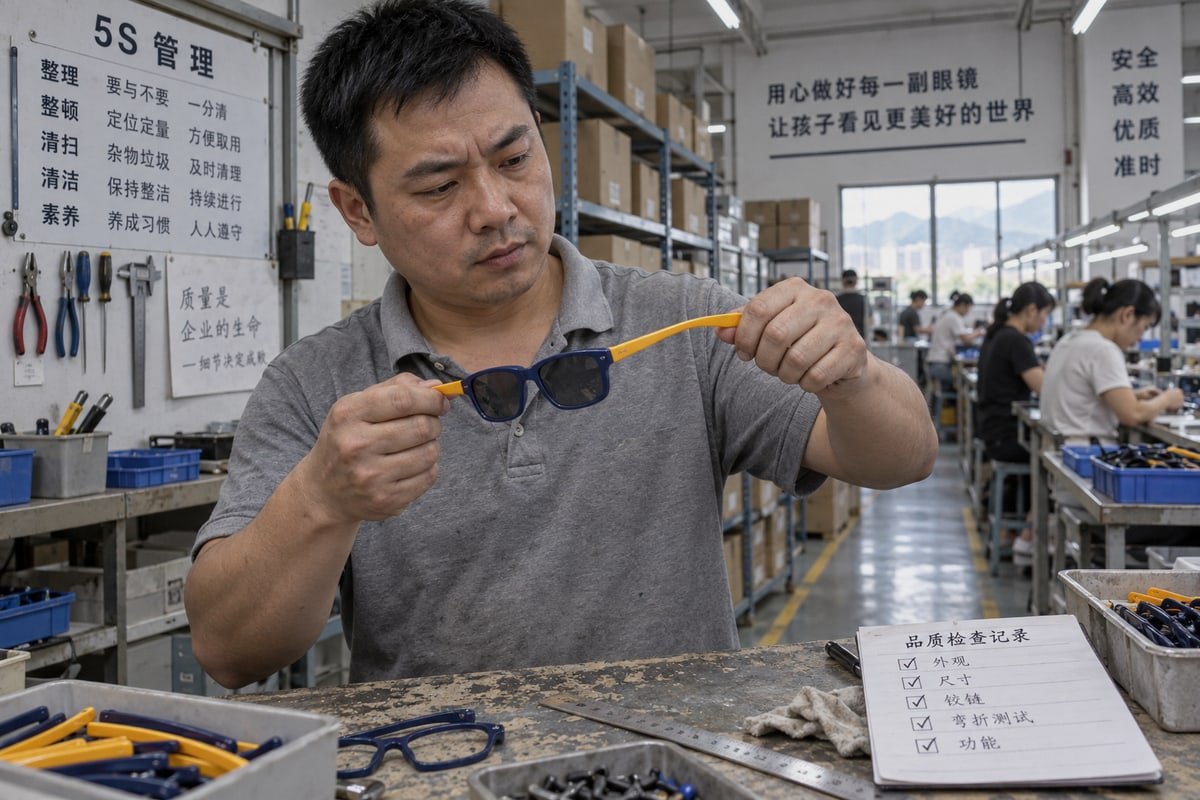
Genuine TR90 kids’ sunglasses have become a buying keyword, and on our Taizhou production line we see why: the label sells, even when the material inside is not real TR90 REACH chemical regulation 1. Fake TR90 frames can snap, warp, or irritate a child’s skin — and the parent or brand buyer only finds out after the damage is done. The good news is that TR90 leaves fingerprints. Once you know the physical tests, the visual clues, and the right supplier questions, disguised PC or PP is surprisingly easy to expose.
Genuine TR90 kids’ sunglasses flex sharply and spring back to shape, feel warm and slightly grippy, weigh roughly 30% less than PC or PP frames, resist acetone, and come with exact resin names like Grilamid TR90 plus MSDS documentation. Disguised PC/PP frames snap, stay warped, feel cold, and hide behind vague labels.
That is the short answer. Now let me walk you through each test, each visual clue, and each supplier question in detail — so you can verify the material yourself before you buy or place an order.
What Physical Tests Can I Use to Check If My Kids' Sunglasses Are Real TR90?
Last year, a buyer from Australia sent our factory a competitor's "TR90" sample. Our engineers ran four quick bench tests on it. Within ten minutes, we confirmed it was surface-painted polypropylene.
**Five physical tests reveal genuine TR90: the flex test (bends and springs back), the saltwater float test (density near 1.0–1.1 sinks slower than PC at 1.2), the acetone test (TR90 stays unaffected), the heat test (no warping below 350°F), and the scratch test (color runs through the material).
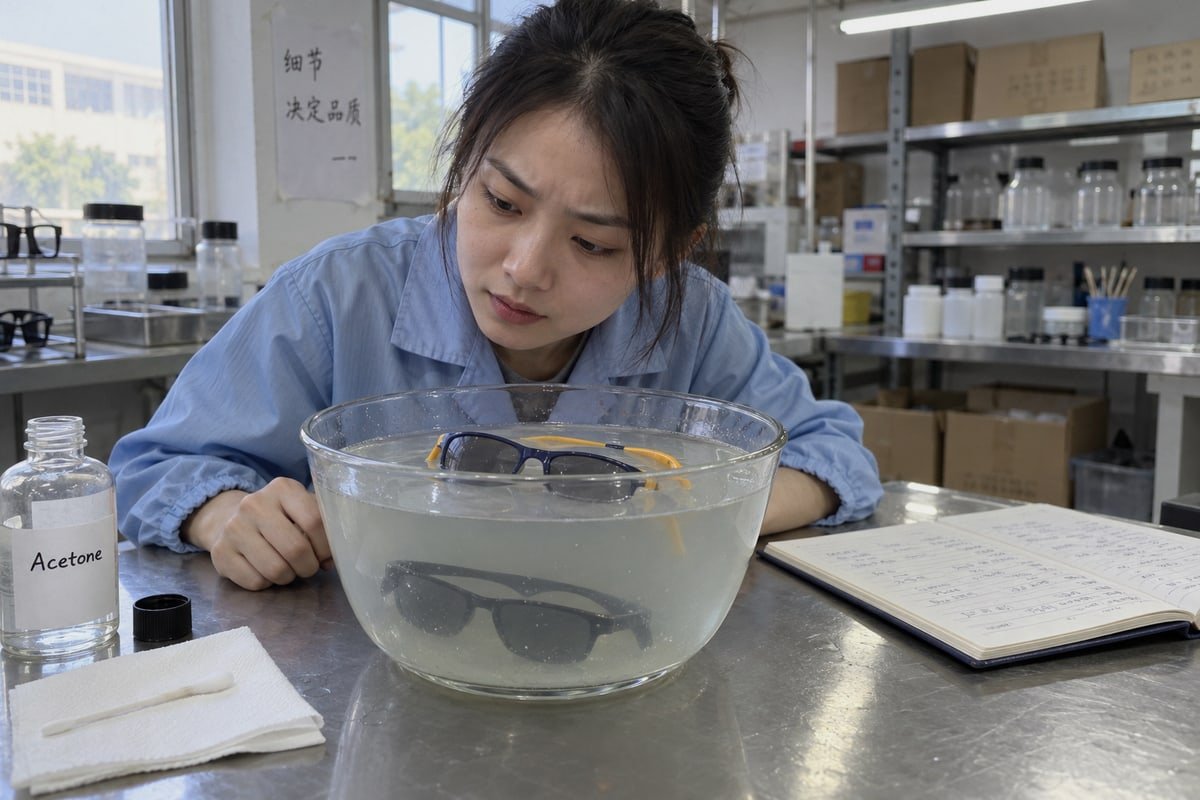
Let me break down each test so you can run them at home or at your sourcing desk. None of them require lab equipment. Together, they build a strong case for or against a frame.
The Flex Test: Memory Polymer Technology in Action
Hold the temple arms and gently bend them outward, well past their normal opening angle. Genuine TR90 is a thermoplastic polyamide with true memory polymer technology. It will flex smoothly and return to its exact original shape. There is no creak, no white stress mark, no permanent bend. PC frames resist hard, then crack or snap. PP frames often flex, but they stay slightly deformed or develop a whitened fold line at the bend point. This frame flexibility test is the single most useful check for parents. But remember: flexibility alone is not proof. Some soft plastics also bend. Use it as one signal among several.
The Saltwater Float Test: Material Density Comparison
Mix a saturated saltwater solution in a bowl. Drop a spare frame (or a cut sample, in a B2B context) into it. TR90 has a specific gravity around 1.0–1.1, so it often floats or hovers. Polycarbonate 2 sits near 1.2 and sinks. Sourcing guides also cite genuine TR90 density around 1.14–1.15 g/cm³ depending on the grade, which is why this material density comparison works best as a procurement check on raw pellets rather than a consumer certainty test.
The Acetone and Heat Tests
| Test | Genuine TR90 | PC | PP |
|---|---|---|---|
| Acetone drop | No reaction | Clouds or softens fast | Surface dulls or melts |
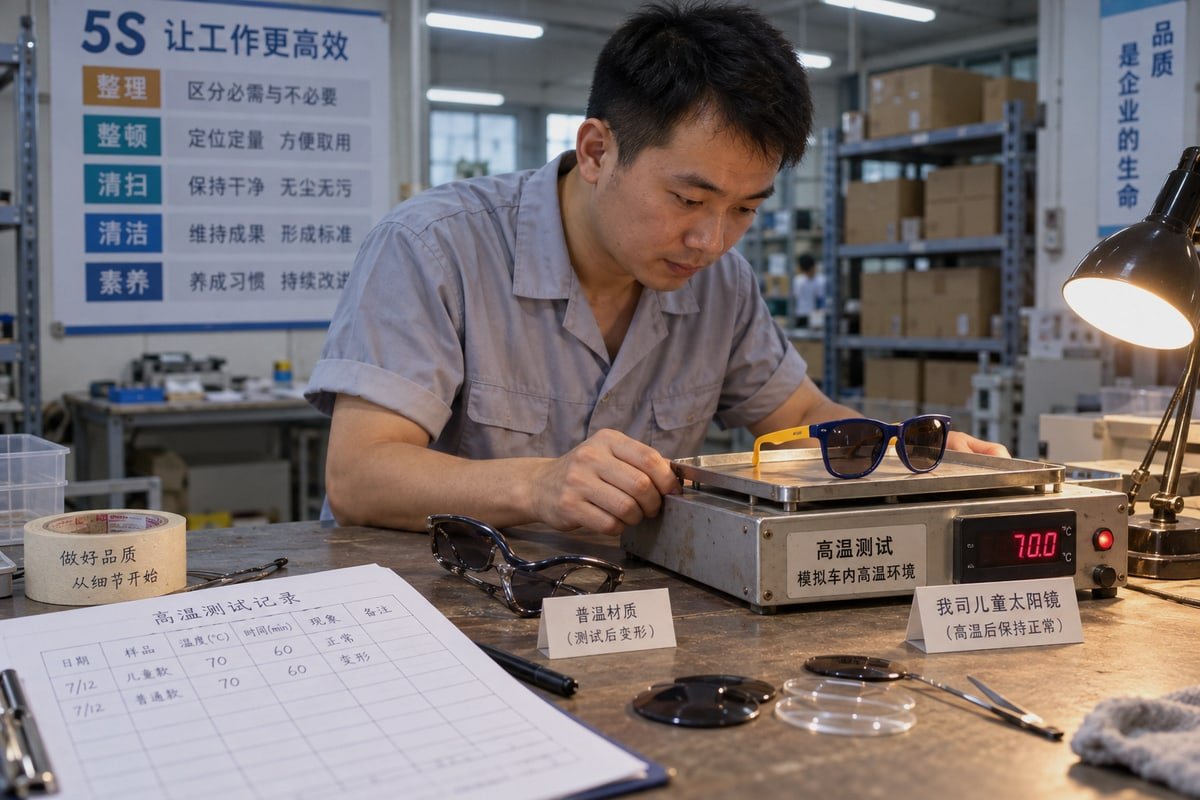
| Heat (car dashboard, ~350°F distortion point) | Holds alignment | Warps at lower temps | Warps and twists easily |
| Deep scratch | Same color underneath | Often reveals base color | Often reveals base color |
| Bend past 90° | Springs back | Snaps or cracks | Stays deformed |
A small drop of nail polish remover on a hidden inner surface will immediately cloud or attack PC and PP. Genuine TR90 shrugs it off. Avoid the burn test for plastics at home — it is a real lab identification method (nylon burns with a distinct smell), but it is unsafe and destructive for consumers.
How Can I Tell TR90 Apart from PC or PP Just by Look and Feel?
During incoming QC at our workshop, our inspectors identify material by touch before any instrument comes out. After fifteen years handling TPEE and TR90 frames daily, the hand knows first.
**TR90 feels warm, matte, and slightly grippy with a weightless quality — about 30–35% lighter than PC or PP. PC feels cold, hard, and glass-like. PP feels waxy and hollow. TR90 color is molded through the material; PC/PP frames are often surface-painted and show mold flash.
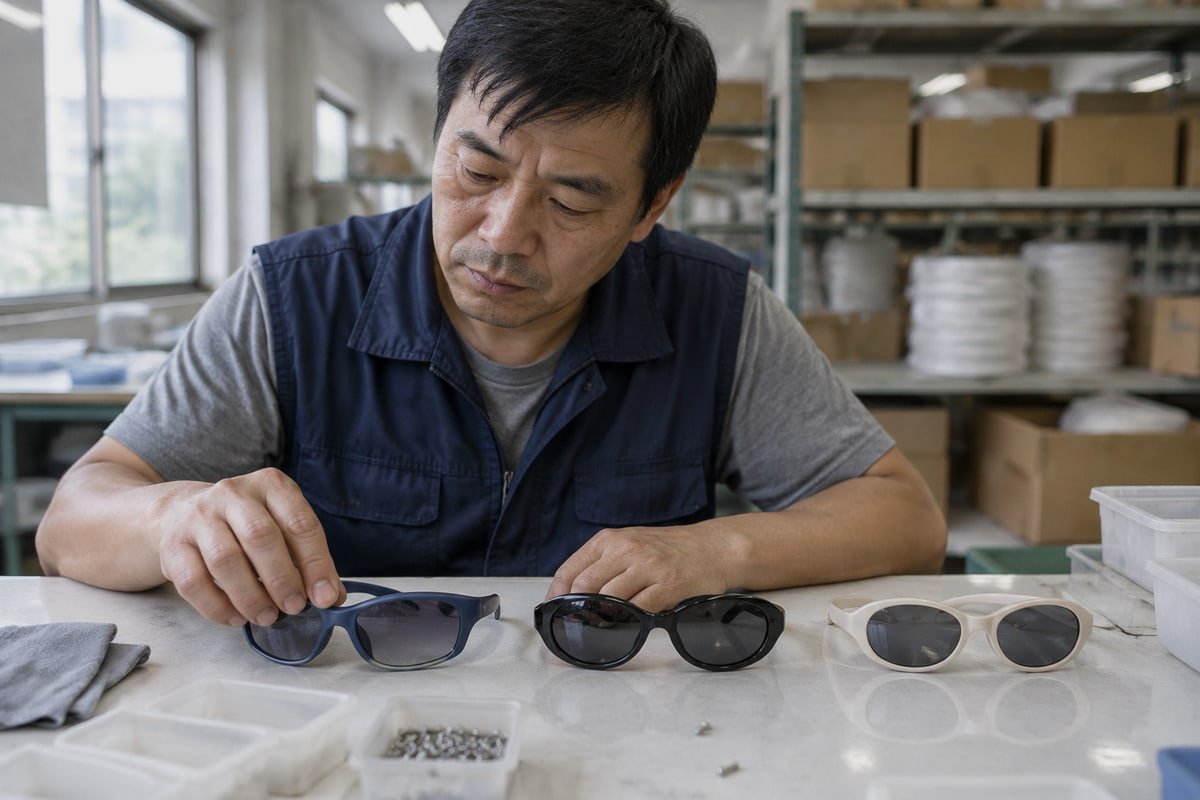
Here is the quick-reference comparison I give buyers who visit our showroom, followed by the details behind each row.
| Clue | Genuine TR90 | PC (Polycarbonate) | PP (Polypropylene) |
|---|---|---|---|
| Weight | Feels weightless | Noticeably heavier | Light but hollow-feeling |
| Surface touch | Warm, slightly grippy | Cold, glass-like | Waxy, slippery |
| Color | Integrated in resin | Often surface-coated | Often surface-coated |
| Mold marks | One tiny injection dimple | Visible seams possible | Messy flash, multiple lines |
| Polarized screen test | Minimal interference | Intense rainbow patterns | Irregular patterns |
Weight: The 30–35% Rule
Pick the frame up. TR90 is approximately 30% to 35% lighter than polycarbonate or polypropylene at the same frame size. On a child's face, this matters enormously — less pressure on the nose bridge, less slipping during play, longer comfortable wear. This lightweight frame durability combination is exactly why we build most of our kids' range in TR90 and TPEE. If a "TR90" frame feels dense in your palm, be suspicious.
Surface Texture and Color Depth
Run your thumb along the temple. TR90 has a distinct warm, slightly grippy texture even in glossy finishes. PC feels cold and hard, almost like glass. Now check a deep scratch or the underside of the nose bridge. TR90 color is mixed into the raw pellets before injection, so the color runs all the way through. Cheap PC/PP frames are frequently spray-painted, and any deep scratch exposes a different base color underneath.
Mold Quality and the Polarized Screen Trick
High-pressure TR90 molding leaves a single, microscopic injection gate dimple, usually hidden at the temple tip. Cheap PP/PC frames show messy flash, rough parting lines, or multiple visible mold seams. One more clever check: hold the clear parts of a frame in front of an LCD screen and view it through a polarized lens. PC shows intense rainbow birefringence stress patterns; TR90 shows much more uniform, minimal interference.
What Questions Should I Ask My Manufacturer to Confirm Genuine TR90 Material?
A procurement manager from a Japanese baby brand once asked us to prove — not just claim — that our frames were TR90. We appreciated it. Serious buyers should always demand evidence, and serious factories should always be able to supply it.
**Ask five things: the exact resin name and grade (such as Grilamid TR90), the MSDS or material datasheet, the resin supplier's origin, compliance references (CE, FDA, REACH, ISO 10993), and whether the factory will accept third-party material verification testing on production samples.
Vague answers are the biggest red flag in sourcing. In our export experience across 20+ countries, suppliers who genuinely buy certified thermoplastic polyamide can answer these questions the same day. Suppliers using disguised PC/PP will stall, deflect, or answer with marketing language.
Question 1: What Is the Exact Resin and Grade?
"TR90" alone is not a specification — it is shorthand. The gold standard is Grilamid TR90, a Swiss material technology from EMS-Chemie, or an equivalent certified PA12 polymer. Watch for weasel phrases: "TR90-style," "TR90-like," "flexible premium plastic." These almost always signal a substitute. A genuine factory can name the resin, the grade, and the supplier without hesitation.
Question 2: Can You Provide the MSDS and Compliance Documents?
Request the Material Safety Data Sheet for the frame resin. Then ask which recognized standards the finished product meets. For kids' eyewear, relevant references include CE marking, FDA compliance 3, REACH chemical regulation, and ISO 10993 4 biocompatibility for skin contact. Impact resistance standards for the lenses matter too — children's sunglasses should pair a resilient frame with impact-resistant lenses and verified UV400 protection. When we developed our TR90 frames with TPEE temples, aligning material documents with lens certification was a core part of the project, because buyers in Europe and Australia will audit both.
The Full Supplier Checklist
| Question | Good Answer | Red Flag Answer |
|---|---|---|
| Resin name? | "Grilamid TR90 / certified PA12" | "High-quality TR90 plastic" |
| MSDS available? | Sent within a day | "It's confidential" |
| Density spec? | 1.14–1.15 g/cm³ documented | No data offered |
| Certifications? | CE, FDA, REACH, ISO 10993 named | "All certificates available" |
| Third-party testing? | "Yes, pick any lab" | Hesitation or excuses |
| BPA-free eyewear materials 5? | Confirmed with documentation | Vague reassurance |
Also verify consistency. The material claim should match across the product page, packaging, spec sheet, and invoice. Keep all documentation — if authenticity is questioned later, that paper trail is your protection.
Why Does It Matter If My Kids' Sunglasses Are Disguised PC/PP Instead of TR90?
The hardest conversation I have had with a new client involved a recall scare. Their previous supplier's "TR90" frames — actually painted PP — were cracking at the hinge and leaving sharp edges. That is when material honesty stopped being abstract for them.
**It matters for safety, comfort, and cost. Disguised PC/PP can snap into sharp fragments, warp in heat, contain BPA or irritating additives, and press painfully on small noses. Genuine TR90 is hypoallergenic, food-grade, shape-retaining, and roughly a third lighter — and you deserve what you paid for.
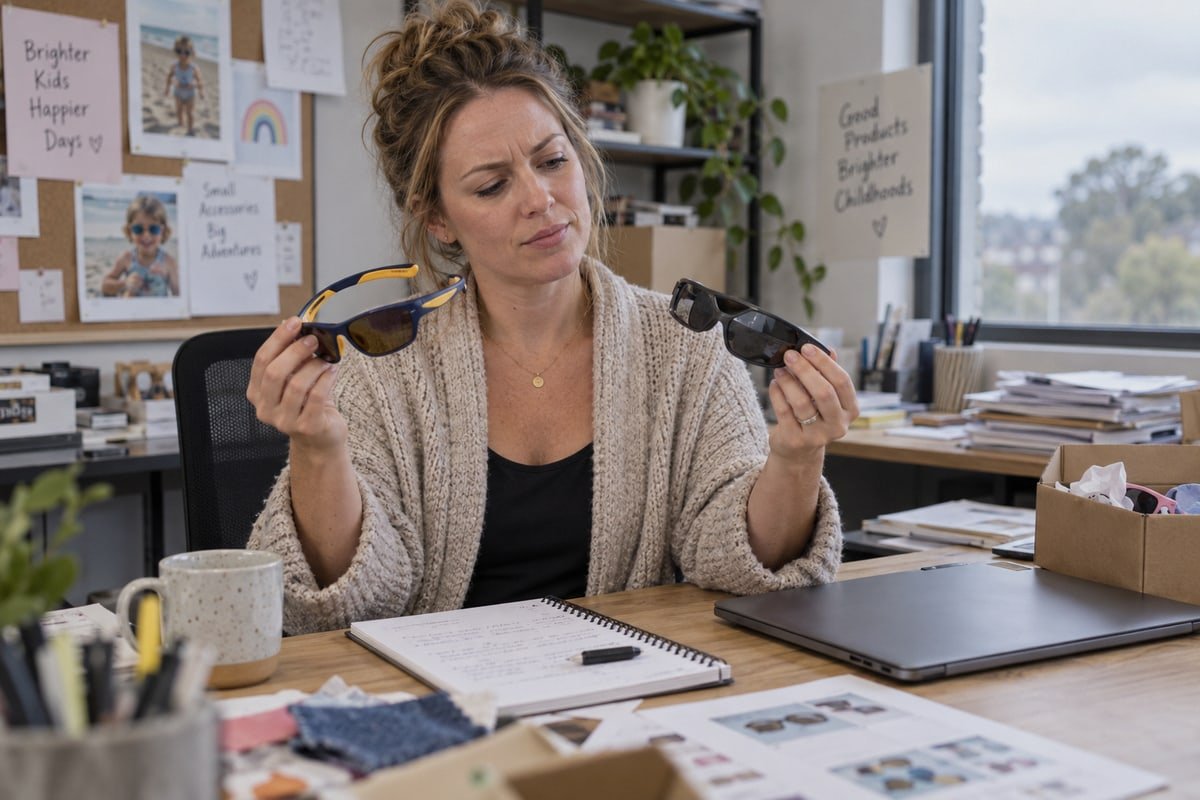
Some buyers push back on this. One common objection: "For kids, fit and UV protection matter more than frame material — so why obsess over TR90?" Fit and UV are indeed critical. If a listing does not state a UV figure, treat the lenses as unprotected, full stop. UV400 or 100% UV protection is non-negotiable regardless of frame material. But this objection sets up a false choice. Material is not secondary; it is what makes fit and protection survive real childhood. A child bends, drops, sits on, and throws sunglasses. A frame that warps loses its fit. A frame that snaps stops protecting anything.
The Safety Dimension
Genuine TR90 is a hypoallergenic, food-grade material that releases no chemical residues onto sensitive skin. That is why hypoallergenic sunglasses frames built from certified thermoplastic polyamide are the default recommendation for children with eczema or contact sensitivity. Cheaper plastics may contain BPA or irritating additives, which is exactly why buyers should insist on documented BPA-free eyewear materials. And on impact: PC lenses are excellent and genuinely impact-resistant — polycarbonate is not a "bad" material. The problem is not PC itself; it is PC or PP frames sold at TR90 prices under a false label.
The Business Dimension for Brands
For a kids' brand, disguised material is a slow-motion liability. Returns rise. Reviews mention cracked temples. Retail partners ask questions you cannot answer. This is why we keep around 800 existing styles in genuine flexible materials — so brands can test the market without heavy mold investment, while knowing every frame's resin identity is documented. A durable frame with a high heat distortion temperature above 350°F also survives the classic killer of kids' sunglasses: the hot car dashboard. Painted PP does not.
Conclusion
Verify, don't trust. Test the flex, feel the weight, check the color depth, demand the Grilamid name and MSDS — and genuine TR90 kids' sunglasses will prove themselves every time.
Interested in sourcing the products mentioned in this article? See details and request a quote here:
Footnotes
1. Authoritative source for European chemical safety regulations mentioned in the procurement checklist. ↩︎
2. Comprehensive technical overview of the material properties of polycarbonate used for comparison in the article. ↩︎
3. Primary regulatory authority for medical devices and eyewear safety standards in the United States. ↩︎
4. Official site for the international standard governing biocompatibility and skin contact safety for materials. ↩︎
5. FDA reference on BPA safety supports claim about avoiding BPA in children’s eyewear materials. ↩︎
More Articles You Might Like
Looking for a Reliable Kids Eyewear Partner?
Explore 800+ ready styles and full OEM/ODM support tailored to your brand.
Get in Touch English
  Español de México
  Deutsch
  Français
  日本語
日本語  العربية
  Português do Brasil