What Is TR90 Kids Optical Frames’ Temperature Resistance? Will They Deform in Heat?
Every summer, buyers ask our Taizhou factory whether TR90 kids optical frames 1 survive the heat. A warped frame means returns, complaints, and lost trust. So we studied the temperature question closely.
TR90 kids optical frames resist everyday heat well, with a heat distortion temperature of roughly 115–135°C and safe long-term use around 80–100°C. They will not warp in normal summer wear, but prolonged exposure inside a hot car or near a heater can soften and deform them.
That short answer hides a lot of detail. Below, I walk through the real numbers, the real risks, how TR90 compares with the TPEE temples we pair it with, and the checks I would want from any supplier. I write from the floor of our own workshop, so the examples are practical, not theoretical.
How Hot Does It Have to Be Before My TR90 Kids Frames Start to Warp?
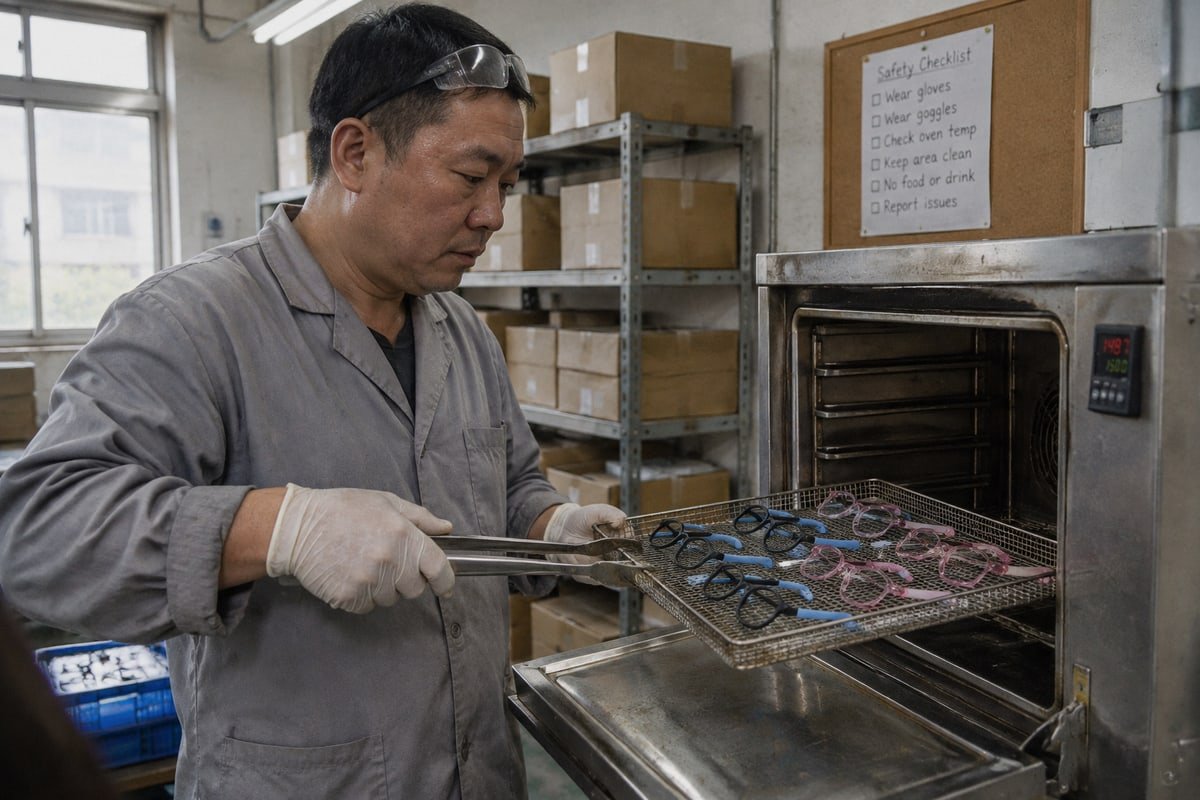
A QC colleague recently pulled a tray of frames from our heat-aging oven and laid each one on its tracing template. That routine check shapes how we answer this question.
TR90 kids frames begin to soften near their heat distortion temperature of about 115–135°C, depending on test load. Long-term use stays safe up to 80–100°C, and short bursts to 120°C are tolerated. Visible warping usually needs sustained heat well above normal summer air temperatures.

What TR90 actually is
TR90 is a thermoplastic polyamide. The best-known grade is Grilamid TR-90 2, a clear nylon developed for eyewear. We buy it as pellets and run it through our own injection molding machines, so the frames leave our line as one-piece injection molded frames 3 with no glued joints. The resin gives kids' eyewear three things at once: low weight, strong impact resistance, and memory plastic properties that let a bent temple spring back to its molded shape.
Why every seller quotes a different number
If you have searched this topic, you have seen figures from 80°C to 400°C. They cannot all be describing the same thing. Here is how I read them.
| Figure you may see | What it most likely means | How much weight to give it |
|---|---|---|
| 80–100°C | Long-term continuous use range | High. This is the practical ceiling for a worn frame. |
| 115–135°C | Heat distortion temperature, which changes with test load | High, but always ask which load was used. |
| 120°C | Short-burst tolerance with no load on the part | Medium. Brief and unloaded only. |
| 350°F (176°C) | Short-term "will not melt" claim on retail pages | Low. Not melting is not the same as keeping shape. |
| 350–400°C | Marketing claims with no test method | Very low. Treat these as errors. |
The honest number for a parent is the long-term range. A frame sits on a warm face, in a school bag, on a sunny table. None of those reach 80°C. So daily wear is not the problem.
The three variables that decide warping
Temperature alone does not tell the story. In our experience, three things must line up before TR90 kids optical frames deform:
- Temperature close to or above the softening zone.
- Time at that temperature. Minutes rarely matter. Hours do.
- Stress on the frame while hot. A frame pressed under a book, or with the temples splayed open, deforms far sooner than a frame lying free.
That third point explains a specific failure. If a TR90 frame is flexed while it sits at its softening point, it can develop permanent opaque stress marks at the bridge or hinge area. Those marks cannot be polished out. So the danger is not just heat. It is heat plus force plus time.
Can I Safely Leave My Child's TR90 Glasses in a Hot Car or Under Direct Sun?
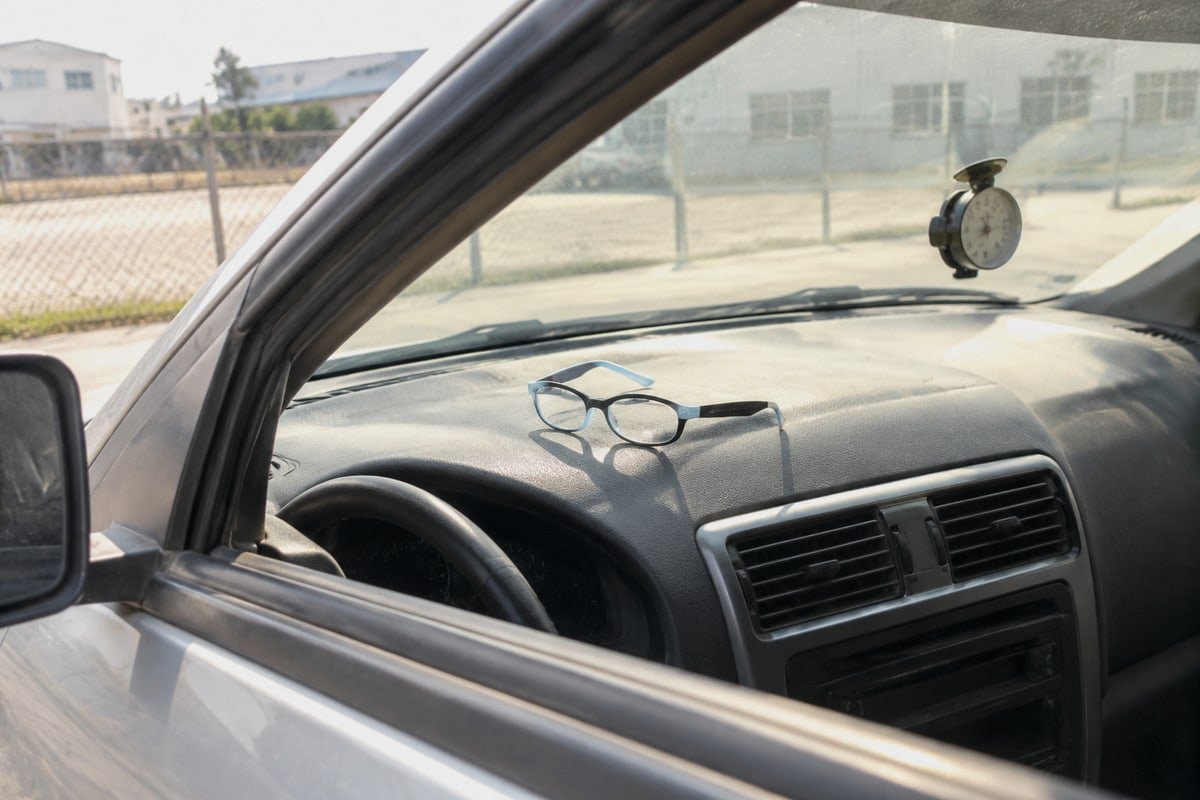
An Australian buyer emailed us a photo of a competitor's frame left on a dashboard in January. The temples had spread wide. We used it in our next care-card draft.
No. Do not leave a child's TR90 glasses in a closed car or on a dashboard. Cabin temperatures can exceed 60°C, which acetate cannot survive and which pushes TR90 toward elastic fatigue over hours. Brief sun exposure on the face is fine; sealed, sustained heat is not.
Ranking the real-world risks
I find it more useful to rank situations than to quote lab numbers to parents. This is the ranking we use when we write care inserts for our OEM customers.
| Scenario | What happens to the temperature | Risk to TR90 kids frames |
|---|---|---|
| Child wearing glasses in direct sun | Frame stays close to skin and air temperature | Low |
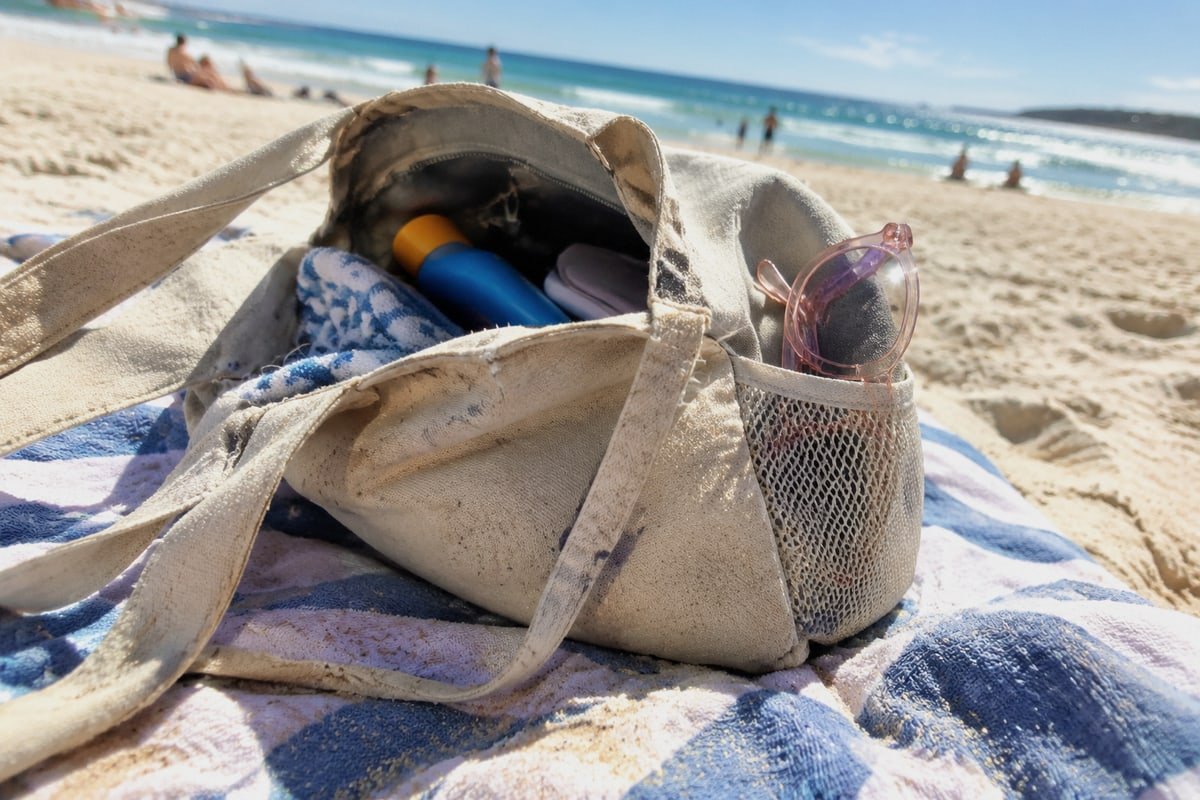
| Beach bag in the sun for an afternoon | Bag interior climbs well above ambient | Moderate |
| Window ledge behind glass | Greenhouse effect for hours | Moderate to high |
| Closed car cabin in summer | Often above 60°C | High |
| Dashboard under the windshield | Hottest surface in the car | Very high |
| Next to a radiator or heater vent | Sustained, localized heat | High |
Notice that the low-risk row is the one parents worry about most. A child playing outside is not the problem. The problem is the frame left behind in a sealed, sun-heated space.
What actually goes wrong in a hot car
Deformation is not the only failure. Four things can happen, and they are worth knowing so you can explain them to your own customers.
- Elastic fatigue. The temples slowly relax outward. The frame no longer grips the head. This is the most common complaint.
- Loose or popped lenses. The TR90 rim expands faster than the lens material. After cooling, the fit is no longer tight. A lens can then drop out during play.
- Stress marks. If the frame is wedged or bent while hot, opaque white marks form at the bridge or hinges. They are permanent.
- Coating damage. Matte or soft-touch finishes can bubble or peel when heat exposure is followed by aggressive ultrasonic cleaning at the optician.
The comparison parents should hear
Acetate begins to warp at around 60°C. A parked car passes that point on an ordinary summer day. So TR90 kids optical frames are a genuinely better choice for families who drive, and we say so. But better is not immune. Our care advice is simple: glasses go in a hard case, and the case goes with the child, not with the car.
Does TR90's Heat Resistance Hold Up as Well as TPEE Temples in Everyday Use?
Choosing between all-TR90 and TR90 fronts with TPEE temples is a trade-off we weigh on almost every kids' project: heat stiffness on one side, face comfort on the other.
Yes, in everyday use both hold up. TR90 fronts offer higher thermal stability and stiffer shape retention, so lenses stay seated. TPEE temples are softer and more elastic, so they flex around heat and rough handling instead of resisting it. Neither should be stored in hot cars.
| Property | TR90 front | TPEE temple |
|---|---|---|
| Material family | Thermoplastic polyamide (nylon) | Thermoplastic polyester elastomer |
| Feel in hand | Firm, light, springy | Soft, rubber-like, very bendable |
| Shape retention | High; holds rim and bridge geometry | Returns from extreme bends, but less rigid |
| Behavior as heat rises | Stays stiff until near its heat distortion temperature | Already pliable, so heat changes it less noticeably |
| Job we give it | Holding lenses securely | Wrapping ears and surviving twisting |
Why we pair the two materials
A rim needs to hold a lens. That calls for stiffness and good thermal stability, which is where TR90 wins. A temple on a six-year-old needs to survive being pulled off sideways, sat on, and chewed. That calls for elasticity, which is where TPEE wins. Our two-tone styles, such as a matte black round front with soft sky-blue temples, are built on exactly this logic. The front keeps its geometry. The temple absorbs the abuse.
How each behaves when it does get warm
TR90 does not gradually go soft. It stays firm, then loses stiffness fairly quickly once it nears the softening zone. TPEE starts softer, so warmth makes it a little more pliable, but there is no sudden loss of grip. In plain terms, a hot TR90 temple can take a new set; a hot TPEE temple tends to just return to shape when it cools. That is one reason we like TPEE arms on toddler frames.
Adjustment, sweat, and skin
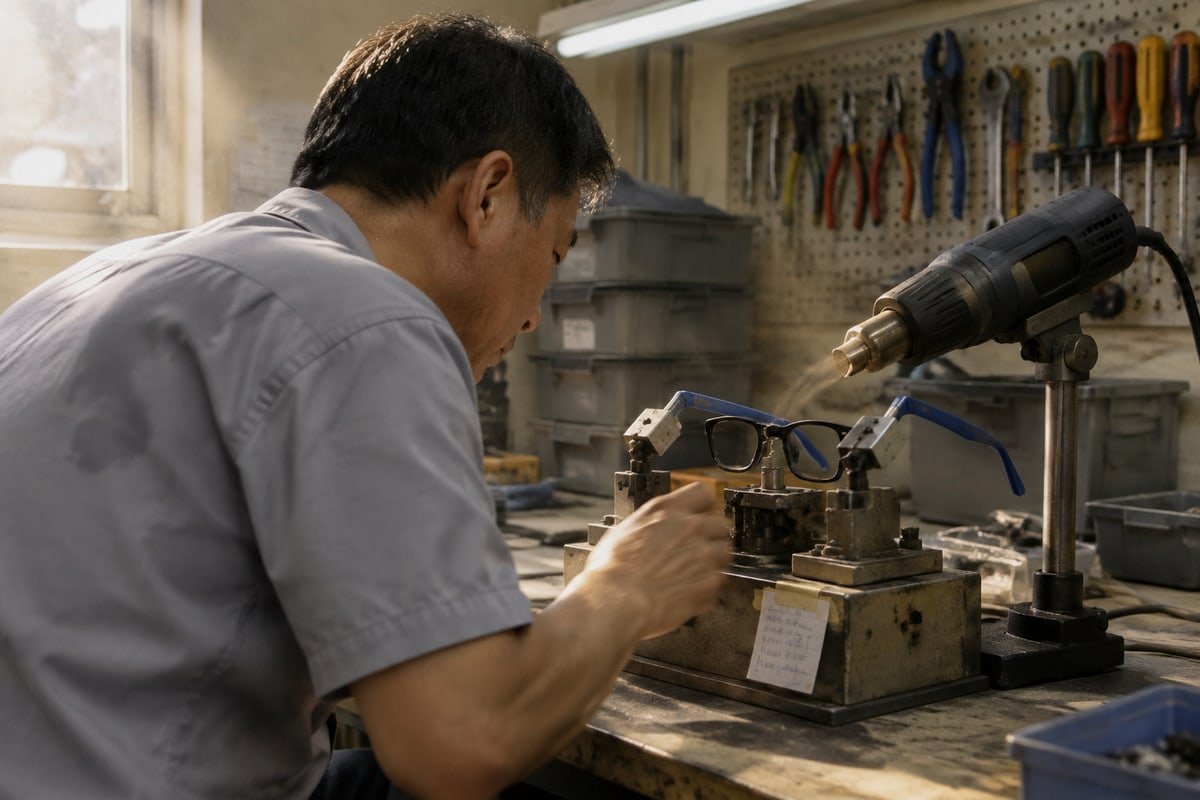
Frame adjustment techniques differ too. An optician usually warms TR90 gently to tweak the temple bend, and that must be done carefully to avoid stress marks. TPEE temples can often be fitted with little or no heat. Both materials resist sweat and skin oils, so they do not turn tacky or discolored during hot outdoor use. Both are also regarded as hypoallergenic material 4, which matters for children with sensitive skin behind the ears. For buyers who want a greener story, castor-bean-derived bio-TR90 is now available and keeps the same thermal behavior as standard grades.
What Quality Checks Should I Ask My Manufacturer to Run to Confirm Heat Stability?
We learned the hard way, years ago, that a frame passing a room-temperature drop test can still fail after a week in a shipping container. Now heat checks come first.
Ask your manufacturer for a heat-aging oven test on finished frames, a lens-retention check after heating, temple flex and hinge tests on heat-conditioned samples, coating adhesion after heat and ultrasonic cleaning, and the resin grade's heat distortion temperature with its test load stated.
A five-step check sequence
This is the order I would request, because each step builds on the last.
- Confirm the resin. Ask for the material data sheet 5 for the actual grade, whether Grilamid TR-90 or an equivalent, with the heat distortion temperature and its test load printed on it. A number without a load is not a specification.
- Heat-age finished frames. Samples from the real production run, not lab plaques, go into an oven at a stated temperature for a stated time. After cooling, each frame is placed on its tracing template and compared to the drawing.
- Check lens retention after heat. Lenses are pressed from behind to confirm the rim still grips. This catches the rim-expansion problem before a lens pops out on a playground.
- Flex and hinge tests on conditioned samples. Temples are opened, closed, and splayed after heat conditioning. Hinge screws are checked for torque loss.
- Coating adhesion. Matte or soft-touch finishes are heat-conditioned, then run through an ultrasonic bath, then tape-tested for lifting.
What each check catches
| Check | Failure it exposes | What to ask for in the report |
|---|---|---|
| Resin data sheet | Vague or exaggerated heat claims | Grade name, HDT, test load |
| Heat-aging on templates | Bridge or rim distortion | Oven temperature, duration, before/after overlay |
| Lens retention | Loose lenses after thermal cycling | Pass/fail on production samples |
| Conditioned flex test | Elastic fatigue and stress marks | Photos of bridge and hinge zones |
| Coating adhesion | Bubbling or peeling finishes | Tape-test result after ultrasonic cleaning |
Why the workshop matters as much as the test
A test is only as reliable as the people running it. Our 5S-managed workshop keeps oven logs, templates, and sample trays in fixed, labelled places, so a frame from last month can be pulled and compared against today's batch. With around 120 workers and fifteen years in eyewear, we have built these checks into the normal flow rather than treating them as a special request. For a brand launching from our roughly 800 existing styles, that means heat stability has already been proven on the tooling before a logo is ever added, and the same checks carry over to full OEM/ODM projects with custom colors, lenses, and packaging.
Conclusion
Heat worries are real, and one warped batch can damage a brand. TR90 kids optical frames handle daily heat well; disciplined storage and heat-focused QC handle the rest.
Interested in sourcing the products mentioned in this article? See details and request a quote here:
Footnotes
1. ISO 12870 is the international standard for spectacle frames, covering requirements for TR90 kids optical frames. ↩︎
2. Official manufacturer documentation for the high-performance Grilamid TR-90 polyamide used in premium eyewear frames. ↩︎
3. Technical overview of the injection molding process used to produce durable, one-piece thermoplastic eyewear frames. ↩︎
4. Definition and context for hypoallergenic materials, which are critical for children’s products to prevent skin irritation. ↩︎
5. ISO 75 is the international standard for determining the heat deflection temperature listed on a material data sheet. ↩︎
More Articles You Might Like



Looking for a Reliable Kids Eyewear Partner?
Explore 800+ ready styles and full OEM/ODM support tailored to your brand.
Get in Touch English
 Español de México
 Deutsch
 Français
 日本語
 العربية
 Português do Brasil