How to Verify Elasticity of Kids’ Optical Frame Memory Material Meets Standard?
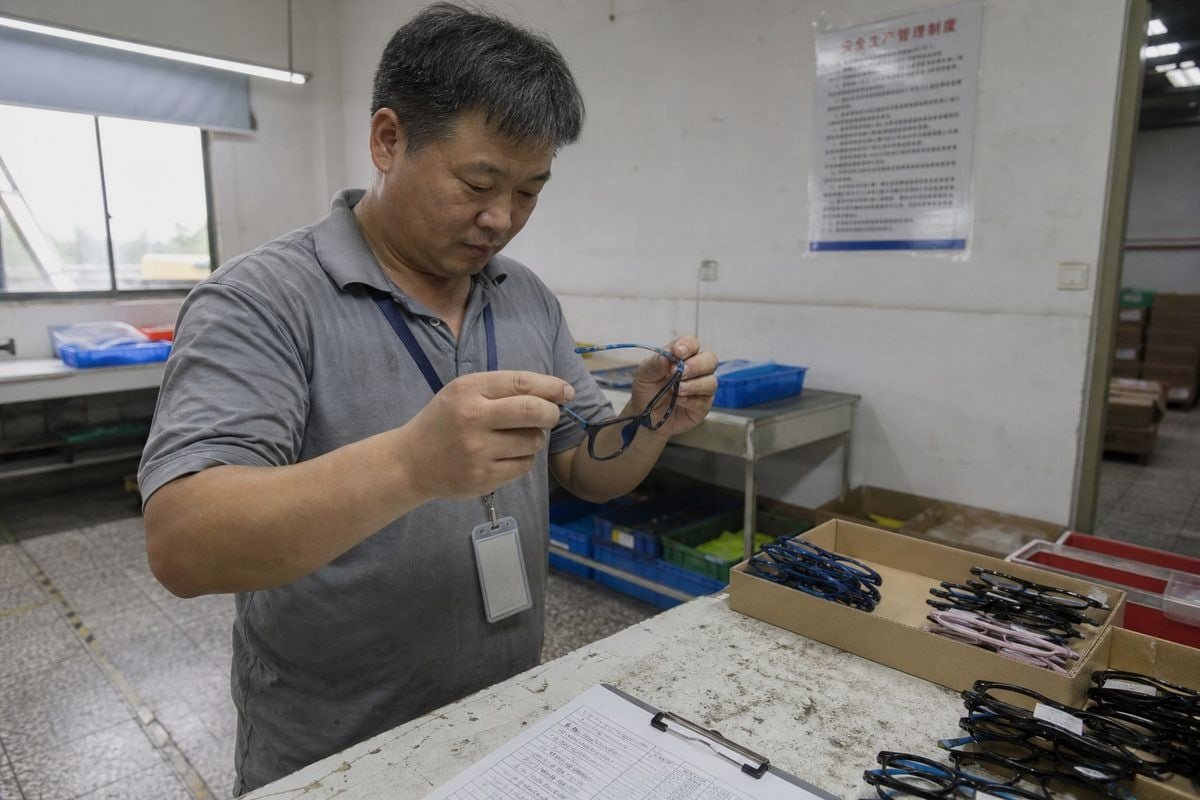
Verifying the elasticity of kids’ optical frame memory material is where I see most buyers get burned. Marketing says “unbreakable.” Our Taizhou production line has seen samples that snap in weeks. The fix? Real testing.
To verify elasticity of kids’ optical frame memory material, confirm the exact polymer name (TR90, Grilamid TR-90), request an ISO 12870 test report showing bridge deformation and 500-cycle endurance results, then run physical bend, twist, and recovery tests on samples under realistic lens load.
That is the short answer. But each of those steps has traps hidden inside it. Below, I break down exactly how to run this verification, question by question, based on what actually happens on a factory floor.
How do I test the flexibility of TR90 memory material before placing a bulk order?
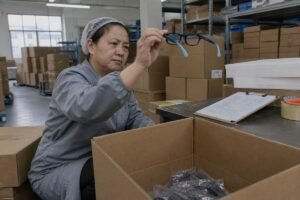
A buyer from Australia once mailed us a competitor's "TR90" sample. Our team bent the temple ninety degrees. It stayed bent. It was cheap PC with a TR90 sticker. That moment shaped how we teach flexibility testing.
Test TR90 flexibility by bending the temple 90 degrees and checking full elastic recovery within seconds, twisting the frame front along its axis, and repeating both actions 20–30 times. Genuine TR90 memory material shows no whitening, cracking, or permanent set after repeated cycles.
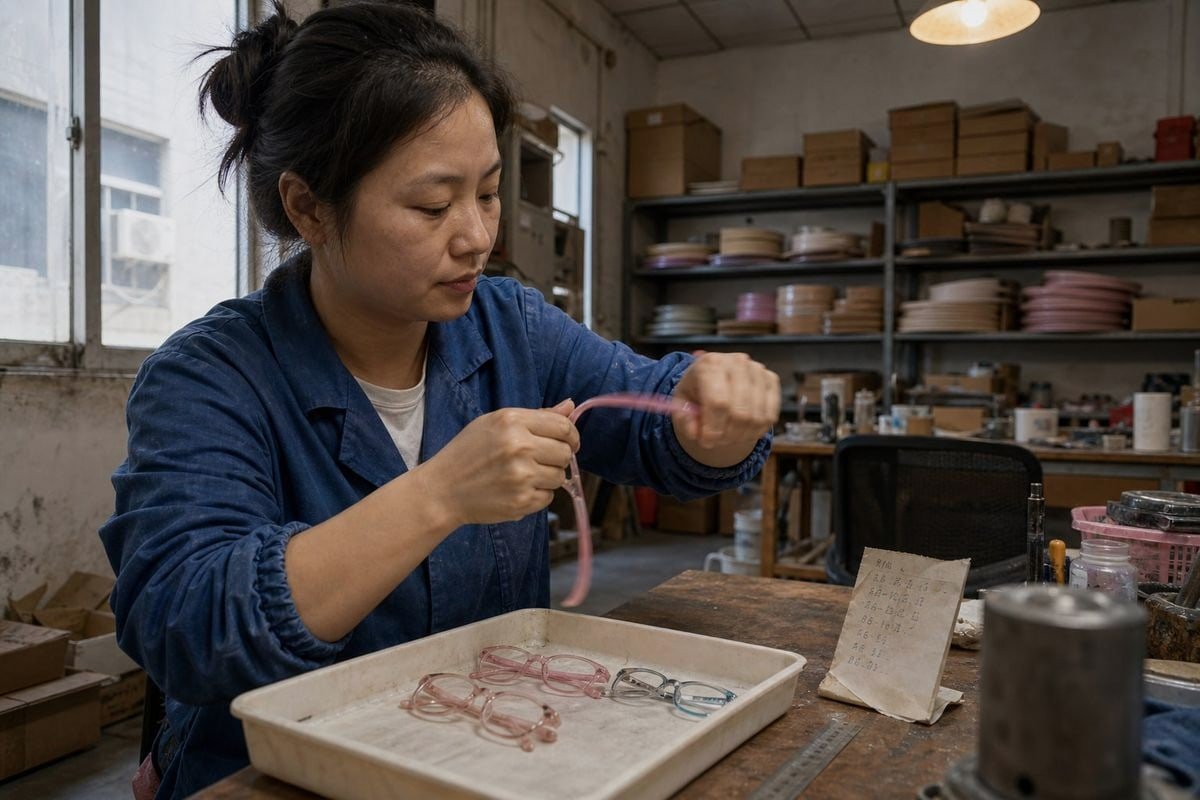
Real TR90 material properties are hard to fake once you know what to look for. TR90 is a polyamide, and Grilamid TR-90 1 is the branded benchmark grade. Its defining trait is a low flexural modulus 2 combined with a high elastic recovery rate. In plain terms, it bends far and springs back fast. Counterfeit or blended material bends, but it either whitens at the stress point or holds a slight curve afterward.
The three-part hands-on test
Here is the sequence we recommend to every new buyer before they commit to a bulk order:
- Bridge flex. Hold both lens rims and gently flex the frame front. It should deform smoothly and return with no visible asymmetry.
- Temple fold-back. Bend each temple outward past 90 degrees. Release. Watch for full return within two to three seconds.
- Repeat cycling. Do both tests 20–30 times on the same frame. Fake material loosens or develops stress marks. Real memory material behaves the same on cycle 30 as on cycle 1.
What to look for at each stress point
| Check point | Genuine TR90 behavior | Warning sign |
|---|---|---|
| Bend area color | No change | White stress lines |
| Recovery speed | 1–3 seconds, complete | Slow or partial return |
| Repeated cycles | Consistent resistance | Force decay, loosening |
| Twist along axis | Springs back symmetrical | Stays skewed |
| Surface after test | Smooth, intact | Micro-cracks near hinge |
One more critical detail: test with lens weight simulated. A frame that flexes nicely when empty can behave very differently with prescription lenses mounted, because load changes the stress distribution across the bridge. We always tell buyers to test at least one glazed sample, not just a demo frame.
What lab certifications should I request to confirm my supplier's flexible frames meet safety standards?
In our 15 years of exporting kids' eyewear to buyers in 20+ countries, one pattern repeats: the buyers who ask for test reports up front avoid nearly every quality dispute later.
Request an ISO 12870 test report for ophthalmic frame durability (covering bridge deformation and 500-cycle endurance), EN 71-1 abuse testing for children under 36 months, biocompatibility or skin-safety certification for the polymer, and ASTM F2516 results if the frame uses shape memory alloy components.

Certifications split into two families, and mixing them up causes confusion. Product standards test the finished frame. Material standards test the raw polymer or alloy. You need evidence from both sides.
The core documents to request
| Standard / Report | What it verifies | Why it matters for kids' frames |
|---|---|---|
| ISO 12870 | Bridge deformation test, 500-cycle mechanical endurance | Proves the frame returns to original geometry after repeated stress |
| EN 71-1 | Toy safety abuse testing, tensile and compression tests | Required logic for frames worn by children under 36 months |
| ASTM F2516 | Superelastic material behavior | Confirms shape memory alloy can take up to 8% strain without permanent plastic deformation |
| Biocompatibility / food-grade cert | Hypoallergenic, no harmful plasticizers | Direct skin contact on a child's face all day |
| Tensile strength testing report | Elongation, elastic limit of the raw polymer | Separates real Grilamid TR-90 from blended imitations |
How to read the report itself
A credible test report is specific. It should state the exact material identification, the test method used, the number of flex or recovery cycles, the load or displacement applied, the pass/fail criterion, and the name of the accredited lab. If any of those elements is missing, ask why. When we hand ISO 12870 compliance documentation to our clients, the cycle counts and deformation limits are printed in black and white, because vague summaries protect nobody.
Also verify the report matches your actual order. A report for one frame model 3 does not automatically cover a different mold, a different colorway with different masterbatch, or a different temple material. Ask your supplier to confirm the tested SKU matches your production SKU.
Can I request physical bend and twist test samples before approving mass production?
Every pre-production package that leaves our workshop includes what we call "sacrifice samples" — frames we expect the buyer to bend, twist, and try to break. Buyers who skip this step negotiate blind.
Yes, and you should. Request 3–5 pre-production samples specifically for destructive testing: bend the bridge, fold temples past 90 degrees, apply multi-axial torsion, and glaze one pair with real lenses. A professional supplier expects this and will supply samples willingly.

The key insight here is that kids do not stress frames the way adults do. Adult frame testing assumes linear bending. Children grab one temple and pull, sit on frames, and twist them off with one hand. That is why multi-axial torsion testing matters more for pediatric frames than the standard linear bend used for adult eyewear. Your sample test protocol should simulate the twist-and-pull mechanics unique to young wearers.
A practical sample-approval protocol
- Order 3–5 identical samples. One stays untouched as the golden reference. The rest get tested.
- Run the bend and recovery cycle. Bridge flex and temple fold-back, 30 repetitions each, checking elastic recovery every 10 cycles.
- Apply twist-and-pull torsion. Grip the frame front, twist the temples in opposite directions, and check whether the frame sits symmetrically afterward on a flat surface.
- Glaze one pair. Have real lenses mounted, ideally as a cold-glazing tension test without heat, then re-run the flex checks. This verifies that elastic recovery stays consistent after lens mounting and prevents long-term frame relaxation.
- Check lens retention. Flex the frame to its practical maximum. Lenses popping out under moderate handling stress is a failure, full stop.
- Document everything. Photograph each frame before and after, and share results with your supplier as the agreed production benchmark.
One objection I hear from buyers: "Isn't destructive testing wasteful before I've even confirmed the order?" My honest answer is the opposite. With around 800 existing styles in our catalog, sampling costs a buyer very little compared to discovering fatigue resistance problems after a container has shipped. A supplier who resists sending test samples is telling you something important about their confidence in their own material.
How do I know if a factory's memory material will stay flexible after months of daily use by kids?
The hardest promise in this business is not day-one flexibility. It is month-six flexibility. When we developed our TR90 frames with TPEE temples, aging behavior — not initial feel — drove every material decision.
Ask for cycle-durability data showing consistent elastic recovery over repeated bends, DMA storage modulus results proving resistance to long-term creep, and heat-exposure test data. Then run your own accelerated check: cycle a sample daily for two weeks and measure any permanent set.
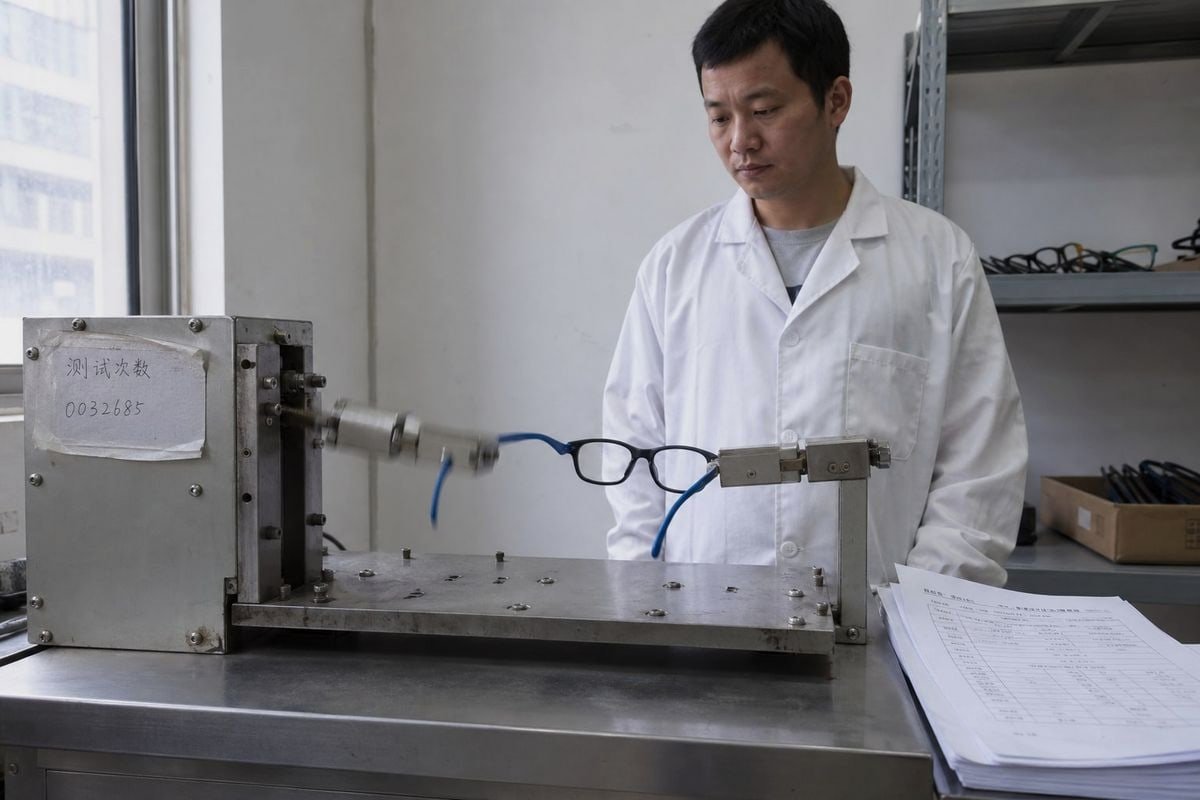
Long-term flexibility depends on three material behaviors that a quick showroom bend test cannot reveal.
The three aging risks and how to check them
| Aging risk | What it means | Verification method |
|---|---|---|
| Elastic creep / sagging | Frame slowly loses shape under constant load | Dynamic Mechanical Analysis (DMA) quantifying storage modulus 4 |
| Force decay | Resisting force drops after repeated use | Cycle testing with force measured at intervals |
| Internal fatigue | Micro-damage builds from molecular friction | Infrared thermography during high-frequency stress cycles to detect localized heat buildup |
DMA is the gold standard here. It measures the storage modulus of the polymer, which predicts whether the frame will suffer elastic creep — that slow sagging that makes six-month-old glasses slide down a child's nose. Infrared thermography adds another layer: localized heat buildup during rapid cycling reveals internal molecular friction, which predicts premature material fatigue before any visible crack appears.
Do not forget heat
Memory polymers have temperature limits. Some memory plastics soften above roughly 110°C, and comparison matters: Ultem (PEI) maintains its elastic memory at thermal thresholds up to 210°C, far above TR90 polyamide. For most children's daily use, TR90 is more than sufficient. But a frame left on a car dashboard in summer, or cleaned in very hot water, can drift outside its intended range and lose recovery performance. We flag this in our care guidance because heat abuse is the most common cause of "the frame stopped springing back" complaints that have nothing to do with material quality.
Here is a counterpoint worth taking seriously: some opticians argue that maximum bendability should not be the top buying criterion at all. Fit, bridge geometry, lens size, and hinge reliability matter just as much for a child's daily comfort. I agree — and that is exactly why long-term testing should include a fit check. A frame that stays flexible but sits crooked, pinches, or leaves red marks will still fail the child. Flexibility is one pillar of ophthalmic frame durability, not the whole building.
Conclusion
Vague "memory" claims cost brands returns and trust. The remedy is simple: verify the material name, verify standardized test reports, and verify samples under real load — before you sign the purchase order.
Footnotes
1. Official manufacturer product page from EMS-Grivory for the Grilamid TR line. ↩︎
2. Technical definition of the physical property that determines the flexibility of eyewear materials. ↩︎
3. ISO 12870 testing is specific to individual frame models and material compositions. ↩︎
4. Scientific explanation of how storage modulus relates to a polymer’s elastic behavior. ↩︎
More Articles You Might Like

August 5, 2026
Bio-Based vs Regular Cellulose Acetate: What's the Difference for Kids' Frames?
August 5, 2026
How Recyclable Are Kids' Optical Frame Materials, and What Eco-Friendly Alternatives Exist?
August 5, 2026
Do Kids Optical Frames Whiten or Age in Storage, and How to Control Warehouse Conditions?
Looking for a Reliable Kids Eyewear Partner?
Explore 800+ ready styles and full OEM/ODM support tailored to your brand.
Get in Touch English
  Español de México
  Deutsch
  Français
  日本語
日本語  العربية
  Português do Brasil