How Is Fatigue Resistance and Temple Bending Tested for TR90 Kids Optical Frames?
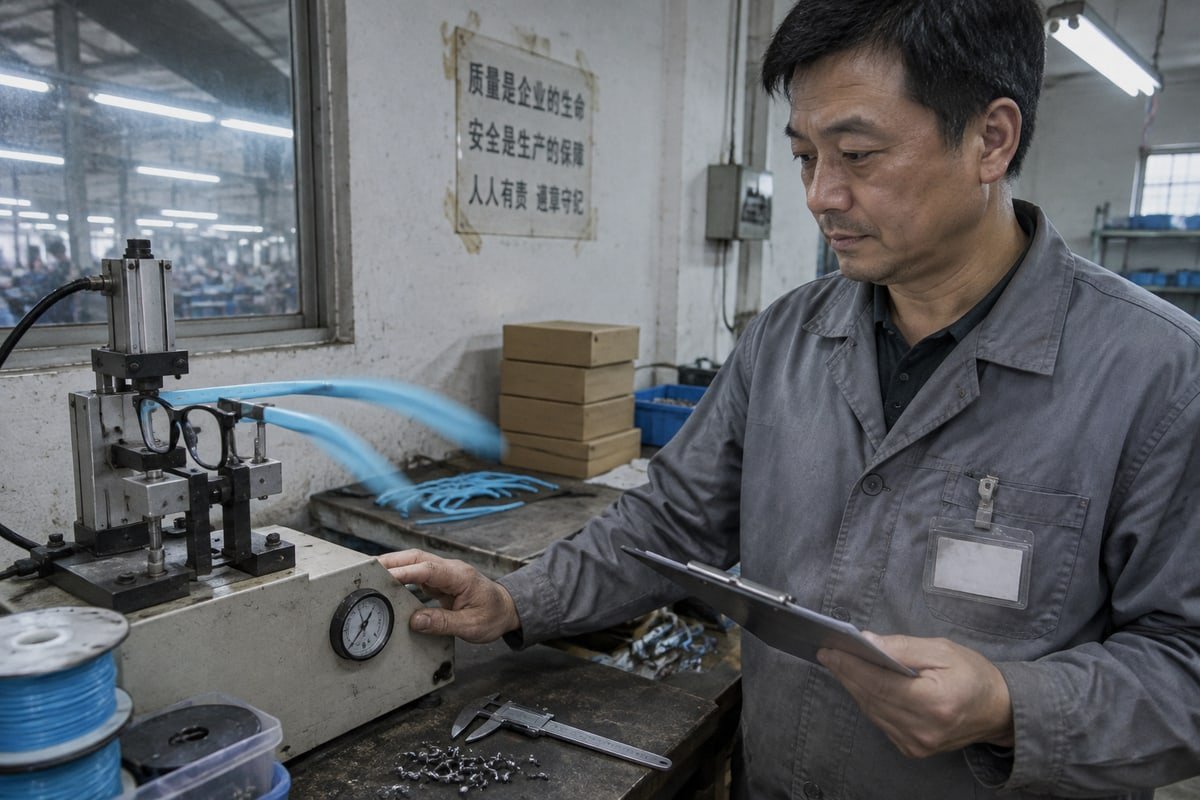
Kids’ glasses break at the temples first. We learned that painfully on our Taizhou line, so fatigue resistance and [temple bending](https://okayeyewear.com/how-frame-flexibility-tested-tr90-tpee-kids-sunglasses-ensure-quality/) testing for TR90 kids optical frames anchors our QC.
Fatigue resistance and temple bending on TR90 kids optical frames are tested by cycling the temples open and closed, 500 cycles under ISO 12870, flexing temples outward to 90–180 degrees, twisting under torsion, and pulling hinges. Frames pass if they show no cracks, whitening, or permanent deformation beyond 5mm.
That is the short version. The longer version matters more if you are sourcing frames for a children’s brand. Below, I walk through the actual test methods, the cycle counts you should expect, why we pair TR90 fronts with TPEE temples, and which documents to ask for before you sign a purchase order.
What Methods Do Manufacturers Use to Test TR90 Temple Flexibility?
Last month a batch of sky-blue TPEE temples came off our molding line slightly stiff. Our QC team caught it on the bending jig before a single frame shipped.
Manufacturers test TR90 temple flexibility with four main methods: cyclic open-close fatigue testing on the hinges, outward temple bending up to 180 degrees, torsional rigidity testing that twists temples in multiple directions, and hinge pull tests. Each method checks for cracking, stress whitening, and loss of shape memory.
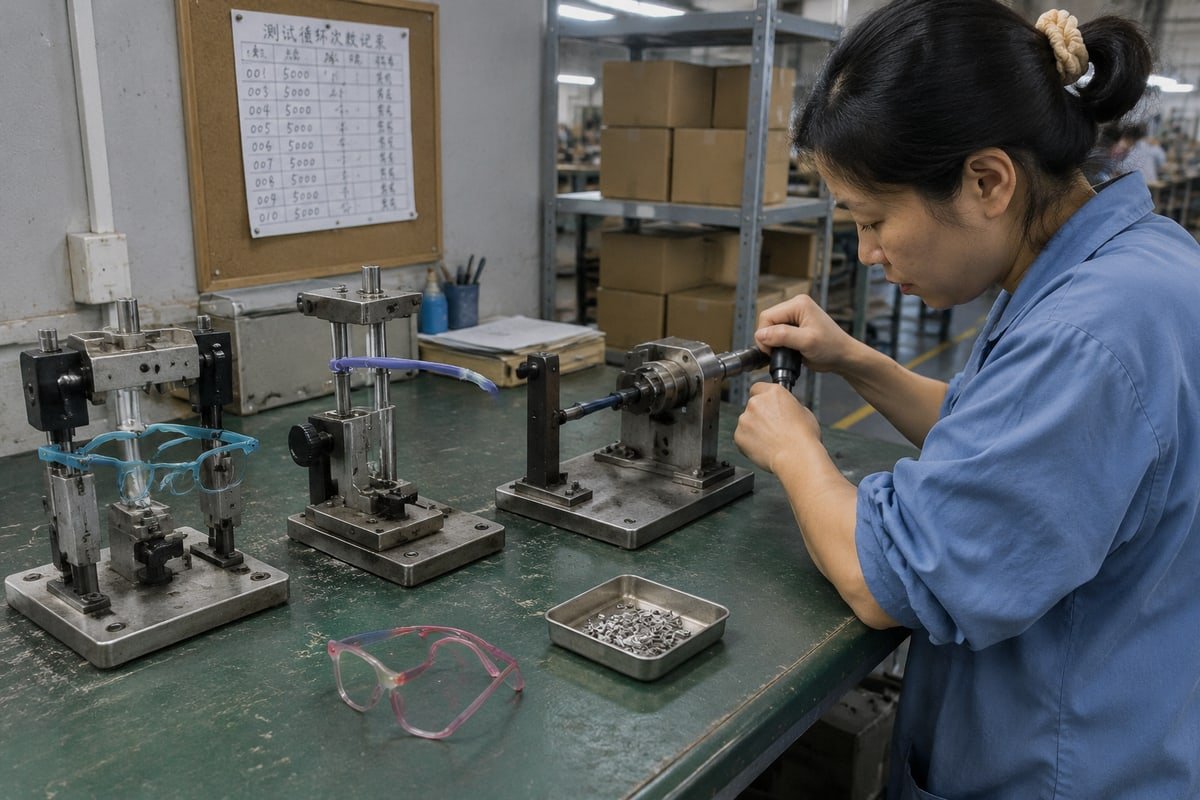
Flexibility testing is not one test. It is a group of tests that each target a different way a child breaks glasses. On our workshop floor, we split them into material-level checks and frame-level checks. Material checks tell us whether the TR90 resin or TPEE compound is behaving as it should. Frame checks tell us whether the finished product, hinges and all, will survive a school year.
The core mechanical tests
| Test | What it does | What we look for |
|---|---|---|
| Cyclic fatigue testing (open-close) | Opens and closes the temples repeatedly on a motorized rig | Hinge looseness, screw back-out, cracks at the end piece |
| Temple bending | Flexes each temple outward, often to 90 or even 180 degrees | Stress whitening, kinking, failure to spring back |
| Torsional rigidity test | Twists the temple around its own axis in several directions | Micro-cracks at the temple-frame junction, permanent twist |
| Hinge pull test | Applies a sudden jerk to the temple away from the front | Hinge separation, rivet or insert pull-out |
| Bridge deformation test | Pushes the front outward, then releases | Whether the frame returns to its original width |
The torsional test deserves a special note. Kids rarely bend temples along one clean axis. They pull glasses off with one hand, sit on them, or shove them into a backpack pocket. Multi-directional twisting gives a far more realistic picture of mechanical durability for pediatric use than single-axis bending alone.
Environmental and secondary checks
Good eyewear quality control also looks beyond the bench. We expose sample frames to perspiration and sebum simulants, because environmental stress cracking 1 can start fatigue long before a child ever bends the temple. Some labs run cryogenic flexibility tests, since ordinary polymers turn brittle in cold weather. A few advanced labs use ultrasonic scanning to find internal stress whitening before it becomes a visible crack. And yes, there is such a thing as a simulated chew-cycle test. Children chew temple tips, so saliva exposure and polymer migration get checked too.
What a passing temple looks like
A passing temple springs back smoothly. It shows no white stress lines at the bend. The hinge tension feels the same after the test as before. And the temple bend behind the ear still lands at the ear-skull junction without pressing on the mastoid. Shape memory flexibility only counts if the frame still fits afterward.
How Many Bending Cycles Should I Expect Before Frame Failure Occurs?
A procurement manager from Australia once asked me why one supplier promised 50,000 cycles while another promised 500. Both numbers were true. They measured different things.
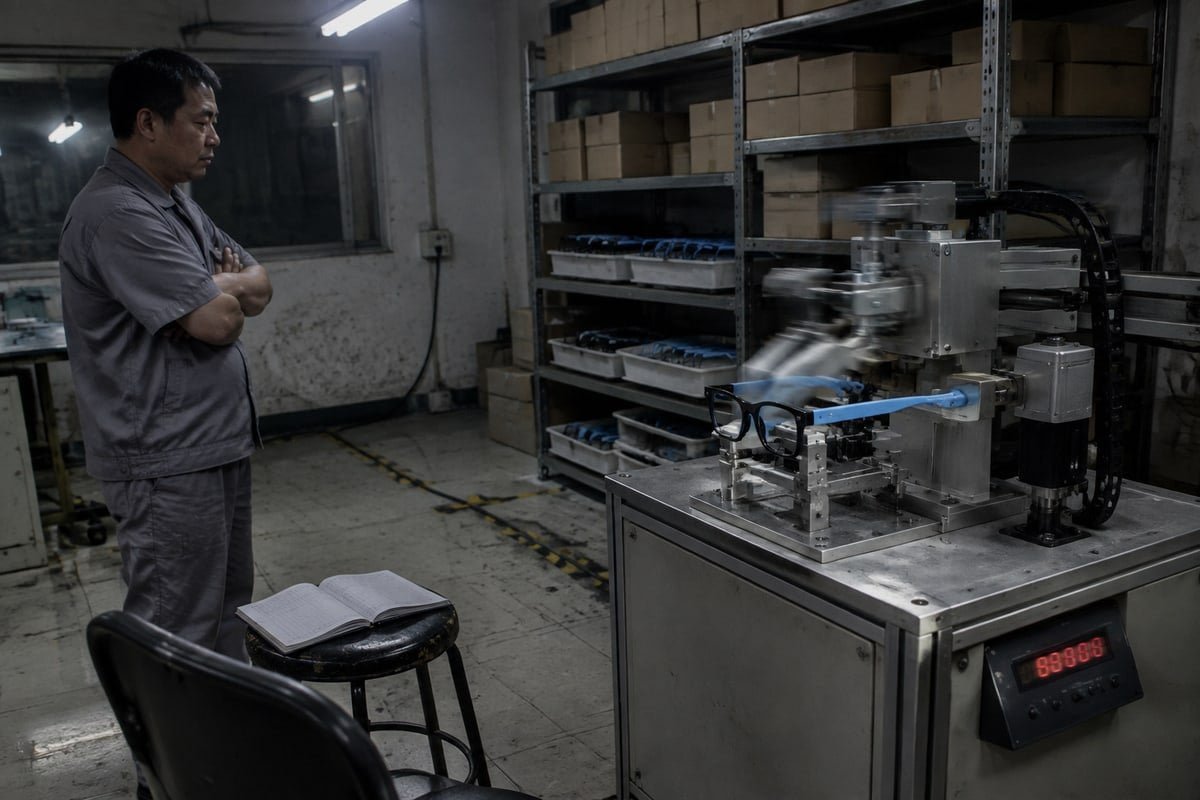
Under ISO 12870, a TR90 kids frame must survive at least 500 mechanical open-close cycles with no structural failure and temple-tip deviation under 5mm. Well-made TR90 frames usually exceed this, and factory tests often run 5,000 to 50,000 flex cycles, though such figures are internal benchmarks, not certified results.
Cycle counts confuse many buyers, and I understand why. The market throws around very different numbers. Some are standard-based. Some are factory-internal. Some are pure marketing. Let me separate them.
Three kinds of cycle numbers
| Cycle count | Source | What it actually tells you |
|---|---|---|
| 500 cycles | ISO 12870 standards endurance test | Minimum pass threshold for hinge and frame integrity |
| 5,000–10,000 cycles | Typical factory hinge endurance testing | Confidence that the frame comfortably clears the standard |
| 50,000+ cycles | Supplier marketing claims | Meaningful only if backed by a lab report and stated test conditions |
The ISO figure is the only one with a defined method behind it. The frame is opened and closed 500 times on a rig. After that, the lab measures the distance between the temple tips and compares it to the pre-test distance. The maximum allowable deviation is 5mm. A frame that spreads wider than that has lost its memory and fails, even if nothing visibly broke.
What failure actually looks like
In our experience, TR90 kids optical frames almost never snap during cycle testing. Failure shows up in quieter ways. The hinge loosens. A screw backs out. The end piece develops a hairline crack. The temple tips drift outward so the frame no longer grips the head. This is why we say fatigue resistance is not about bending without breaking. It is about keeping shape, hinge function, and fit after many cycles.
The unbreakable objection
Buyers sometimes ask us for unbreakable glasses technology. I push back gently on that phrase. No frame is unbreakable. A child can defeat any polymer with enough force. What we can promise is controlled durability: a documented cycle count, a measured tip deviation, and a hinge that holds tension. That is a promise you can verify. A slogan is not.
Kids versus adults
Adult frames see gentle open-close motion a few times a day. Kids' frames see pulling, dropping, backpack compression, and being worn on top of the head. So we treat the ISO number as a floor, not a target, for every children's style in our catalog.
Why Does TPEE Temple Material Improve Fatigue Resistance Compared to Standard Plastics?
Every time we pair a TR90 front with TPEE temples, we weigh softness against crisp shape. Softer temples survive more abuse but can feel less precise.
TPEE improves fatigue resistance because it is a thermoplastic elastomer with a high elastic limit and true shape memory flexibility. It stretches and returns without stress whitening, stays flexible in cold, and absorbs twisting loads that cause micro-fractures in rigid plastics like standard polycarbonate or acetate.
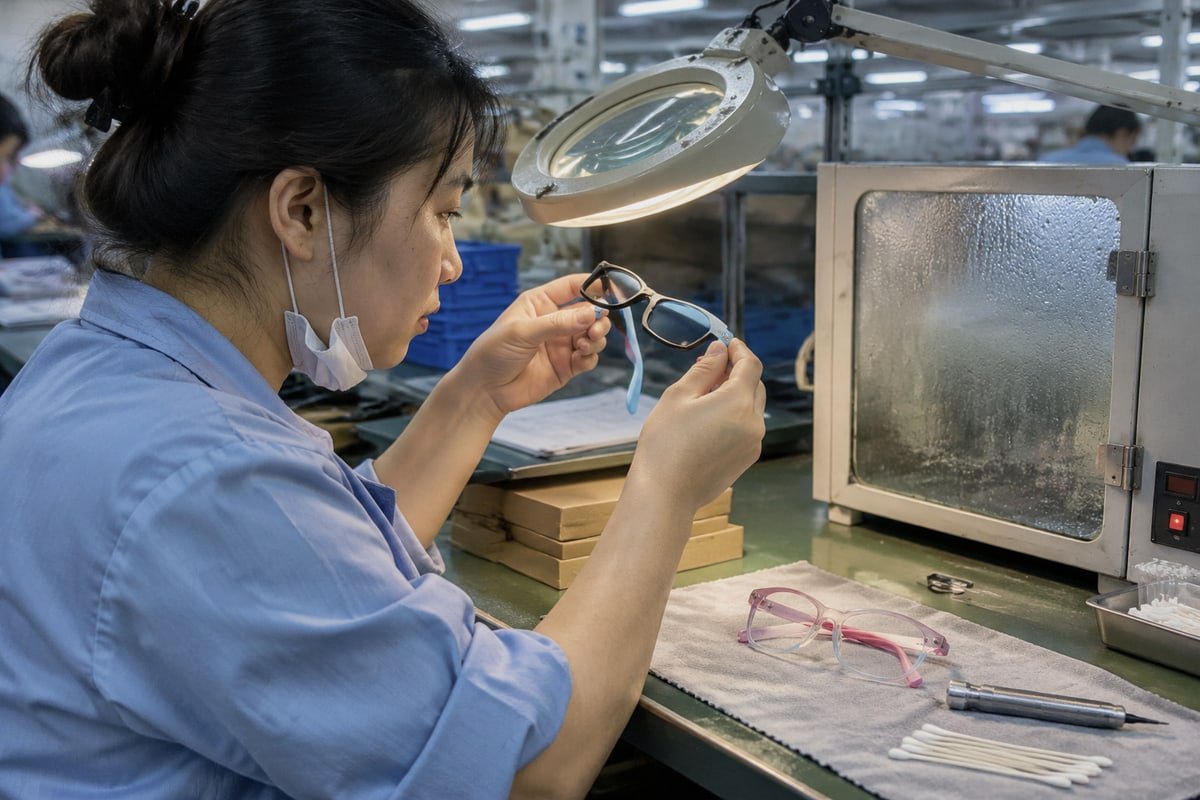
To understand why we mix materials, it helps to know what each one does well. TR90 is a nylon-based material, often sold under the Grilamid name. Grilamid material properties include low weight, good impact resistance, and solid shape recovery. That makes it an excellent front rim. TPEE goes one step further on the elastic side. It behaves more like a spring than a stiff beam.
How the materials compare
| Property | TR90 (Grilamid) | TPEE | Acetate / standard PC |
|---|---|---|---|
| Flexibility | High | Very high | Low to moderate |
| Shape memory after bending | Good | Excellent | Poor; may take a permanent set |
| Stress whitening at the bend | Rare | Very rare | Common |
| Cold-weather brittleness | Low | Very low | Moderate to high |
| Weight | Very light | Light | Heavier |
| Shape precision and finish | Good | Softer edges | Excellent |
Why the temple is the right place for TPEE
The temple carries the most repeated stress on any pair of glasses. It bends every time the frame goes on or comes off. It twists when a child tugs it. It compresses in a backpack. A rigid plastic handles a few of these loads and then fatigues. It develops micro-fractures near the hinge, and one day it snaps. TPEE absorbs those cycles. Its tensile strength 2 is lower than a rigid plastic, but its elastic limit is much higher. It stretches, then returns, over and over.
Our matte black round frame with sky-blue temples is a good example. The TR90 front keeps the lens seat rigid and the keyhole bridge stable. The TPEE temples take the punishment. The child gets impact resistance safety 3 at the front and fatigue resistance at the sides.
The honest trade-off
Flexible does not automatically mean better. Too much spring-back can make a frame feel unstable on a small face. TPEE also limits how sharp an edge or how glossy a finish we can achieve. So thermoplastic frame performance 4 is always a balance. We tune temple thickness and the bend profile so the frame stays planted without pinching. Durability is one part of quality. Fit and comfort are the other parts.
What Quality Certifications Should I Request to Verify Durability Testing Results?
Years ago we shipped a test report in our own cycle count format. The European buyer could not compare it to anything. Now we align every report to ISO 12870.
Request an ISO 12870 mechanical test report from a third-party lab covering the 500-cycle endurance test, bridge deformation, and temple deviation results. Also ask for hinge pull test data, environmental stress cracking results, and material data sheets for TR90 and TPEE. Treat unbranded cycle-count claims as marketing.
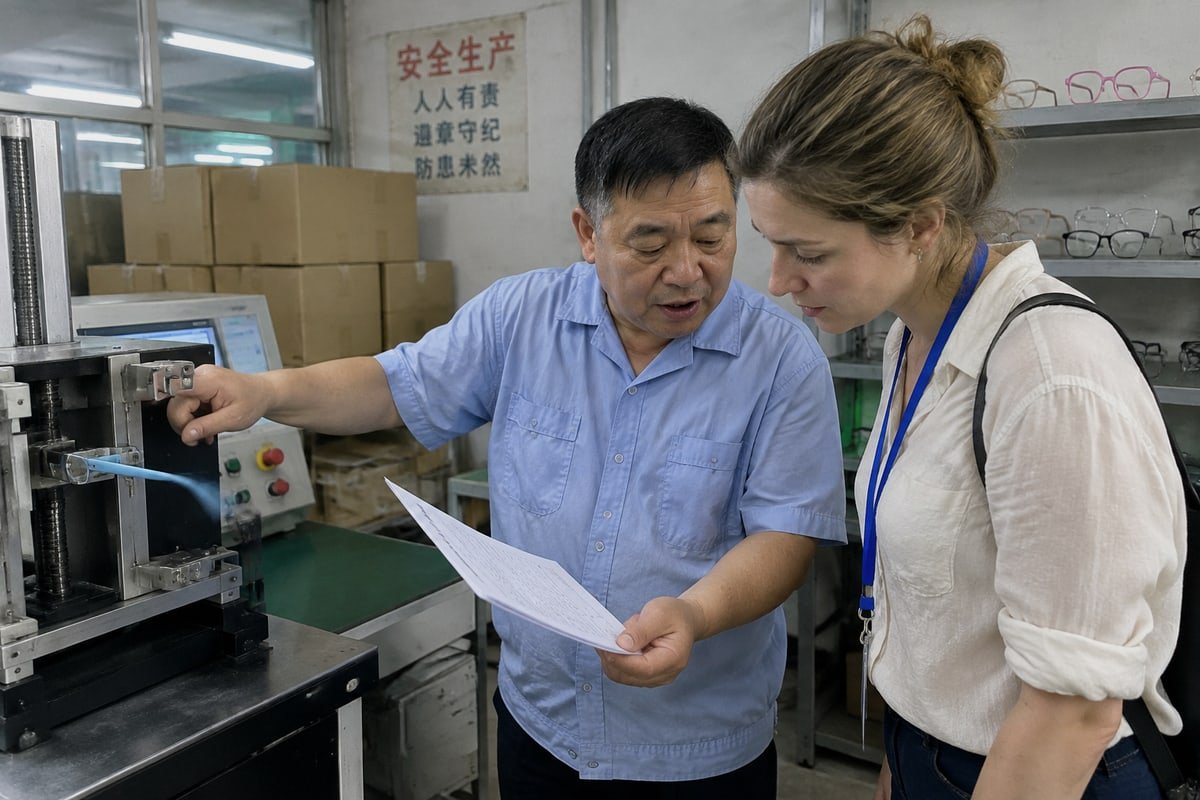
Certifications and reports are where many sourcing conversations go wrong. Buyers ask for "a certificate." Suppliers send a one-page letter with a logo. Neither side gets what it needs. What you want is traceable evidence that a specific frame style, from a specific production batch, passed a specific test. Here is how I would structure that request.
A practical document checklist
- ISO 12870 mechanical test report. Ask that it name the lab, the test date, the style number, and the result for the endurance test, the bridge deformation test, and temple-tip deviation.
- Hinge pull test result. For children's frames this matters as much as cycling. The temple-to-front connection must survive a sudden snag.
- Environmental stress cracking result. Perspiration and sebum exposure should be listed, since these accelerate fatigue on TR90.
- Material data sheets. These confirm the resin grade for the TR90 front and the TPEE compound for the temples. They are not test results, but they let you check that the supplier is using what it claims.
- Factory internal QC record. This is where hinge endurance testing beyond 500 cycles usually lives. It is useful context, not a substitute for the lab report.
- Your market's own compliance requirements. Australia, Japan, and the EU each have their own rules for children's products. Confirm those separately with the supplier before ordering.
Lab testing versus factory testing
Both have value, but they answer different questions. A third-party lab answers "does this frame meet the standard?" Our factory bench answers "is this batch consistent with the approved sample?" We run flex checks on incoming temple material and on finished frames from each production lot. That is routine eyewear quality control. It does not replace a lab report, and we tell buyers that plainly.
Why this protects your brand
If a parent complains that a frame broke, you want to show a report, not a slogan. A documented ISO 12870 result 5 gives your customer service team something concrete. It also gives you a clear basis for holding a supplier accountable. On our side, working from about 800 existing styles means many of those styles already carry test history, which shortens the path from sample approval to a retail-ready order.
Conclusion
Kids destroy frames at the hinges and temples. That is the risk. The answer is TR90 fronts, TPEE temples, and ISO 12870 test reports you can actually verify.
Interested in sourcing the products mentioned in this article? See details and request a quote here:
Footnotes
1. Wikipedia provides a technical overview of environmental stress cracking in polymers. ↩︎
2. Wikipedia explains the mechanical concept of tensile strength in materials science. ↩︎
3. The FDA regulates eyewear as medical devices, ensuring impact resistance and safety standards. ↩︎
4. EMS-GRIVORY is a leading manufacturer of high-performance thermoplastics used in durable eyewear frames. ↩︎
5. ISO is the primary international body for eyewear standards like ISO 12870. ↩︎
More Articles You Might Like


Looking for a Reliable Kids Eyewear Partner?
Explore 800+ ready styles and full OEM/ODM support tailored to your brand.
Get in Touch English
 Español de México
 Deutsch
 Français
 日本語
 العربية
 Português do Brasil