How to Test for Frame Distortion and Lens Dislodgement in Kids Optical Frames When Sourcing?
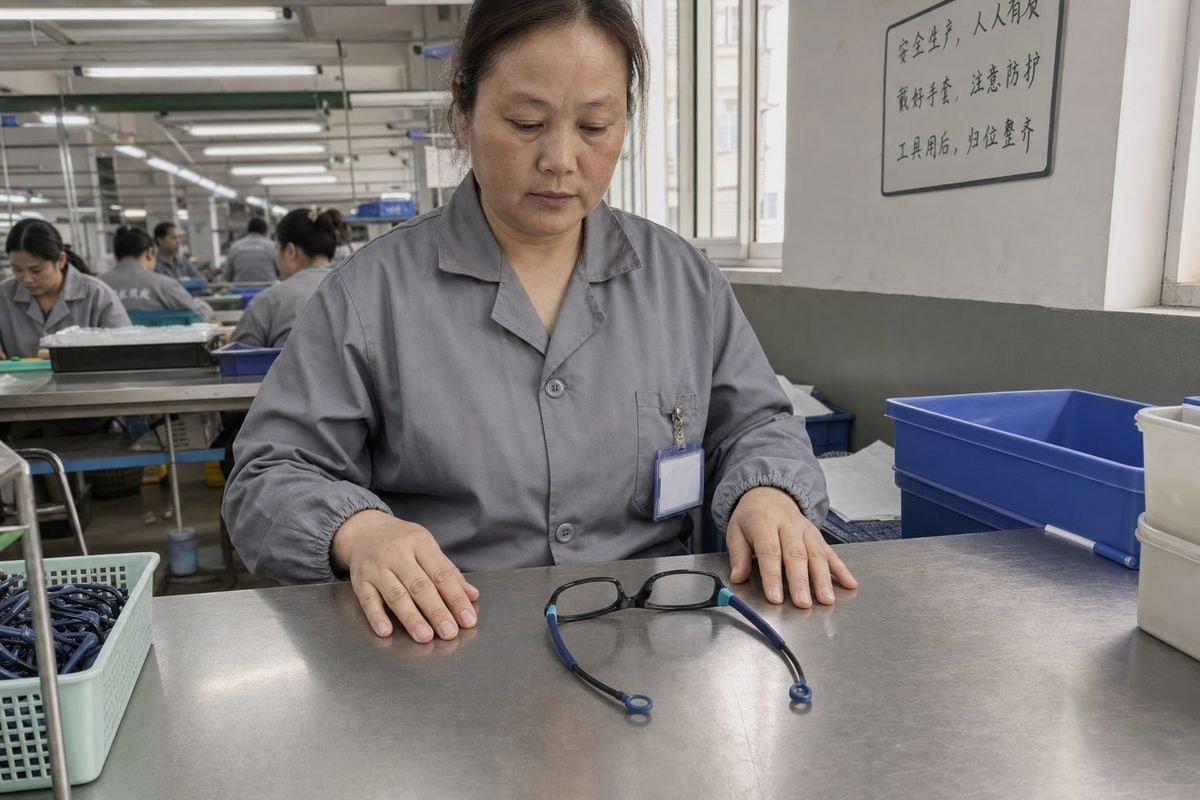
Frame distortion and lens dislodgement in kids optical frames can quietly ruin a launch. On our production line, we have seen one warped batch trigger returns, complaints, and lost retail trust.
To test kids optical frames for frame distortion and lens dislodgement, run a flat-surface four-point touch test, check temple and bridge symmetry, press the lens rim to confirm secure seating, perform flex and drop tests, and verify results against ISO 12870 and children’s eyewear safety standards.
These tests sound technical, but they are simple to run. Below, I will walk you through each one, step by step, exactly as we do them in our own workshop.
What Testing Methods Can I Use to Check Frame Flexibility Before Placing a Bulk Order?
Last spring, a buyer from Australia sent back a competitor's sample that snapped at the temple after two twists. Our QC team uses that sample in training to this day.
Before a bulk order, test frame flexibility with a temple twist test, a full-frame flex test, a four-point touch check on a flat surface, and repeated open-close hinge cycling. Quality TR90 frame material and TPEE temples should return to shape with no whitening, cracking, or permanent warp.
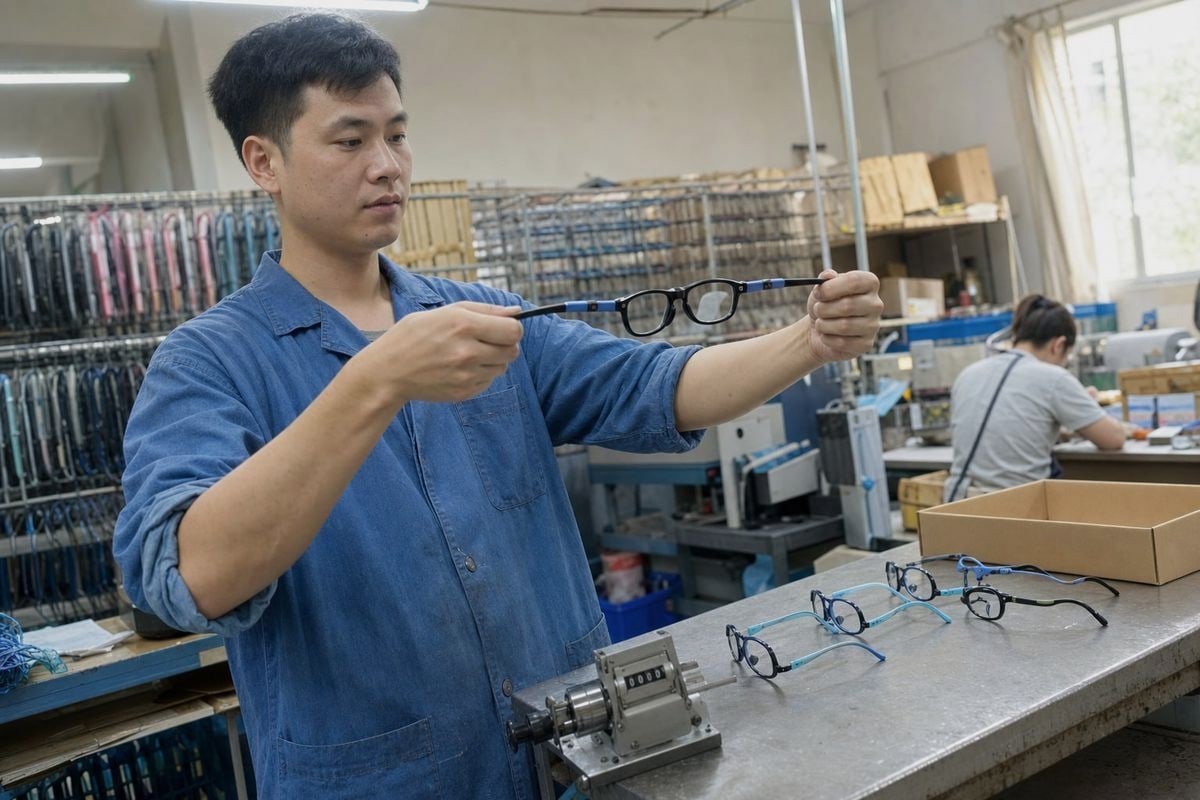
Flexibility testing is the first gate in eyewear quality control, because children bend, sit on, and pull their glasses daily. A frame that cannot flex and recover will distort long before the lenses ever fall out. In our 5S-managed workshop, we run these checks on every pre-production sample and again on random units from each bulk run.
The Four-Point Touch Test
Place the frame upside down on a flat table with temples open. Both temple tips and both lens rims should touch the surface evenly. If the frame rocks, the front is twisted or one temple sits higher than the other. This is the fastest bench screen for dimensional stability, and it costs nothing to perform.
Flex and Recovery Tests
Gently twist the frame front, bend the temples outward past their normal spread, and release. Good TR90 frame material and TPEE recover instantly. Watch for stress whitening near the hinges and bridge — that pale line means the polymer is fatigued and will fail in a child's hands.
| Test | How to Perform It | Pass Criteria | Reject Signal |
|---|---|---|---|
| Four-point touch | Rest frame on flat surface | No rocking, even contact | Any wobble or tilt |
| Temple spread flex | Open temples 15–20° past normal | Full return to shape | Permanent splay or whitening |
| Front twist | Twist frame front gently | Springs back symmetrically | Residual warp |
| Hinge cycling | Open/close temples 50+ times | Consistent tension | Loosening or squeaking |
We also recommend asking your supplier for temperature cycling data. Frames stored in hot shipping containers can soften and warp, so material behavior between roughly -10°C and 55°C matters for real-world hinge durability and shape retention.
How Do I Verify That Lenses Stay Securely Fitted Under Everyday Stress and Impact?
There is a trade-off we weigh on every new style: a tighter lens groove holds lenses firmly, but too much tension stresses the rim and can crack it during assembly.
Verify lens retention by pressing around the lens rim to check for movement, performing a shake test, flexing the frame while watching the lens seat, and running impact resistance testing such as the drop ball test. Lenses must not shift, rotate, rattle, or pop out.
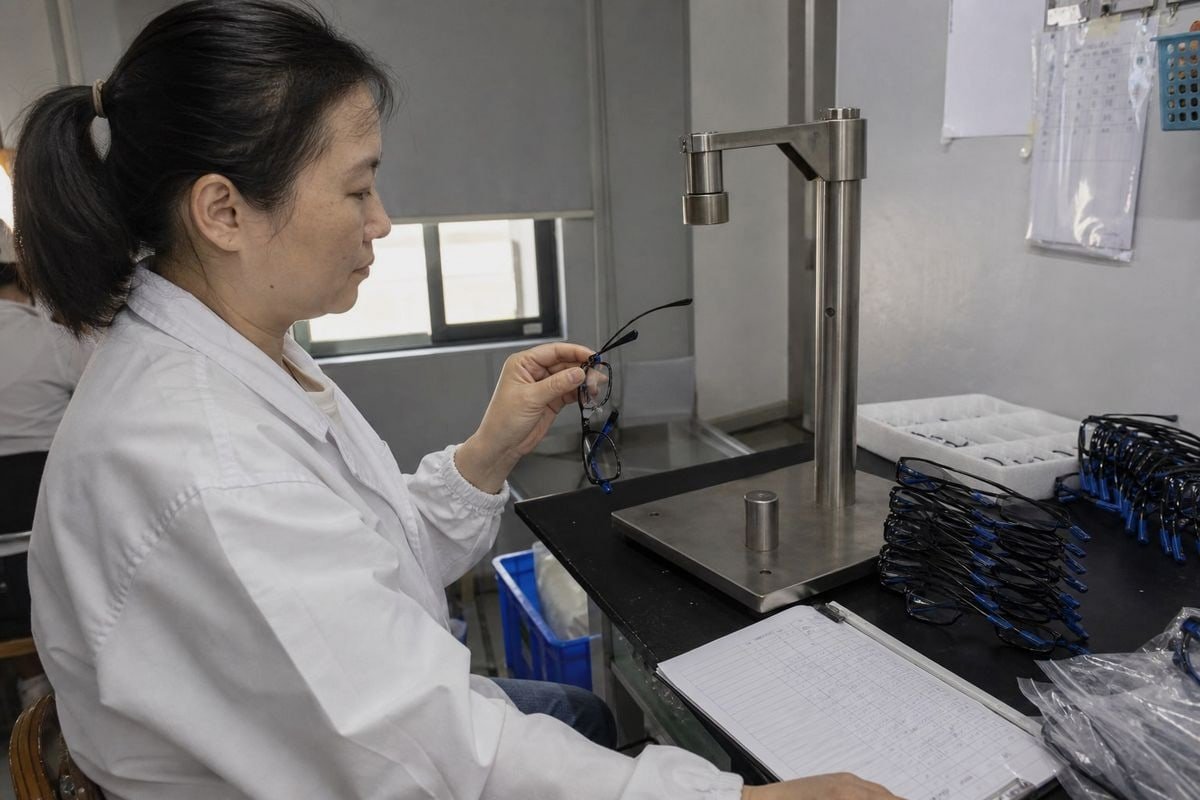
Lens dislodgement is more dangerous than frame distortion, because a loose lens is both an optical failure and a safety risk. In pediatric optical frames, a lens that pops free during play can expose a sharp rim edge near a child's eye. That is why we treat lens retention standards as a hard pass-fail item, never a cosmetic note.
Hands-On Seat Checks
Press lightly around the full rim of each lens with your thumb. The lens should feel solid, with no clicking, lifting, or lateral shift. Then hold the frame by one temple and shake it firmly. Any rattle means the bevel is not fully seated in the groove. Finally, flex the frame front gently while watching the lens edge — a well-cut lens stays seated even as the rim moves.
Rotation and Alignment Checks
A lens does not need to fall out to fail. A rotated lens in an asymmetric eye shape behaves like a defect, and on marked lenses the fitting cross and 180 line must stay level. If you are sourcing pre-lensed finished eyewear rather than stock frames, this matters even more. Some buyers assume lens verification is the optician's job downstream — I disagree. Once lenses are mounted at the factory, a lensometer check for power and orientation belongs in the supplier's final inspection, not the retailer's returns desk.
Impact Testing
For everyday stress, we drop-test samples from table height onto hard flooring and inspect the lens seat afterward. Polycarbonate lenses paired with a flexible TR90 rim absorb impact well; rigid, brittle rims transfer shock directly to the lens groove. Ask your supplier which lens material they fit as standard, and confirm demo and prescription-ready lenses both pass impact resistance testing before shipment.
Which Safety Standards Should I Reference When Auditing Kids Optical Frame Durability?
A procurement manager from Japan once asked me for our full test documentation before she would even review pricing. I respected that — standards are the shared language between factory and brand.
Reference ISO 12870 for spectacle frame requirements including bridge deformation, dimensional stability, and hinge endurance; the FDA drop ball test for lens impact resistance; and regional children's eyewear safety standards such as EN toy-adjacent and nickel-release rules for your target markets.
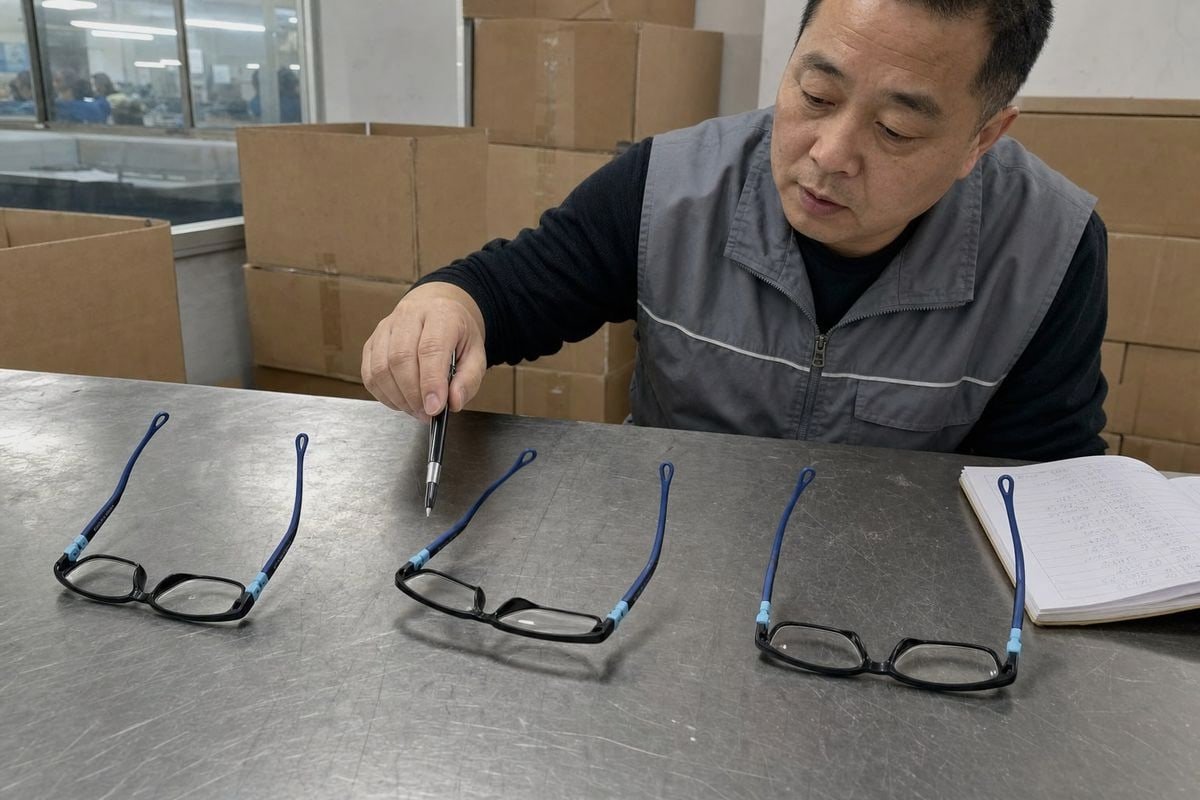
Standards turn subjective judgment into acceptance criteria you can write into a purchase order. When we export to buyers in 20+ countries, the standard set below covers most audit conversations, and it should anchor your supplier quality assurance program too.
| Standard / Test | What It Covers | Why It Matters for Kids' Frames |
|---|---|---|
| ISO 12870 | Frame dimensional stability, bridge deformation test, temple endurance, resistance to perspiration | The core benchmark for whether a frame keeps its shape under load and heat |
| FDA drop ball test 1 (US) | Lens impact resistance | Confirms lenses withstand a defined impact without shattering |
| EN / regional chemical rules | Material safety, nickel release, restricted substances | Children mouth and touch frames constantly; skin contact must be safe |
| UV stability evaluation | Material aging under sunlight | Prevents brittleness and fading that lead to distortion and loose lenses over time |
How to Use These in an Audit
Do not just ask "are you compliant?" Ask for the specific clauses tested. Under ISO 12870, the bridge deformation test loads the frame and measures permanent set — a direct predictor of whether the frame will sag on a child's nose after months of wear. Hinge endurance cycling under the same standard predicts hinge durability far better than a quick wiggle at the trade show booth.
Some buyers argue that hands-on judgment matters more than paperwork, since children's face shapes and frame materials vary so widely. That is partly fair — no certificate replaces an on-face fit check on a child head form. But in our experience, the strongest sourcing programs use both: standards define the floor, and hands-on inspection catches what paperwork misses. Also consider chemical resistance against sunscreen and cleaning agents, plus a simulated chew test on temple tips and small parts, since chipped components are a choking hazard for younger children.
What Questions Should I Ask My Manufacturer to Confirm Their Quality Control Process?
Early in my fifteen years in this industry, I learned that a factory's answers reveal more than its showroom. Vague replies about QC usually mean vague QC.
Ask your manufacturer how they inspect raw materials, what in-process checks they run during injection and assembly, whether final inspection covers alignment, lens seating, and flex recovery, which standards they test against, and how they document and handle rejected units.

The goal of these questions is to see whether quality control exists at every stage, or only as a final cosmetic glance before packing. At our factory in Taizhou, we structure eyewear quality control in three layers — incoming material, in-process, and final inspection — and any serious supplier should be able to describe something similar without hesitation.
The Question Framework
| Stage | Questions to Ask | Strong Answer Sounds Like |
|---|---|---|
| Raw materials | How do you verify TR90 and TPEE batches? Do you test for restricted substances? | Batch certificates, material traceability, environmental compliance reports |
| In-process | What checks happen during molding and assembly? How is hinge tension controlled? | Defined checkpoints, torque or tension specs, operator sign-offs |
| Final inspection | Do you run four-point touch, flex, and lens seat checks on every unit or by AQL sampling? | A written AQL plan with clear reject criteria |
| Standards | Which clauses of ISO 12870 do you test? Do lenses pass the drop ball test? | Specific clause numbers and third-party test reports |
| Failures | What happens to rejected units? How do you handle a defective shipment? | Rework or scrap policy, corrective action process, replacement terms |
Red Flags Versus Green Flags
A red flag is a supplier who answers every question with "no problem." A green flag is one who explains their reject criteria — for example, any rocking on the bench, uneven temple opening, loose lens retention, or misaligned lens markings triggers rejection or rework. Ask to see their inspection records from a previous order. Ask who performs the checks and how those staff are trained.
One more question I always encourage: how do you protect frames during shipping? Heat and pressure in containers can undo perfect factory alignment. Proper individual packing, retail-ready boxing, and container loading practices are part of supplier quality assurance, not an afterthought. A partner who thinks about your product until it reaches the child's face — not just until it leaves the dock — is the partner worth keeping for years.
Conclusion
Frame distortion and lens dislodgement are preventable. Bench tests, retention checks, ISO 12870 benchmarks, and pointed supplier questions protect your brand — and every child wearing your frames.
Footnotes
1. Official FDA guidance document explaining the impact-resistant lens regulation and drop ball test. ↩︎
More Articles You Might Like

Looking for a Reliable Kids Eyewear Partner?
Explore 800+ ready styles and full OEM/ODM support tailored to your brand.
Get in Touch English
  Español de México
  Deutsch
  Français
  日本語
日本語  العربية
  Português do Brasil