How to Judge TR90 Kids Optical Frames Quality by Craftsmanship Details?
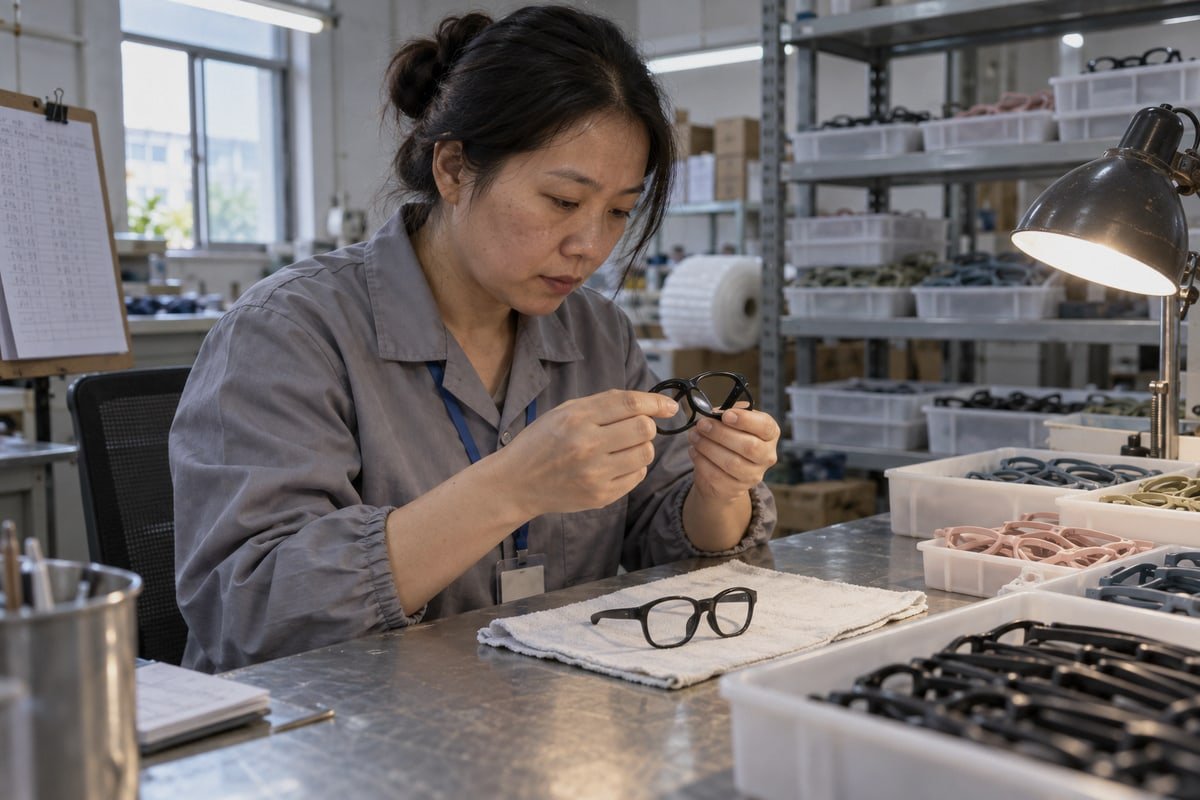
TR90 kids optical frames quality is hard to judge from photos, and our factory sees the result: two frames look alike, one lasts, one cracks FDA-related compliance statements 1. Craftsmanship details tell them apart.
TR90 kids optical frames quality shows in craftsmanship details: clean burr-free edges, tight stable hinges, even lens grooves, a flat non-twisting front, consistent color, and a smooth flexible feel that springs back after bending. Genuine TR90 is light, warm to the touch, and never brittle.
The “TR90” label alone tells you almost nothing. Two suppliers can use the same material name and ship very different frames. The difference sits in the mold, the trimming, the hinge assembly, and the final check. Below, I walk through four areas you can inspect with your own hands. Each one takes a few minutes. Together they tell you whether a frame will survive a real child.
What Should I Check in the Frame Joints and Hinges to Confirm Quality Craftsmanship?
Last spring a QC inspector on our line pulled a tray of matte-black frames because the temples swung too freely. Loose hinges on kids' glasses never stay a small problem.
Check that hinges open and close with even, smooth resistance, with no wobble, grit, or gap at the joint. Screws should sit flush, hinge plates should be fully embedded in the TR90, and flexible spring hinges should return to position without clicking or sticking.
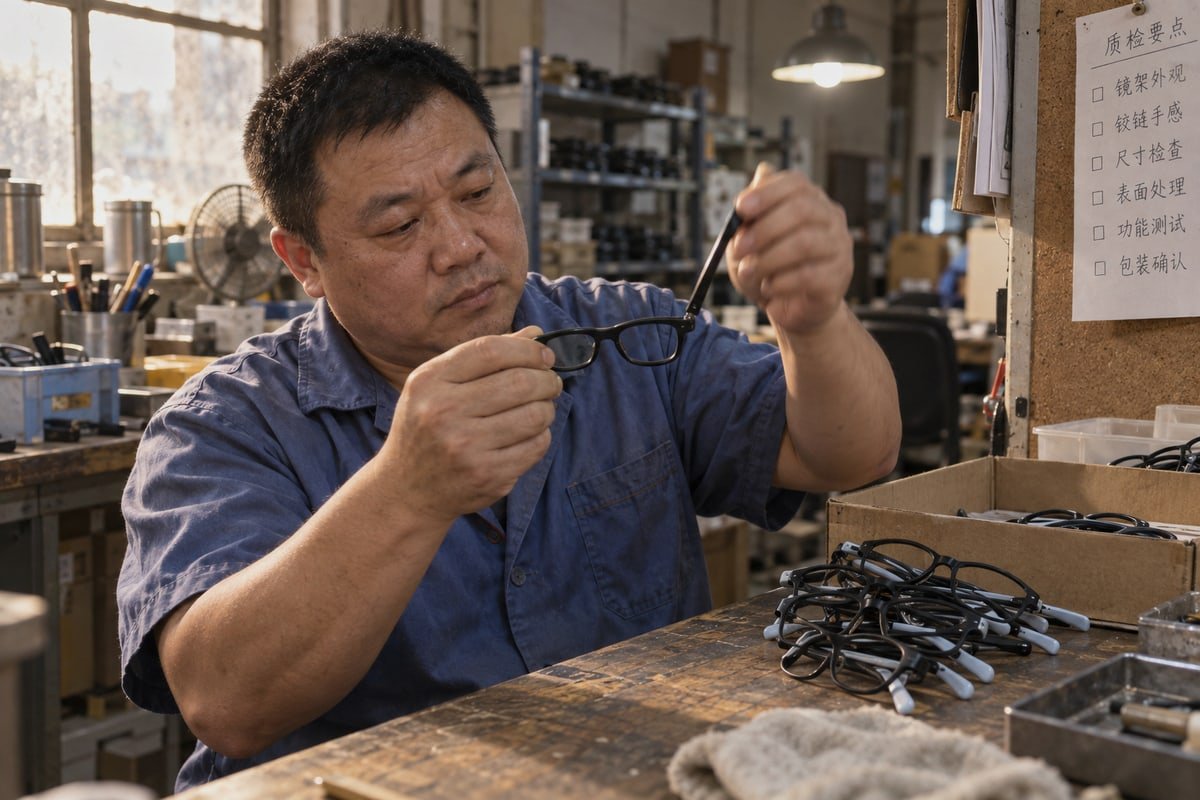
The hinge is the hardest-working part of any children's frame. A child opens and closes glasses dozens of times a day. They also pull the temples outward when they take the frame off with one hand. So the joint takes both cycling stress and lateral stress. Some suppliers report testing kids' frames through thousands of open-close cycles before approving a style. That number is a vendor claim, not a universal standard, but the idea behind it is right. A hinge that feels loose on day one will feel worse on day thirty.
The hand test I use first
I hold the front in one hand and swing the temple slowly. I am feeling for three things. First, even resistance from fully closed to fully open. Second, no side-to-side play when the temple is open. Third, no grinding or gritty sensation. Grit usually means metal shavings or poor polishing inside the joint.
Then I look at the joint itself. On our TR90 fronts with TPEE temples, the metal hinge plate is set into the plastic during molding. If the plate is fully embedded, you see no gap between metal and plastic. If it sits proud or shows a shadow line, the insert was misaligned. That frame will loosen early.
Hinge inspection table
| Check point | What good looks like | Red flag |
|---|---|---|
| Opening resistance | Smooth, even, consistent on both sides | One temple stiff, the other loose |
| Lateral play | None when open | Temple wobbles side to side |
| Screw seat | Flush, centered, no cracked plastic around it | Raised head, stripped slot, hairline crack |
| Hinge plate embedding | No visible gap between metal and TR90 | Shadow line, plate lifting, glue residue |
| Spring hinge return | Snaps back quietly to rest position | Clicks, sticks, or stays over-extended |
| Left-right symmetry | Both temples stop at the same angle | One temple opens wider than the other |
Screwless and integrated hinges
Many kids' styles now use screwless or reinforced integrated hinges. These reduce small parts that can loosen or fall out. They also remove sharp screw heads near the temple of a child's head. They are not automatically better, though. An integrated hinge that is molded with poor tolerance will crack at the pivot instead of loosening. So I still apply the same hand test. The hinge type matters less than the execution.
How Can I Tell If the TR90 Material Is Genuine and Not a Cheap Substitute?
A procurement manager from Australia once mailed us a competitor's sample labeled TR90. It felt dry and stiff. She wanted to know how to tell before ordering next time.
Genuine TR90 feels silky and smooth, weighs very little, bends far without stress whitening, and snaps back to its original shape. Cheap substitutes feel dry or sticky, show white marks at flex points, stay bent, or turn brittle in cold weather.
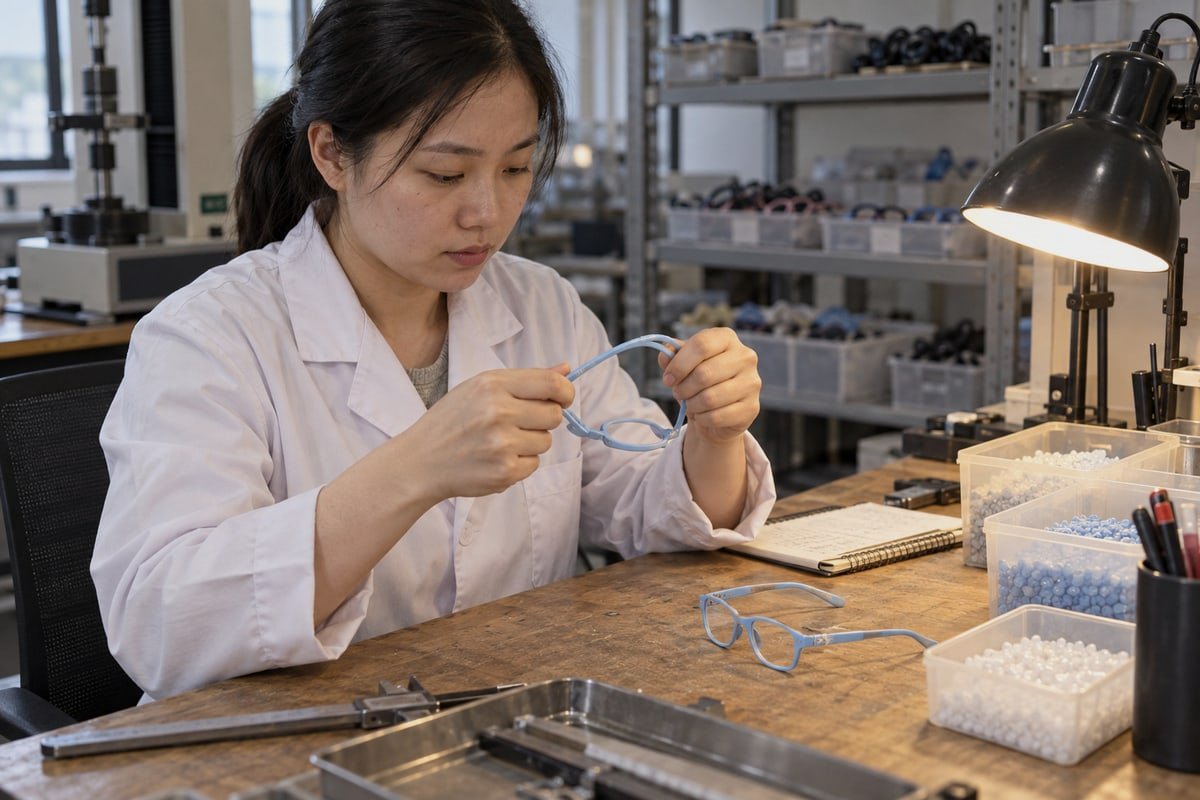
TR90 is a thermoplastic polyamide, often called a memory resin. The best-known grade is Grilamid TR90 material from EMS-Chemie. Its value for children's eyewear comes from three properties working together: low weight, high impact resistance, and shape memory. The problem is that the name has become a marketing word. Some frames sold as TR90 are made from recycled blends or lower-grade polyamides. They look the same in a photo. They do not behave the same on a child's face.
Four tests you can do without a lab
I use these on every incoming material lot and on every competitor sample a buyer sends us.
| Test | How to do it | Genuine TR90 | Likely substitute |
|---|---|---|---|
| Texture | Run your thumb along the temple | Smooth, slightly silky, no drag | Dry, chalky, or tacky feel |
| Flex and return | Bend the temple outward well past normal | Returns instantly, no set | Stays bent or returns slowly |
| Stress whitening | Look at the flex point after bending | No white marks | White or cloudy blanching |
| Weight | Weigh the complete frame | Roughly 12g to 22g depending on size | Noticeably heavier for the same size |
The weight range above comes from typical kids' and small optical frames on the market. A translucent rounded-square frame like our pink gradient style sits toward the lighter end. A thicker matte-black round front sits toward the middle. Either way, the frame should feel almost weightless in your palm.
Cold, tensile strength, and the "unbreakable" claim
Two more points matter for real use. First, thermal stability. Quality TR90 stays flexible in freezing weather. Low-grade material stiffens and snaps in a cold playground. If you serve markets with harsh winters 2, ask your supplier for a cold-flex test on the actual production color. Second, tensile strength. Genuine TR90 resists pulling and twisting far better than commodity plastics. That is why a child can sit on the frame and the temple flexes instead of breaking.
That brings me to a common buyer objection. Many suppliers call TR90 "unbreakable." I never use that word with our customers. The honest claim is that TR90 flexes instead of snapping and absorbs impact very well. It can still be cut, crushed, or damaged at a poorly molded thin section. Honest claims build longer relationships than big ones.
The premium-feel objection
Buyers coming from acetate sometimes tell me TR90 feels less luxurious. That is fair. TR90 has a solid color rather than the layered depth of acetate, and it lacks acetate's cool, dense hand-feel. But the trade-off is deliberate. Acetate is heavier and can crack on impact. For a five-year-old who wears glasses eight hours a day and drops them twice, light and flexible beats layered and dense. We solve the visual side with two-tone combinations, such as a matte black front with glossy sky-blue temples, and with translucent gradients that give depth without weight.
What Surface Finish and Edge Details Reveal a Manufacturer's Attention to Quality?
Every extra polishing pass costs seconds per frame on our line. We keep it anyway, because a rough edge is the first thing a parent's finger finds.
A quality TR90 frame has a burr-free surface finish with no flash, seam lines, air bubbles, or uneven pigment. Edges are rounded and smooth inside and out, the front sits flat without warping, lens grooves are even, and logos print crisply in the correct position.
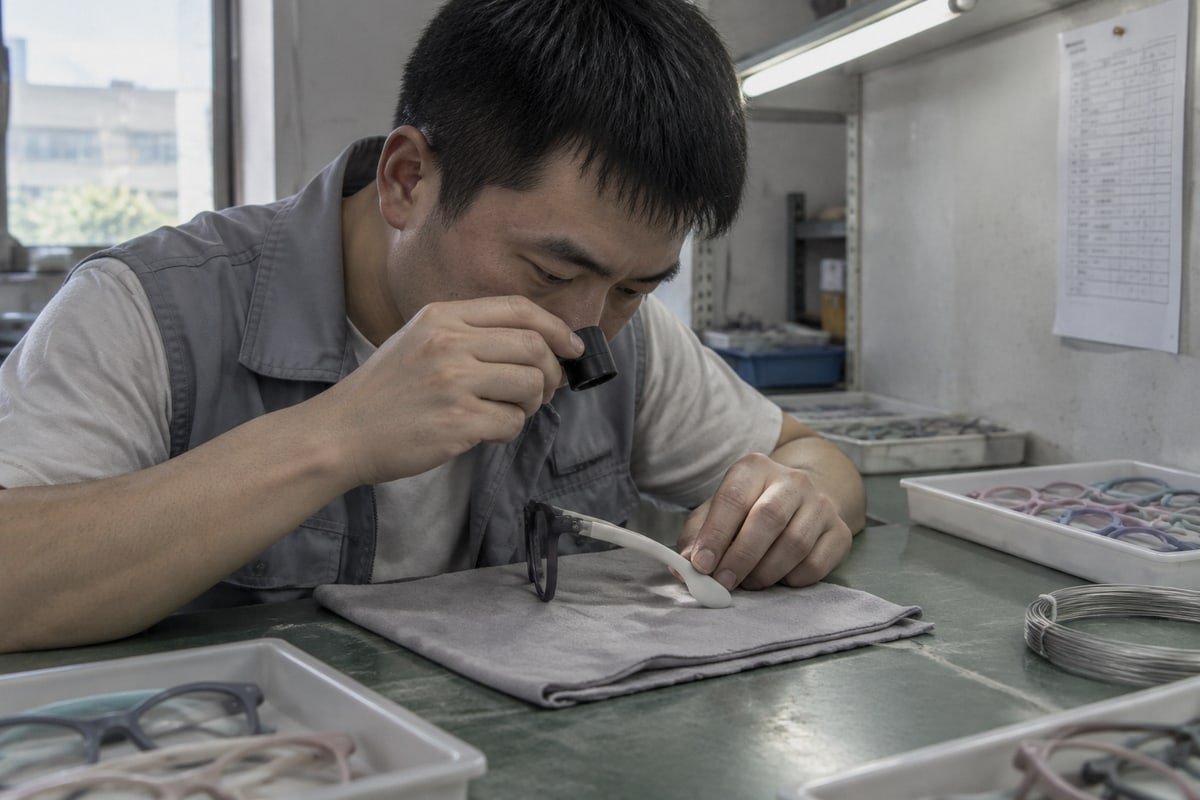
TR90 frames are injection molded. One manufacturer claims a full frame can be molded in about 45 seconds. That speed is exactly why finishing matters. A fast process with loose control produces fast defects. A fast process with injection molding precision produces consistent frames by the thousand. The surface tells you which one you are holding.
A six-step surface inspection
I run this sequence on production samples 3 before any bulk order leaves our 5S-managed workshop. You can run it on a supplier sample in under five minutes.
- Hold the front up to a window. Look for air bubbles, cloudy spots, or pigment streaks in translucent colors. In solid colors, look for dull patches or color shifts between the front and the temples.
- Run a fingernail along the parting line. The mold splits the frame into two halves. A faint line is normal. A raised ridge, or flash, means the mold halves are worn or the trimming was skipped.
- Feel the inside edge of the rim. This surface touches the eyebrow and cheek. It must be as smooth as the outside. Rough trimming here is the most common sign of a cheap frame.
- Place the front face-down on a flat table. All four contact points should touch. If it rocks, the front warped during cooling. Warped fronts twist the lenses and never fit right.
- Check the lens groove with a lens out. The groove should be the same depth all the way around. Uneven grooves let lenses pop out or sit crooked.
- Inspect the logo. A clean, centered, fully cured logo shows the factory controls its final steps. A smeared or off-center logo shows it does not.
Why consistency across pairs matters more than one perfect sample
Anyone can polish one showpiece. The real test is the bulk shipment. Line up five frames from the same order. Compare the color, the edge finish, and the flatness of the fronts. They should be identical. Color drift between pairs is a process-control failure, not a cosmetic issue. It means the material dosing or the cooling time moved between shifts.
One supplier claims a defect rate under 0.5% on TR90 kids' frames, compared with 3–5% for acetate. Treat that as one vendor's figure, not a benchmark. But the direction is right. TR90 molding is very repeatable when the mold and process are controlled. So a high defect rate on TR90 is a factory problem, not a material problem.
Edge radius and child safety
One detail I look for specifically on children's frames is the edge radius. Adult frames often have crisp, square edges for a sharp look. Kids' frames should have rounded edges on the rim, the bridge, and the temple ends. A rounded edge does not scratch a cheek during a fall. It also feels softer to a child who is still getting used to wearing glasses. This is a small design choice that happens at the mold stage. It cannot be fixed with polishing later.
Which Small Design Details Show That a Factory Truly Understands Kids' Comfort and Safety?
Fifteen years of making children's eyewear taught us one thing early: a frame can pass every bench test and still slide down a five-year-old's nose. Comfort lives in small details.
Look for integrated nose pads molded in one piece, rounded temple tips with no detachable parts, curved adjustable temple tips that hug the ear, a low-profile keyhole or saddle bridge, and hypoallergenic, BPA-free materials. These details show a factory designs for real children, not scaled-down adults.
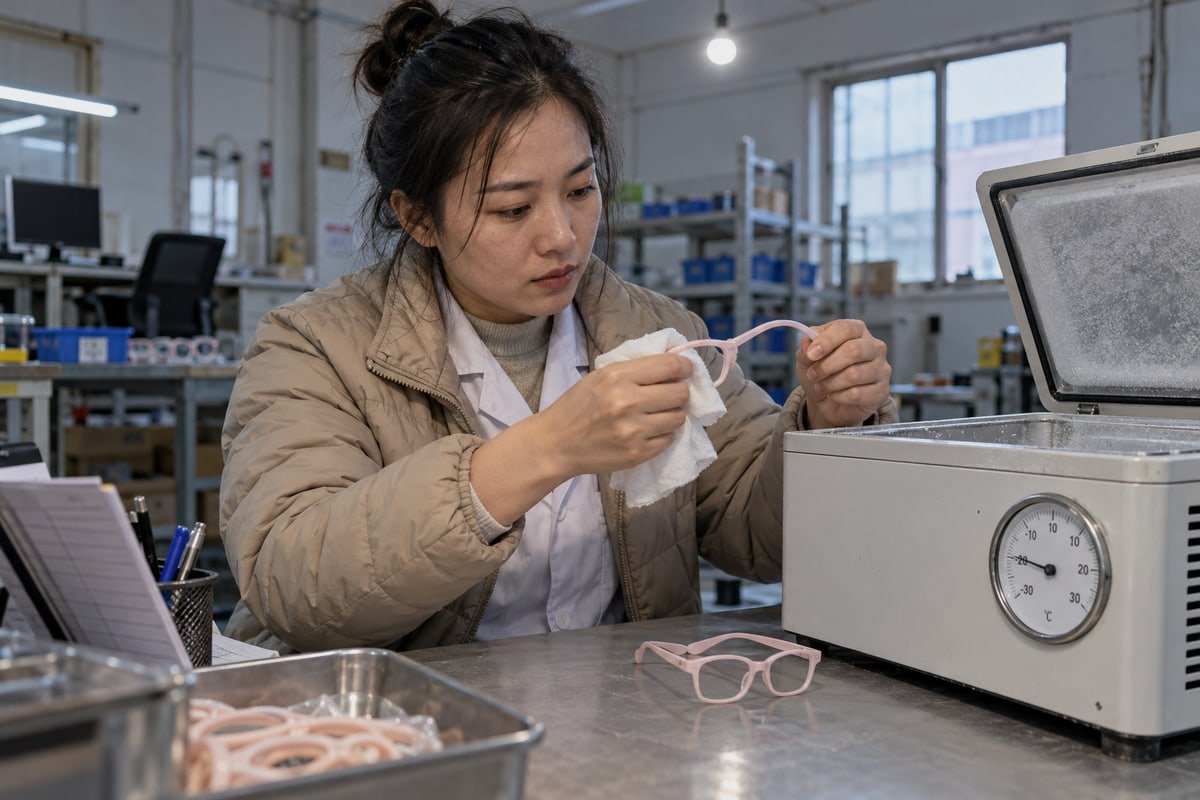
Children's faces are not small adult faces. The nose bridge is lower and flatter. The ears sit differently. The skin is more sensitive. And a child will chew, bend, drop, and sit on the frame. A factory that understands this makes different choices at the drawing stage. Here is how I read those choices on a finished frame.
Design details and what they signal
| Detail | What to look for | What it tells you about the factory |
|---|---|---|
| Nose bridge | Integrated nose pads molded into the front, keyhole or saddle shape, wide contact area | Designed for low kids' bridges; no small pads that detach and become a choking risk |
| Temple tips | Curved, rounded, soft-feeling, no sharp corners | Understands ear comfort and all-day wear |
| Temple material | Softer TPEE or similar on a TR90 front, adjustable temple tips that can be warmed and reshaped | Knows heads grow and opticians need to fine-tune fit |
| Temple tip bonding | Tips fused by ultrasonic welding 4 or co-molded, not glued | Avoids adhesives and parts that separate when chewed |
| Metal exposure | Hinges recessed, no exposed metal on skin-contact surfaces | Reduces irritation for sensitive skin |
| Overall weight | Balanced front-to-back, no heavy front pulling down | Real wear testing, not just visual design |
Nose pads and temple tips deserve a closer look
Integrated nose pads are the single detail I check first. On our round two-tone style, the keyhole bridge is part of the TR90 front. There is no separate pad, no screw, no wire arm. That means nothing can snap off, and the contact area spreads the weight across the bridge instead of two small points. Children with low bridges need this. Frames with adult-style separate pads slide constantly and leave red marks.
Temple tips are the second detail. Children take glasses off by pulling one temple. They also chew on the tips. A tip that is glued on will come loose. A tip that is co-molded or ultrasonically bonded will not. Adjustable temple tips also let an optician gently reshape the curve as the child grows. That extends the useful life of the frame.
Skin safety and documentation
Hypoallergenic properties are a common marketing line for kids' TR90 frames. The claim is reasonable, since TR90 itself contains no nickel or latex, and our production uses environmentally friendly materials. But I always tell buyers to ask for paperwork rather than accept a phrase. Useful documents include a BPA-free certification for the resin, a biocompatibility report to ISO 10993 5 for skin contact, and any CE or FDA-related compliance statements the supplier provides. Treat these as the supplier's positioning until you verify them. A serious factory will not be offended by that request. In our experience serving brands across 20+ countries, the buyers who ask the most documentation questions become the longest-term partners.
Why this matters for brand launches
A brand launching its first kids' optical range often cannot afford new molds. That is why we keep around 800 existing styles ready for customization. But existing styles only help if the underlying design already solves these comfort details. Custom colors, logos, lenses, and packaging sit on top of the mold. They do not fix a bridge that slides or a tip that falls off. So inspect the base design first, then talk about branding.
Conclusion
Marketing labels can't protect a child's face. Craftsmanship can. Check hinges, feel the material, inspect the finish, and study the small comfort details before you commit to a TR90 kids frame.
Interested in sourcing the products mentioned in this article? See details and request a quote here:
Footnotes
1. Official regulatory resource for compliance and safety standards for medical devices and eyewear. ↩︎
2. National authority for material testing standards, including performance in extreme environmental conditions. ↩︎
3. Overview of the workplace organization method used to ensure quality control in manufacturing. ↩︎
4. Technical explanation of the high-precision bonding process used for durable eyewear components. ↩︎
5. Authoritative source for the international standard regarding biological evaluation of medical devices. ↩︎
More Articles You Might Like


Looking for a Reliable Kids Eyewear Partner?
Explore 800+ ready styles and full OEM/ODM support tailored to your brand.
Get in Touch English
 Español de México
 Deutsch
 Français
 日本語
 العربية
 Português do Brasil