TR90 vs Acetate and Metal Kids Optical Frames: Safety, Weight, and Durability?
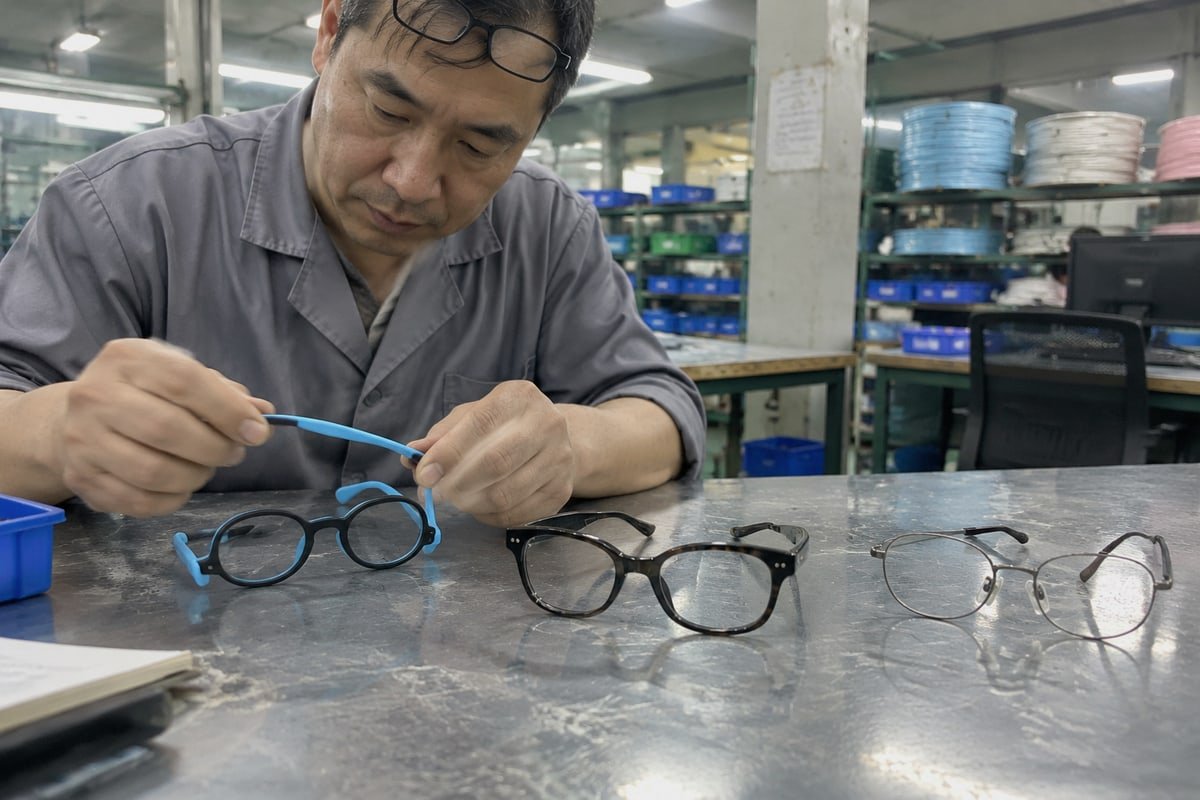
Every week our Taizhou factory gets the same question: TR90 vs acetate and metal kids optical frames—which one survives a real child low-density thermoplastic material 1? Pick wrong, and returns pile up fast.
For most children, TR90 kids optical frames are the safest, lightest, and most durable choice. TR90 bends instead of snapping, weighs roughly half of acetate, and is hypoallergenic. Acetate wins on style and heat-adjustable fit; metal wins on slim looks and adjustable nose pads.
That is the short answer. The longer answer depends on the age of the child, how rough the child is, and what your brand needs to sell shape memory polymer 2. Below, I walk through safety, weight, and durability one at a time. Then I give you a simple way to decide for your next line.
How do I know if TR90 frames are actually safer for my kids' collection than acetate or metal?
Last month our QC team bent a batch of TR90 sample temples flat against the front for a buyer video. Every one sprang back. That test explains a lot.
TR90 is safer for most kids because it flexes under impact instead of cracking into sharp pieces, has hypoallergenic properties with no nickel, and pairs naturally with rounded edges and soft temple tips. Acetate can crack on hard drops, and poorly adjusted metal creates pressure points.
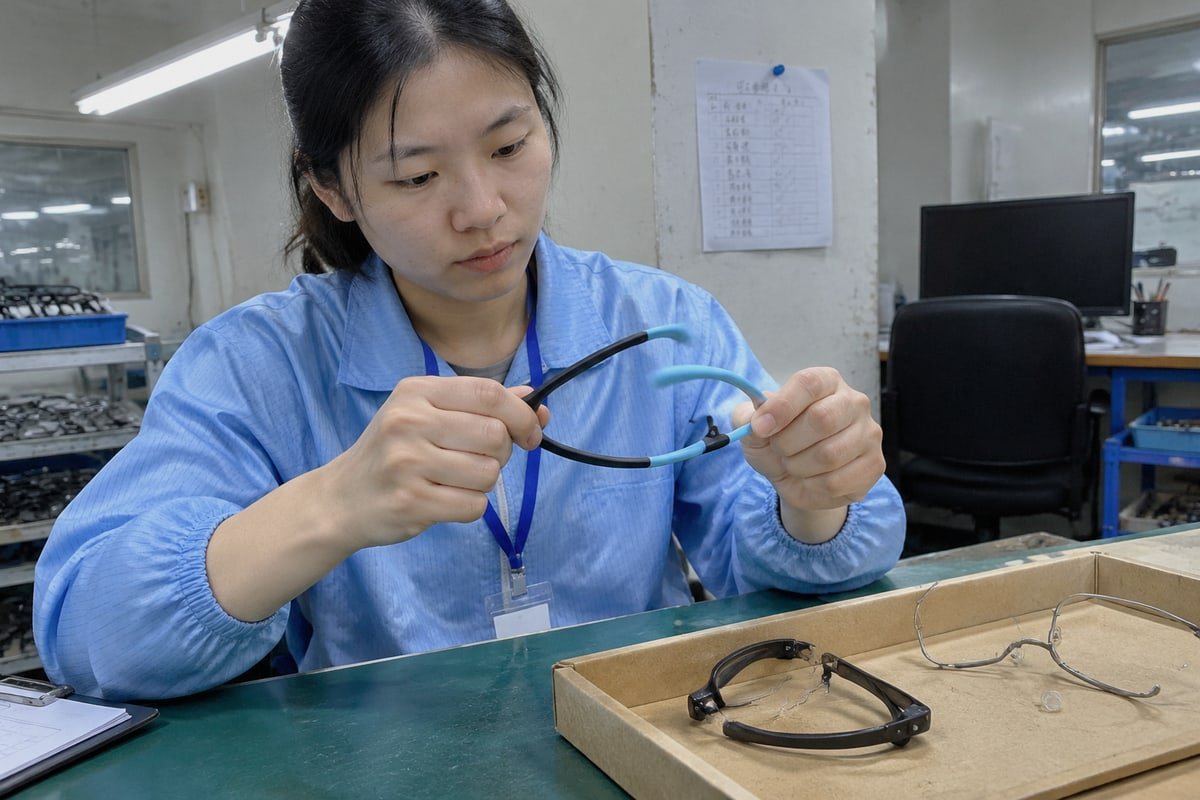
When buyers ask me about safety, I ask them to think about three moments. The moment a child falls face-first on a playground. The moment a child sits on the glasses in a car seat. And the long hours when the frame just sits on skin. Each material behaves differently in each moment.
| Safety factor | TR90 | Cellulose acetate 3 | Metal (stainless steel 4 / alloy) |
|---|---|---|---|
| Behavior on hard impact | Flexes, returns to shape | Can crack or splinter | Bends, may not return; joints fail |
| Sharp fragments risk | Very low | Moderate on hard drops | Low, but broken nose pads or wires can scratch |
| Skin reaction risk | Very low, no nickel | Low, but plasticizers can migrate over years | Higher with nickel alloys; low with titanium |
| Pressure points | Low, even contact | Moderate, heavier front | Depends heavily on adjustment |
| Typical child-safe pairing | Soft TPEE temples, rounded edges | Wire-core temples | Adjustable nose pads, spring hinges |
What "safe" means when a child falls
Impact resistance is the first thing I look at. Manufacturer-facing material data for TR90 lists a Charpy impact result of "no break" at room temperature and below freezing. I always add a caveat here. That figure comes from material suppliers, not from an independent lab. Still, it matches what we see on our own line. A TR90 front twisted in a school bag comes back flat. An acetate front under the same stress can develop a crack at the hinge corner, and a crack means an edge.
Metal frames rarely shatter. The problem is different. The frame itself is strong, but the weak spots are the hinges, the bridge, and the soldered joints. When a child lands on a metal frame, the joint gives before the wire does. A bent metal frame can then press into the skin until someone fixes it.
What "safe" means on the skin
Hypoallergenic properties 5 matter more for kids than adults. Children wear glasses through sweat, sun, and long school days. TR90 has no nickel, which is the common irritant in cheap metal alloys. Pure titanium is also nickel-free, but it costs far more and still needs metal hinges and nose pads.
We also specify BPA-free materials for the TR90 and TPEE we use. Buyers in Australia and Europe ask for this early, and I think that is the right instinct. Non-toxic finishes and child-safe coatings should be part of the spec sheet, not an afterthought.
Safety details beyond the resin
Material is only half the story. Rounded edges, soft temple tips, and flexible temple arms are the features that turn a safe material into a safe frame. That is why we pair TR90 fronts with TPEE temples in many of our styles. The two-tone round frame with a matte black front and sky-blue temples in our range is a good example. The front resists impact. The temples flex around the ear instead of digging in.
Why do parents and brands say TR90 feels lighter and more comfortable for children compared to metal frames?
A Japanese brand buyer once put our TR90 optical frame on a kitchen scale during a video call. The number surprised her and reframed her whole line plan.
TR90 feels lighter because it is a low-density thermoplastic material, around 1.00 g/cm³, so a full kids frame often weighs 8–22 grams, up to 50% less than metal or acetate. Less weight means less nose bridge pressure, fewer red marks, and fewer glasses pulled off during school.

Weight is the quiet reason children keep their glasses on. A frame that presses on a small nose bridge for six hours gets taken off. A frame that the child forgets about stays on. That is the whole comfort argument in two sentences.
| Material | Typical kids frame weight | Where the weight sits | Comfort note |
|---|---|---|---|
| TR90 | 8–15 g for small frames; 18–22 g for larger or thicker designs | Evenly spread | Lightest mainstream option |
| Cellulose acetate | Often 25–40 g, very size-dependent | Heavy front, thick rims | Comfortable, but noticeable on small noses |
| Stainless steel / metal | Can be very light in thin designs | Concentrated at nose pads | Comfort depends on precise adjustment |
Why the TR90 weight range is so wide
You will see 8–15 g in some listings and 18–22 g in others. Both are honest. The difference is frame size and wall thickness. A toddler frame with slim rims sits at the bottom of that range. A tween frame with a thicker brow line sits at the top. When we quote weight to a buyer, we quote the actual style, not a material average. I suggest you ask any supplier to do the same.
The metal objection, and why it only half holds
Some buyers push back here. They say a thin stainless steel frame can weigh less than a chunky TR90 frame. That is true. But weight on a scale is not the same as weight on a face. A metal frame carries its load through two small nose pads. If the pads are set slightly wrong, the whole frame weight sits on two points. That creates red marks fast. A TR90 frame with a keyhole or saddle bridge spreads the load across the whole nose.
Adjustable nose pads are still a real advantage for metal. Children with flat or underdeveloped bridges sometimes need them. In those cases, we suggest a TR90 front with a slightly deeper molded bridge first, and metal only if that fails.
Comfort comes from flex, not just grams
Flexible temple arms do more for all-day comfort than a few grams. Our TPEE temples bend around the ear and follow the head shape. A rigid acetate temple, even a light one, can pinch behind the ear if the fit is off by a few millimeters. Metal temples are adjustable, but each adjustment needs an optician. A soft, flexible temple forgives a growing head between visits.
Which material holds up better over time when active kids bend, drop, or twist their glasses daily?
The trade-off we weigh on every new mold is stiffness versus spring-back. A stiffer frame holds lenses tighter, but a frame that springs back survives the school bag.
TR90 holds up best under daily bending, dropping, and twisting because it is a shape memory polymer that returns to form instead of breaking. Acetate lasts well with careful use but can crack under sharp impact. Metal frames usually fail at hinges, bridges, and solder joints.

Durability is not one property. It is how a frame handles four kinds of abuse, again and again. Here is how I break it down when a buyer asks which frame will still be in one piece next school year.
- Twisting – the child pulls the glasses off with one hand. TR90 twists and recovers. Acetate resists, then stresses the hinge. Metal loosens at the hinge screw.
- Sitting on them – the frame is crushed flat. TR90 springs back. Acetate may snap at the bridge. Metal bends and stays bent.
- Dropping on concrete – sharp impact at one corner. TR90 usually survives. Acetate can chip or crack. Metal survives, but nose pads and lens screws take the hit.
- Heat and sweat – hot car, summer sport. TR90 has strong temperature resistance. Acetate can soften and warp. Metal handles heat, but cheap alloys lose corrosion resistance under sweat.
Where TR90 actually fails
I want to be straight with you, because your buyers will be. TR90 has three real weaknesses.
First, bridge splay. Kids push their glasses up onto their heads. Over months, a TR90 bridge can widen permanently. A wider bridge sits lower on the nose. We reduce this with a thicker bridge section and a snug initial fit, but no TR90 frame is immune.
Second, no wire core. Acetate temples often have a metal wire inside, so an optician can heat and set them wider as a child grows. TR90 temples have no core. Their molecular memory resists permanent reshaping. That is why we rely on flexible TPEE temples that adapt without being set.
Third, cold-glazing. Lenses must go into TR90 rims without heat. If an optician warms the frame the way they warm acetate, the material can lose its tension and never hold the lens tightly again. We put this on every spec sheet we ship.
Where acetate and metal fail
Cellulose acetate has a slow enemy: plasticizer migration. Over years, the material can leach plasticizers. A white, chalky film appears, and the frame turns brittle. A careful child may never reach that point. A child who leaves glasses in a hot car will.
Metal frames need a good spring hinge design to last. A spring hinge lets the temple open past ninety degrees and snap back. Without it, the hinge is the first thing a child breaks. Corrosion resistance is the second issue. Stainless steel resists sweat well. Cheap plated alloys do not, and green marks on the skin follow.
| Failure mode | TR90 | Acetate | Metal |
|---|---|---|---|
| Snap at bridge | Rare | Possible on hard impact | Rare; bends instead |
| Hinge failure | Low; molded hinge or metal hinge | Moderate at hinge corner | Highest; screws and springs |
| Permanent deformation | Bridge splay over time | Warping with heat | Bending at temples and bridge |
| Surface aging | Minimal | Plasticizer migration, chalky film | Plating wear, corrosion |
| Re-adjustment by optician | Limited | Easy with heat | Easy with pliers |
Should I choose TR90, acetate, or metal for my next kids' optical line based on cost, durability, and supplier reliability?
Fifteen years of making pediatric eyewear taught us one thing: a beautiful frame that comes back in a returns box costs more than any mold fee.
Choose TR90 for toddlers, active school-age kids, and sensitive-skin wearers; it is the lowest-risk default. Choose cellulose acetate for style-led tween collections where a careful wearer is expected. Choose metal for older kids wanting slim, adjustable frames. Then verify supplier hinge quality, testing, and consistency.
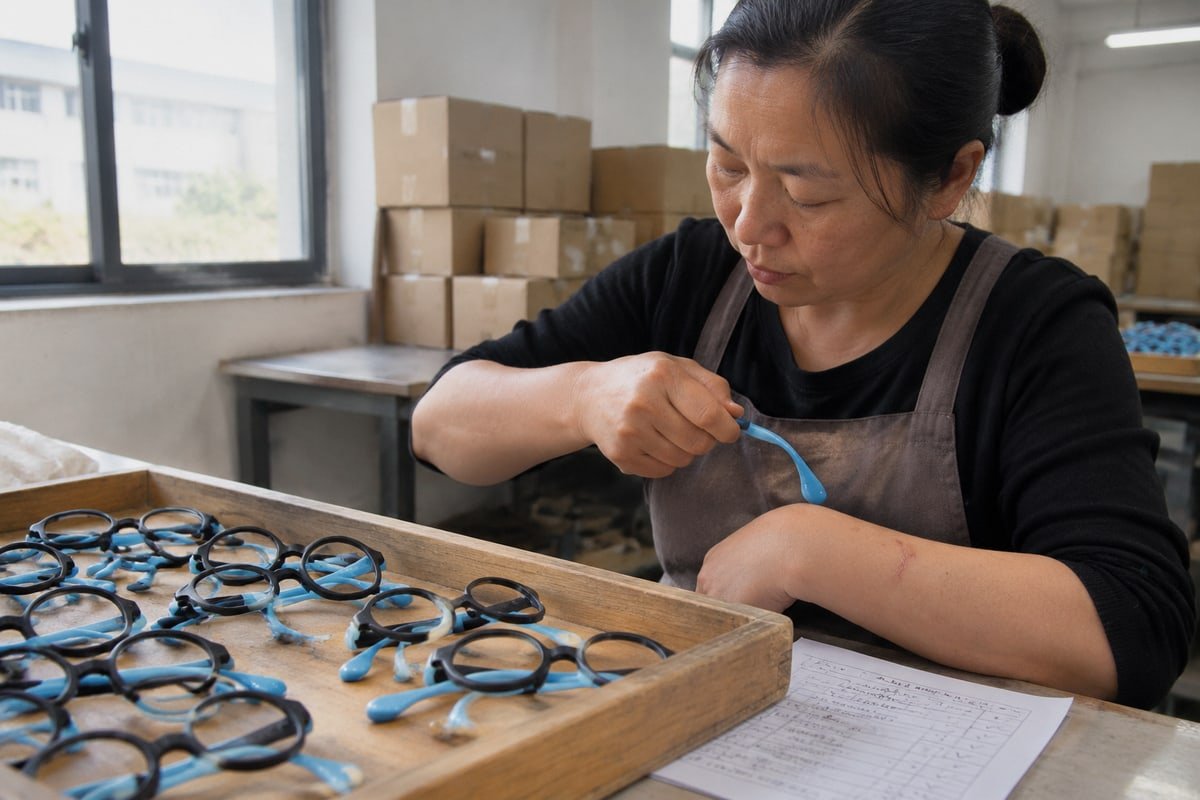
The right material follows the child, not the catalog. Here is the framework I use with founders and product managers who are planning a first or second optical range.
| Child type | Best material | Why | Watch out for |
|---|---|---|---|
| Toddlers (2–5) | TR90 with TPEE temples | Maximum flex, light, no sharp fragments | Bridge fit; small heads need a snug start |
| Active school-age (6–10) | TR90 | Survives drops, twisting, sports | Bridge splay; specify thicker bridge |
| Fashion-conscious tweens (10–13) | Acetate, or two-tone TR90 | Color depth, premium look | Heat exposure; hinge cracking |
| Older kids wanting a grown-up look | Thin stainless steel or titanium | Slim profile, adjustable nose pads | Nickel alloys; spring hinge quality |
| Sensitive-skin wearers | TR90 or pure titanium | Nickel-free, hypoallergenic | Titanium cost; alloy hinges on metal |
The cost question
Acetate advocates will tell you the material feels more premium and carries a higher retail price. That is fair. Acetate is carved from solid blocks, so it offers layered colors that injection-molded TR90 cannot match. But acetate also means a heavier frame and a higher return risk with young children. If your brand sells to parents of active six-year-olds, the premium feel rarely covers the replacement cost.
Metal supporters point to precise adjustment and a slim look. Also fair. For an older child who takes care of glasses, a stainless steel frame with adjustable nose pads is a good product. For a younger child, the hinge is a liability.
TR90 sits in the middle on unit cost and at the top on risk control. And you can go further on style than most buyers expect. Our translucent frames with a soft pink gradient show that TR90 does not have to look plain. It is injection-molded, so it stays with solid or translucent finishes, but color contrast between front and temple gives plenty of room to build a look.
Mold investment and testing the market
New brands often assume they need a custom mold before they can launch. They do not. We keep around 800 existing styles across TR90 and TPEE. A buyer can pick a shape, choose colors, add a logo, select UV400 or optical lenses, and ship with retail-ready packaging. That lets you test three or four styles in one market before you spend on a mold.
How to check a supplier, whatever the material
Material is only as good as the factory behind it. I would check five things.
- Temple flexibility. Bend the temple outward past ninety degrees. It should return without a white stress mark.
- Hinge quality. Open and close it fifty times. Look for play or grinding.
- Bridge fit. Ask for at least two bridge widths in each style for young children.
- Documented QC. Ask how samples are inspected and whether the workshop is managed under a system like 5S. Ask to see it on video.
- Consistency. Order a small repeat batch and compare it against your first sample. A real factory with its own workers delivers the same frame twice. A trading company often cannot.
Conclusion
Kids' glasses fail in school bags, not showrooms. For most lines, TR90 is the safest default; acetate serves style, metal serves slim fit. Pick the frame that bends, not breaks.
Interested in sourcing the products mentioned in this article? See details and request a quote here:
Footnotes
1. Scientific definition and engineering properties of thermoplastic materials used in injection molding. ↩︎
2. Official site of the primary manufacturer of TR90 (Grilamid) explaining material properties. ↩︎
3. Authoritative overview of cellulose acetate’s chemical properties and common industrial applications. ↩︎
4. Technical background on stainless steel composition and its corrosion resistance in manufacturing. ↩︎
5. Medical resource detailing nickel allergy causes, which is critical for hypoallergenic eyewear selection. ↩︎
More Articles You Might Like



Looking for a Reliable Kids Eyewear Partner?
Explore 800+ ready styles and full OEM/ODM support tailored to your brand.
Get in Touch English
 Español de México
 Deutsch
 Français
 日本語
 العربية
 Português do Brasil