How Does Nose Pad Design Affect Stability in Kids’ TR90 & TPEE Sunglasses?
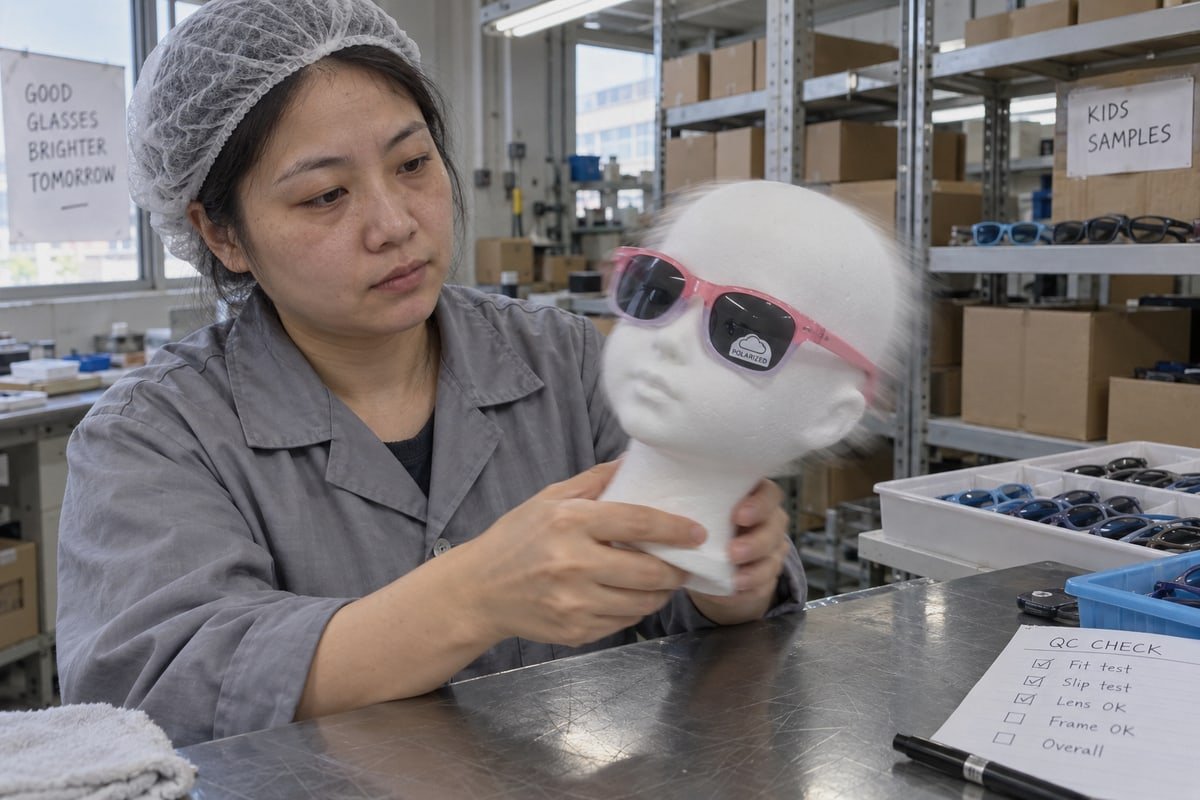
Nose pad design decides whether kids’ TR90 & TPEE sunglasses stay on a running child or slide off. Parents notice. Brands get returns. Our Taizhou line spent years fixing it.
Nose pad design affects stability in kids’ TR90 & TPEE sunglasses by controlling contact area, friction, and weight balance on the bridge. Wide, contoured, textured TPEE pads spread load and grip sweaty skin, while lightweight TR90 frames reduce downward pressure, so the glasses lock in gently instead of sliding.
Stability is not tightness. It is fit geometry, material grip, and weight balance working together. Below, I break down each part so you can judge a frame before you order it.
What nose pad shapes work best for keeping kids' sunglasses from sliding down?
Last season our QC team pulled a batch from the line. The frames were light and pretty. But on the shake test, the narrow pads let them slide.
The best nose pad shapes for kids' sunglasses are wide, flat, contoured pads or a saddle bridge design that follows a child's lower, flatter nose. They spread weight over a larger area, reduce pressure points, and resist sliding better than narrow, rounded, or hard pads.
Why a child's bridge changes the geometry
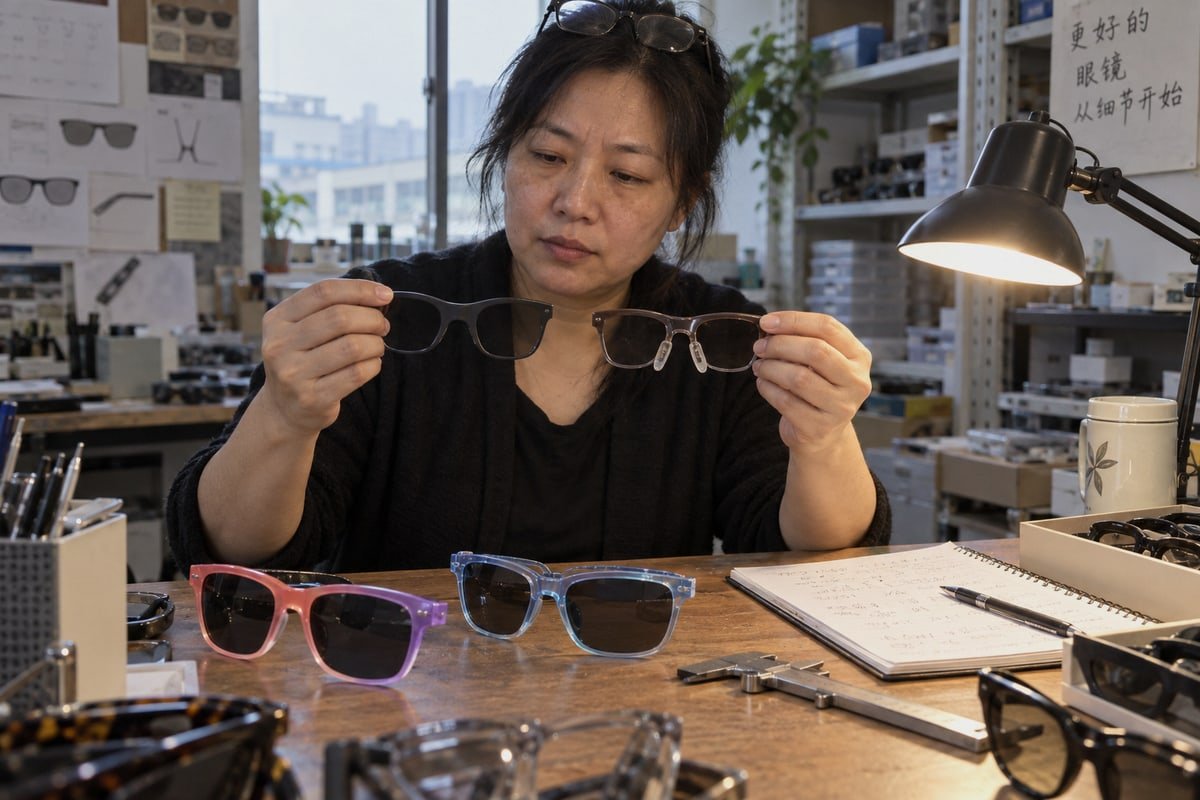
Kids do not have small adult noses. Their bridge sits lower and flatter. It also sits closer to the eyes. When you put an adult-style pad on that bridge, it touches at two tiny points. Those two points carry the full weight of the frame and lenses. The result is red marks and a frame that walks down the nose with every step. Anatomical bridge fit starts with lower pad curvature and a wider contact patch. We treat this as a design rule, not a size option.
Four shape factors we tune on every kids' style
| Shape factor | What it controls | What goes wrong if ignored |
|---|---|---|
| Pad width | Contact area and pressure point reduction | Narrow pads dig in and concentrate load |
| Pad angle | How flat the pad sits on the nose slope | Only the pad edge touches, so it slips |
| Pad spacing | Wearing height and left-right balance | Frame drops low and the lens sits under the eye |
| Pad position | Center of gravity versus lens weight | Front-heavy lenses tip the frame forward |
Saddle bridge versus paired pads
A saddle bridge design is one continuous molded surface that rests across the top of the nose. It spreads load the widest. We use it on most toddler and preschool frames. Paired contoured pads give a more defined seat. They suit school-age faces where the bridge has started to rise. On our translucent wayfarer-style frames, including the coral gradient and sky-blue versions, the seat is molded straight into the TR90 front. There is nothing to bend and nothing to lose.
One more point. Polarized lenses 1 add weight at the front. When a buyer picks a heavier lens, we widen the pads or deepen the saddle. Otherwise even a good nose pad design cannot hold the frame level.
How do I choose nose pad materials that stay comfortable on sensitive young skin?
Every time we spec a new TPEE compound, we weigh grip against wear. Softer pads hold better. Firmer pads last longer. Children's skin decides where we land.
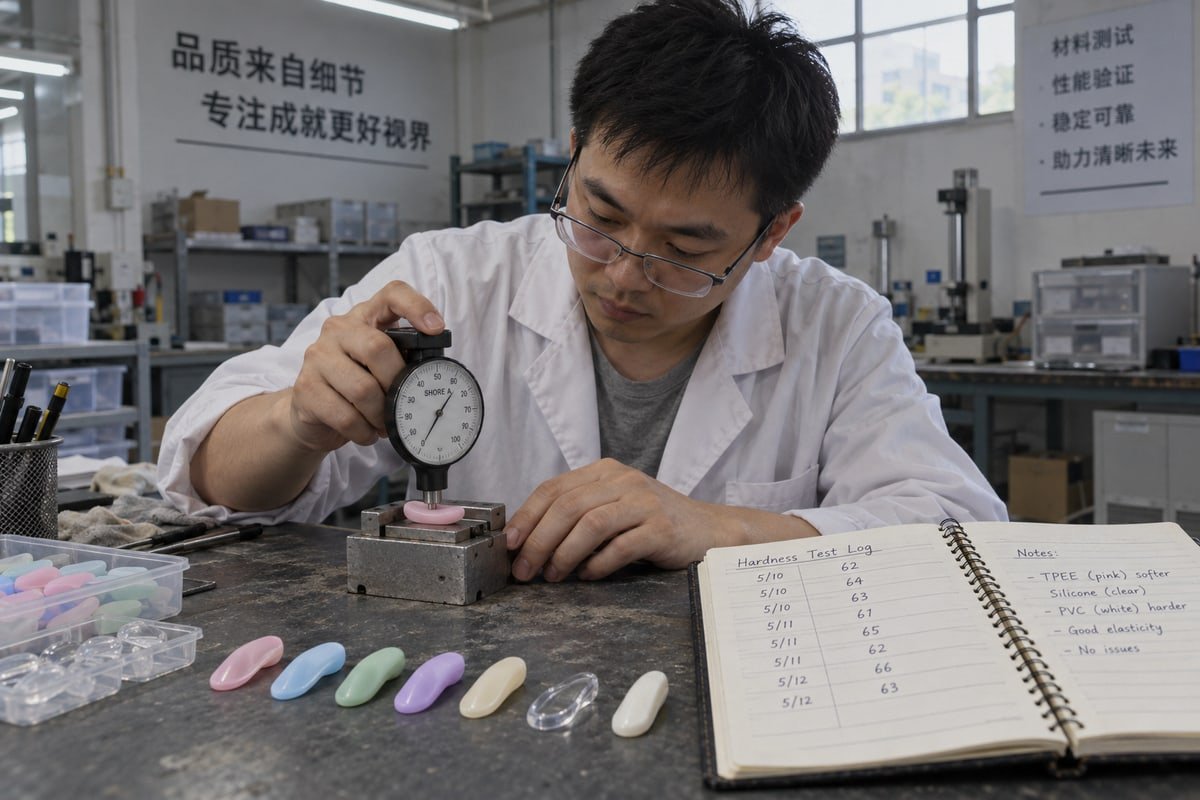
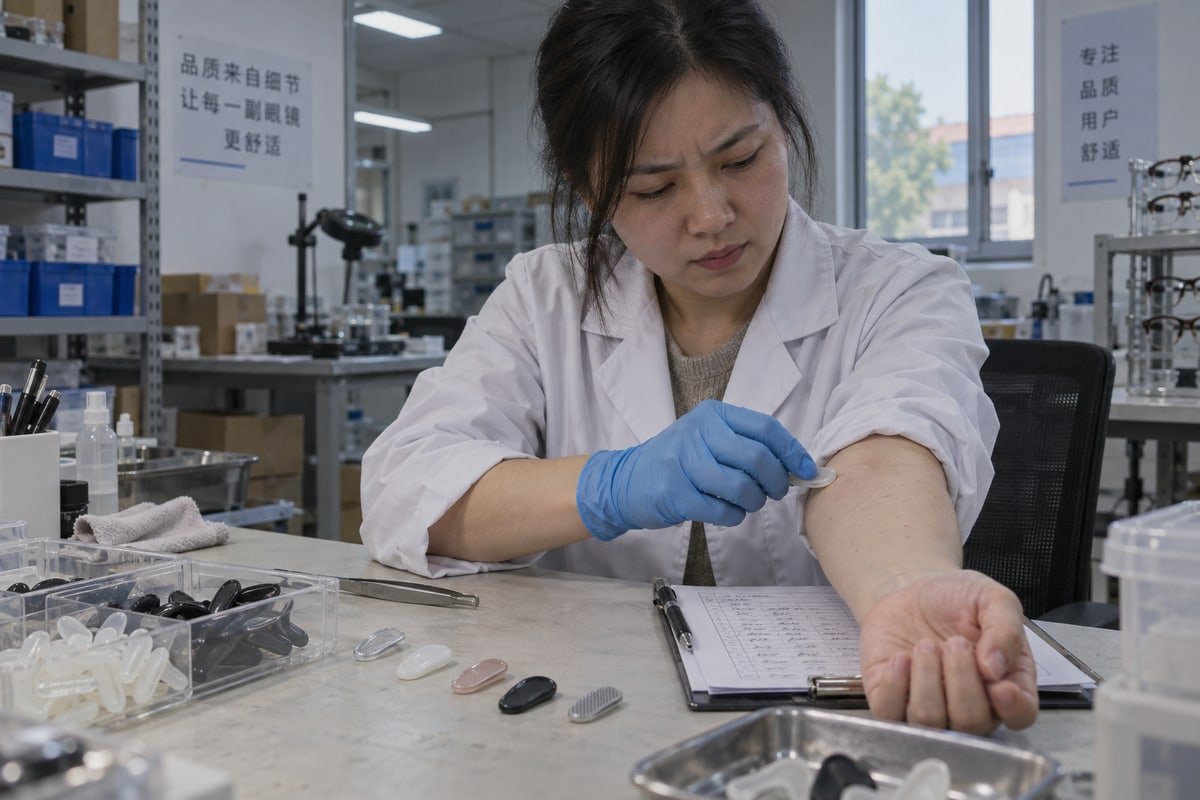
Choose latex-free, hypoallergenic TPEE or anti-slip silicone nose pads with a medium Shore A hardness and a lightly textured surface. These materials stay soft on sensitive young skin, grip well when sweaty, and avoid the irritation risk of standard PVC pads during long outdoor wear.
Comparing the common pad materials
| Material | Grip when sweaty | Skin comfort | Our view for kids |
|---|---|---|---|
| Molded TPEE | High, rubbery, non-slip | Soft, latex-free, hypoallergenic | Our default for integrated pads |
| Anti-slip silicone (separate pad) | High | Soft | Good grip, but separate parts can detach |
| TPU grip zones | Medium to high | Slightly firmer | Useful on temples as well as the nose |
| Hard PVC or acrylic | Low | Firm, higher irritation risk | We avoid it on children's frames |
The Shore A trade-off
Buyers often ask for the softest possible pad. I understand why. Soft feels kind. But hardness is a real trade-off. A softer TPEE grips better yet wears faster. A firmer TPEE lasts longer but may slip on smooth or sweaty skin. We keep our pads in a medium band. Then we add texture rather than dropping the hardness further. That gives grip without a pad that scuffs after one summer.
Texture beats softness
Smooth pads slip when wet. Grooved or slightly ribbed surfaces raise friction and hold contact under sweat. This is why "soft" does not mean "unstable." A very light TR90 frame with soft but smooth pads can still slide more than a slightly firmer rubberized TPEE setup. The surface finish matters as much as the compound.
Skin safety and temperature
Sweat sits on the pad for hours during outdoor play. Latex-free, hypoallergenic materials 2 cut the irritation risk that standard PVC pads carry. Our compounds are also environmentally friendly, which our European buyers ask about first. One caution: TPEE can stiffen a little in cold weather, which reduces grip. TR90's flexible memory helps here. It keeps frame tension steady, so the pads still press evenly against the nose on a cold morning.
Can adjustable nose pads really improve fit across different children's face shapes?
A buyer from Australia once asked us for adjustable metal-arm pads on a toddler frame. We talked her out of it. Here is why, and when adjustable still wins.
Yes, adjustable nose pads can improve fit across different children's face shapes, especially low or narrow bridges. But for toddlers and preschoolers, integrated nose pads in age-tiered sizes are safer, because metal-arm pads can be bent, chewed, or pulled off during play.

Integrated versus adjustable at a glance
| Integrated nose pads | Adjustable nose pads | |
|---|---|---|
| Fit range | One bridge geometry per size tier | Arms bend to match bridge height |
| Safety | No small parts, cannot be chewed or lost | Metal arms and loose pads are a risk for young kids |
| Weight and look | Seamless and lighter | Slight added bulk |
| Best for | Toddler, preschool, active school-age | Older children, low-bridge fits, optical frames |
Why we build in age-specific tiers
Craniofacial proportions 3 change a lot between a toddler, a preschooler, and a school-age child. The bridge rises. The eyes spread. A single pad shape cannot serve all three. That is why our style library is grouped by age tier, with the bridge geometry molded differently for each. Buyers can pick from existing tooling and launch without a new mold. This gives most of the fit benefit of adjustment with none of the loose parts.
Handling low-bridge faces
Some children have a very low bridge. Standard frames sit on the cheeks. For these faces we offer a low-bridge configuration: a deeper, flatter saddle seat with more contact on the sides of the nose. On school-age optical frames, adjustable pads are a fair option here. On sunglasses for younger kids, we prefer a molded TPEE pad that flexes slightly. It adapts a little without becoming a small part.
Where adjustable does win
I do not dismiss adjustable pads. On our TR90 kids optical frames for older children, they help an optician fine-tune wearing height and optical center alignment. The child is old enough not to chew them. The frame is fitted once and checked at the shop. In that case, adjustable delivers real fit control. The rule we share with buyers is simple. Match the pad system to the age tier, not to the catalog trend.
Why does nose pad design matter so much for TR90 and TPEE frame durability?
We learned this the hard way years ago. A frame with a perfect bridge still failed because the temples were weak. Stability is a system, not a pad.
Nose pad design matters for TR90 and TPEE frame durability because the pads set where load and flex concentrate. Good pad placement keeps optical center alignment stable, spreads stress away from the bridge, and works with soft temple tips so the frame flexes evenly instead of cracking or loosening.
Where the frame flexes
TR90 is a lightweight thermoplastic 4 with real frame flexibility and memory. It bends when a child sits on it and returns to shape. It is often described as around 20 to 25 percent lighter than conventional plastics. That lower weight means less downward pressure on the bridge. But the pads still define the pivot point. If the pads sit too high or too far apart, every bend of the frame twists around the bridge. Over months, that loosens hinges and shifts the lens seat. A balanced pad position spreads the stress across the whole front. Impact resistance also improves because the frame is not pre-loaded at one spot.
Alignment and lens performance
Our lenses are UV400 or polarized. They only do their job when the child looks through them, not over them. A pad seat that lets the frame drop pushes the lens below the eye line. The chunky slate-blue frame in our range, for example, has a wide front. Its saddle seat is placed so the lens stays level during running. Optical center alignment is a stability issue and a durability issue at the same time.
Temples finish what the pads start
Nose pads alone cannot hold an active child's glasses. The load must be shared between the bridge and the sides of the head. This is why our most stable styles pair a TR90 front with TPEE temples. The soft temple tips grip behind the ears. The pads grip the nose. A lightweight frame with wrong bridge geometry will still slide. A good bridge with slippery temples will slide forward. Both need to be right.
A simple fit check for buyers
| Check | What to look for |
|---|---|
| Nose bridge fit | Pad surface sits flat, no gap, no pinch |
| Nose pad comfort | No red marks after a few minutes of wear |
| Temple curve | Temples follow the head without pressing |
| Temple grip | Tips hold behind the ears without slipping |
| Lens angle | Lens stays level and centered on the eye |
| Head-movement stability | No bounce or slide when the child jogs or looks down |
We run these checks on samples before a buyer approves a color or a logo. It takes minutes and saves a season of returns.
Conclusion
Sliding sunglasses cost brands returns and trust. The fix is not tighter pads. It is matching pad shape, material, and placement to the child. That is what we build daily.
Interested in sourcing the products mentioned in this article? See details and request a quote here:
Footnotes
1. Explains the optical principle behind polarized lens technology referenced for weight balance. ↩︎
2. Provides an authoritative definition and context for hypoallergenic standards in consumer products and materials. ↩︎
3. CDC growth data supports claims about changing child facial proportions across age tiers. ↩︎
4. Background on thermoplastic material properties underlying TR90 frame flexibility and memory. ↩︎
More Articles You Might Like



Looking for a Reliable Kids Eyewear Partner?
Explore 800+ ready styles and full OEM/ODM support tailored to your brand.
Get in Touch English
 Español de México
 Deutsch
 Français
 日本語
 العربية
 Português do Brasil