What Are Common Mistakes When Choosing TR90 Kids Optical Frames?

Buyers often pick TR90 kids optical frames by look and price. Then frames slip, snap, or fail tests. On our Taizhou line, I’ve learned exactly why—and the fixes.
The most common mistakes when choosing TR90 kids optical frames are buying oversized for growth, skipping frame measurements, ignoring bridge fit, accepting unverified TR90 material, choosing rigid temples over flexible ones, sourcing without consistent QC, and overlooking child-safety certifications and test reports.
Let me break these mistakes down one by one. I will start with the material itself, because everything else rests on it. Then I will move to temples, sourcing habits, and safety testing. Each section ends with a practical check you can use on your next sample.
How can I tell if a TR90 frame is genuine quality or a cheap imitation?
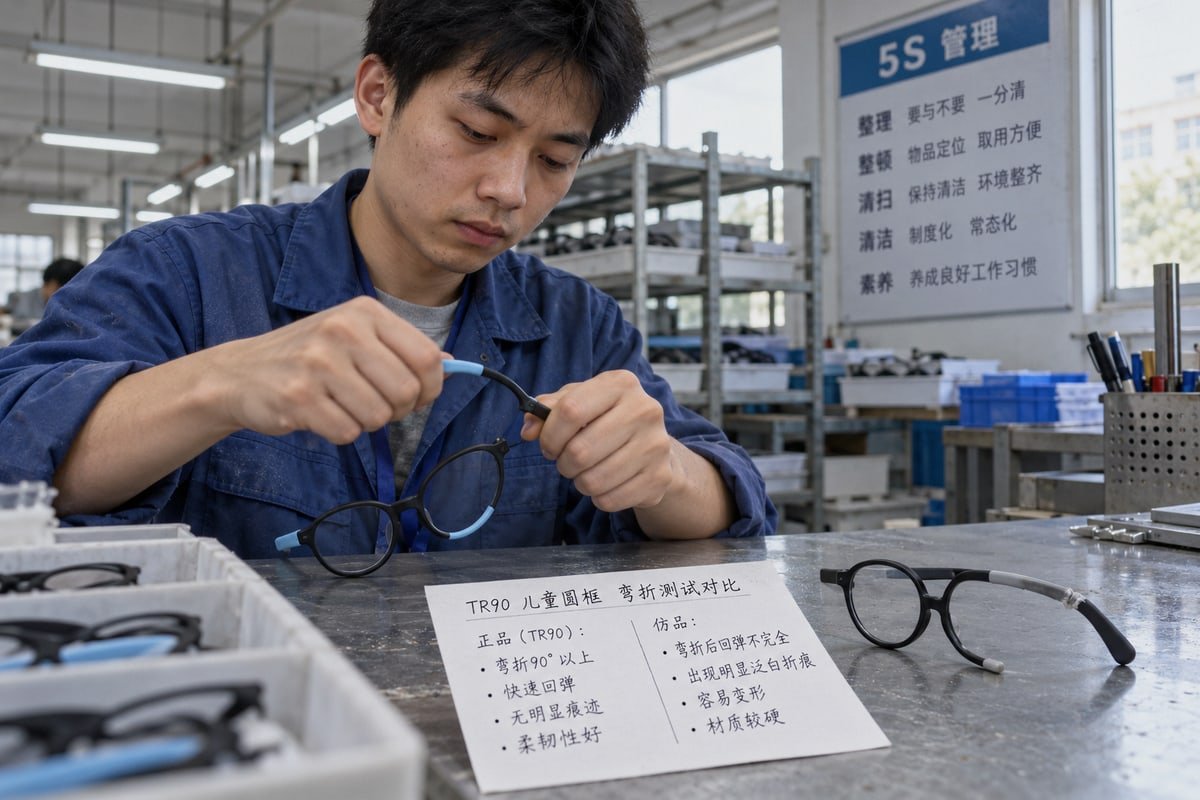
Last year a buyer sent our QC team a rival sample labeled TR90. We bent the temple ninety degrees. It whitened at the fold and never fully returned.
Genuine TR90 kids optical frames bend deeply and spring back without stress-whitening, feel light yet rigid at the rim, show clean uniform surfaces with no odor, and come with a material declaration naming Grilamid TR-90 or an equivalent polyamide, backed by supplier test data.
What Grilamid TR-90 actually is
TR90 is a trade name, not a generic word for "flexible plastic." It refers to a transparent polyamide, best known as Grilamid TR-90 1 from EMS-Grivory. It is a flexible memory resin. That means it bends under load and returns to its original shape. The Grilamid TR-90 properties that matter for children are low weight, high impact resistance 2, good chemical stability, and a smooth skin-friendly surface. The resin itself is widely regarded as a hypoallergenic material. It also takes color evenly, which is why pastel and two-tone styles look so clean in it.
Imitations copy the look, not the chemistry. Some suppliers use recycled polyamide 3 with unknown history. Others use polycarbonate, polypropylene, or a nylon blend 4 and still call it TR90. These lightweight thermoplastic frames may bend once. They rarely bend a hundred times. On our production line, every new batch goes through a repeat-flex check on temples and fronts before we approve it. Imitation fronts tend to whiten at the bridge or crack at the hinge screw after a handful of cycles. This is the first check I recommend for any TR90 kids optical frames you are evaluating.
Bendable does not mean TR90
Marketing photos mislead. A frame that looks soft or bendy is not proof of TR90. Silicone frames bend too, but they are a different product. They are much softer, hold lenses less firmly, and are mostly used for babies. I have seen online listings that use "TR90" and "silicone" as if they were the same label. They are not. Ask for the material name in writing. Ask for the resin certificate that came with the pellets. A real factory has that document on file.
Simple checks you can do with a sample
| Check | Genuine TR90 | Cheap imitation |
|---|---|---|
| Deep bend of temple | Springs back, no white line | Whitens, stays bent, or snaps |
| Weight in hand | Very light, but rim feels firm | Light but floppy, or oddly heavy |
| Surface finish | Even, smooth, no flow marks | Swirls, pits, sink marks near hinge |
| Smell | Neutral | Sharp plastic or solvent odor |
| Heat exposure | Softens slightly, recovers when cool | Warps and stays warped |
| Documents | Resin grade, lot number, test report | Only a photo and "TR90" in the title |
A note on heat. TR90 has thermal memory. A frame left on a car dashboard in summer can lose its shape. Genuine material usually recovers with a gentle reset by an optician. An imitation will not recover. Tell your retail partners this, because it affects how they handle warranty claims.
Am I choosing the wrong temple material and risking comfort issues for my customers?
When we pair a TR90 front with TPEE temples, I weigh two things: how much the temple should flex, and how firmly it must hold behind a small ear.
Yes, if you pick temple material for looks or cost alone. Rigid or over-thin temples pinch, slip, or snap. For kids, a TR90 front with soft TPEE temples, spring hinges or flexible ends, and correct temple length gives comfort and retention.
The trade-off nobody puts on the spec sheet
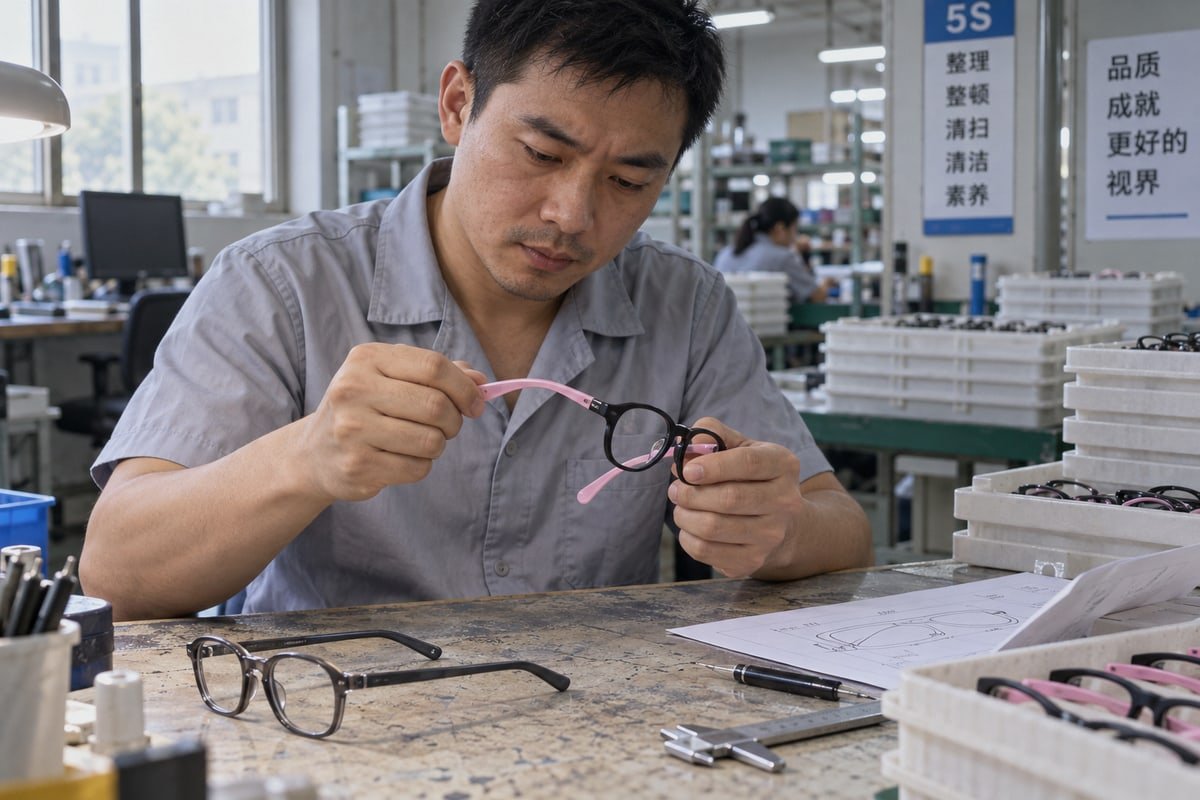
The temple does two jobs. It holds the frame on the head. It also carries every knock the child gives it. A rigid temple holds its shape well but transfers pressure to the skin behind the ear. A very soft temple is gentle but slides down. Our engineers have found that the sweet spot for most children is a TR90 front with a TPEE temple. TPEE is a soft thermoplastic elastomer. It grips lightly behind the ear, and it survives twisting without cracking. The matte black round frame with sky-blue temples in our range is built this way. The two-tone look sells the frame, but the split material is the real reason it stays comfortable all day.
Temple length and curvature
Adults tolerate a temple that is a few millimeters too long. Kids do not. A long temple hooks too far back and pushes the frame forward onto the nose. A short temple pinches and leaves red marks. Temple length and curvature must match the age range you sell to, not a single average. We offer several temple lengths on the same front for this reason, so a brand can cover ages three to twelve with one design language.
Adjustability, spring hinges, and rough play
Here is a real weakness of TR90 that buyers should know. Solid TR90 ear tips cannot be heat-bent as precisely as a wire-core temple. An optician can shape a wire-core acetate temple neatly around the ear. A solid TR90 temple resists that adjustment. That is one reason we use TPEE ends or soft rubberized tips instead. They flex to the ear on their own and do not need a heater.
Spring hinges for durability matter most in active lifestyle eyewear. A spring hinge lets the temple open past ninety degrees and return. Without it, a child pulling the glasses off with one hand puts all the load on the hinge screw. For toddlers, cable temples or a strap harness add retention during play.
Is lighter always better?
No. Buyers often ask us for the lightest possible frame. A front that is too thin can flex so much that the lens pops out. It can also slide, because there is not enough rim mass to sit firmly. Stable on the face beats light in the hand. And do not ignore the child's taste. A comfortable frame the child hates stays in the drawer. Comfort and style must land together.
| Temple option | Comfort | Retention | Adjustability | Best for |
|---|---|---|---|---|
| Solid TR90 temple | Good | Medium | Low | Older school children |
| TR90 with wire core | Good | Good | High | Stronger prescriptions, precise fitting |
| TPEE soft temple | Very good | Good | Self-adjusting | Ages three to ten, active play |
| Cable temple or strap | Fair | Very good | Medium | Toddlers, sports |
What sourcing mistakes lead to inconsistent quality across my TR90 frame orders?
A procurement manager from Europe once asked me why her third order felt stiffer than her first. The answer was in the supplier's resin bag, not her spec.
Inconsistent quality comes from buying through traders instead of a real factory, unlocked resin grades, vague spec sheets without sizes and tolerances, no golden sample, skipped pre-shipment inspection, and switching molds or suppliers to chase the lowest unit price.

Our Taizhou factory ships to buyers in more than twenty countries. The repeat orders that stay consistent all share the same habits. The ones that drift do not. Here is the process I recommend to every new brand.
-
Confirm you are dealing with a factory, not a trader. A trader may move your order between workshops when prices change. That is how order three ends up stiffer than order one. Ask for a video call from the workshop floor. Ask how many workers and how many years of eyewear experience. Our workshop runs about 120 workers under 5S management, and we are happy to show it live.
-
Lock the resin grade and color. Write the resin name and grade 5 into the purchase contract. Ask that color masterbatch codes stay fixed. A cheaper polyamide can look identical in a photo but change flex, fit, and impact resistance.
-
Write a complete spec sheet. Most spec sheets I receive list eye size and color and nothing else. That leaves the rest to chance. Kids' frames are fit-and-function products first.
| Spec field | Why it matters for kids | Typical mistake |
|---|---|---|
| Eye size and bridge width | Bridge fit and stability decide whether the frame slides | Buying one size up "to grow into" |
| Temple length | Retention and pressure behind the ear | Reusing adult lengths |
| Nose pad type | Flatter bridges need adjustable silicone nose pads or a wider keyhole | One fixed low bridge for every market |
| Lens groove depth | Lens thickness compatibility for stronger prescriptions | Groove too shallow, lens pops out |
| Rim thickness and vertex distance | Thicker TR90 rims sit farther from the eye than thin metal and subtly shift effective power | Ignored when switching from metal styles |
| Eye size versus PD range | Frame must allow correct pupillary distance measurement placement | Eye size too large, optical center drifts outward |
-
Approve a golden sample and keep it. Sign two. One stays with us. Every production lot is compared against it for color, flex, and dimensions. This is the single best defense against drift.
-
Inspect before shipment. Check hinge torque, lens retention, and temple flex on a sample basis. Check packaging too. TR90 kids optical frames packed loose in a hot container can deform in transit because of thermal memory.
-
Use existing molds before opening new ones. With around 800 existing styles, a new brand can launch and test the market without mold investment. A new mold adds cost and adds a new source of variation. Customize color, logo, lenses, and packaging first. Open a mold once sales prove the shape.
One last item for your retail insert: alcohol-based sanitizers can dull the surface of TR90 over time. Recommend mild soap and water. It protects the finish and lowers complaints.
Am I overlooking safety certifications when selecting TR90 optical frames for children?
Fifteen years in eyewear taught me one hard lesson: a frame that passes our bend test can still fail a buyer's lab if we never asked which standard applied.
Probably, if you have not asked for test reports. TR90 optical frames for children should be tested to the spectacle-frame standard for your market, such as EN ISO 12870, plus chemical checks for restricted substances like nickel, phthalates, and heavy metals under REACH or CPSIA.

Material is not a safety claim
TR90 is often described as a hypoallergenic material. That is true of the resin. It is not automatically true of the finished frame. Paint, plating on hinges, nose pads, screws, and any recycled content can each add risk. A safety file covers the finished product, not the pellet. This is the gap most buyers miss when they read "TR90" and stop asking questions.
What to ask for
| Test area | What it covers | Ask your supplier for |
|---|---|---|
| Frame performance (EN ISO 12870 or market equivalent) | Bridge deformation, hinge endurance, dimensional stability, resistance to sweat | Third-party report per style family |
| Chemical safety (REACH, CPSIA, or local rules) | Phthalates, heavy metals such as lead and cadmium, restricted dyes | Report covering paint, resin, nose pads, and packaging |
| Nickel release | Metal hinges and screws that touch skin | Report on the hinge components |
| Lens safety | Impact resistance and UV400 where sun lenses are fitted | Lens supplier certificate |
| Flammability and small parts | Required by some kids' and baby categories | Confirmation of which apply to your product class |
Ask before you order, not after
The most common mistake I see is asking for reports after the goods are ready. By then the frame is designed, the paint is chosen, and changes cost time and money. When we develop a new style with a brand, we ask which market it goes to first. Japan, Australia, and the EU do not have identical demands. We then test the finished frame, not just the resin. We share reports by style and lot and keep them together with the golden sample, so the file matches what actually shipped.
Two more points. First, "hypoallergenic" on a package is a marketing claim in most markets. Back it with a chemical report or leave it off. Second, certifications age. If you change a color, a hinge supplier, or a nose pad material, retest that part. Consistent, safe TR90 kids optical frames come from a test file that grows with the product, not from a single certificate issued years ago.
Conclusion
Poor fit, fake material, and skipped tests turn TR90 frames into returns. Verify the resin, match temples to real kids, lock your spec, and demand reports before you order.
Interested in sourcing the products mentioned in this article? See details and request a quote here:
Footnotes
1. Official manufacturer documentation for the specific polyamide resin used in high-quality TR90 frames. ↩︎
2. FDA overview of medical device safety standards, including impact resistance requirements for eyewear. ↩︎
3. Scientific resource detailing the properties of recycled polyamides and their performance in industrial applications. ↩︎
4. Technical overview of nylon polymers, which are sometimes blended with or substituted for genuine TR90. ↩︎
5. International standards for quality management systems ensuring consistent material specifications and production quality. ↩︎
More Articles You Might Like


Looking for a Reliable Kids Eyewear Partner?
Explore 800+ ready styles and full OEM/ODM support tailored to your brand.
Get in Touch English
 Español de México
 Deutsch
 Français
 日本語
 العربية
 Português do Brasil