What Are the Design Differences Between Infant and School-Age TR90 Kids Optical Frames?
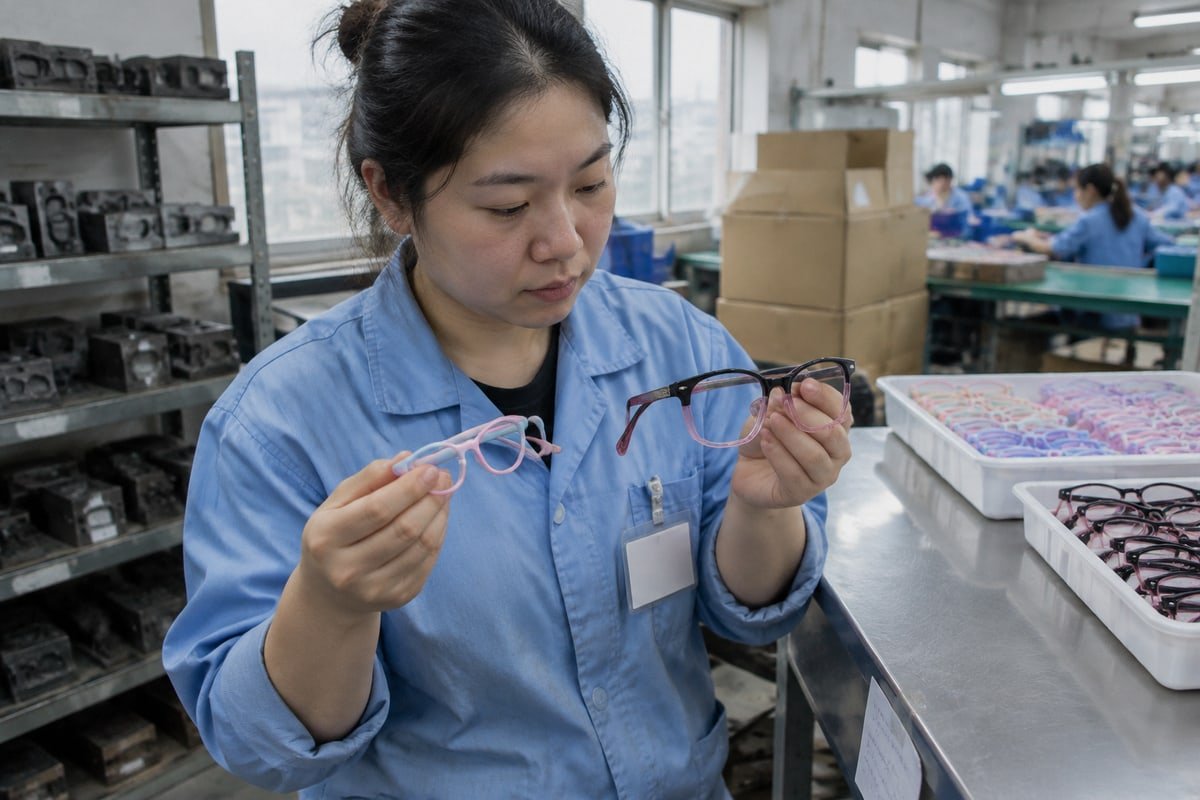
TR90 kids optical frames look similar on a catalog page, yet the wrong age fit costs brands returns and trust. I have watched buyers order one design for every child and regret it. On our production line, we engineer infant and school-age frames as two different products.
Infant TR90 frames are smaller, softer, and retention-focused, using low saddle bridges, rounded edges, strap-ready temples, and metal-free construction. School-age TR90 frames are larger and more structured, with spring hinges, adjustable metal-core temples, defined bridges, and geometry built for all-day classroom and playground wear.
Both frame types can use the same base material. But the engineering goals are completely different. Let me walk you through each design decision, so you can source the right frame for the right age band.
How do I choose the right frame size for infants versus school-age children?
A buyer from Australia once asked us to ship the same 46 mm frame for her whole 0–12 range. We pulled out our sizing charts and showed her why that plan would fail on real faces.
Choose infant frames with 36–39 mm lens widths, 14–15 mm bridges, and 110–120 mm temples for ages 0–2. School-age children need roughly 46–50 mm eye sizes with longer temples, following age bands like 0–3, 3–6, and 6–12 rather than one generic kids size.
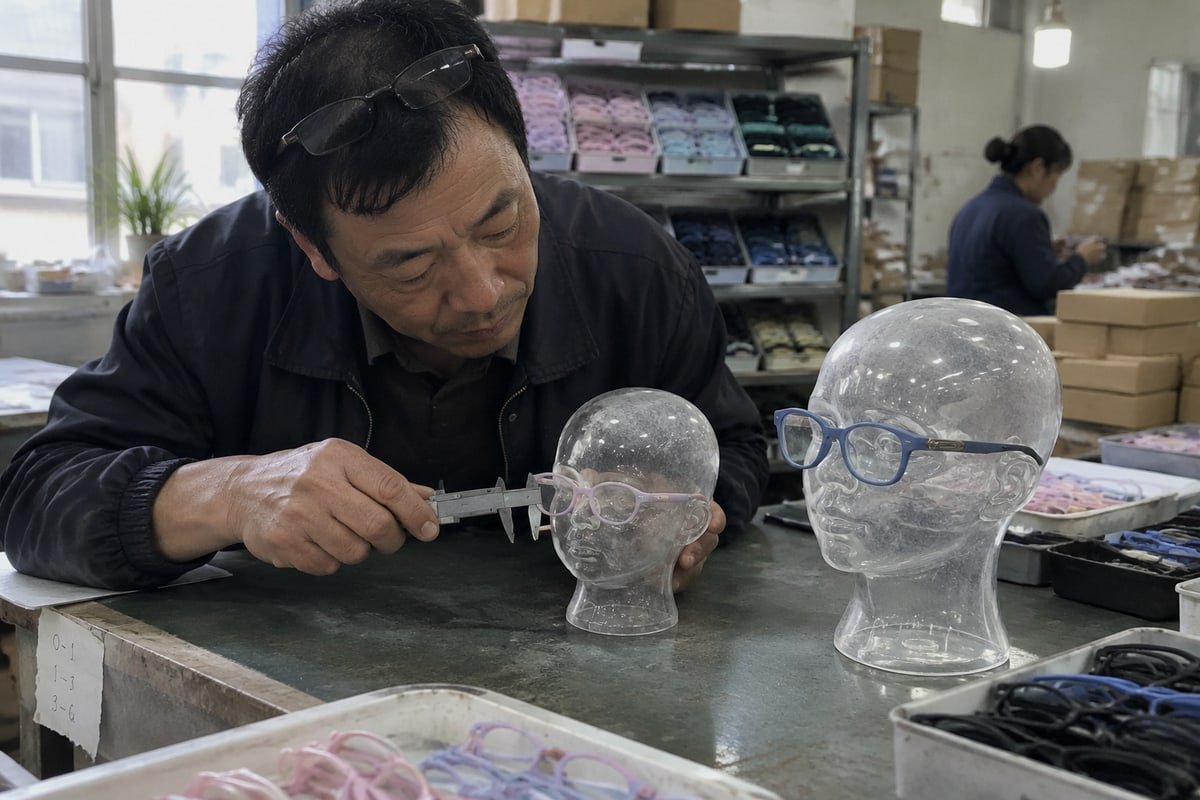
Sizing is where most sourcing mistakes start. Facial morphology in children changes fast. An infant has almost no nasal bridge. The head is wide relative to the face. Ears sit differently. By age six, the skull has hardened and the nose has projected forward. So a frame that fits a toddler will slide straight down a nine-year-old's face, and a school-age frame will sit on an infant's cheeks.
That is why serious suppliers now segment by age band instead of selling one broad kids category. In our own catalog of around 800 existing styles, we group frames by 0–3, 3–6, and 6–12 so buyers can build a full range without guessing.
Reference sizing by age band
| Age band | Lens width | Bridge width | Temple length | Typical weight |
|---|---|---|---|---|
| 0–2 years | 36–39 mm | 14–15 mm | 110–120 mm | Very light, under 20 g |
| 2–5 years | 40–44 mm | 15–16 mm | 115–125 mm | ~20 g |
| 6–12 years | 46–50 mm | 15–17 mm | 125–135 mm | 20–25 g |
A common school-age reference size is 44–15–130 at around 20–25 g, and that is a good sample-check benchmark. Bridge width and fit matter more than lens width alone. If the bridge gaps, the frame slides no matter how well the lenses fit the pupils. When we sample new molds, we check bridge contact first, then temple length adjustment, then overall balance on a child head form.
Two more sizing rules help. First, never size up so a child can "grow into" glasses. The optical center must sit in front of the pupil today, not next year. Second, check vertical lens height, not just width, because young children look upward far more than adults do.
What flexibility and safety features should I look for at each age stage?
There is a trade-off our engineers weigh on every infant project: more flex means better survival when a baby chews or twists the frame, but too much flex means the frame will not hold its position on a tiny face.
For infants, look for soft TR90 or silicone-blend construction, rounded edges, 100% metal-free chew-safe builds, and 180-degree outward-flex hinges. For school-age children, look for impact-resistant TR90 with flexible spring hinges, metal-core temples for cold-bending adjustments, and compliance with child-product safety standards.

TR90 earns its reputation. It is a hypoallergenic thermoplastic material that is flexible, lightweight, and impact-resistant, which is why it has become the default choice for active-kid eyewear. But the way we deploy it changes completely between age stages.
Infant safety priorities
Babies mouth everything. So infant frames should be fully metal-free. No metal hinge cores, no exposed screws, no small detachable parts. We mold rounded edges everywhere and eliminate protruding components. Hinges, when present, are simple 180-degree outward-flex designs so the temples splay open without snapping when a toddler pulls the glasses off sideways. Some of our softest infant designs skip conventional hinges entirely and use a one-piece flexible construction, because the fewer moving parts, the fewer failure points.
Surface finish matters too. Infant frames often use a micro-textured soft-touch finish that grips smooth baby skin. School-age frames flip this logic and use high-gloss finishes that resist the higher sebum production of older children.
School-age safety priorities
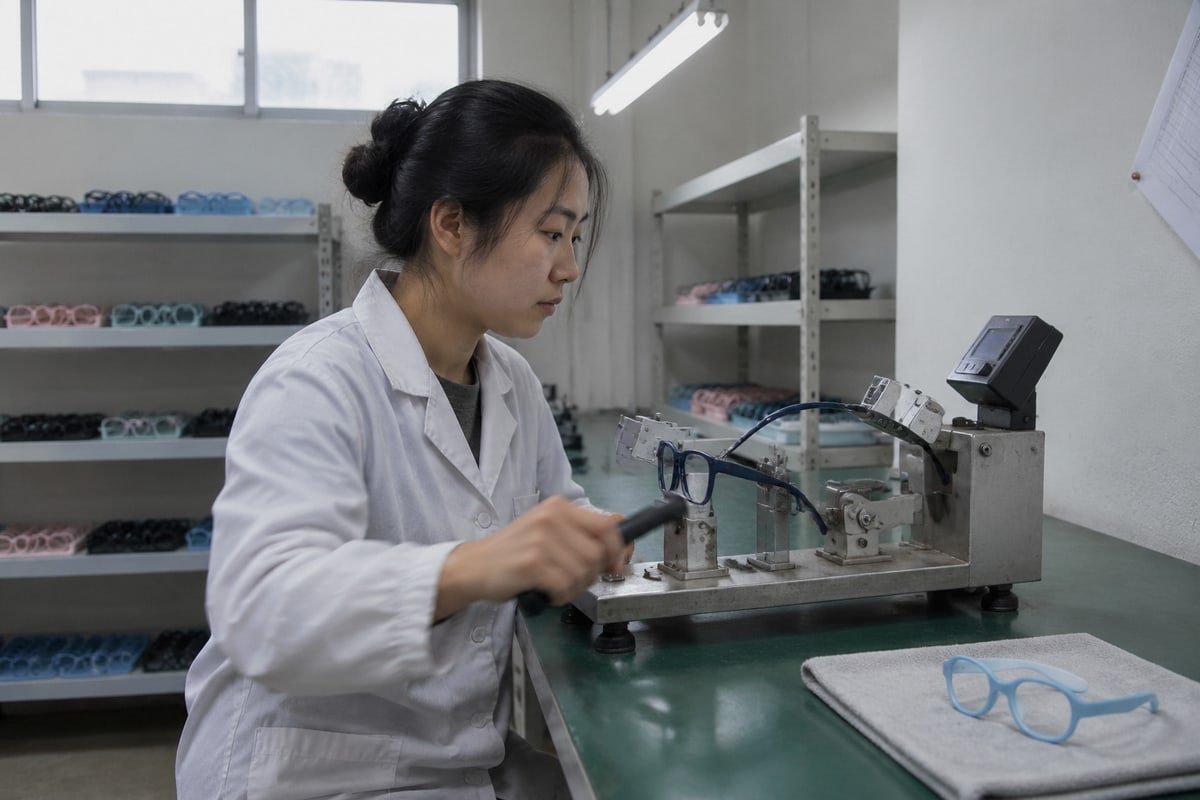
By age six, the risk profile shifts from chewing to impact. Playground falls, flying balls, and dropped backpacks are the enemies now. Here we specify rigid-flex TR90 fronts that meet impact resistance standards 1, flexible spring hinges that survive repeated donning, and metal-core temples 2 so an optician can cold-bend the fit professionally. Buyers in Europe and Japan increasingly ask us for documented compliance with child-product safety requirements, and that scrutiny is a healthy trend for the whole category.
One objection I hear often: since TR90 is flexible, is it not automatically safe for babies? Not quite. A highly flexible frame that lacks retention or sits loosely on a very small face is a fit failure, not a safety win. Softness must be paired with security.
How do temple and strap designs differ between infant and school-age frames?
During a factory visit last year, a Japanese buyer picked up two of our temples and asked why one curled like a hook and the other lay flat. That single question captures the whole retention story.
Infant frames rely on wrap-around cable temples, adjustable elastic headbands, or integrated strap systems to survive crawling, stroller rides, and naps. School-age frames use straight temples with spring hinges and ergonomic tips, relying on fit precision and bridge stability instead of straps.

Retention is the biggest functional divide in pediatric eyewear anatomy. An infant cannot be told to keep the glasses on. A ten-year-old will refuse to wear anything that looks like baby gear. So the two designs solve opposite problems.
Infant retention systems
Infant frames use three main retention methods, often in combination:
- Cable temples that wrap fully behind the ear, holding the frame through crawling and rolling.
- Adjustable elastic headbands that replace or supplement temples, spreading pressure across the back of the head.
- Wrap-around frame styles with a one-piece contour that hugs the head with gentle, even tension.
Short temples of 110–120 mm keep leverage low, so a grabbing hand is less likely to torque the frame off. We also mold larger contact surfaces at the temples to distribute weight across soft facial bones, since an infant's skull has not hardened yet.
School-age temple ergonomics
School-age temples run 125–135 mm and stay straight or gently curved. Flexible spring hinges take over the retention job, keeping constant light pressure without pinching. Silicone temple tips add grip during sports. One modern detail we now build into many school-age styles: ultra-thin, flat temple tips that sit comfortably under over-ear headphones, because classroom audio use has become a daily reality.
| Feature | Infant frames | School-age frames |
|---|---|---|
| Primary retention | Straps, cables, headbands | Fit precision and spring hinges |
| Temple length | 110–120 mm | 125–135 mm |
| Temple style | Cable or wrap-around | Straight with ergonomic tips |
| Adjustability | Elastic tension | Cold-bendable metal core |
| Headphone compatibility | Not a design factor | Flat, thin temple tips |
One trade-off to flag for buyers: school-age children genuinely outgrow strap-based designs. They want frames that look normal, feel stable on the bridge, and do not mark them as different at school. Forcing a strap style on a seven-year-old usually ends with glasses left in a backpack.
Why do lens shape and fit requirements change as my child grows older?
Early in my time developing children's frames, I assumed lens shape was purely a style choice. Then an optician partner showed me how a toddler looks up through the top rim of an adult-shaped lens, and I understood shape is optical engineering.
Infant lenses are rounder and vertically taller so children looking up at adults still see through the optical zone, with a low saddle bridge and neutral tilt. School-age lenses adopt horizontal adult-style shapes, defined bridges, 8–12 degree pantoscopic tilt, and reinforced zones for myopia-control lenses.
Children do not just grow bigger. Their viewing habits 3, nose shape, and optical needs all change. Frame geometry has to follow.
Vertical field of view for infants
An infant spends most of the day looking upward at caregivers. A round, vertically tall lens keeps the gaze inside the corrective zone even at extreme upward angles. Pair that with a low-profile saddle bridge that spreads contact across the undeveloped nasal area 4, and you get a frame that corrects vision without pressure points. Neutral tilt is correct here. There is no reading posture to optimize for yet.
School-age optical geometry
By school age, three new demands appear:
| Requirement | Design response |
|---|---|
| Long near-work and screen time | 8–12 degree pantoscopic tilt for a better downward viewing angle |
| Developed nasal bone | Higher, more defined bridge, often with silicone nose pads for grip |
| Myopia-control lenses (DIMS, HALT) | Reinforced, non-flexing optical zones to hold precise vertex distance |
The myopia-control point deserves emphasis. These advanced lens designs only work when the lens sits at a stable, precise distance from the eye. A frame front that flexes too freely lets that distance drift, which can undermine an expensive treatment lens. So our school-age TR90 fronts are engineered stiffer around the lens groove, while the temples keep their flexibility. Same material family, opposite flex targets in different zones of the frame.
Weight distribution shifts too. Infant designs spread load over large soft-tissue contact areas. School-age frames concentrate weight on the hardened bridge and ears, which allows slimmer, more stylish silhouettes, brighter two-tone colorways, and translucent pastel finishes that older kids actually want to wear.
Conclusion
Same material, different engineering goals. Infant TR90 frames prioritize retention, softness, and metal-free safety. School-age frames prioritize stability, adjustability, and all-day durability. Match the frame to the developmental stage, prioritize fit and retention first, and your kids eyewear range will earn parents' trust.
Interested in sourcing the products mentioned in this article? See details and request a quote here:
Footnotes
1. ISO 12870 defines the international requirements and testing for spectacle frame impact resistance. ↩︎
2. CPSC outlines mandatory safety standards and testing for products intended for children. ↩︎
3. The AAO provides resources on how viewing habits and developmental changes affect pediatric eye health. ↩︎
4. The WHO provides global guidance on vision health and addressing pediatric refractive errors. ↩︎
More Articles You Might Like


Looking for a Reliable Kids Eyewear Partner?
Explore 800+ ready styles and full OEM/ODM support tailored to your brand.
Get in Touch English
 Español de México
 Deutsch
 Français
 日本語
 العربية
 Português do Brasil