Are TR90 Kids Optical Frames Safe for PE Class or Sports?
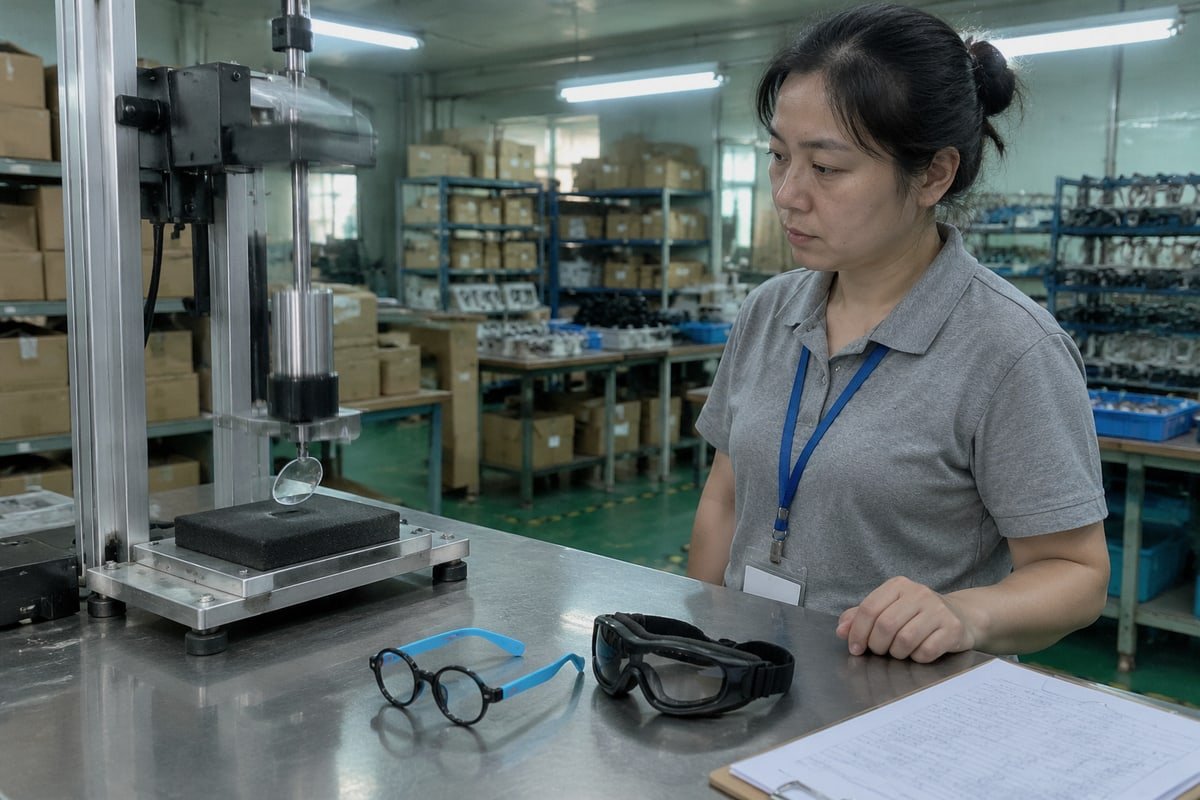
Every season, buyers touring our Taizhou factory ask one worried question: are TR90 kids optical frames safe for PE class? Broken glasses mean upset kids, returns, and lost trust.
TR90 kids optical frames are generally safe for PE class and non-contact sports because the flexible memory resin bends instead of snapping. However, TR90 alone is not sports-certified. For ball or contact sports, pair frames with impact-rated polycarbonate lenses or choose ASTM F803 sports goggles.
That short answer hides four practical questions. What makes the material flexible? Does it stay tough after months of abuse? Are the lenses actually impact-resistant? And which fit features matter? I will walk through each one below, using what we see on our own production line.
What makes TR90 frames flexible enough to survive rough play?
Last month our QC team twisted a batch of round black TR90 fronts with sky-blue temples through repeated bend tests. Every frame sprang back flat.
TR90 is a thermoplastic nylon, often called a flexible memory resin. Its polymer chains absorb and dissipate energy, so the frame bends under pressure and returns to shape instead of snapping. It is also up to 50% lighter than acetate and stays elastic in heat and cold.
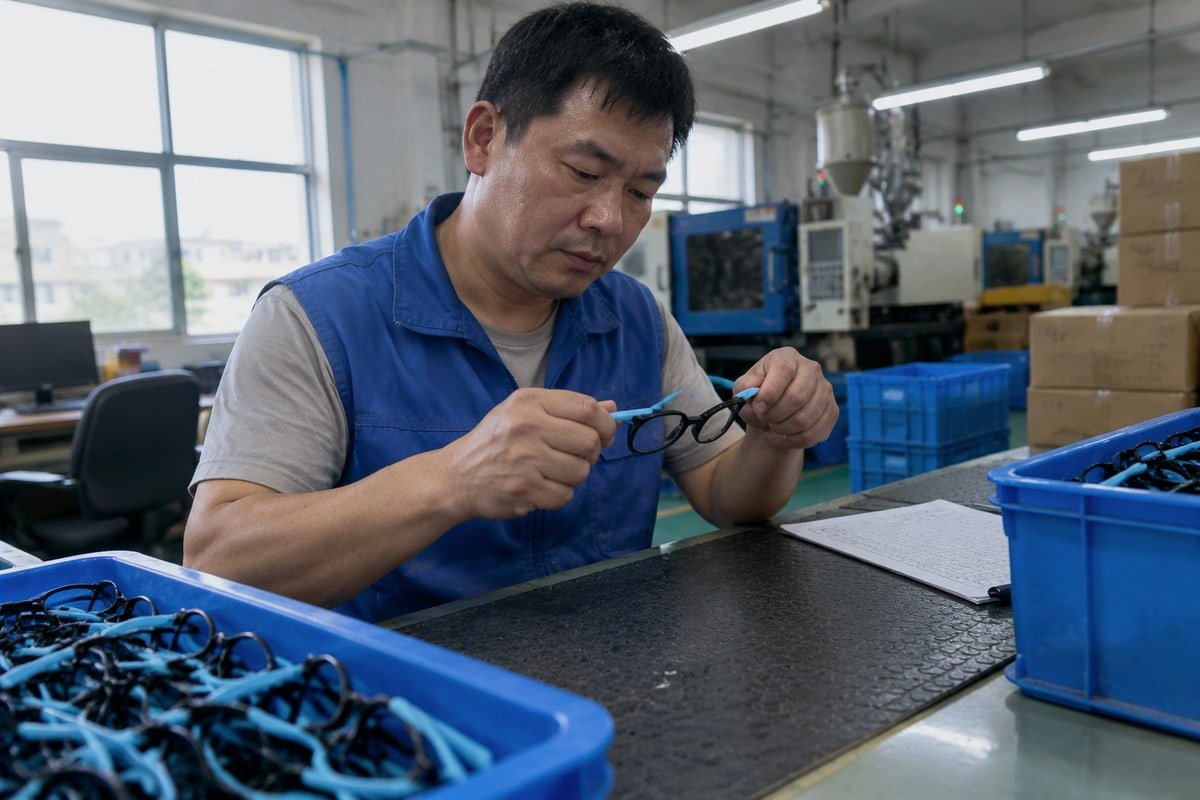
TR90 belongs to the polyamide family, a thermoplastic material originally developed for lightweight durability. Some newer grades are made from bio-polyamides derived from castor oil. We like those grades because they keep the same performance while fitting the environmentally friendly material story our buyers want to tell.
Why "memory" matters for children
A child does not treat glasses gently. They sit on them. They pull them off by one temple. They drop them on gym floors. Acetate can crack at the hinge under that load. Metal can bend and stay bent. TR90 does something different. It flexes, stores the energy, and releases it as the frame returns to its molded shape. That is the memory effect, and it is the main reason TR90 kids optical frames are so popular for school wear.
Weight and stability during movement
Weight matters more than most parents realize. A heavy frame bounces on the nose when a child runs or jumps. That bounce shifts the optical center and makes vision unstable. Because TR90 is up to 50% lighter than acetate, the frame stays closer to the face. The polymer also has natural damping properties, so fewer micro-vibrations reach the head during high-impact movement. Some sources suggest this can reduce fatigue and help focus, although we treat that as a secondary benefit.
Temperature and sweat resistance
TR90 keeps its structure in high temperatures. A frame left in a hot locker or worn in direct summer sun will not warp or lose its fit. It also stays elastic in freezing weather, unlike many plastics that turn brittle and shatter. And it resists skin oils and perspiration, so it does not go brittle or irritate skin during long PE sessions.
How TR90 compares with other kids frame materials
| Material | Flexibility | Weight | Break behavior | Best for |
|---|---|---|---|---|
| TR90 | High, returns to shape | Very light | Bends, rarely snaps | School-age kids, daily active wear |
| TPEE | Very high, rubber-like | Very light | Bends freely, very soft | Toddlers and very rough users |
| Acetate | Low | Heavier | Can crack into sharp edges | Fashion frames, calm wear |
| Metal | Low, bends and stays bent | Medium | Deforms, loose parts possible | Adult and teen dress frames |
In our own range we often combine the two flexible materials. TR90 fronts with TPEE temples give a structured look at the front with a softer, safer temple on the ear.
Can I trust TR90 frames to stay durable after repeated drops or bends?
Softer resin survives more abuse but loses crisp shape; stiffer resin looks sharper but cracks sooner. We weigh that balance for every kids style we mold.
Yes, TR90 frames handle repeated drops and bends far better than acetate or metal because the material recovers its shape and resists skin oils and sweat. Real durability, however, also depends on hinge quality, temple construction, and lens groove depth, not the resin alone.
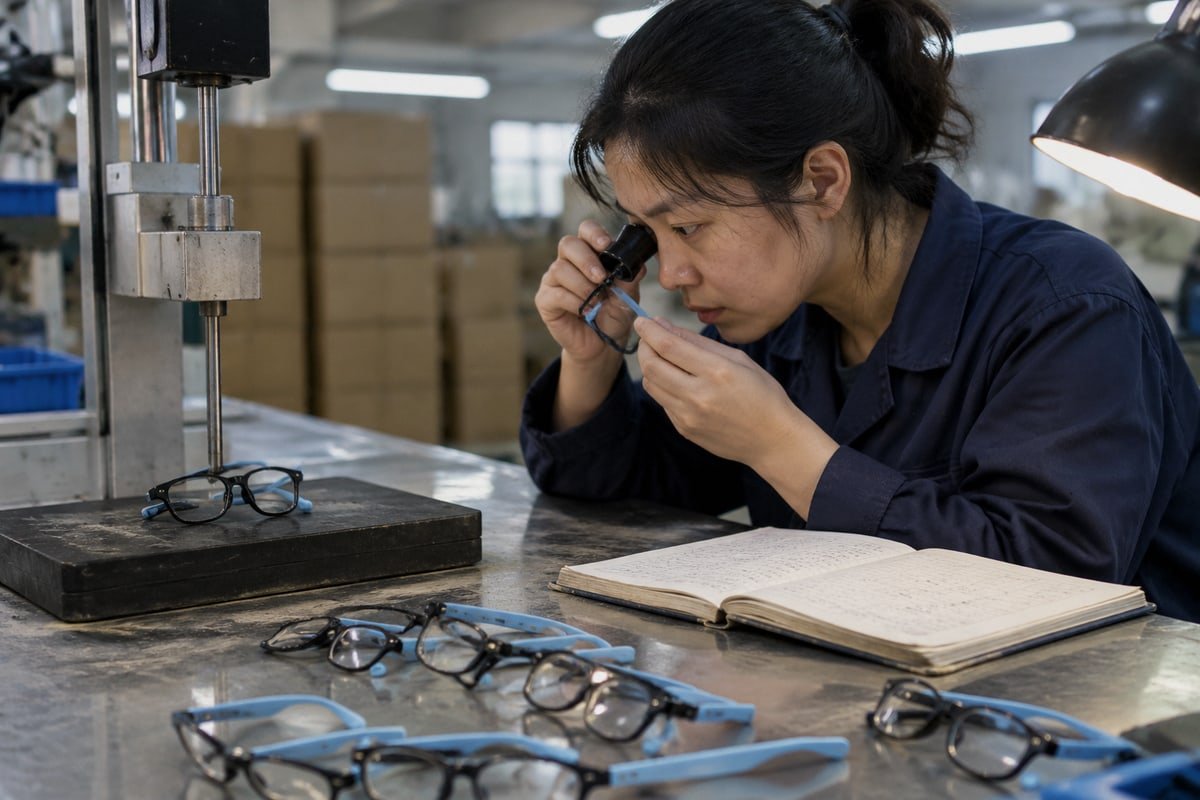
Durability is a system property. The resin is only the start. Over 15 years of making children's eyewear, we have learned that most failures happen at the joints, not in the middle of the front. So when a buyer asks whether they can trust TR90, I answer with the whole frame in mind.
Where kids glasses actually fail
Here are the weak points we watch on every new style, in the order we check them:
- Hinge screws. A loose screw creates a small detachable part. That is a choking hazard for younger kids and a common return reason for older ones.
- Temple root. This is where the temple meets the front. It takes the most twisting force. On TR90 we thicken this area slightly so it flexes without thinning out.
- Lens groove. If the groove is too shallow, a hard flex can pop the lens out. For PE-focused styles we specify a deep-groove design so the lens stays seated when the frame bends.
- Temple tips. Tips that harden or crack after months of sweat exposure will pinch behind the ear.
What testing looks like in practice
Manufacturers in this category typically run drop tests and tension tests that mimic rough handling. In our workshop that means dropping finished frames onto a hard surface, pulling the temples outward well past normal wearing width, and cycling the hinges open and closed many times. We do not publish these as certifications. They are internal checks, and I would encourage any buyer to ask their supplier to describe their version of them.
The "unbreakable" objection
Buyers sometimes push back with a fair concern. If TR90 is marketed as unbreakable, why do they still see broken kids glasses in the market? The honest answer is that "unbreakable" is a marketing word, not a test result. TR90 resists breakage very well. It is not immune. A frame thrown against a wall or crushed under a backpack full of books can still fail, especially at a poorly designed hinge. What TR90 does is change the failure mode. When it does fail, it tends to deform rather than shatter into sharp pieces. That is the safety benefit that matters most for shatterproof eyewear on a child's face.
Durability over the school year
| Stress event | Acetate frame | TR90 frame |
|---|---|---|
| Sat on in a backpack | Often cracks at bridge or hinge | Usually flexes and recovers |
| Dropped on gym floor weekly | Chips and micro-cracks build up | Minimal visible damage |
| Left in hot car or locker | May warp or loosen | Holds shape and fit |
| Winter outdoor use | Can become brittle | Stays elastic |
| Daily sweat exposure | Surface can dull | Resists oils and perspiration |
The short version: trust TR90, but inspect the hinges and groove before you place a bulk order.
How do I know if the lenses are impact-resistant enough for sports?
A procurement manager from Australia once asked me why our frames passed bend tests yet she still needed lens certificates. Her question was exactly right.
Check the lens material and the standard. Polycarbonate lenses are the sports baseline. In the U.S., FDA drop-ball testing under 21 CFR 801.410 uses a 5/8-inch steel ball dropped from 50 inches. For ball sports, only ASTM F803 standard protective eyewear guarantees projectile protection.
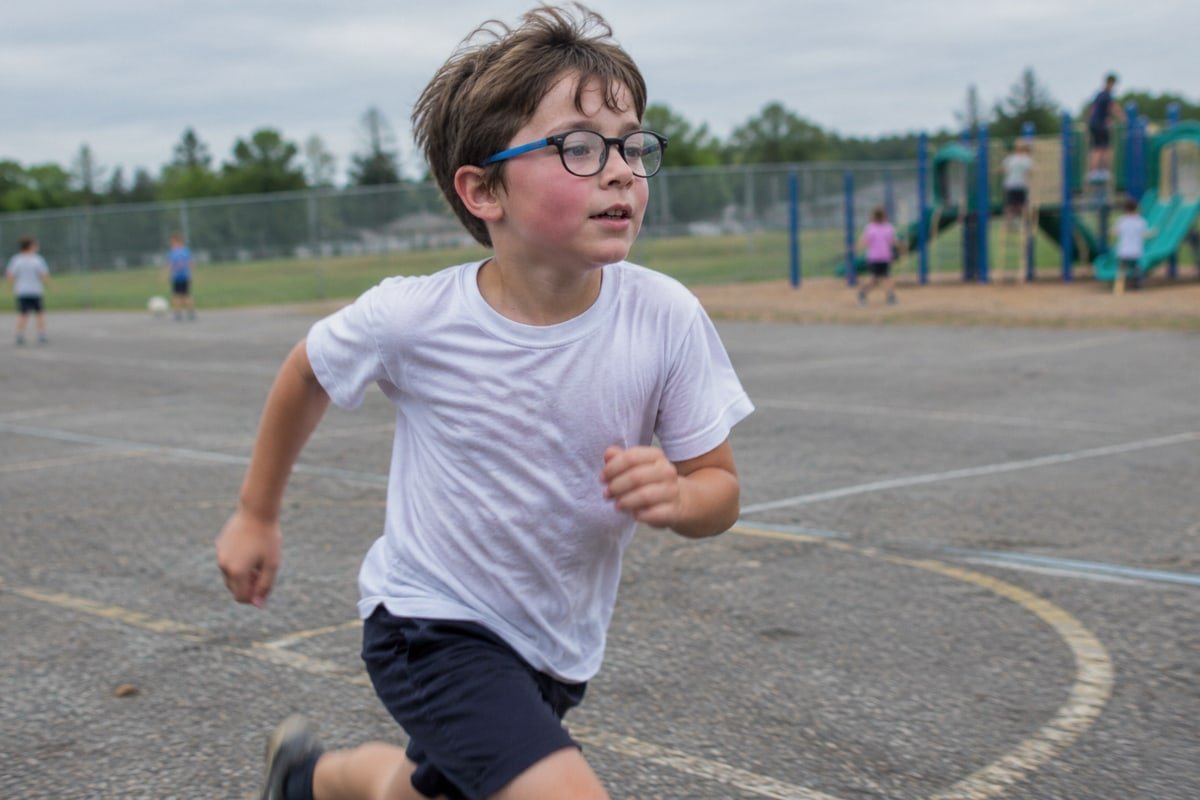
This is the point where TR90 marketing often goes quiet, so let me be direct. Frame flexibility protects the frame. Lens impact resistance protects the eye. The two are tested separately, and the lens standard is the one a school nurse or pediatric optometry clinic will actually ask about.
Which standard applies to what
| Standard or test | What it covers | What it does not cover |
|---|---|---|
| FDA drop-ball test, 21 CFR 801.410 | Basic lens impact resistance for everyday eyewear in the U.S. | Frame strength, lens retention, high-velocity balls |
| ASTM F803 standard | Complete protective sports glasses tested against sport-specific projectiles 1 | Regular optical frames, even with polycarbonate lenses |
| CPSIA requirements 2 | Lead and phthalate limits in children's products | Impact performance |
| CE, EN 71-3, REACH, ISO or USP biocompatibility claims 3 | Material safety and chemical content, as declared by the seller | Sports impact unless separately tested |
Notice the gap. The FDA drop-ball test applies to lenses, not frames. So a TR90 frame that survives every bend test in our workshop still needs lenses that pass the drop-ball requirement 4 before it is a legitimate option for PE class. And even then, it is not the same as ASTM F803 sports goggles for kids.
Lens material choices
Polycarbonate lenses are the standard choice for children because they are light and highly impact-resistant. Standard CR-39 plastic is heavier and more likely to crack under a direct hit. For our optical frames we supply lenses in a range of options, including UV400 and polarized for sun styles, and we always recommend polycarbonate when a buyer tells us the frames are going to active kids.
Matching the setup to the activity
I find it easiest to think in levels rather than in yes or no answers:
- Classroom and recess. TR90 frame plus impact-resistant lenses is enough.
- PE class, running, gymnastics, swimming warm-ups. TR90 frame, polycarbonate lenses, secure fit features. Suitable.
- Basketball, soccer, baseball, racquet sports. These involve balls, elbows, and collisions. Dedicated sports goggles for kids rated to ASTM F803 are the right product. Standard TR90 optical frames are not a substitute here.
Why the lens groove matters again
In a standard optical frame, extreme flexing can push the lens out. That is fine on a desk. It is dangerous during a fall. For any PE-focused style, ask whether the frame uses a deep-groove design that keeps the lens secure under stress. This is one of those details that separates a well-engineered kids frame from a cheap one that simply uses the same resin.
Should I look for extra features like rubber tips or adjustable straps for active kids?
Years ago we shipped a school-focused style with slick temple tips. Feedback came back fast: the glasses slid during running. We added soft TPEE tips the next season.
Yes. For active kids, fit features matter as much as the frame material. Look for soft rubber or TPEE temple tips, anti-slip nose pads, secure hinges, rounded edges, and no small detachable parts. An adjustable elastic strap adds stability for PE and playground use, and helps younger children.
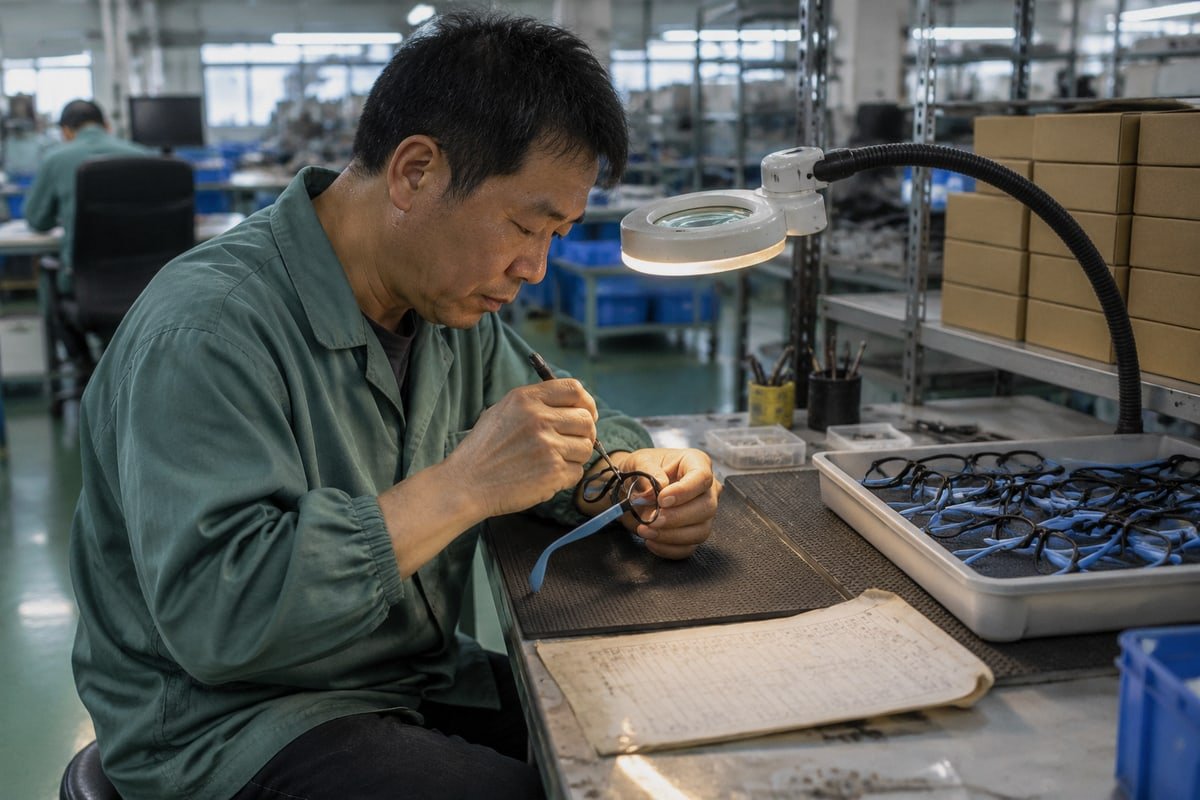
Children's eyewear is treated as a higher-risk product category for good reason. It sits on a child's face all day, gets pulled, thrown, and chewed, and must not create sharp edges, loose parts, or skin irritation. The frame material addresses the first risk. The fit features address the rest.
A practical checklist for buyers
When a product development manager sends us a brief for an active kids line, these are the features I ask them to confirm:
- Rounded edges on the front and temples, so a fall does not press a hard corner into the brow or cheek.
- Soft temple tips in rubber or TPEE, which grip lightly behind the ear and do not pinch when the child sweats.
- Anti-slip nose pads or a molded saddle bridge, because sweat makes smooth plastic slide down the nose during PE.
- Secure hinges that cannot shed a screw, ideally with a design that limits how far the temple can be forced outward.
- No small detachable parts, including decorative charms or clip-ons, that could become choking hazards.
- An adjustable elastic strap as an optional accessory, especially for children under about seven, or for any style sold as PE-ready.
That last item is easy to add. We supply straps as a packaged accessory on request, and several of our brand customers include one in every retail box for their sports-facing collections.
TR90 or TPEE for which age?
The two flexible materials overlap, but they suit different users. TPEE is softer and more rubber-like. We recommend it for toddlers and preschoolers, and for any child known to be very rough on glasses. TR90 is slightly more structured. It looks more like a normal frame, which matters to school-age kids who do not want to look like they are wearing goggles. The translucent pink rounded-square style in our range is a typical example of that more grown-up look. For many customers the best answer is the hybrid: a TR90 front with TPEE temples, which keeps the front crisp and makes the part touching the ear as soft as possible.
A note on skin and chemical safety
TR90 is often described as hypoallergenic because it contains no nickel or chromium and is biologically inert. Many suppliers, including us, also describe it as BPA-free and phthalate-free. Hypoallergenic frames are a real benefit for children 5 with metal allergies. Still, "hypoallergenic" does not mean zero risk. Some children may react to dyes or surface additives. That is one reason we keep our color and coating processes consistent from sample to bulk, so a buyer who tested a sample can trust the production run. Buyers selling into the U.S. should also confirm CPSIA compliance for lead and phthalates, and treat any CE, EN 71-3, or REACH claims as seller statements until they see documentation.
Where OEM flexibility helps
Because we hold around 800 existing styles, a new brand can pick a TR90 or TR90/TPEE base, then customize colors, logos, lens options, straps, and packaging without investing in new molds. That lets a brand test a PE-ready line in one market before committing further.
Conclusion
Broken glasses in PE class cost brands trust. TR90 kids optical frames solve everyday impact, but true sports safety needs rated lenses, secure fit, and honest labeling.
Interested in sourcing the products mentioned in this article? See details and request a quote here:
Footnotes
1. The standard-setting body for ASTM F803, the primary safety specification for eye protectors used in sports. ↩︎
2. U.S. government agency overseeing the Consumer Product Safety Improvement Act (CPSIA) for children’s product safety. ↩︎
3. International organization responsible for standards like ISO 10993 regarding the biological evaluation of medical and optical devices. ↩︎
4. Official eCFR source for 21 CFR 801.410, detailing the mandatory drop-ball test for impact resistance. ↩︎
5. Technical overview of the polyamide polymer family, which includes the TR90 material used in flexible eyewear. ↩︎
More Articles You Might Like

Looking for a Reliable Kids Eyewear Partner?
Explore 800+ ready styles and full OEM/ODM support tailored to your brand.
Get in Touch English
 Español de México
 Deutsch
 Français
 日本語
 العربية
 Português do Brasil