How to Prevent Kids Eyewear Accessories From Deforming During Shipping and Stacking?
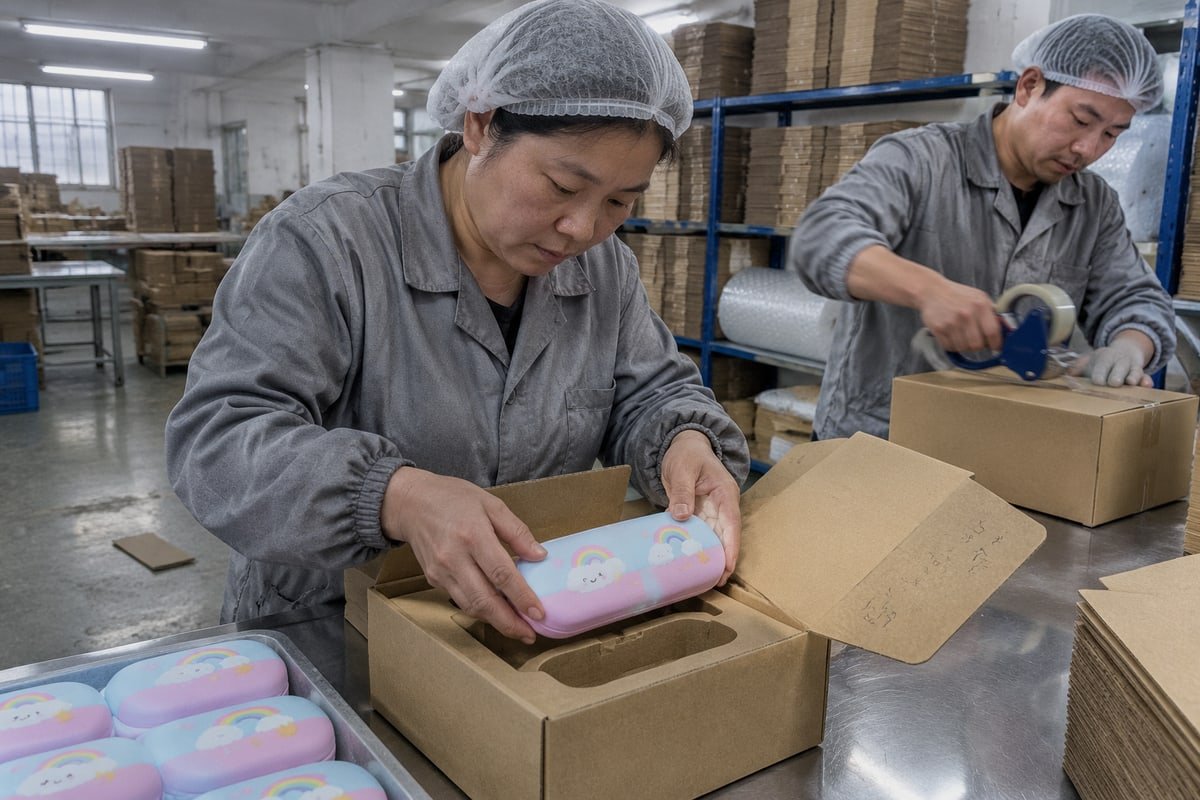
Kids eyewear accessories arrive flattened, creased, or warped far too often. Every crushed EVA case costs a brand a return. On our Taizhou line, we build packaging to stop that.
Kids eyewear accessories stay in shape when each item sits in a snug primary case, a fitted corrugated insert stops movement, and a double-walled outer carton carries the stacking load. Add breathable wraps for TR90 and TPEE parts, limit stacking height, and test with drop, vibration, and compression checks.
That is the short version. The rest of this article explains each layer, how to test it, what to demand at loading, and how to pick a supplier who gets it right.
What packaging materials actually protect flexible kids' eyewear from warping in transit?
Every packaging quote we prepare forces a choice: a rigid EVA case that resists crushing, or a lighter velvet pouch that ships cheaper but flattens under a pallet.
The materials that protect flexible kids' eyewear from warping are a hard-shell EVA case as the primary layer, a breathable microfiber or perforated inner wrap, corrugated box inserts or molded pulp dividers, and a double-walled corrugated master carton with reinforced corners for stacking.
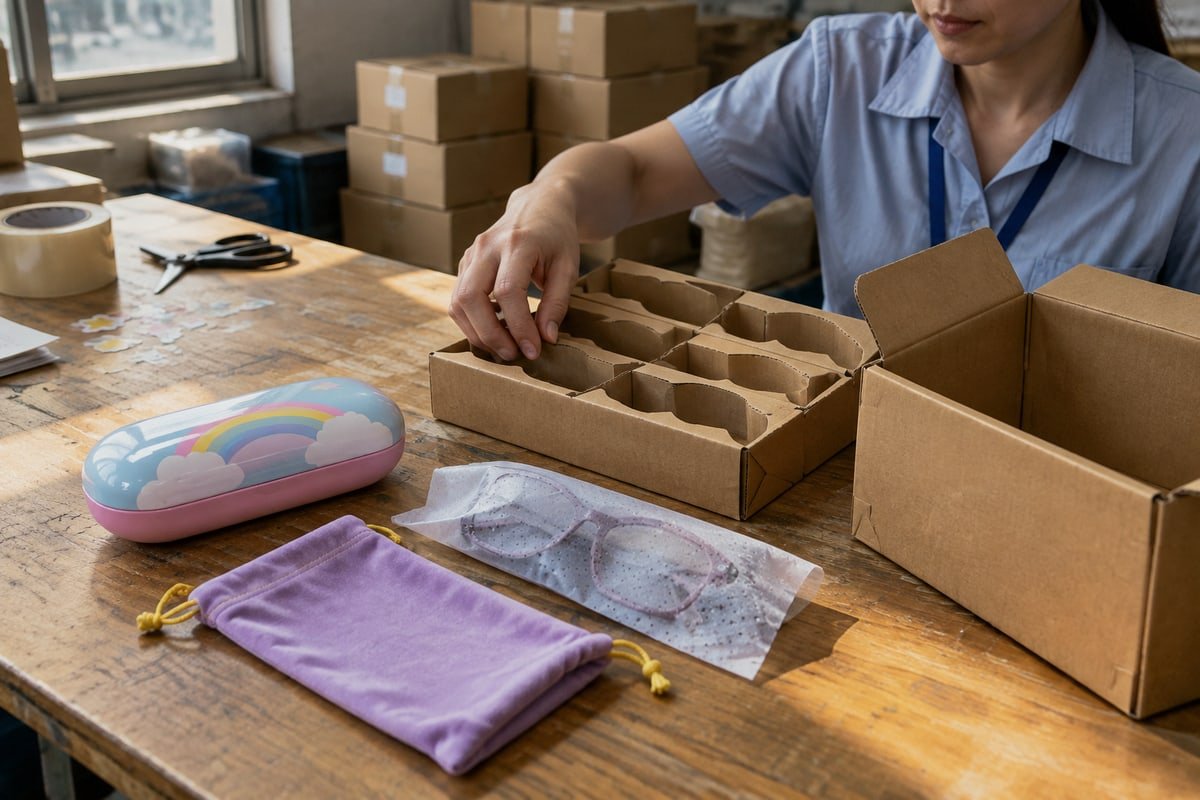
Deformation has three sources. Crushing comes from stacked loads. Shape change comes from internal movement. Softening comes from heat and moisture. Good protective packaging materials answer all three at once. No single layer does the full job.
Compare the options first
| Layer | Material | Protects against | Weak point |
|---|---|---|---|
| Primary case | Hard-shell EVA (our rainbow-cloud case) | Vertical compression, creasing | More bulk, higher cost |
| Primary pouch | Velvet drawstring pouch | Dust, scuffing, gifting appeal | Flattens under load |
| Inner wrap | Microfiber sleeve or perforated polybag | Scratches, trapped heat | No crush protection |
| Insert | Corrugated box inserts or molded pulp | Movement, unit-to-unit friction | Softens if wet |
| Insert | Custom foam tray | Movement, shock absorption | Cost, less recyclable |
| Outer shipper | Double-walled corrugated carton | Stacking load, handling drops | Overhang and damp storage |
Why the hard case matters most
Hard cases give the most structure and crush resistance. When a pallet is stacked, weight travels down through every carton. A rigid EVA shell passes that load through its walls. A soft pouch passes it straight to the strap or cloth inside. That is why our accessory set ships with the glossy hard-shell case as the anchor item.
The soft pouch objection
Buyers often tell me the velvet pouch is cheaper and looks better on a shelf. Both points are true. My answer is simple. Ship the pouch flat, unfilled, inside the hard case or in its own divided cell. Never let a pouch carry stacking weight. You keep the retail appeal without the crushed corners.
Why breathable wraps matter for TR90 and TPEE
Flexible frames and silicone strap ends can outgas slightly in a hot container. A sealed, unvented polybag traps that heat and moisture. Under pressure, the part can take a set. We use perforated or microfiber wraps for anything molded in TR90 or TPEE. For silicone loop ends, a small clay-based desiccant in the unit bag helps prevent stickiness in humid micro-climates.
Foam or paper?
Foam gives the tightest fit. Molded pulp and corrugated dividers are easier to recycle. For most kids' accessory kits, a die-cut corrugated insert 1 holds each item still and stays paper-based. We only move to foam for hinged optical frames with tight tolerances.
How can I test if my supplier's frames will survive long-distance shipping without deforming?
A procurement manager from Australia once asked us to prove our TR90 frames would arrive straight after weeks at sea. We showed her our test sequence.
Test supplier frames by requesting samples in final packaging, then run a drop test, a vibration or shake test, and a stacking compression test. Measure temple spread, bridge alignment, and hinge play before and after. Add a heat-and-humidity soak to simulate container conditions.
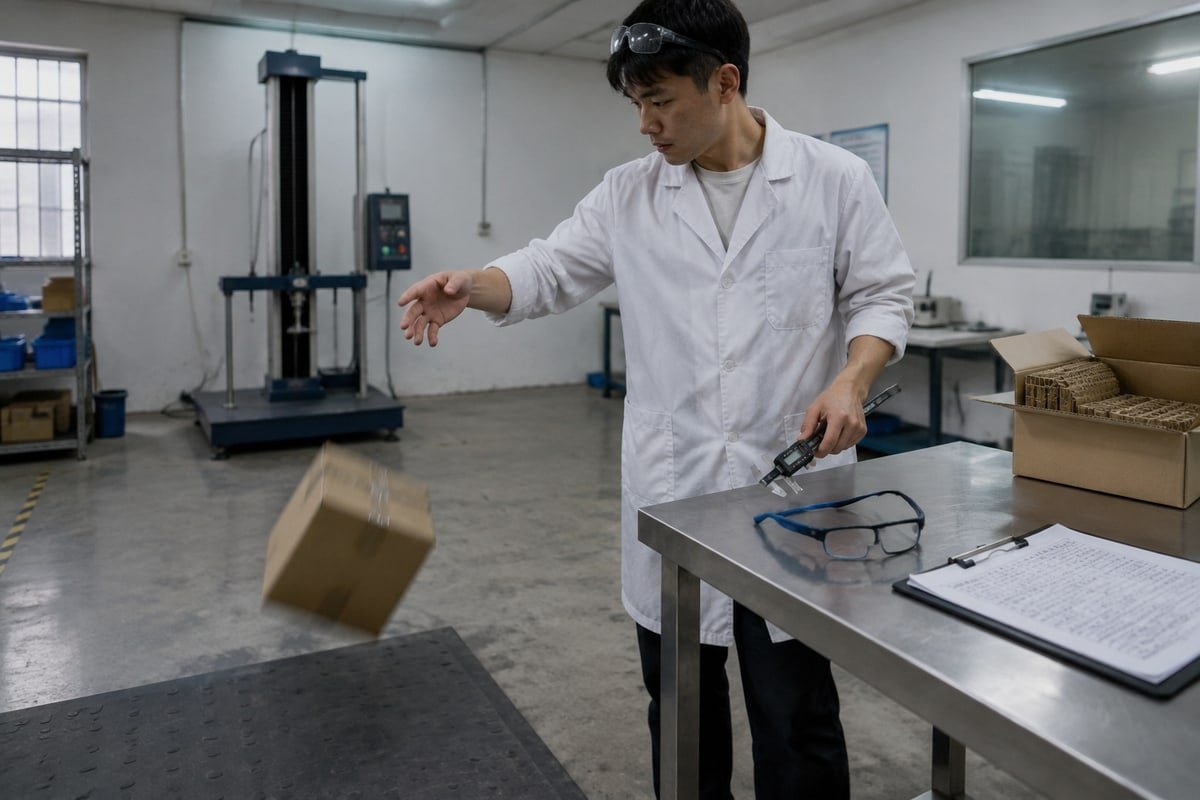
Visual inspection at arrival tells you what went wrong. It does not tell you why. Simple pre-shipment tests do. You do not need a lab for most of them. You need the real carton, the real insert, and a few measurements.
A simple test sequence you can run or request
- Baseline the sample. Measure temple-tip spread, bridge width, and lens alignment on a flat surface. Photograph the frame and the case.
- Drop test. Drop the packed master carton from waist height onto each face and one corner. Open it. Check for movement marks on the inserts.
- Vibration or shake test. Strap the carton to a vibrating table, or drive it in a van over rough road for an hour. Look for scuffing, shifted dividers, and loose zipper pulls.
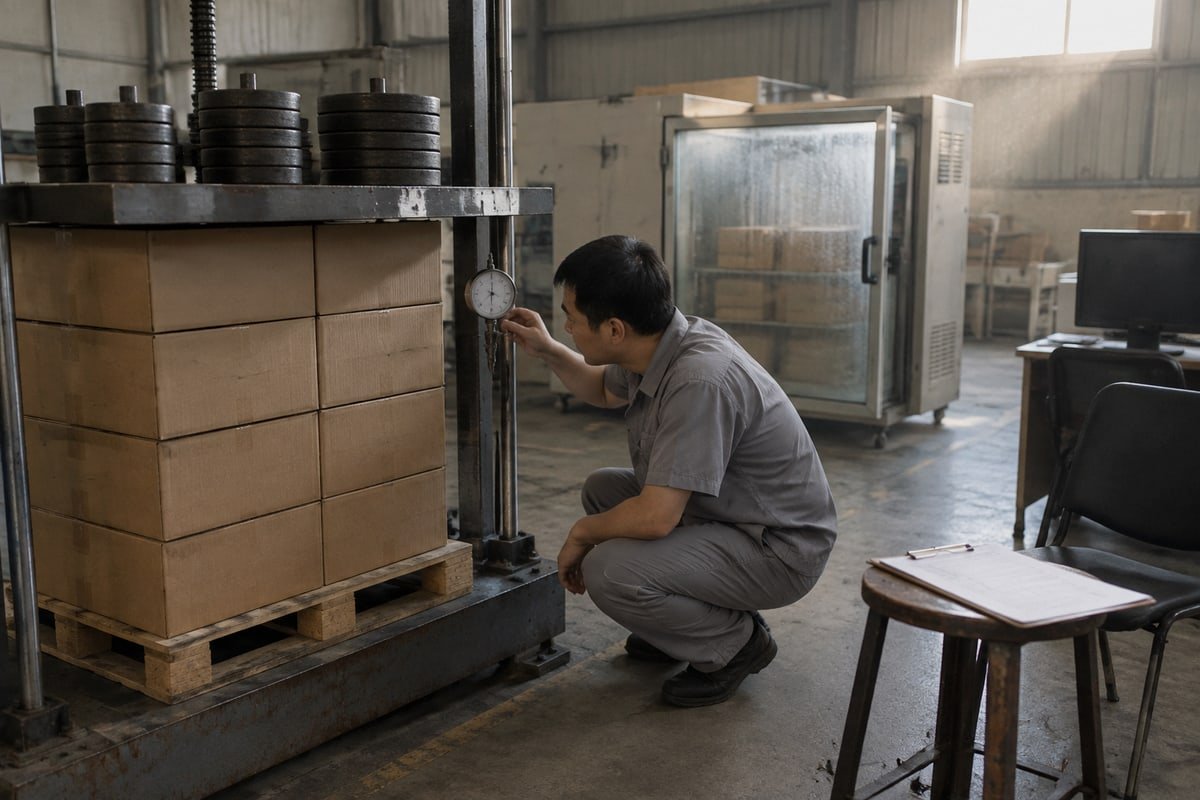
- Compression test. Load the bottom carton with the weight of a full stack for several days. Measure carton bow and check case corners.
- Heat-and-humidity soak. Hold packed samples in a warm, humid room. Then re-measure the frames.
- Final comparison. Compare every measurement to the baseline. Any change beyond your tolerance is a fail.
What each test reveals
| Test | Failure it exposes | Pass signal |
|---|---|---|
| Drop | Weak carton corners, poor shock absorption | No dents, item still fixed in insert |
| Vibration | Void space, loose fill, friction | No scuffs, dividers in place |
| Compression | Low compression strength, soft primary case | Carton flat, case corners crisp |
| Heat soak | Heat-set risk in TR90, TPEE, silicone | Temple spread unchanged |
Reading the results honestly
Crush resistance testing 2 is where most soft cases fail. A velvet pouch can look fine after a drop and still collapse after three days under load. The compression step is the one buyers skip most often. It is also the one that matches a real warehouse. I ask every new client to run it, or to let our QC team run it and send video.
One more point. Fit matters in both directions. Too much space lets the item hammer the walls during vibration. Too little space creates a pressure point on a hinge or a case corner. Your tests should check for both.
What stacking and container-loading practices should I require to avoid pressure damage to eyewear stock?
During one container loading last season, our QC lead pulled a pallet because the bottom cartons had begun to bow. That single stop saved a whole shipment of cases.
Require heavier master cartons at the base and lighter ones on top, a written stacking height limit, no overhang on pallets, corner boards and strapping, dry loading only, and cartons rated above the actual stacked load. Ask for photos of every loaded pallet before the container seals.
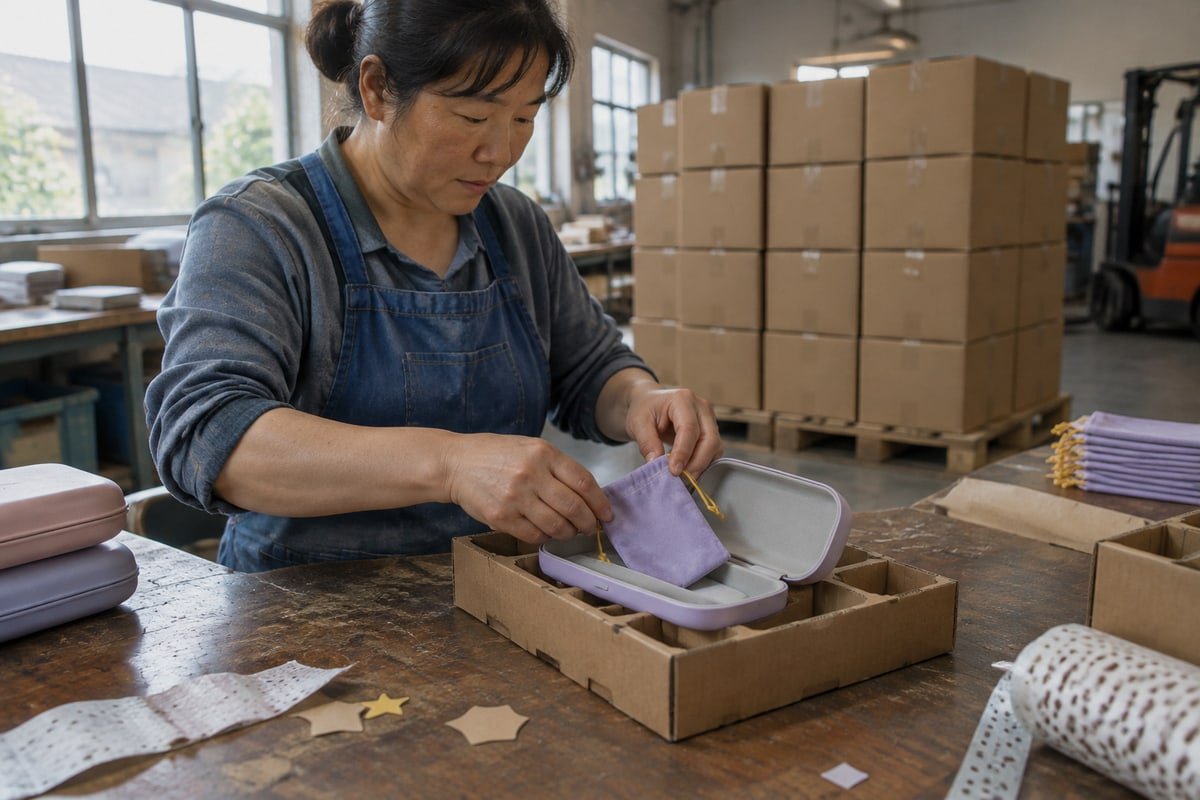
Most pressure damage happens after the packaging design is finished. It happens on the pallet and in the container. So the requirements you write into a purchase order matter as much as the carton spec. Here is what I recommend you demand.
Loading rules worth putting in writing
| Practice | Why it prevents deformation | What to request as proof |
|---|---|---|
| Heavy cartons at base, light on top | Keeps center of gravity low and stops light cases from carrying load | Pallet photo showing carton order |
| Stacking height limit 3s | Limits total compression on the bottom carton | Written limit on the packing list |
| Column stacking, aligned edges | Loads travel through carton corners, not panel centers | Top-down pallet photo |
| No overhang | Overhanging edges lose most of their compression strength | Side pallet photo |
| Corner boards and strapping | Spreads strap pressure, stops shifting | Photo before wrapping |
| Dry cartons, dry container | Moisture cuts corrugated strength fast | Container inspection photo |
| Double-walled master cartons | Higher stacking and crush resistance | Carton spec on the quote |
Why height and weight order matter
A carton at the bottom of a tall stack holds everything above it for weeks. If a light carton of cleaning cloths sits under a heavy carton of hard cases, it will bow. Once it bows, the stack leans. Then vibration finishes the job. Putting heavier master cartons at the base keeps the load stable. A stacking height limit keeps the bottom carton within its rating.
Internal pillars and corner posts
For bulk shipping solutions, we sometimes add reinforced corner posts inside the master carton. They carry stacking weight straight to the carton floor. The accessory cells in the middle carry nothing. This is a cheap upgrade. It matters most for mixed cartons that hold pouches, cloths, and straps together with hard cases.
The compact-parcel objection
Some buyers want the smallest carton to cut freight cost. I understand that. But a carton that is too tight puts pressure on the case corners and zipper. Our rule is the smallest carton that still fits a die-cut insert with no direct pressure on the product. That usually adds very little volume and removes most transit damage.
Wet loading and storage
Damp cartons deform even without heavy stacking. I ask clients to refuse loading in rain, to check the container floor for moisture, and to keep stock off concrete floors in the warehouse. Weak paper gives up its shape long before the accessory does.
We learned years ago that the frame material decides half the shipping outcome before any carton is chosen. Brittle acetate cracks; TR90 and TPEE 4 flex and recover.
Choose a manufacturer that molds frames in memory-flexible TR90 and TPEE, owns its factory and quality control standards, offers a large existing style library to avoid untested molds, and supplies matching rigid eyewear cases and packaging in-house so the frame and its protection are designed together.
Packaging protects a product. Material decides how much protection it needs. A frame that bends and springs back needs less cushioning than one that snaps. This is why the supplier question matters so much for transit damage prevention.
Why flexible materials help before the carton is built
TR90 is a lightweight nylon-based polymer with memory. TPEE is a softer elastomer we use for temples that wrap around a child's ear. Both bend under load and return to shape once the load is gone. A short pressure event on a pallet is far less likely to leave a permanent set. Acetate and cheap PC frames do not forgive that way. At our factory, most kids' optical frames pair a TR90 front with TPEE temples for exactly this reason.
Questions to ask a supplier
| Question | Good answer | Warning sign |
|---|---|---|
| Do you mold TR90 and TPEE yourselves? | Yes, with in-house injection and tooling | Frames are sourced from other factories |
| Are you a factory or a trading company? | Real workshop, named workers, 5S management | Vague answers, no factory video |
| Can I choose from existing styles? | Hundreds of ready designs to launch without mold cost | Every project needs a new mold |
| Do you make the cases and accessories too? | Cases, cloths, straps, and inserts designed together | Accessories bought from a third party |
| Can you test in final packaging? | Drop, vibration, compression checks with reports | Visual inspection only |
Why an existing style library lowers risk
Our library holds around 800 existing styles. A new brand can pick a proven frame and a proven case. Both have already shipped to many markets. The molds are tuned. The fit between frame and case is known. A brand new mold has none of that history. It may ship fine. Or it may reveal a thin temple that takes a set in a hot container. Testing the market with existing styles keeps that risk small.
Why frame and packaging should come from one place
When we develop a hard-shell case, we shape the cavity around the frames it will hold. The rainbow-cloud EVA case in our children's set is sized so the frame cannot slide. The microfiber cloth doubles as a soft wrap inside it. When frame and case come from two suppliers, that fit is luck. When both come from one line, it is design.
Factory versus trader
A trading company sells whatever it can source. It cannot change a temple thickness or add a vent to a polybag. A factory with fifteen years of eyewear experience and its own quality control standards 5 can. That control is what turns a packaging idea into a shipment that arrives straight.
Conclusion
Warped kids eyewear accessories cost brands trust. Combine a rigid case, fitted inserts, double-walled cartons, strict loading rules, and flexible TR90 and TPEE frames from one factory.
Interested in sourcing the products mentioned in this article? See details and request a quote here:
Footnotes
1. Authoritative overview of corrugated materials used for protective packaging inserts and master cartons. ↩︎
2. The International Safe Transit Association (ISTA) sets global standards for crush and vibration testing. ↩︎
3. OSHA provides safety guidelines for material storage and safe stacking height limits in warehouses. ↩︎
4. Technical definition of thermoplastic elastomers like TPEE and memory polymers used in eyewear. ↩︎
5. ISO 9001 is the international standard for quality control and management in manufacturing. ↩︎
More Articles You Might Like

September 29, 2026
How to Interpret Material, Age, and Warning Info on Kids' Eyewear Hang Tags?
September 29, 2026
How to Recycle Discarded Kids' Eyewear Accessories: Can Silicone and Plastic Parts Be Sorted?
September 29, 2026
How Recyclable Are Kids' Eyewear Materials, and What Are Eco-Friendly Alternatives?
Looking for a Reliable Kids Eyewear Partner?
Explore 800+ ready styles and full OEM/ODM support tailored to your brand.
Get in Touch English
 Español de México
 Deutsch
 Français
 日本語
 العربية
 Português do Brasil