How Do Optical Frames Differ From Sunglasses in Kids’ Eyewear Design?
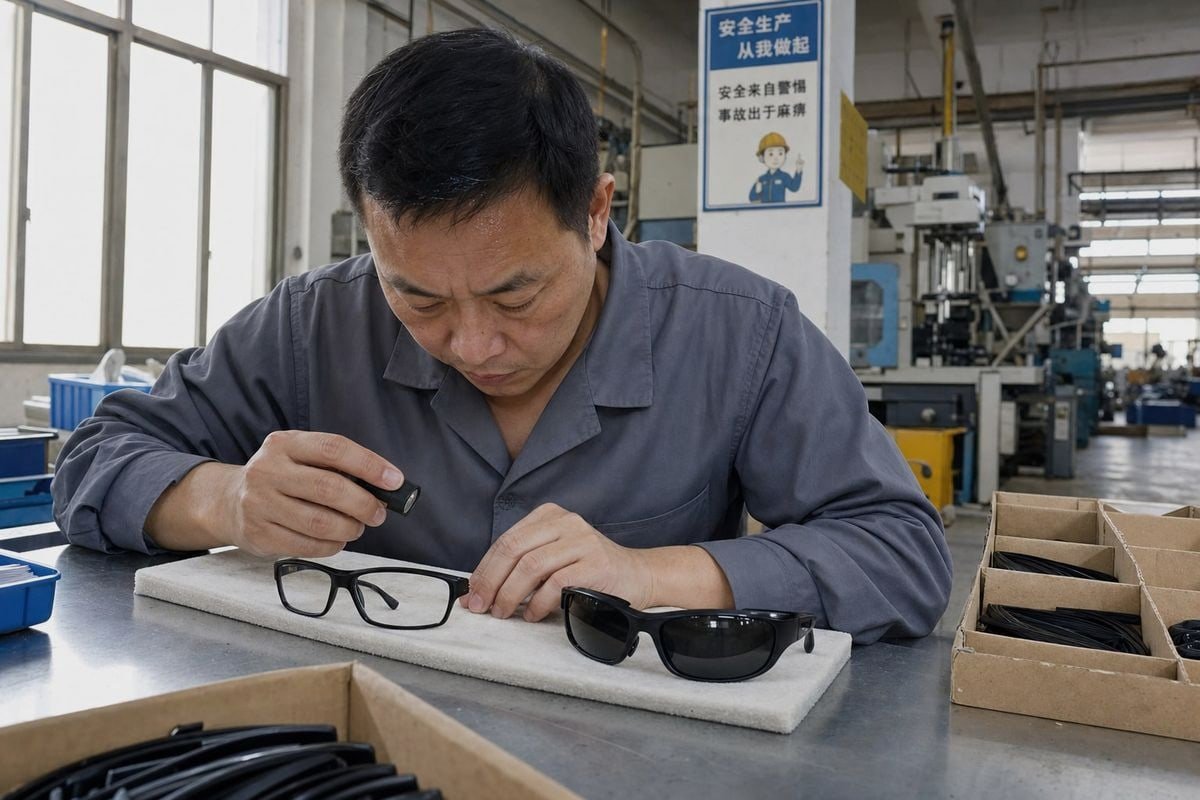
Many buyers assume kids’ optical frames and sunglasses are interchangeable products. On our production line in Taizhou, that assumption causes real sourcing mistakes — and returned shipments, disappointed retailers, and safety complaints follow fast. The fix starts with understanding how differently these two products are engineered.
Kids’ optical frames are engineered to hold prescription lenses in stable alignment for all-day indoor wear, using deeper rim grooves and precise pediatric bridge fit. Kids’ sunglasses prioritize UV400 protection, wraparound coverage, and outdoor impact durability, blocking light from the front, sides, and top.
Both products sit on a small face. Both must survive an active child. But the design logic behind each one is different. Let me walk you through the four areas where those differences matter most for anyone sourcing children’s eyewear.
How Do Material and Flexibility Requirements Differ Between Kids' Optical Frames and Sunglasses?
Last year, a European buyer asked our team to quote the same TR90 formula for both an optical line and a beach sunglasses line. Our engineers pushed back — and for good reason, as I will explain.
Kids' optical frames need TR90 memory plastic or TPEE that flexes without shifting the optical center, keeping lenses aligned all day. Kids' sunglasses can use softer, more rubbery flexible blends because tint uniformity, not optical center stability, is the lens priority outdoors.
The core difference comes down to one question: what happens to the lens when the frame bends? For an optical frame carrying a prescription, even a small twist can move the optical center away from the child's pupil. That degrades vision correction. So optical frames need materials that flex under stress but always return to their exact original shape. This is why TR90 memory plastic 1 dominates kids' optical frames. It is lightweight, hard to break in normal use, and it snaps back to its molded geometry.
Sunglasses have more freedom. A non-prescription tinted lens works the same whether it sits one millimeter left or right. So we can use softer, grippier compounds. In our own catalog, many sunglasses styles combine a TR90 front with TPEE temples. The TPEE gives a soft, rubbery feel that stays comfortable during sweaty outdoor play and grips better when a child runs.
Material Choices by Product Type and Age
| Factor | Kids' Optical Frames | Kids' Sunglasses |
|---|---|---|
| Primary material | TR90 memory plastic | TR90, TPEE, flexible plastics |
| Flex behavior | Must return to exact shape | Softer flex acceptable |
| Toddler option | Full silicone or TPEE, soft-contact | Full soft TPEE, often with strap |
| Older kids | TR90, flexible metal for a grown-up look | TR90, acetate for fashion styles |
| Skin contact | Hypoallergenic frame materials essential | Hypoallergenic, sweat-resistant |
One buyer objection we hear often: acetate looks more premium, so why not use it everywhere? The trade-off is real. Acetate and bio-acetate photograph beautifully, but they are stiffer than performance-first designs. For a fashion sunglasses line aimed at older children, acetate can work. For a toddler's everyday prescription frame, flexibility and hypoallergenic frame materials must win over looks. We frame this for clients as an age-and-use decision, not a one-material rule.
What Safety Standards Should I Check When Sourcing Kids' Optical Frames Versus Sunglasses?
The trade-off I weigh most often with new clients is speed versus compliance. A buyer wants samples in two weeks; the destination market wants documented testing. In fifteen years of exporting to over twenty countries, skipping the second has never ended well.
For optical frames, verify frame material safety, nickel-release limits on metal parts, and impact-resistant lens compatibility. For sunglasses, additionally require UV400 protection certification, lens category labeling, and lens retention testing. Both need small-parts and chemical safety compliance for children's products.
Safety documentation is where optical frames and sunglasses diverge most sharply on paper. Sunglasses are regulated in most markets as personal protective products against solar radiation. That means the lens itself carries the compliance burden: UV transmission, tint category, and refractive quality all get tested. Optical frames, by contrast, ship without corrective lenses in most B2B deals — the prescription lens is fitted locally by an optician. So the frame's material safety and mechanical durability carry the compliance weight.
A Practical Compliance Checklist for Buyers
- Confirm the destination market first. EU buyers need CE-marked sunglasses under EN ISO 12312-1 2; US buyers should check FDA drop-ball requirements for lenses; buyers wanting occupational-grade impact protection may reference ANSI Z87.1 safety standards 3, though that is a workwear benchmark rather than a children's fashion requirement.
- Request chemical safety reports for children's products — phthalates 4, heavy metals, and nickel release on any metal hinge screws or decorative parts.
- For sunglasses, demand UV400 protection 5 test reports per production batch, not just a one-time certificate. UV performance can drift if a supplier quietly changes lens vendors.
- For optical frames, verify hinge cycle testing. Flexible spring hinges should survive thousands of open-close cycles because prescription glasses are handled many times every day.
- Check small-parts and sharp-edge safety for younger age grades, since toddler eyewear is treated closer to a toy or childcare article in some jurisdictions.
Some buyers argue that a trusted brand look matters more than paperwork, especially for promotional sunglasses. I disagree, and so do customs authorities. A stylish frame that fails a port inspection serves nobody. Our QC team keeps batch records precisely so our clients can answer a retailer's compliance question the same day it arrives.
How Do Lens Choices and Certifications Differ Between Kids' Optical Frames and Sunglasses?
A Japanese client once sent us a competitor's kids' sunglasses to analyze. The lenses were dark, glossy, and completely uncertified. Our lab check showed weak UV filtering — exactly the failure that damages a children's brand overnight.
Optical frames require prescription lens compatibility: deep rim grooves for varying lens thickness, anti-reflective coatings, and stable optical centers, increasingly for myopia management lenses. Sunglasses require certified UV400 protection, impact-resistant polycarbonate, defined tint categories, and optional polarized lens technology for glare.
The lens is where the two product categories truly become different products. An optical frame is a lens carrier. Its rim groove must be cut deep enough to secure prescription lenses of very different thicknesses — a mild prescription edge is thin, while a strong one can be several millimeters thick. Sunglasses frames, by contrast, are optimized for uniform, thin non-prescription lenses, so their grooves and bevels are simpler.
Coating priorities flip between categories too. Indoors, an optical lens benefits from anti-reflective and blue-light coatings for screen time and classroom clarity. Outdoors, a sunglasses lens is judged on UV400 protection, tint category, and glare control. Polarized lens technology 6 is a genuine upgrade for water, snow, and road glare — we offer it as a standard OEM option — but it is an addition to UV protection, never a substitute for it.
Lens Specification Comparison
| Lens Attribute | Kids' Optical Frames | Kids' Sunglasses |
|---|---|---|
| Lens type | Prescription, fitted locally | Non-prescription tinted, factory-fitted |
| Core certification | Lens supplied per optician standards | UV400 protection, tint category label |
| Key material | Impact-resistant polycarbonate or Trivex | Impact-resistant polycarbonate |
| Coatings | Anti-reflective, blue-light, hard coat | Mirror, polarized, hard coat |
| Positioning tolerance | Tight — optical center on pupil | Looser — uniform tint forgives shift |
| Emerging trend | Myopia management lens compatibility | High-energy visible light filtering |
One trend deserves a buyer's attention: modern optical frames are increasingly designed around myopia management lenses 7. These lenses only work when their optical zones sit precisely in front of the pupil, so frame tolerances must be tighter than ever. Some emerging designs even integrate passive ambient light sensors to track a child's outdoor time as part of myopia prevention. That is a level of engineering no fashion sunglasses frame needs — and it explains why we hold our optical tooling to stricter dimensional checks than our sunglasses tooling.
Can I Source Both Kids' Optical Frames and Sunglasses From the Same OEM/ODM Manufacturer?
A question I fielded from an Australian brand founder last quarter: could one factory realistically handle her prescription-ready line and her beach sunglasses line? My honest answer shaped this whole section.
Yes — if the manufacturer has genuine expertise in both categories. Look for pediatric-specific tooling, TR90 and TPEE material capability, UV400-certified lens supply chains, and full OEM/ODM services covering custom colors, logos, lenses, and retail-ready packaging under one quality control system.
Sourcing both categories from one partner has real advantages: unified quality control, consolidated shipping, consistent branding across your range, and one relationship to manage. But it only works when the factory truly understands both products. Many suppliers are sunglasses factories that bolt on optical frames as an afterthought — or the reverse. The gaps show up in details like pediatric bridge fit, hinge durability, and lens sourcing.
What to Verify Before Committing
Children's faces have lower nose bridges, fuller cheeks, and smaller ears than adults. A capable kids' specialist designs around that anatomy in both categories — and knows, for example, that adjustable silicone nose pads suit some school-age optical frames but can be problematic for younger children whose nose bridges are still developing. Soft-contact molded bridges often fit toddlers better. Ask your prospective supplier how they handle this, and listen for a specific answer, not a generic one.
Then check the practical capabilities:
- Existing style library. A deep catalog lets you launch without heavy mold investment. At our factory we maintain roughly 800 existing styles across both categories, which lets new brands test the market with far lower risk than opening custom tooling on day one.
- Dual material competence. Confirm the factory molds both TR90 memory plastic for optical stability and softer TPEE for sunglasses comfort, and can combine them — such as TR90 fronts with TPEE temples.
- Hardware standards. Flexible spring hinges should be standard on optical frames for constant daily handling; sunglasses hinges can be simpler but still need corrosion resistance for sweat and salt air.
- Lens supply chain. Ask for batch-level UV400 test reports and polarized lens options on the sunglasses side, and prescription lens compatibility specs on the optical side.
- Finishing and packaging. Retail-ready presentation — custom colors, logos, cases, and cloths — should come from the same 5S-managed workshop, not a third-party subcontractor you never audit.
One caution: a single frame rarely does both jobs well. A wraparound sunglasses front with a strong base curve cannot hold most prescriptions without distortion, and a flat optical front leaves side gaps that let light leak in outdoors. The smarter play is one manufacturing partner running two purpose-built product lines.
Conclusion
Treating kids' optical frames and sunglasses as one product invites returns and compliance failures. Sourcing them as two engineered categories — from a partner fluent in both — protects children and your brand.
Footnotes
1. Wikipedia background on thermoplastics clarifies the shape-memory material properties described. ↩︎
2. Authoritative Wikipedia section detailing
More Articles You Might Like

Looking for a Reliable Kids Eyewear Partner?
Explore 800+ ready styles and full OEM/ODM support tailored to your brand.
Get in Touch English
  Español de México
  Deutsch
  Français
  日本語
日本語  العربية
  Português do Brasil