How to Match TR90 Kids Optical Frames Size by Age Group?
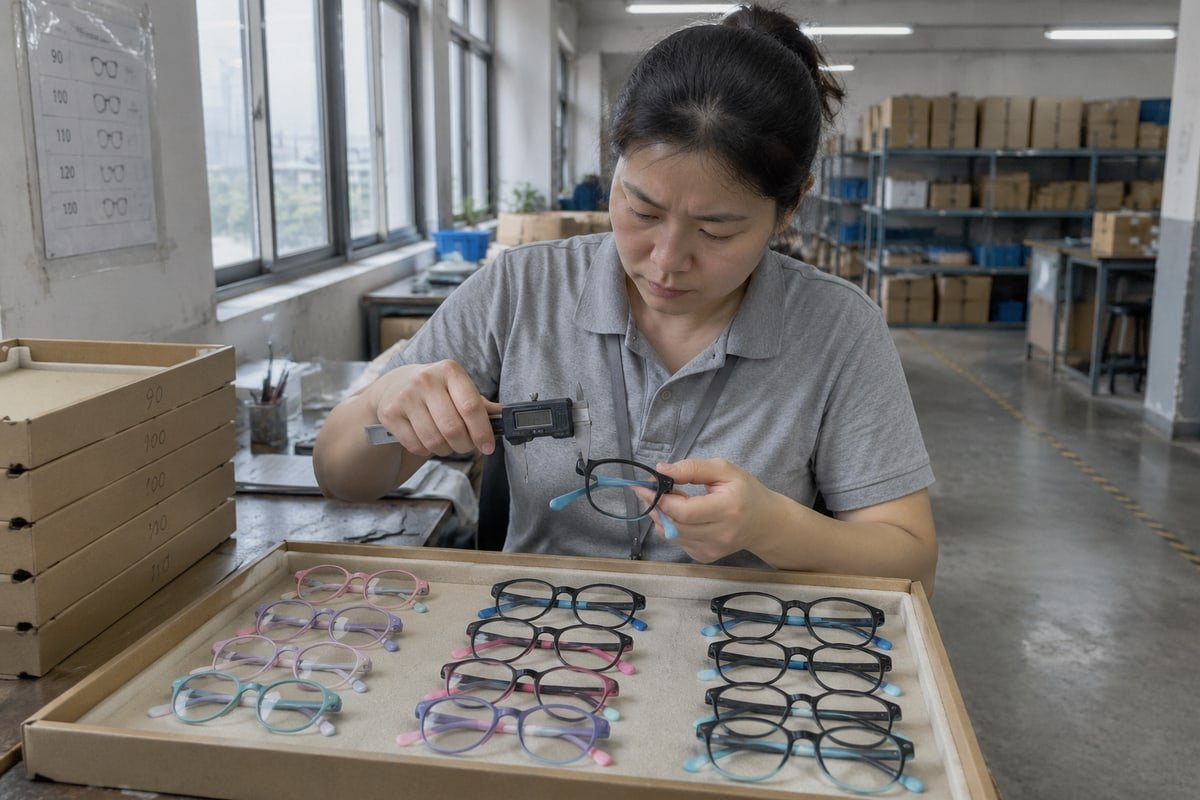
Buyers ask our factory team every week which TR90 kids optical frames size suits which age. Guess wrong, and the glasses slide, pinch, and end up in a drawer.
Match TR90 kids optical frames size by age group using lens width, bridge width, and temple length: toddlers 0–3 need 35–42mm lenses, preschoolers 4–6 need 42–46mm, and school-age kids 7–12 need 45–48mm. Confirm every band with the child’s actual face measurements.
Age is a useful starting point. It is not the finish line. Below, I walk through the sizing standards we use, the fit checks that matter more than age, why flexibility changes with age, and how to build a size chart with your manufacturer.
What sizing standards should I use to match TR90 kids optical frames to different age groups?
Last season our QC team held a batch because the temple length on a preschool style measured 130mm instead of 125mm. Five millimetres matters a lot at that age.
Use the standard three-number code — lens width, bridge width, temple length — as your sizing standard. Toddlers 0–3 fit 35–42mm lenses with 13–15mm bridges, preschoolers 4–6 fit 42–46mm lenses with 120–130mm temples, and children 7–12 fit 45–48mm lenses with 15–17mm bridges.

Reading the three-number code
Every optical frame carries a code on the inner temple, such as 46-16-125. The first number is the lens width 1 in millimetres. The second is the bridge width 2, often called DBL. The third is the temple length. On our production drawings, these three numbers plus total frame width and lens height define the fit. If a child already wears glasses, that printed code is the best baseline you can have. It tells you what already works on that face.
An eyewear size chart by age band
Here is the age-banded eyewear size chart we use as a starting point when a brand asks us to propose a range. The example codes are real dimensions we see across the market, not one universal standard.
| Age band | Lens width | Bridge width | Temple length | Example codes seen in the market |
|---|---|---|---|---|
| Infant / toddler, 0–3 | 35–42mm | 13–15mm | 115–125mm | 43-14-125 (sold for ages 2–3), 39–43mm toddler range |
| Preschool, 4–6 | 42–46mm | 14–16mm | 120–130mm | 45-16-128 |
| Young school-age, 7–9 | 45–48mm | 15–17mm | 125–135mm | 48-16-125, 49-16-135 |
| Pre-teen, 10–12 | 47–50mm | 15–17mm | 130–138mm | 50-16-135 |
| Young teen, 13–14 | 49–52mm | 16–18mm | 135–140mm | Small adult / teen sizing |
One more rule sits above the chart. Total frame width should equal the child's temple-to-temple measurement plus a 5–10mm buffer. If the frame runs wider than that, the lenses stick out past the face and the temples never grip.
Why age is only a proxy
Some catalogs list one frame for ages 0–14 or 4–14. I understand the appeal for a buyer who wants fewer SKUs. But a span like that describes the material's suitability, not the fit. A four-year-old and a fourteen-year-old do not share a bridge width. Children also grow at very different rates. A tall six-year-old may need the 7–9 band. A small nine-year-old may still fit 44mm lenses. So we treat the bands as overlapping ranges. We size the frame, then we place it in the band it serves best.
How can I tell if a TR90 frame’s bridge and temple length fit my child’s face shape correctly?
A product manager from Australia once sent us photos of a frame sitting on a child's cheeks. The lens width was right. The bridge width was the real problem.
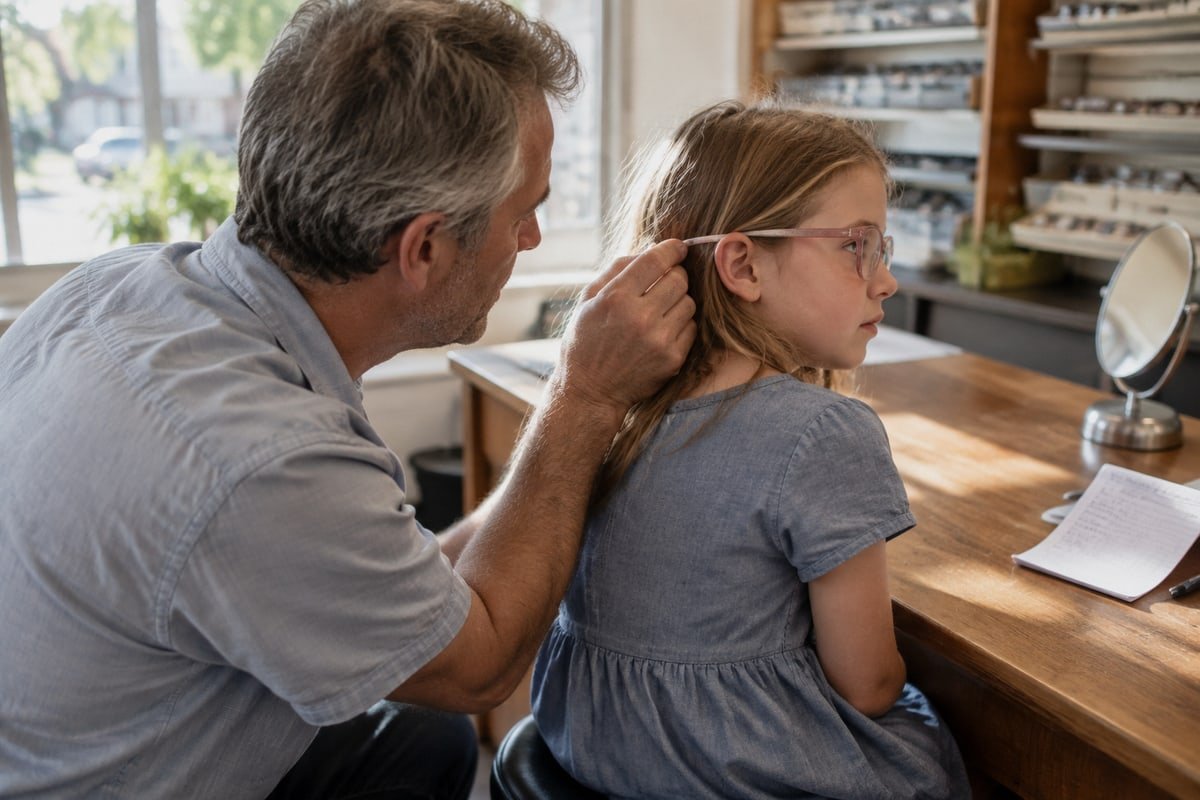
A TR90 bridge fits when it rests fully on the nose with no gap, and the frame stays centered without sliding. Temple length fits when the arm reaches behind the ear and curves down without pinching. Check the eyes sit in the top third of the lens.
A five-point fit check
We teach this sequence to every new buyer who samples our frames. It takes about two minutes per child.
- Bridge contact. Look at the nose from the side. The TR90 bridge should touch the nose along its full surface. Any gap means the bridge width is too wide, and the frame will slide. Younger children need 13–15mm because their nasal bridge 3 is still undeveloped. Older children usually sit well in 15–17mm.
- Centering. Look at the child from the front. The pupils should line up with the optical centre of each lens. If the frame drifts to one side, the pupillary distance and the frame's lens spacing do not match.
- Vertical position. Use the rule of thirds. The eyes should sit in the top third of the lens. This keeps the field of vision correct through a growth spurt, when the face lengthens before the child needs new glasses.
- Temple reach. The temple should run straight past the ear, then curve down behind it. Red marks mean the temple length is short or the tip bends too tightly. Because TR90 has shape memory, you can choose a slightly snugger fit than you would with metal. The material contours to the head over roughly 48 hours of wear.
- Cheek clearance. Ask the child to smile. The lower rim should not lift off the nose when the cheeks rise.
Reading the symptoms
| Symptom | Likely cause | What we adjust |
|---|---|---|
| Frame slides down the nose | Bridge width too wide | Narrower DBL, keyhole bridge, or adjustable nose pads |
| Red marks behind the ears | Temple length too short or tip too tight | Add 5mm temple length or soften the tip curve |
| Lower rim rests on cheeks | Lens height too tall for the face | Lower the lens height or raise the bridge |
| Lenses stick out past the face | Frame width exceeds temple-to-temple plus 10mm | Drop one lens width size |
| Frame tilts to one side | Uneven temple bend | Re-set the temple angle |
Face shape and bridge style
Face shape changes which bridge works. A narrow face with a low nasal bridge does well with a keyhole bridge and a round lens, like the matte black frame with sky-blue temples in our range. A fuller, rounder face often suits a rounded-square lens with a saddle bridge, like our translucent pink gradient style. For markets such as Japan, where a flatter nasal bridge is common, buyers often ask us for adjustable nose pads on the TR90 front, and we build that in at the tooling stage.
Why do TR90 kids frames need different flexibility levels for toddlers versus older children?
Every time we select a TR90 grade, we weigh softness against hold. Too soft, and a toddler frame flops; too stiff, and it fights a ten-year-old's bump.
Toddlers need the most flexible TR90 because they pull, twist, and sleep in their frames, so the frame must bend fully and recover its shape. Older children need firmer TR90 with flexible spring hinges, because they wear larger lenses and need hold and impact resistance.

Why toddlers need maximum bend
Watch a two-year-old remove glasses. The child grabs one temple and pulls sideways. A rigid frame twists at the hinge and breaks, or worse, it snaps near the face. A very flexible TR90 front bends with the pull and returns to shape. That is why the toddler band in our range pairs a TR90 front with TPEE temples. TPEE is softer than TR90, so the temples wrap around the head without pressing on the skin. Both are hypoallergenic materials 4, which matters when the frame sits against a toddler's cheeks for hours.
Weight matters just as much at this age. TR90 has a density 5 of about 1.14 g/cm³, and a complete children's frame can weigh around 12g. A frame that light does not slide off a small nose, and it does not leave marks. For the 1–3 band, we still add strap loops or cable temples. Flexibility helps the frame survive; retention keeps it on the face.
Why older kids need firmer hold
By age seven, the picture changes. The lens width grows to 45–48mm, and some children carry strong prescriptions. Thick lenses add weight at the front, so the frame needs enough stiffness to keep the temples pressing evenly behind the ears. Here the low density of TR90 works in the buyer's favour. You can specify a slightly larger lens shape for a high-prescription child without adding much load on the nasal bone.
Sport is the other driver. School-age children run, fall, and get hit by balls. Impact resistance becomes the priority, and flexible spring hinges let the temples open past ninety degrees without stressing the joint. For the 5–9 band, we recommend co-molded silicone grip tips on the temples. They hold the frame during play and remove the need for an external elastic strap, which many children at this age refuse to wear.
Thermal stability is the final point. Unlike acetate, TR90 keeps its calibrated fit in extreme heat and cold. A frame adjusted in our workshop holds that adjustment through an Australian summer or a Nordic winter.
Flexibility priorities at a glance
- Toddlers, 1–3: softest TR90 front, TPEE temples, strap or cable-temple retention, lightest possible weight.
- School-age, 5–9: medium TR90 grade, flexible spring hinges, co-molded silicone grip tips, impact resistance first.
- Pre-teens and teens, 10–14: firmer TR90, slimmer profiles, hold for larger lenses, teen-style colours and shapes.
How do I work with my manufacturer to build a size chart across all age groups for my product line?
One lesson took us years to learn: a size chart built from a single sample per age band fails at reorder. The process below is what we now use.
Build the size chart in five steps: define your age bands, collect existing three-number codes from well-fitting frames in your market, select base styles from the manufacturer's catalog, request fit samples for each band, and lock frame dimensions with tolerances before mass production.
The five-step process
- Define the age bands. Most retailers merchandise in toddler, junior, and teen categories rather than by numeric size alone. Decide which bands your brand will carry. Three bands work for a small launch. Five bands cover a full range.
- Collect real codes from your market. Ask your optical partners or retail staff for the three-number codes of frames that already fit well in each band. This grounds your chart in local face shapes, not in a generic catalog.
- Select base styles. This is where existing tooling saves months. Our catalog holds around 800 styles, so a brand can pick a round keyhole-bridge style for toddlers and a rounded-square style for pre-teens without paying for new molds. You test the market first and invest in custom tooling only when a style proves itself.
- Request fit samples for every band. One sample per band is not enough. Ask for the smallest and largest lens width in each band, then test them on real children at both ends of the age range. Record which frames sit correctly using the five-point fit check.
- Lock the frame dimensions. Put lens width, bridge width, temple length, total width, and lens height on a spec sheet with an agreed tolerance for each. Our QC team measures against that sheet on the 5S-managed line, not against a general "kids size" note.
What to send your manufacturer
| Deliverable | What to include | Why it matters |
|---|---|---|
| Age band definition | 3–5 bands with target ages | Aligns product, packaging, and retail display |
| Target codes per band | Lens width, bridge width, temple length | Drives tooling choice and QC inspection |
| Retention features | Straps, cable temples, silicone grip tips by band | Keeps toddler and sport frames on the face |
| Material spec | TR90 grade, TPEE temples, hypoallergenic material confirmation | Child safety and comfort |
| Hinge spec | Flexible spring hinges or fixed hinges by band | Durability for school-age wear |
| Packaging and labelling | Size code printed on the temple, age band on the box | Helps parents and retailers choose correctly |
A buyer objection worth answering
Buyers sometimes tell me that TR90 is so durable the exact size is a secondary concern. I disagree, and I say so. Durability means the frame survives. Comfort means the child keeps it on. A frame that is too wide will not break, but it will slide down the nose fifty times a day until the parent gives up. Fit and weight decide whether a product gets reordered. The size chart is the tool that protects both.
With OEM/ODM support, the same chart also carries your custom colours, logos, lens options, and retail-ready packaging, so every band launches as one consistent branded range.
Conclusion
Age tells you where to start. Lens width, bridge width, and temple length tell you where to finish. Build your TR90 range on measurements, and children will actually wear it.
Interested in sourcing the products mentioned in this article? See details and request a quote here:
Footnotes
1. The AAO provides clinical guidance on how lens width impacts vision and pediatric frame fitting. ↩︎
2. ISO sets international standards for spectacle frame measurements and bridge width specifications. ↩︎
3. The nasal bridge is the anatomical feature that determines the required bridge width for a stable frame fit. ↩︎
4. FDA regulates spectacle frames as medical devices, ensuring hypoallergenic materials meet safety standards. ↩︎
5. Density is a key physical property of TR90 that determines the weight and comfort of children’s eyewear. ↩︎
More Articles You Might Like



Looking for a Reliable Kids Eyewear Partner?
Explore 800+ ready styles and full OEM/ODM support tailored to your brand.
Get in Touch English
 Español de México
 Deutsch
 Français
 日本語
 العربية
 Português do Brasil