How to Choose the Right Size TR90 & TPEE Kids Optical Frame?

Every season, buyers send our factory TR90 & TPEE kids optical frame orders sized by age alone. Returns pile up: sliding frames, red nose marks, unworn glasses. We measure first.
The right size TR90 & TPEE kids optical frame matches the child’s temple-to-temple face width plus 5–10 mm, uses a lens width of 40–52 mm, a bridge width of 14–18 mm, and a temple length of 120–140 mm, keeps the pupils centered, and stays secure without pinching or sliding.
That answer packs a lot into one sentence. Below, I break it into four practical questions. I cover how to measure, which sizes to stock, how material changes fit, and how to test samples before you commit to bulk.
How do I measure my kids optical frame size correctly before ordering?
Last month our QC team rejected a sample batch. The frame dimensions were perfect on paper. On a real child's head, the temples pressed hard behind the ears.
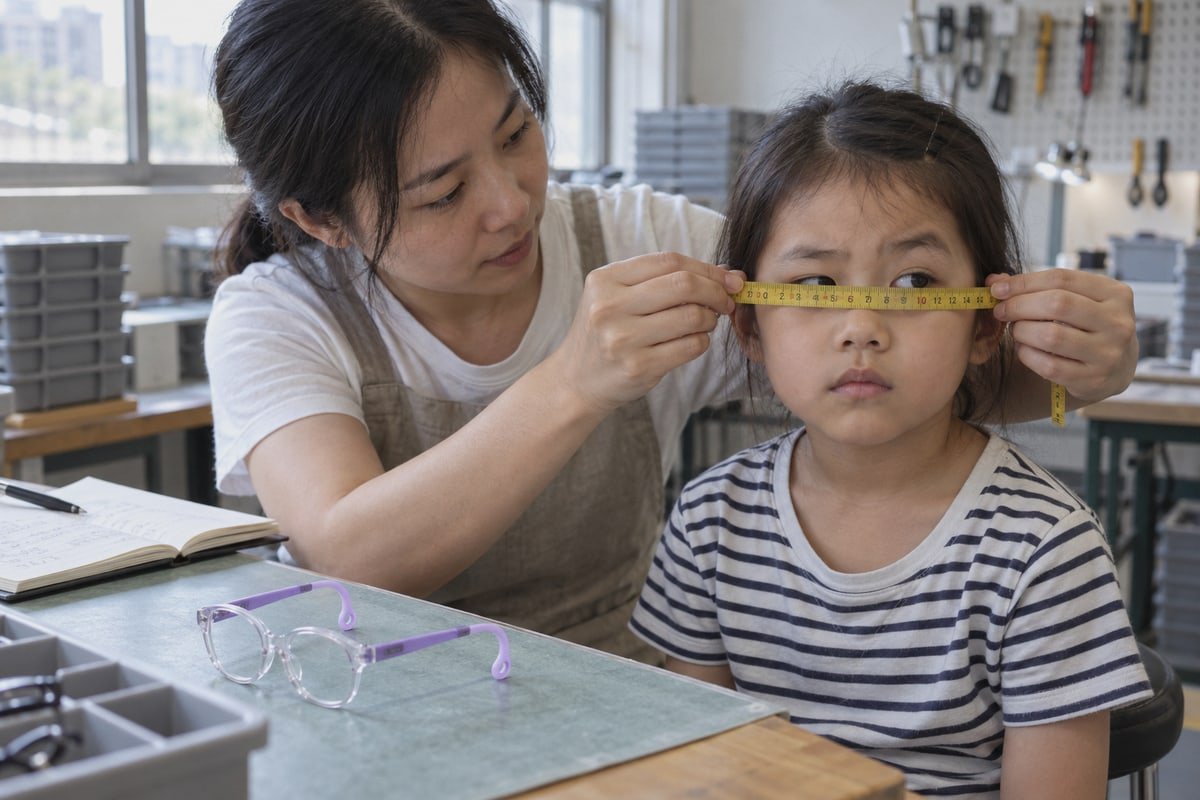
Measure the child's face width temple to temple with a soft tape, add 5–10 mm for total frame width, then read lens width, bridge width, and temple length from a well-fitting existing pair. Confirm pupils sit centered and in the top third of the lens.
That rejected batch taught us something simple. Numbers describe a frame. They do not describe a fit. So I always ask buyers to check both.
The five-minute measurement routine
Here is the process we share with brand partners who run fit sessions in their own markets.
- Hold a soft tape across the child's face from temple to temple. Keep it level with the eyes. Write down the number in millimeters.
- Add 5–10 mm. This is your target total frame width. The extra room stops the front from squeezing the sides of the head.
- If the child already owns glasses that fit well, look inside one temple arm 1. You will see three numbers, such as 45-16-128. These are lens width 2, bridge width, and temple length.
- Check the nose. Young children often have a low, underdeveloped nose bridge. They need a narrower bridge width or integrated non-slip pads. Otherwise the frame slides down.
- Check the ears. The temple should extend just past the ear and curve gently down. It should not press on the bone behind the ear.
What the three frame numbers mean
| Measurement | What it controls | Typical kids range |
|---|---|---|
| Lens width (lens diameter) | Field of view and pupil centering | 40–52 mm |
| Bridge width | Where the frame rests on the nose and how far it slides | 14–18 mm |
| Temple length | How the arm reaches and hooks behind the ear | 120–140 mm |
Pupillary distance also matters, even though it is not printed on the frame. When the lens width and bridge width add up correctly, each pupil lands near the center of its lens. The optician then has room to grind the prescription without thick edges.
Quick fit check during try-on
A frame that is too big lets the lenses touch the cheeks. It slides when the child looks down. The eyes sit too low or off-center. A frame that is too small presses the temples into the head. The eyes sit near the lens edge. Red marks appear on the nose within minutes.
One warning from our export experience. Many product pages list a label like "kids size" or a model name, with no fit logic behind it. Do not order by name. Order by the three numbers, and then verify them on a real face.
What size range should I offer if my brand targets different age groups?
Offering many sizes raises inventory cost. Offering too few loses sales. When we plan a collection with a brand, we weigh those two forces before choosing size steps.
Offer at least three size tiers: toddler frames around 40–42 mm lens width with 14–16 mm bridges and 115–125 mm temples, school-age frames at 43–47 mm, and pre-teen frames at 47–52 mm with 130–140 mm temples. Verify each tier against real face measurements, not age alone.

Some buyers push back here. They tell me an age-based chart is easier for parents and easier for retail staff. I agree it is simpler. But a chart alone causes the returns I mentioned at the start. My answer is to use age as the entry point, then print the real frame dimensions next to it. Parents get the simple label. Opticians get the numbers they need.
Reference sizes by age
This table is the starting grid we use when a brand asks us to map our existing styles to their age segments.
| Age group | Lens width (mm) | Bridge width (mm) | Temple length (mm) |
|---|---|---|---|
| 0–1 years | 35–37 | 13–14 | 105–115 |
| 1–2.5 years | 37–38 | 14–15 | 110–120 |
| 2.5–4 years | 40–42 | 14–16 | 115–125 |
| 4–7 years | 43–45 | 15–17 | 120–130 |
| 7–10 years | 45–47 | 16–17 | 125–135 |
| 10–16 years | 47–52 | 16–18 | 130–140 |
Why the market uses small size steps
Look at real wholesale listings for kids TR90 frames. You see sizes like 41-14-125, 45-15-125, 46-17-138, and 45-16-128. Notice how close they are. A 45-15-125 and a 45-16-128 share the same lens width, but the second has a wider bridge 3 and a longer temple. That is a different child. The market moves in small steps because faces do.
How many sizes does a new brand really need?
My practical advice depends on your positioning.
- A baby and toddler brand can often launch with two sizes, both in the 37–42 mm lens width band, with softer TPEE construction.
- A general kids brand should carry three tiers as a minimum: toddler, school-age, and pre-teen.
- An optical company serving prescription customers 4 should carry four or five, because pupillary distance and prescription strength both demand tighter centering.
This is where our catalog of roughly 800 existing styles becomes useful. A brand can pick proven sizes off the shelf, test them in its market, and skip the mold investment until the data says which sizes sell. That lowers launch risk for a founder who is still learning her customer.
How do TR90 and TPEE materials affect the fit and comfort of kids frames?
A Japanese baby-brand buyer once asked me why we used TPEE, not TR90, for the under-three range. She wanted one material for everything. The answer changed her lineup.
TR90 is a light, flexible memory polymer that holds its shape and suits active kids aged about 3–10. TPEE is softer, more bendable, and chew-resistant, so it forgives small sizing errors and suits ages 0–4. Both materials reduce weight, so slightly larger lenses stay comfortable.

The right size TR90 and TPEE kids optical frame is not only a set of numbers. The material decides how much those numbers can be off before the child notices. Here is the comparison I walk buyers through.
| Feature | TR90 | TPEE |
|---|---|---|
| Feel | Light, firm-flexible, springs back | Very soft, rubber-like, highly bendable |
| Shape retention | High; memory polymer returns to form | Elastic recovery; micro-molds to head with body heat |
| Best age fit | About 3–10 years | About 0–3 or 2–4 years |
| Forgiveness if between sizes | Moderate | High |
| Impact resistance | Strong for sports and school play | Strong; also chew-resistant for babies |
| Typical fit hardware | Flexible hinges, optional adjustable strap, optional metal cores | Wrap-around temple geometry, strap loops, no metal core |
| Safety profile | Hypoallergenic materials, BPA-free frames | Hypoallergenic materials, BPA-free frames |
Sizing rules that change with material
Our engineers have found a few material-specific rules that matter more than most buyers expect.
TPEE should feel slightly snug at first. The material has elastic recovery. It warms against the skin and settles onto the head. If you size TPEE loosely on day one, it will slide by week two. So choose the tighter of two candidate sizes.
TPEE needs wrap-around temple geometry. Most TPEE temples have no adjustable metal core. An optician cannot bend them to fit. So we design the temple tip to curve fully around the ear and create a mechanical lock. Our crystal-clear front with purple gradient TPEE temples uses exactly this looped ear hook, plus small perforations along the arm to add flex.
TR90 rim thickness must match the prescription. TR90 is flexible. A high-index or strong prescription lens puts tension on the rim. A thin rim can bow outward and change the fit. For stronger prescriptions we recommend a slightly thicker rim or a smaller lens diameter.
Younger faces need pantoscopic tilt. Toddlers have full cheeks. When they smile, the cheeks rise. A TR90 frame with a wider pantoscopic tilt lifts the bottom of the rim away from the cheek so the glasses do not push upward.
Hybrid construction: TR90 front, TPEE temples
Many of our best-selling pediatric eyewear styles combine both materials. The TR90 front holds the lens and keeps the optical center 5 stable. The TPEE temples give softness and grip. Our translucent light-blue front with matte blue rubberized temple tips follows this logic. The buyer gets shape stability where the lens sits and comfort where the frame touches skin.
One more objection I hear often: "Just tell me the best material and I will buy that." Material-first shopping is common in marketing. It does not produce comfortable glasses on its own. The working formula is material plus measurements plus a real fit test.
Can I get sample sizes from a manufacturer before placing a bulk order?
Years ago we shipped a bulk order straight from a size chart. The frames fit the chart, not the children. Since then, we push samples before every production run.
Yes. Reputable kids eyewear factories supply sample frames in each size before bulk production. Buyers typically request one or two pieces per size and color, test them on children in the target age group, confirm fit and finish, then sign off on frame dimensions for the full order.

Sampling is the cheapest insurance in this business. A sample costs a little time. A wrong bulk order costs a season. Here is how the process usually runs when a brand works with our Taizhou workshop.
A practical sampling sequence
- Shortlist styles. Pick candidates from existing stock. With around 800 styles on hand, most buyers find suitable sizes without opening a mold.
- Request one or two pieces per size tier. Ask for both TR90 and TPEE versions if your range spans babies and school-age children.
- Run a fit session. Put the samples on children in your real target age groups. Check pupil centering, cheek contact, temple length behind the ear, and slipping during movement.
- Record findings by frame code. Write "46-17-138 slides on the 5-year-old" rather than "medium too big." The factory can act on the first note.
- Confirm or adjust. We can shift a bridge width, adjust temple curvature, or move a style to TPEE temples before bulk.
- Approve a pre-production sample. This piece fixes color, logo, lens, and packaging along with fit.
What to check on each sample
| Check point | Pass sign | Fail sign |
|---|---|---|
| Pupil position | Centered, upper third of lens | Near edge or low |
| Nose bridge | Rests without pressure marks | Slides or leaves red marks |
| Temple fit | Passes ear, gentle curve, no pinch | Presses behind ear or floats |
| Flex and hinge | Flexible hinges return to shape | Loose, stiff, or creaking |
| Surface | Smooth edges, even color, no burrs | Sharp mold lines, rough tips |
Why a real factory matters at this stage
Sampling only works when the people who made the sample also control production. A trading company passes your notes down a chain. Our 120 workers and 5S-managed workshop sit in one place. When a buyer in Australia or Europe says the temple tip needs a deeper hook, the change reaches the line directly. That is also why full OEM/ODM support fits naturally here. Custom colors, logos, lens options, and retail-ready packaging all get approved on the same pre-production sample as the fit.
I have shipped to buyers in more than 20 countries over 15 years. The projects that go smoothly share one habit. They test size on children before they test price on a spreadsheet.
Conclusion
Guessing by age wastes stock and frustrates parents. Measure faces, offer clear size tiers, match material to age, and test samples first. We're ready to help you build that range.
Interested in sourcing the products mentioned in this article? See details and request a quote here:
Footnotes
1. Wikipedia provides a comprehensive overview of eyeglass components, including the temple arms and frame geometry. ↩︎
2. ISO 12870 establishes the fundamental technical requirements and measurement standards for spectacle frames. ↩︎
3. The International Trade Administration provides guidance on technical specifications for manufactured goods in global trade. ↩︎
4. The FDA regulates prescription eyewear and frames as Class I medical devices to ensure safety and efficacy. ↩︎
5. Explains the technical necessity of aligning the lens optical center with the wearer’s pupil for clear vision. ↩︎
More Articles You Might Like



Looking for a Reliable Kids Eyewear Partner?
Explore 800+ ready styles and full OEM/ODM support tailored to your brand.
Get in Touch English
 Español de México
 Deutsch
 Français
 日本語
 العربية
 Português do Brasil