How to Assess Choking Risk & Get GPSR Risk Analysis for Kids’ Optical Frames from China?
Choking risk and GPSR risk analysis for kids’ optical frames trip up many importers REACH restrictions 1. I have watched buyers lose whole seasons because our competitors’ paperwork failed at EU customs.
Assess choking risk on kids’ optical frames by testing every detachable part — screws, nose pads, temple tips, decorations — against the small-parts cylinder after tension, torsion, and drop tests. Then require your China manufacturer to supply a written GPSR risk analysis covering hazards, severity, likelihood, mitigation, and verification.
That is the short answer. The rest of this article shows you exactly how to do both, step by step, based on what actually happens on a factory floor in Taizhou.
What Choking Hazards Should I Check for in Kids' Optical Frame Components Before Import?
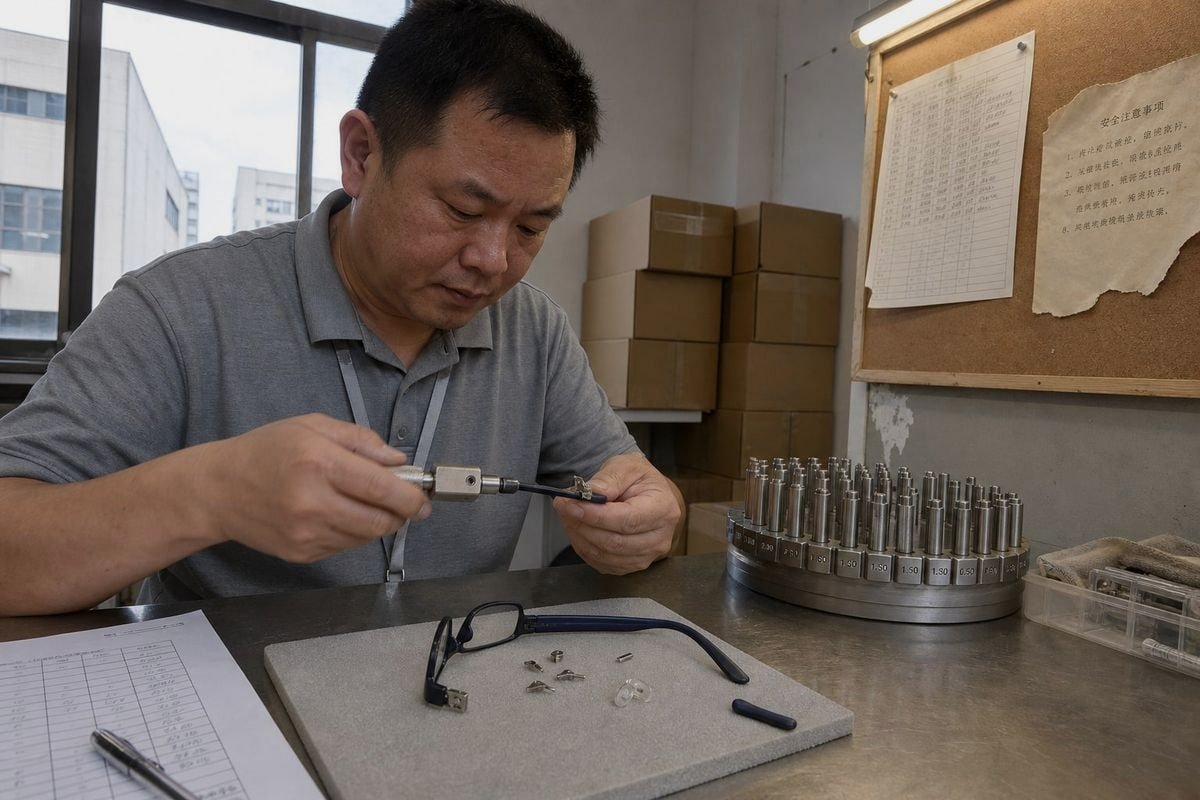
A buyer from Germany once asked me to walk her through every single part on one of our TR90 frames that could, in theory, end up in a toddler's mouth. That review took two hours. It was worth every minute, and it changed how our factory documents new styles.
Check every component that could detach: hinge screws, nose pads, decorative charms or logo inserts, end caps, silicone temple tips, and hinge pins. Any part that separates under pulling, twisting, biting, or dropping — and fits the small-parts cylinder — is a choking hazard for young children.

Children do not treat glasses the way adults do. They mouth them, chew the temple tips, pull the temples outward, twist the frame, and drop it onto hard floors. That is why product safety standards treat children's eyewear as a "small parts plus foreseeable misuse" category, even though a frame is not a toy. In our experience exporting to 20+ countries, the failure point is almost never the frame front. It is the small attached pieces.
The High-Risk Component Map
Here is the inspection map we use internally before any children's style goes into production:
| Komponente | Detachment Trigger | Choking Risk Level | Was zu überprüfen ist |
|---|---|---|---|
| Hinge screws | Loosening over time, twisting | Hoch | Thread-lock applied, retention after torsion test |
| Nose pads (push-in type) | Biting, pulling | Hoch | Pull force required to remove; molded-in pads preferred |
| Decorative charms / logo inserts | Picking, biting | Sehr hoch | Avoid entirely, or bond permanently |
| Silicone temple tips | Chewing, pulling | Medium–High | Tension test after aging; over-molded designs safer |
| End caps and hinge pins | Drop impact, hinge stress | Mittel | Post-drop-test inspection |
Think Beyond Normal Use
A valid hazard assessment covers foreseeable child behavior, not just intended wear. Under GPSR-style thinking, "the child was not supposed to bite it" is not a defense. Age grading guidelines matter here too: frames aimed at children under three demand the strictest scrutiny, because mouthing behavior peaks in that group. For older kids, detachable decorations still deserve attention, because injury-prevention sources keep warning about small detachable objects well past age three.
On our line, we design most of the risk out first. Molded-in nose pads instead of push-in pads. Over-molded TPEE temple tips instead of slip-on ones. No detachable charms on any children's SKU. Design beats testing every time.
How Do I Obtain a Valid GPSR Risk Analysis Document From My China Optical Frame Manufacturer?
The trade-off I weigh most often with new EU buyers is speed versus documentation depth. A rushed one-page "risk statement" gets goods shipped faster, but it collapses the moment a market surveillance authority asks questions. We learned to build the full document once, per SKU family, and maintain it.
Request a written risk analysis tied to your exact SKU that lists each hazard, the exposed user group, severity, likelihood, mitigation measures, and verification tests. Confirm the manufacturer names a responsible person, references applicable standards like EN 71, and commits to updating the document after any design change.

A GPSR-compliant risk analysis is not a test report. This confuses many first-time importers. A test report says "this sample passed on this date." A risk analysis explains why the product, as designed and produced, is safe — and how the factory verifies that continuously. You need both, and they must reference each other.
What a Valid Risk Analysis Contains
When we prepare these documents for EU clients, we structure them in five parts:
- Product identification. Exact model number, materials (TR90 front, TPEE temples), lens type, decorations, coatings, accessories, and the intended age group.
- Hazard identification. Choking (detachable small parts), mechanical (sharp edges, pinch points, fragment creation), and chemical (restricted substances in plastics, coatings, and silicone).
- Risk evaluation. For each hazard: who is exposed, how severe the outcome could be, and how likely it is under normal use and foreseeable misuse.
- Mitigation measures. Design controls (molded-in pads, rounded temple tips, smooth hinge design), material specs, and production controls.
- Verification methods. Small parts testing, tension and drop tests, chemical hazard assessment reports, incoming inspection, and final inspection criteria.
How to Actually Get It From Your Supplier
Ask early — before you pay a deposit, not before you book the container. Put the requirement in your purchase order and pre-production specification. A factory that genuinely serves EU brands will already have a template and sample documents to show you. If a supplier responds with only a vague "CE certificate," treat that as a red flag: CE marking compliance for eyewear rests on a technical file, and someone has to have built that file. Also remember your own EU importer responsibilities under GPSR — you must verify the documentation exists, keep it available, and ensure product traceability. The manufacturer writes the analysis; you cannot legally outsource your duty to check it.
Which Small Parts and Materials in TR90 Kids' Frames Are Most Likely to Fail Choking Safety Tests?
During a pre-production trial two years ago, our QC team pulled a slip-on temple tip off a sample frame with a force well below our internal threshold. The tip fit the cylinder. We scrapped that design and moved to an over-molded construction. That one afternoon shaped our entire temple-tip policy.
Slip-on silicone temple tips, push-in nose pads, standard hinge screws without thread-lock, and glued decorative inserts fail most often. TR90 itself rarely fragments, but attached components detach under tension, torsion, or drop impact — and any detached piece fitting the 31.7 mm cylinder counts as a choking hazard.
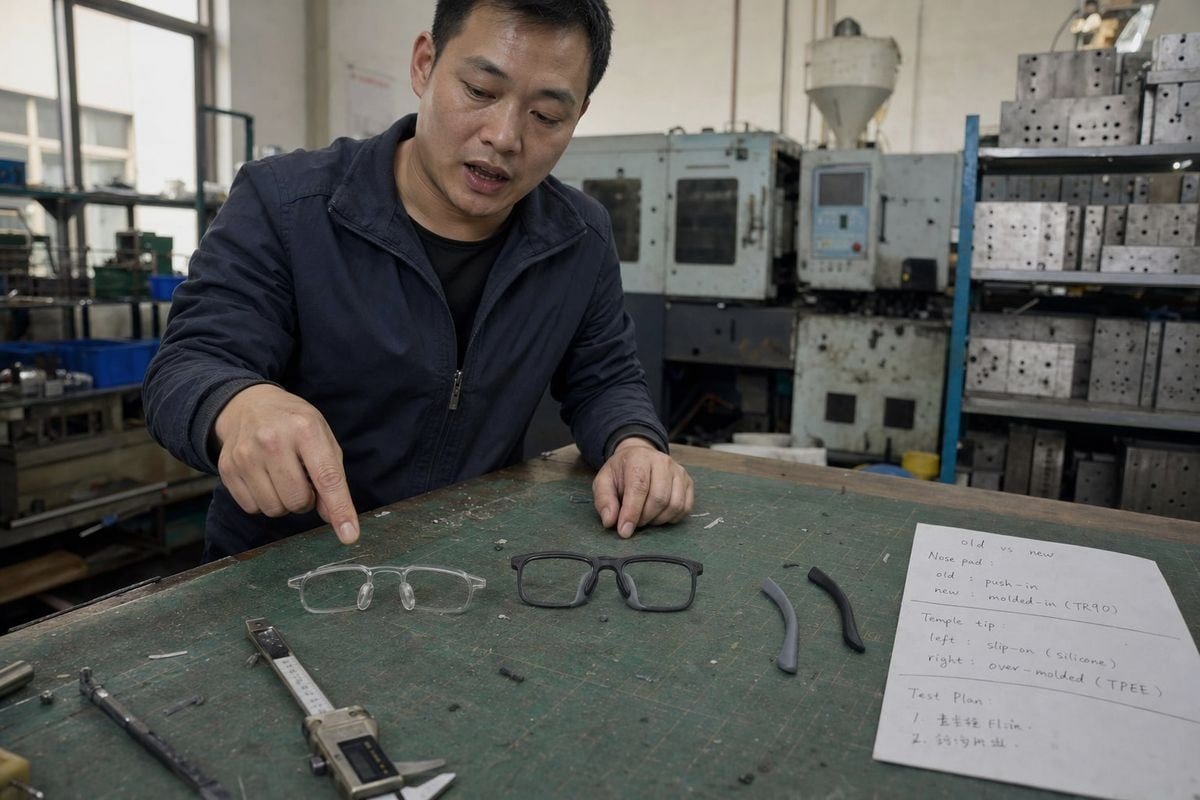
TR90 is a strong base material. It flexes instead of snapping, which is why we build most of our children's optical range on it, often paired with TPEE temples for extra bend tolerance. But the material choice does not automatically clear the product. The failures happen at the joints and attachments.
The Small-Parts Cylinder, Explained
The cylinder is a screening tool that approximates the expanded throat of a child under three. If a removable component fits entirely inside it, in any orientation, without compression, it is treated as a small part.
| Parameter | Specification |
|---|---|
| Internal diameter | 31.7 mm |
| Depth | 25.1 mm to 57.1 mm (angled base) |
| Test logic | Part fits fully, any orientation, no compression = choking hazard |
| Applies after | Tension, torsion, and drop tests — not just as-shipped condition |
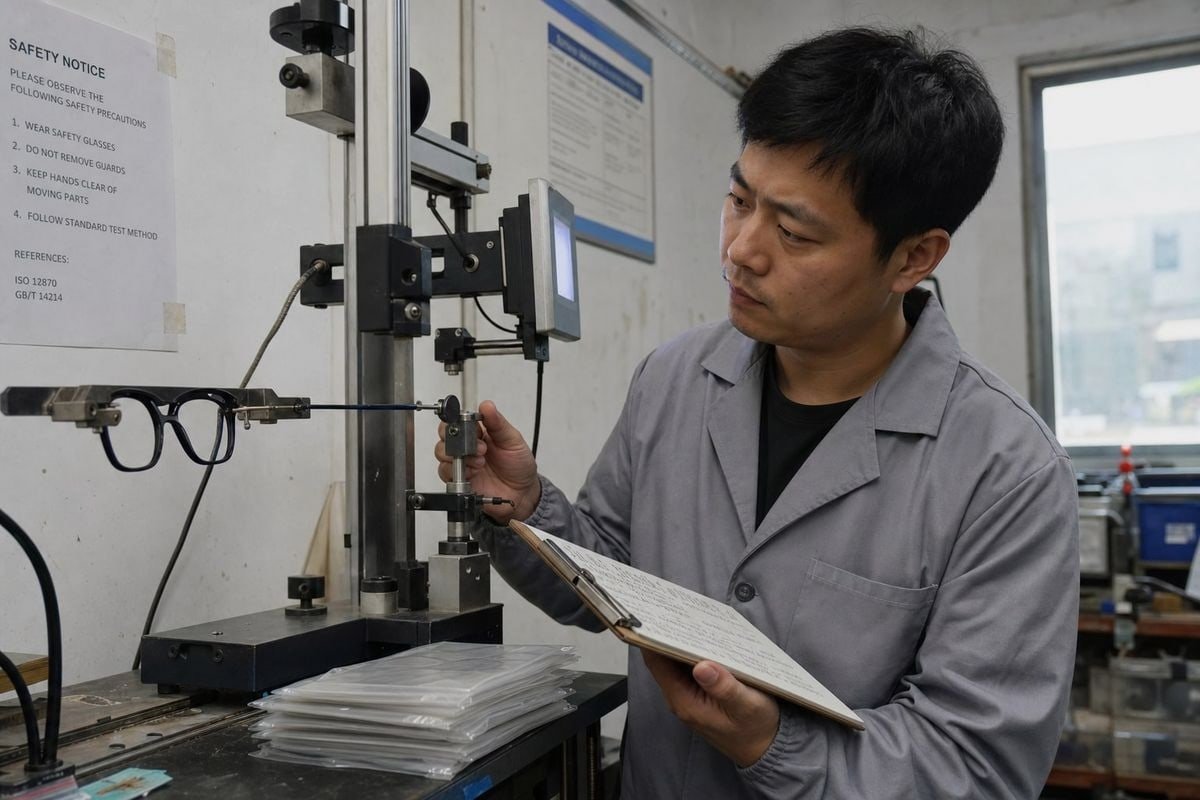
The key point most buyers miss: components are tested after mechanical abuse, not just as assembled. Mechanical safety testing — tension pulls on temples and tips, torque on screws and hinges, drops onto hard surfaces — comes first. Whatever detaches then goes into the cylinder.
Where the Nuance Matters
Some buyers push back and tell me the cylinder test is the whole story. I disagree, and the testing literature backs this up. The cylinder is a size screen. It does not capture shape, detachment force under real chewing, or aspiration scenarios with flexible parts. So we embed cylinder screening inside a broader assessment: how much force detaches the part, whether fragments have sharp edges, and whether the impact resistance of the lens-and-frame assembly holds up in drop tests. On chemical safety, we specify materials that meet migration limits under EN 71 standards 2 and REACH restrictions, because a part a child mouths raises both choking and chemical questions at once.
Ranked Failure Risk in Typical TR90 Kids' Frames
- Glued or press-fit decorative elements — highest failure rate; we simply do not use them on children's styles.
- Slip-on temple tips — fail tension tests when aged or when tolerances drift.
- Push-in nose pads — detach under biting; molded-in pads eliminate the risk.
- Hinge screws — loosen over months of daily open-close cycles without thread-lock.
- Spring hinge internals — rare, but drop impact can release small pins.
What Documentation Should I Request From My Supplier to Prove GPSR and Choking Hazard Compliance?
One lesson I learned early in our fifteen years of eyewear production: buyers who ask for documents by name get real documents, while buyers who ask "is it certified?" get a scanned certificate of unknown origin. Precision in your request protects you.
Request the GPSR risk analysis, third-party test reports for small parts and mechanical tests, chemical test reports, material specifications, the EU Declaration of Conformity where applicable, labeled component photos, traceability details, and a written change-control commitment. Verify every document matches your exact SKU.
Documentation is where supply chain due diligence becomes real. A children's frame can be perfectly safe and still be non-compliant on paper — and paper is what customs officers and market surveillance authorities examine. Here is the package we prepare for our EU and Australian brand clients, and the package you should demand from any supplier.
Die vollständige Checkliste der Dokumente
| Dokument | Was es beweist | Verify That |
|---|---|---|
| GPSR risk analysis | Hazards identified, assessed, mitigated | It names your exact SKU, materials, and decorations |
| Small parts / mechanical test report | Components stay attached under abuse | Test lab is accredited; sample matches production version |
| Chemical test report | No restricted substances migrate | Covers all materials: TR90, TPEE, silicone, coatings, paints |
| Material specifications | Consistent inputs batch to batch | Grades and suppliers are named, not just "TR90" |
| EU-Konformitätserklärung | Manufacturer's formal compliance claim | Correct legislation and standards are cited |
| Component photos | Visual baseline of critical parts | Photos are date-stamped and SKU-labeled |
| Change-control commitment | Design stays frozen | Any change triggers re-assessment and your approval |
Why SKU-Level Alignment Matters
A risk analysis written for a plain black frame does not cover the same frame with a printed pattern, a different temple tip, or a new lens coating. Small design changes alter the choking and chemical profile. So we align technical documentation to the exact SKU, and we re-open the file whenever a client requests a custom color, logo, or accessory through our OEM program. If your supplier reuses one generic report across their whole catalog, the document proves very little.
Also ask how the factory verifies ongoing conformity: incoming material inspection, in-process checks, and final inspection against defined criteria. Children's product certification frameworks in other markets — such as the CPC in the US 4 — follow the same logic, so a supplier who handles one market well usually structures documents well for all. Keep everything in your own technical file for the retention period GPSR expects, because as the importer, that file is your legal shield.
Schlussfolgerung
Choking risk assessment and GPSR risk analysis are one connected workflow: identify detachable parts, abuse-test them, screen with the cylinder, document everything per SKU, and demand the full paper trail before you ship.
Fußnoten
1. Official EU source explaining the Registration, Evaluation, Authorisation and Restriction of Chemicals regulation. ↩︎
2. Provides a comprehensive overview of the European safety requirements for toys. ↩︎
3. Details the small parts cylinder test for choking hazards under EN 71-1 standards. ↩︎
4. Official CPSC information on the Children’s Product Certificate required for US imports. ↩︎
Weitere Artikel, die Ihnen gefallen könnten

August 2026
Bio-Based vs Regular Cellulose Acetate: What's the Difference for Kids' Frames?
August 2026
How Recyclable Are Kids' Optical Frame Materials, and What Eco-Friendly Alternatives Exist?
August 2026
Bleichen Kinderbrillengestelle im Lager aus oder altern sie, und wie kontrolliert man die Lagerbedingungen?
Auf der Suche nach einem zuverlässigen Partner für Kinderbrillen?
Entdecken Sie über 800 sofort verfügbare Modelle und umfassenden OEM/ODM-Support, der auf Ihre Marke zugeschnitten ist.
Kontakt aufnehmen English
  Español de México
  Deutsch
  Français
  日本語
日本語  العربية
  Português do Brasil