How to Manage Compliance Documentation for Kids Optical Frames Across Regional Stores?

Managing compliance documentation for kids optical frames nearly broke one of our first multi-country buyers FDA 21 CFR 801.410 impact resistance evidence 1. Missing test reports froze their stock at customs. Our factory helped them rebuild the whole file system.
Manage compliance documentation for kids optical frames by building one centralized master file per product family, then attaching market-specific annexes for the US, EU/UK, and Korea. Link every SKU to test reports, declarations, and labels, and reopen the file whenever materials, suppliers, or claims change.
This sounds simple. In practice, most retailers get it wrong. Below, I break down what documents you need, how to organize them, how your manufacturer can help, and what to check before importing.
What compliance documents do I actually need for kids optical frames in each regional market?
Early in our export history, a European buyer asked us for a "CE file" and a US buyer asked for a "CPC" in the same week REACH data 2. Our team quickly learned these are completely different document stacks.
For the US, you need CPSIA test reports, a Children's Product Certificate, tracking labels, and FDA 21 CFR 801.410 impact resistance evidence. For the EU/UK, you need a Declaration of Conformity, technical file, and REACH data. Korea requires KC supplier conformity confirmation with designated-lab testing.
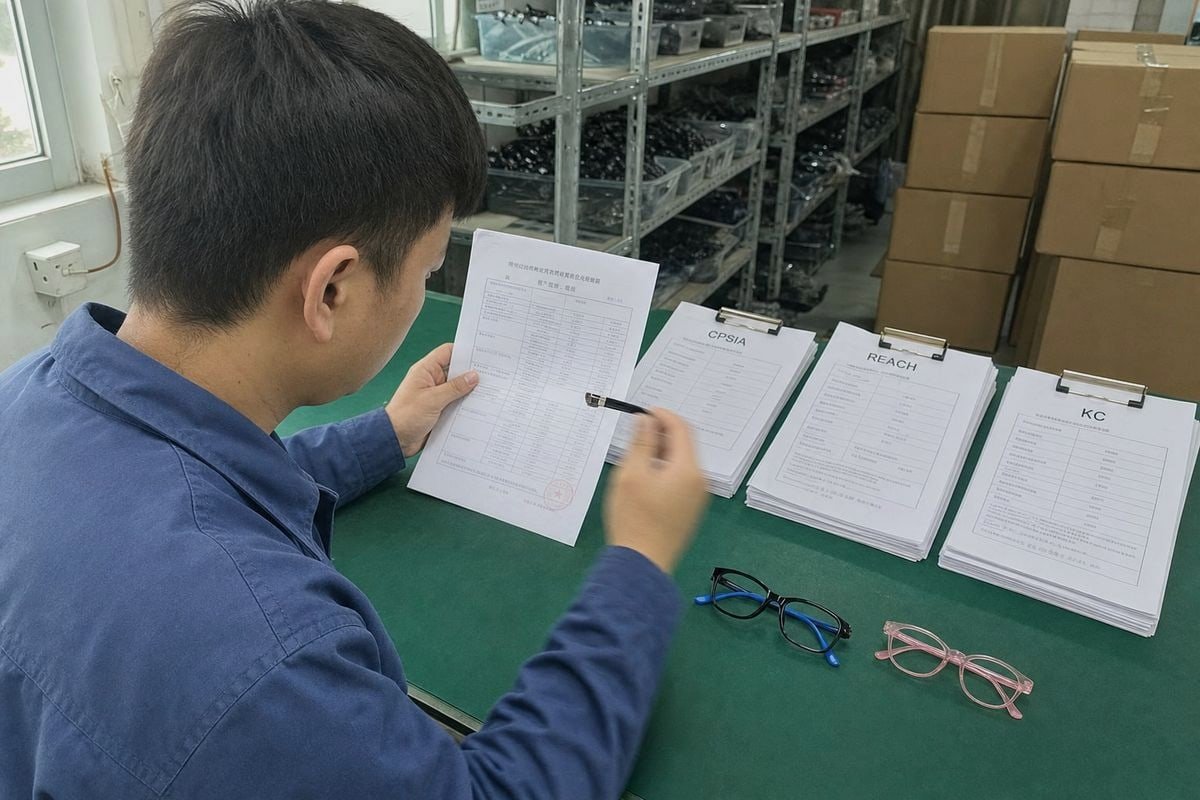
Children's eyewear is more document-heavy than adult eyewear. The reason is simple. Kids' products trigger extra rules on chemical safety requirements, age grading, and traceability that adult frames escape. A translucent pink acetate frame for a child needs paperwork that the identical adult version does not.
The core document stack by region
Here is how the requirements break down across the three major markets we ship to most often:
| Region | Key Documents | What They Prove |
|---|---|---|
| Vereinigte Staaten | CPSIA test reports 3, Children's Product Certificate (CPC), tracking label records, FDA 21 CFR 801.410 lens drop-ball certification, Prop 65 assessment (California) | Lead and phthalate limits, impact resistance testing, traceability, chemical disclosure |
| Zweck | Konformitätserklärung 4, technical file, risk assessment, REACH material declarations, labeling samples, instructions for use | General product safety, nickel release and heavy metal limits, correct labeling |
| Korea | KC supplier conformity confirmation 5, test reports from designated institutions | Children's optical frames and sunglasses meet Korean safety standards |
Claims change everything
One point buyers often miss: your marketing claims can pull in extra standards. If a sporty black-and-blue frame with flexible silicone temples is sold as sports eye protection, ASTM F803 may apply in the US. If sunglasses are marketed as protective equipment in Europe, Regulation (EU) 2016/425 and EN standards can apply. UV protection standards also require test evidence if you print "UV400" on the temple. My advice is to document what you claim, and claim only what you can document.
Retention rules differ too
EU guidance generally expects technical files to be kept for ten years. UK clinical dispensing records for children can run even longer. Financial records typically need seven years. Build these retention periods into your system from day one, not after an audit request arrives.
How can I keep my compliance paperwork organized when selling across multiple countries and stores?
A procurement manager from Australia once showed me her compliance "system": three email inboxes and a shared drive with folders named by month. When one store listed an old frame version, nobody could find the matching test report for two weeks.
Organize compliance paperwork by building a master compliance matrix at the product-family level, then storing SKU-level document packs for each store region. Use version control, assign one document owner and one store-release owner, and centralize everything in a single digital repository.

The core insight is this: compliance for multi-region retail is a document-control problem, not just a product-safety problem. Your frames may be perfectly safe. But if a store in Germany sells stock backed by an expired test report, you still fail an audit.
Build the file at family level, retain it at SKU level
We recommend a tiered structure. The core evidence — material declarations, base test reports, risk assessment — lives at the product-family level, because a TR90 frame family with TPEE temples shares the same materials across colorways. Then each market gets a local annex: translated instructions, region-specific labels with choking hazard warnings, age grading like "3+", and local declarations. This avoids the two extremes buyers worry about. Over-documenting every colorway from scratch slows launches. Under-documenting risks delisting or seizure. Tiered files reuse core evidence while keeping regional accuracy.
Assign clear ownership
| Rolle | Responsibility | Failure It Prevents |
|---|---|---|
| Document owner | Approves and versions every compliance file | Expired or mismatched test reports |
| Store-release owner | Confirms documents before stock goes on sale | Regional stores selling unapproved SKUs |
| Supplier contact | Delivers updated certificates on change | Stale factory paperwork after material swaps |
Version control is non-negotiable
Two frames can look identical and still be different products on paper. If the hinge material, lens supplier, or factory site changes, the compliance file must be reopened. We tag every production run at our workshop so buyers can match physical stock to the exact document version. Marketplace platforms enforce this strictly now — a CPC that does not match the listing description can trigger extra review or removal. Modern retailers are also moving from paper binders to centralized digital repositories, sometimes integrated with POS systems, so regional staff can pull the right file during any inspection. Pair this with basic retail staff training so store teams know what a Declaration of Conformity is and where to find it.
Can my manufacturer help me prepare and update certification documents as regulations change?
When a Japanese kids' brand asked us last year whether we could "handle all the paperwork," I gave them an honest answer: yes, we prepare most of it — but they still own the process legally.
Yes, a capable manufacturer can supply test reports, material declarations, labeling artwork, product specifications, and updated certificates when regulations change. However, the importer or retailer remains legally responsible, so you must verify all documents rather than accept factory paperwork blindly.

This is one of the biggest tensions in the industry. Many retailers assume the factory's paperwork transfers all responsibility. It does not. Compliance guidance is consistent on this point: the retailer or importer must verify documentation and maintain ownership of the compliance process. A good factory makes that job easier — it never makes it disappear.
What a strong factory partner should provide
At our Taizhou facility, we support B2B buyers from more than twenty countries, and the document package we prepare typically includes:
- Detailed product specification sheets for each frame style and colorway.
- Material declarations covering our TPEE and TR90 formulations, including chemical safety data.
- Third-party test reports from accredited labs for impact resistance, lead, phthalates, and nickel release.
- UV400 or polarized lens test evidence when we supply the lenses.
- Labeling artwork samples showing age grading, batch codes, and country of origin.
- Change notifications whenever we adjust a material, mold, or component supplier.
That last item matters more than most buyers realize. Supplier changes are becoming more frequent across the industry, which raises the risk of stale certificates. A responsible factory triggers a re-approval workflow automatically. We flag changes before production, not after shipment, so buyers can update their files in time.
Questions to ask your manufacturer
Ask whether test reports come from ISO 17025 accredited labs 7, since marketplaces increasingly require this. Ask how quickly the factory can re-test when a regulation updates. Ask whether they keep production records tied to batch numbers, because eyewear traceability depends on matching documents to physical shipments. With fifteen years of eyewear experience and a 5S-managed workshop, we treat these questions as normal onboarding — and any serious factory should too. If a supplier hesitates on any of them, treat that as a warning sign for your product recall prevention strategy.
What should I check before importing kids optical frames to avoid compliance delays at customs?
The most painful call I ever received came from a distributor whose container sat at a port for three weeks. The cause was tiny: the age grading on the packaging did not match the age grading in the test report.
Before importing, verify that test reports are current and match the exact product version, labels carry required marks and warnings, the CPC or Declaration of Conformity lists correct manufacturer details, and shipping documents align with product descriptions. Any mismatch invites customs holds.
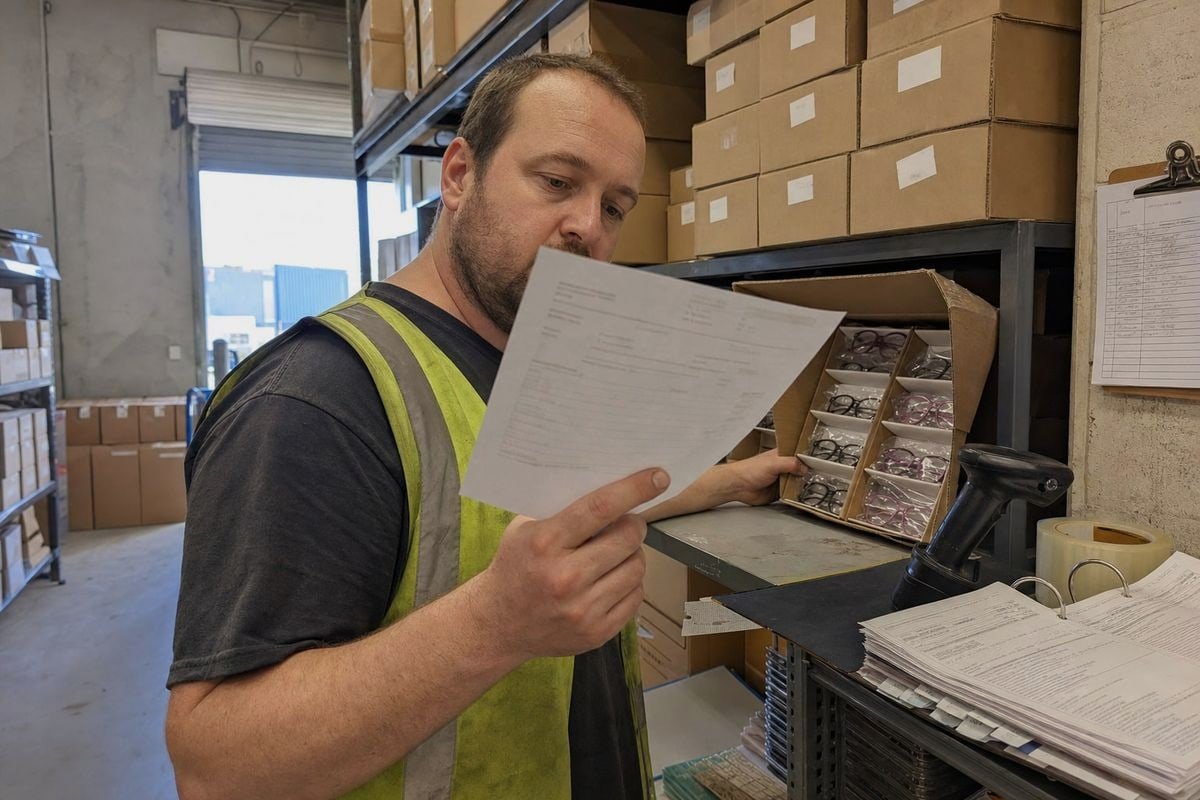
Customs delays rarely come from unsafe products. They come from paperwork that does not line up. The physical frame, the label, the certificate, and the shipping declaration must all tell the same story. Here is the pre-import checklist we walk our buyers through before every shipment leaves our factory.
The pre-import verification checklist
| Check Point | What to Verify | Common Failure |
|---|---|---|
| Test report validity | Report covers current material, supplier, and production site | Report predates a material or factory change |
| Certificate details | CPC or DoC lists product, applicable rules, test dates, lab, and manufacturer contacts | Missing manufacturing location or record keeper |
| Labeling accuracy | Age grading, choking hazard warnings, CE/UKCA or tracking labels, country of origin | Label says "3+" but the file says "5+" |
| Lens claims | UV protection standards evidence for any UV400 or polarized claim | Marketing claim without supporting test data |
| Description matching | Invoice, packing list, and listing match the certified product exactly | HS code or description conflicts with certificate |
| Batch traceability | Cartons carry batch codes linked to specific document versions | Mixed batches under one certificate |
Match documents to the physical product
Pull samples from the actual shipment and compare them to the file. Check the frame color, temple material, and printed markings against the specification sheet. Global safety standards enforcement increasingly happens at the border, and inspectors compare physical goods to documents line by line. We photograph every production batch before packing so our buyers have visual evidence linking stock to certificates. It takes minutes and has saved buyers weeks of port storage fees. Finally, confirm retention: keep the full import file for at least ten years for EU shipments, because a customs question can arrive long after the frames have sold through.
Schlussfolgerung
Compliance documentation for kids optical frames fails at the file level, not the product level. Centralize your master files, localize your annexes, verify everything before shipping, and partner with a factory that treats paperwork as seriously as production.
Fußnoten
1. Provides the specific US federal regulation requiring impact-resistant lenses in eyewear. ↩︎
2. Provides an overview of the EU regulation for chemical substances, including registration and restriction. ↩︎
3. Explains the mandatory third-party testing requirements for children’s products under CPSIA. ↩︎
4. This is an official European Union website providing authoritative guidance on the EU Declaration of Conformity. ↩︎
5. Explains the Korean certification scheme where manufacturers confirm product compliance with national standards. ↩︎
6. Details the mandatory certification document for children’s products sold in the US market. ↩︎
7. Highlights the international standard for laboratory competence, ensuring accuracy and reliability in testing. ↩︎
Weitere Artikel, die Ihnen gefallen könnten

August 2026
Bio-Based vs Regular Cellulose Acetate: What's the Difference for Kids' Frames?

August 2026
How Recyclable Are Kids' Optical Frame Materials, and What Eco-Friendly Alternatives Exist?
August 2026
Bleichen Kinderbrillengestelle im Lager aus oder altern sie, und wie kontrolliert man die Lagerbedingungen?
Auf der Suche nach einem zuverlässigen Partner für Kinderbrillen?
Entdecken Sie über 800 sofort verfügbare Modelle und umfassenden OEM/ODM-Support, der auf Ihre Marke zugeschnitten ist.
Kontakt aufnehmen English
  Español de México
  Deutsch
  Français
  日本語
日本語  العربية
  Português do Brasil