Bio-Based vs Regular Cellulose Acetate: What’s the Difference for Kids’ Frames?

Buyers keep asking our sourcing team about bio-based vs regular cellulose acetate 1 for kids’ frames. The labels look similar, the prices don’t, and choosing wrong can hurt your brand story.
Bio-based cellulose acetate replaces petroleum-derived plasticizers with plant-based ones and raises renewable content to roughly 60–70%, versus around 40–50% for regular acetate. For kids’ frames, both perform almost identically; the real differences are sustainability credentials, chemical composition, and a 10–40% cost premium.
That is the short answer. But the details matter when you are building a children’s collection. Let me walk you through what actually changes, what stays the same, and how to decide.
How do bio-based and regular cellulose acetate differ in safety for my children's frames?
At our Taizhou factory, we spend most of our time on flexible TR90 and TPEE frames, so when brand buyers ask us about acetate safety, we answer from a materials-selection view first.
Both materials start from plant cellulose and are considered safe for children's frames. The key safety difference is the plasticizer: regular acetate often uses petroleum-derived plasticizers, while bio-based acetate uses phthalate-free, plant-derived alternatives like citric acid esters, reducing chemical migration risk when kids chew on temples.

Here is the part many people miss. Regular cellulose acetate is not the same as ordinary petroleum-based plastics. Its base comes from wood pulp and cotton fibers, which are renewable resources. That base is then combined with plasticizers to make the material workable. In standard acetate, those plasticizers are often fossil-derived. In bio-acetate, they come from plants — think citric acid or vegetable oil derivatives.
Why plasticizers matter for kids specifically
Children treat glasses differently than adults do. They chew on temple tips. They wear frames against sweaty skin for ten hours a day. They have higher skin sensitivity than most adults. So the "mouthability" question is real. Bio-acetate's phthalate-free plasticizers 2 and BPA-free composition give it a cleaner toxicological profile for exactly this kind of contact. When we develop TPEE temple tips for our own frames, we apply the same logic: the material touching a child's skin and mouth must be non-toxic materials by design, not by accident.
A quick composition comparison
| Faktor | Regular cellulose acetate | Bio-based cellulose acetate |
|---|---|---|
| Cellulose base | Wood pulp / cotton linters | Wood pulp / cotton linters |
| Plasticizer type | Often petroleum-derived | Plant-derived (e.g., citric acid esters) |
| Bio-based content | ~40–50% (one supplier cites 42%) | ~60–70% (one supplier cites 67%) |
| Phthalates / BPA | Varies by formulation | Free by design |
| Skin contact profile | Generally good | Often marketed as hypoallergenic |
One caution I always share with buyers: hypoallergenic properties are frame-specific claims, not automatic guarantees. Ask your supplier for the exact formulation documentation rather than trusting the word "bio" on its own.
Will bio-based cellulose acetate affect the durability or flexibility of my kids' eyewear?
A procurement manager from Australia once asked me whether "bio" meant "weaker" — she assumed eco-friendly materials sacrifice frame durability. It is a fair worry, and the answer surprised her.
No. Bio-based cellulose acetate matches regular acetate in flexibility, impact resistance, polish, and color depth. Both are thermoplastics that opticians can heat-adjust to a child's face. Some bio-acetate formulations even show enhanced shape memory, holding adjustments better during active play.
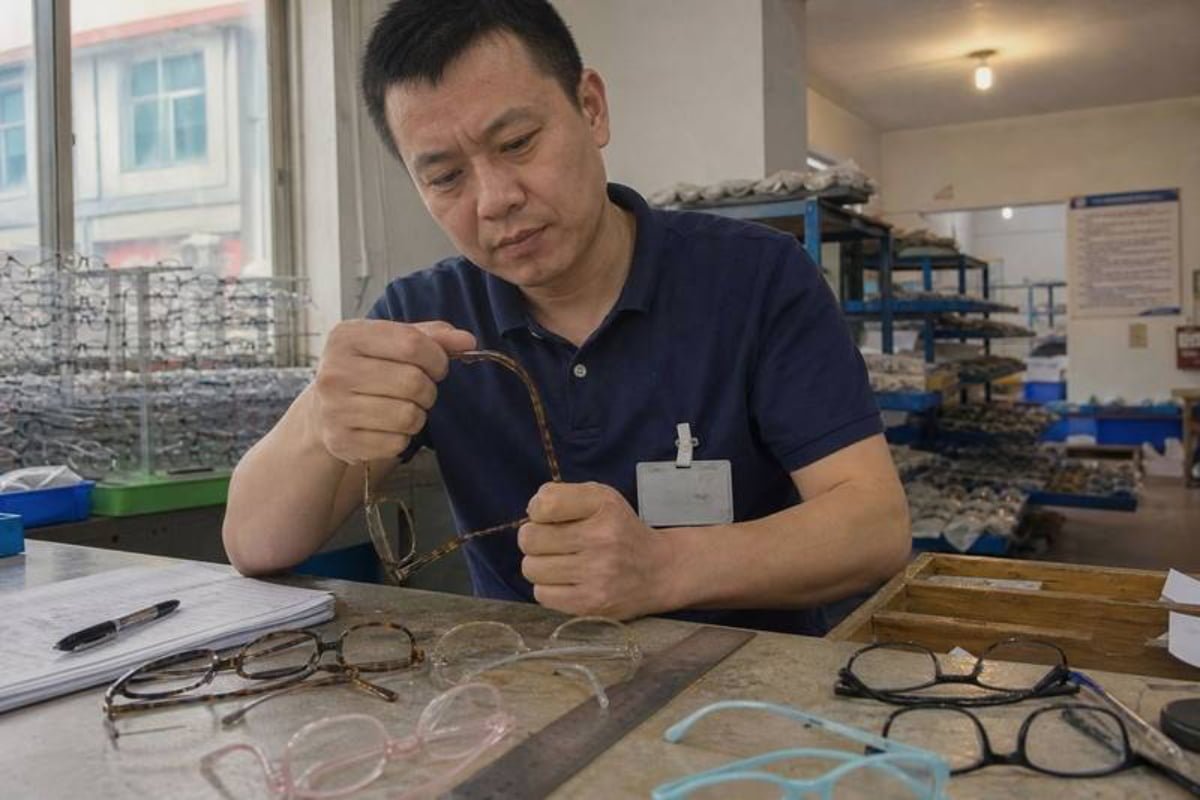
Durability is where parents judge kids' eyewear hardest, so let us break this down honestly. In everyday wear — playground drops, backpack squashing, constant on-off handling — bio-acetate and regular acetate behave essentially the same. Both offer the deep color saturation and complex patterns, like tortoiseshell, that acetate is famous for. Both take a high-gloss finish that does not fade quickly. Both are thermoplastic, which means an optician can warm the temples and bend them to fit a child's nose bridge and ear shape precisely. That adjustability matters more for children than adults, because small faces vary enormously and grow fast.
Shape memory and active kids
Some industry sources report that bio-acetate exhibits improved shape memory and thermal stability. In plain terms, the frame is less likely to stretch out or lose its fit after months of high-energy play. That is a genuine advantage for a children's line, though I would still verify it per formulation rather than assume it.
Material alone is not the whole story
Here is a lesson from fifteen years of building kids' frames: material choice never guarantees durability by itself. Hinge quality, temple design, lens retention, and frame geometry matter just as much. We learned this the hard way early on — a beautiful material in a poorly engineered frame still fails QC drop tests. Our own catalog leans on flexible TR90 fronts with soft TPEE temples for the youngest wearers precisely because construction and material must work together. If you specify bio-acetate, pair it with spring hinges or reinforced barrel hinges, generous temple curves, and impact-tested lenses. The best-case result is a frame that looks premium, flexes safely, and survives a school year.
Is bio-based cellulose acetate worth the extra cost for my brand's sustainability goals?
The trade-off we weigh most often with brand clients is simple: a stronger sustainability story versus a thinner margin on a product a child will outgrow in eighteen months.
Bio-acetate costs roughly 10% more to produce, with ex-works premiums of 20–40% depending on formulation and supply chain. It is worth it if sustainable eyewear is central to your brand positioning and your customers will pay for it; otherwise regular acetate remains a credible, plant-derived choice.

Let me put real numbers on the table, because vague sustainability talk helps nobody make a purchasing decision.
| Cost and sustainability factor | Regular acetate | Bio-based acetate |
|---|---|---|
| Production cost | Baseline | ~10% higher (one manufacturer source) |
| EXW price premium | Baseline | 20–40% higher in some supply chains |
| Bio-based content | ~42% in one cited comparison | ~67% in the same comparison |
| Carbon footprint | Lower than petroleum plastics | Up to 50% lower than regular acetate (per one source) |
| Biodegradability | Yes, but very slow | Under industrial composting, under 115 days per one claim |
The honest environmental picture
I will raise the objection some critics make, because your customers will make it too: since regular acetate is already plant-derived, isn't bio-acetate just an incremental upgrade? Partly, yes. That is exactly why your marketing language matters. Biodegradability claims for bio-acetate depend on industrial composting conditions 3 — certifications such as ISO 14855 test controlled environments, not a landfill or a backyard compost bin. If you print "biodegrades naturally" on a hang tag, you are drifting into greenwashing territory, and European and Australian regulators increasingly punish that.
Where the premium pays off
The premium makes sense in three scenarios. First, your brand already leads with eco-friendly manufacturing and your buyers expect material transparency. Second, you are targeting premium retail price points where a 20–40% material premium dissolves into the final margin. Third, you are exploring circular models — some brands now run subscription programs where outgrown kids' frames are returned for industrial composting or specialized recycling. Bio-acetate enables that story. There is also a subtle environmental angle for children specifically: micro-particles shed from frames during playground wear are more likely to break down with bio-acetate, modestly reducing the microplastic footprint compared with petroleum-based plastics.
Which type of cellulose acetate should I choose for my next kids' eyewear collection?
During a recent development call, a European kids' brand asked us to build one collection in two material tiers — and honestly, that dual approach solved their dilemma better than picking a single winner.
Choose bio-based cellulose acetate if sustainability is a core brand pillar and your price point absorbs the premium. Choose regular acetate for value-focused lines, since it is already plant-derived and high-performing. Many brands succeed by offering both tiers within one children's collection.

There is no universally correct answer here, only the right fit for your positioning, your market, and your customer. Use this decision framework as a starting point:
| Hier ist das Gerüst, das ich den Käufern während des Onboardings mitteile: | Recommended choice | Warum |
|---|---|---|
| Eco-positioning is your main differentiator | Bio-acetate | The 67% renewable content and phthalate-free plasticizers back up your claims |
| Mid-market pricing, fast outgrow cycle | Regular acetate | Solid safety and frame durability without the 20–40% premium |
| Premium boutique retail | Bio-acetate | Buyers at this tier expect material transparency and non-toxic materials |
| First collection, testing the market | Either, or flexible alternatives | Minimize risk; validate demand before committing to premium materials |
| Sensitive-skin or baby-adjacent positioning | Bio-acetate or TPEE/TR90 | Skin sensitivity concerns favor phthalate-free, soft-touch materials |
A buying checklist before you commit
Before you sign a purchase order, run through these five checks. First, request the material datasheet showing actual bio-based content — do not accept the word "bio" alone. Second, confirm plasticizer type in writing; phthalate-free should be documented, not implied. Third, verify any compostability claim against a named standard like ISO 14855 4 and understand it applies to industrial conditions only. Fourth, evaluate the whole frame: hinges, temple flexibility, and lens fit drive real-world durability as much as the acetate itself. Fifth, check your supplier's QC process for children's products specifically, because kids' frames face regulatory and physical demands adult frames never see.
One practical note from our side: acetate is not the only path to a safe, sustainable kids' frame. Our own line of roughly 800 existing styles is built mainly on flexible TR90 fronts and soft TPEE temples, chosen for impact resistance and comfort on small faces. For many brands, a mixed-material strategy — acetate for premium optical styles, flexible materials for toddler and active-wear styles — covers the full age range better than any single material.
Schlussfolgerung
Bio-acetate upgrades the sourcing and chemistry; regular acetate remains a strong, plant-derived material. Match the choice to your brand's sustainability goals, price point, and your customers' priorities.
Fußnoten
1. Authoritative Wikipedia entry providing a comprehensive overview of the material’s properties and history. ↩︎
2. Official FDA information regarding the safety and regulation of phthalates in consumer products. ↩︎
3. EPA guidance and definitions regarding composting processes and environmental sustainability standards. ↩︎
4. Official international standard for determining the aerobic biodegradability of plastic materials. ↩︎
Weitere Artikel, die Ihnen gefallen könnten

August 2026
How Recyclable Are Kids' Optical Frame Materials, and What Eco-Friendly Alternatives Exist?
August 2026
Bleichen Kinderbrillengestelle im Lager aus oder altern sie, und wie kontrolliert man die Lagerbedingungen?

August 2026
Wie verhindert man Verformungen und Transportschäden bei Kinderbrillengestellen während des Versands?
Auf der Suche nach einem zuverlässigen Partner für Kinderbrillen?
Entdecken Sie über 800 sofort verfügbare Modelle und umfassenden OEM/ODM-Support, der auf Ihre Marke zugeschnitten ist.
Kontakt aufnehmen English
  Español de México
  Deutsch
  Français
  日本語
日本語  العربية
  Português do Brasil