What Do Nickel Release and Phthalate Limits Mean for Kids’ Eyewear?

Nickel release 1 and phthalate limits confused me too, until a buyer’s rejected shipment forced our Taizhou factory to master them. One bad hinge can sink an entire kids’ eyewear order.
Nickel release and phthalate limits are chemical safety rules for kids’ eyewear. EU REACH caps nickel migration at 0.5 µg/cm²/week for skin-contact metal parts, while CPSIA restricts eight phthalates to 0.1% in accessible plasticized components, protecting children from allergies and hormonal harm.
These two rules target different materials and different risks. Let me walk you through what each one covers, how testing works, and how to buy compliant frames with confidence.
How do nickel release limits actually apply to children's eyewear components?
A few years back, one of our European clients asked why we test hinges separately from the frame. The answer changed how they wrote every purchase order afterward.
Nickel release limits apply to metal parts in direct, prolonged skin contact — hinges, screws, temple cores, nose pads, and decorative accents. EU REACH Annex XVII caps migration at 0.5 µg/cm²/week, measured with artificial sweat testing under EN 16128 and the EN 1811 standard.
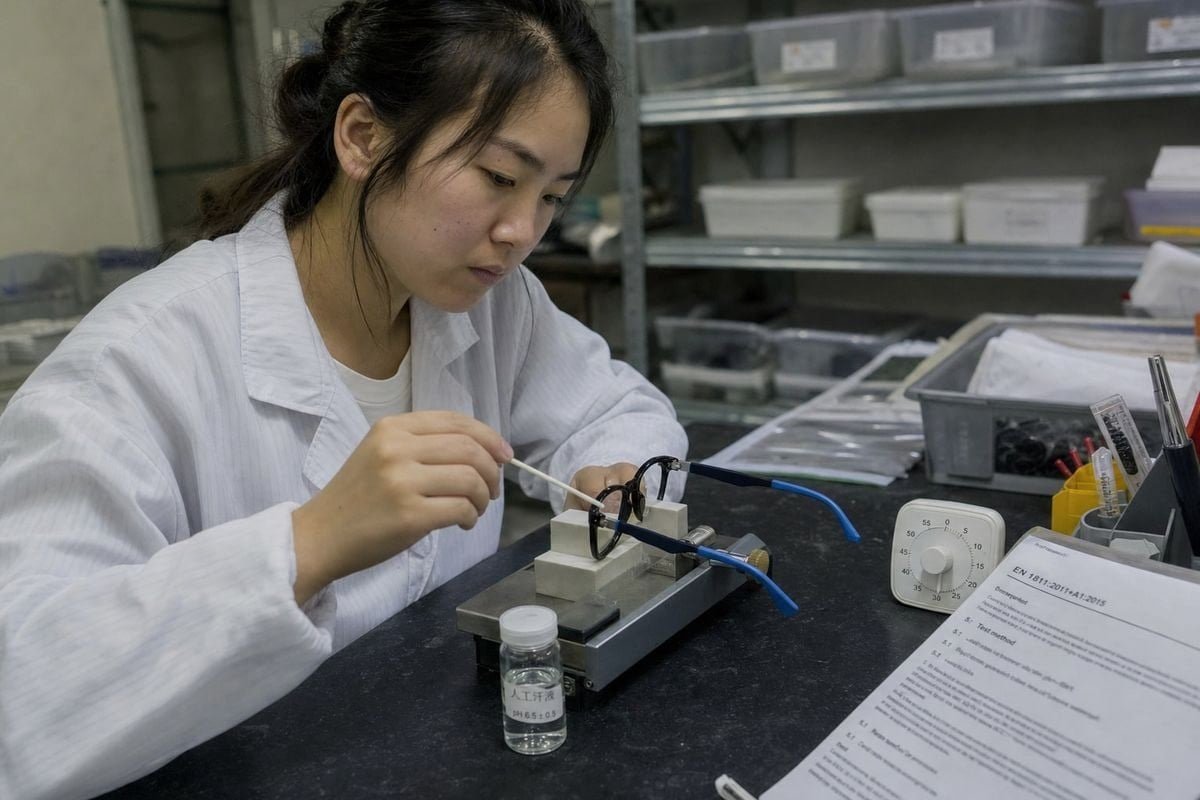
The key idea here surprises many buyers: the rule does not ban nickel. It limits how much nickel can migrate out of a part and onto a child's skin over time. A frame can contain nickel inside an alloy and still pass, as long as the plating and manufacturing quality keep the release below the threshold. That is why the REACH regulation talks about "release," not "content."
In our workshop, we map every metal touchpoint on a kids' frame before production starts. Even a mostly plastic TR90 frame can hide metal in places parents never think about.
Where nickel hides in a kids' frame
| Component | Skin contact level | Nickel risk |
|---|---|---|
| Hinge screws | Occasional | Moderate |
| Spring hinges | Occasional to frequent | Moderate |
| Metal core wire inside temples | Indirect (can be exposed by wear) | Low to moderate |
| Nose pads with metal arms | Direct and prolonged | High |
| Decorative metal accents | Direct if placed on temples | High |
"Direct and prolonged contact" matters legally. The parts resting on the nose, behind the ears, and along the temples touch skin continuously, so regulators treat them as the priority. Testing is not applied to the whole frame as one unit. Labs target the accessible parts a child touches or even mouths.
Why does this matter more for kids? Children wear glasses for many hours, sweat during play, and handle frames roughly. Acidic perspiration accelerates nickel ion migration into the skin. One published study found nickel release in roughly a quarter of new metal frames — and in 96% of used frames. Wear makes the problem worse over time, which is exactly why coatings alone are never a perfect fix. Coated metal may pass at first, but corrosion and friction can degrade a poor coating within months.
Why are phthalate restrictions so important for kids' sunglasses and frames?
When we were developing a soft-touch temple tip for a baby eyewear line, our material supplier offered two plasticizer options. The cheaper one would have failed CPSIA instantly.
Phthalate restrictions matter because phthalates are endocrine disruptors that can interfere with children's hormonal development, reproductive health, and respiratory systems. Under CPSIA, eight specific phthalates cannot exceed 0.1% in any accessible plasticized part of children's eyewear, including grips, tips, and coatings.
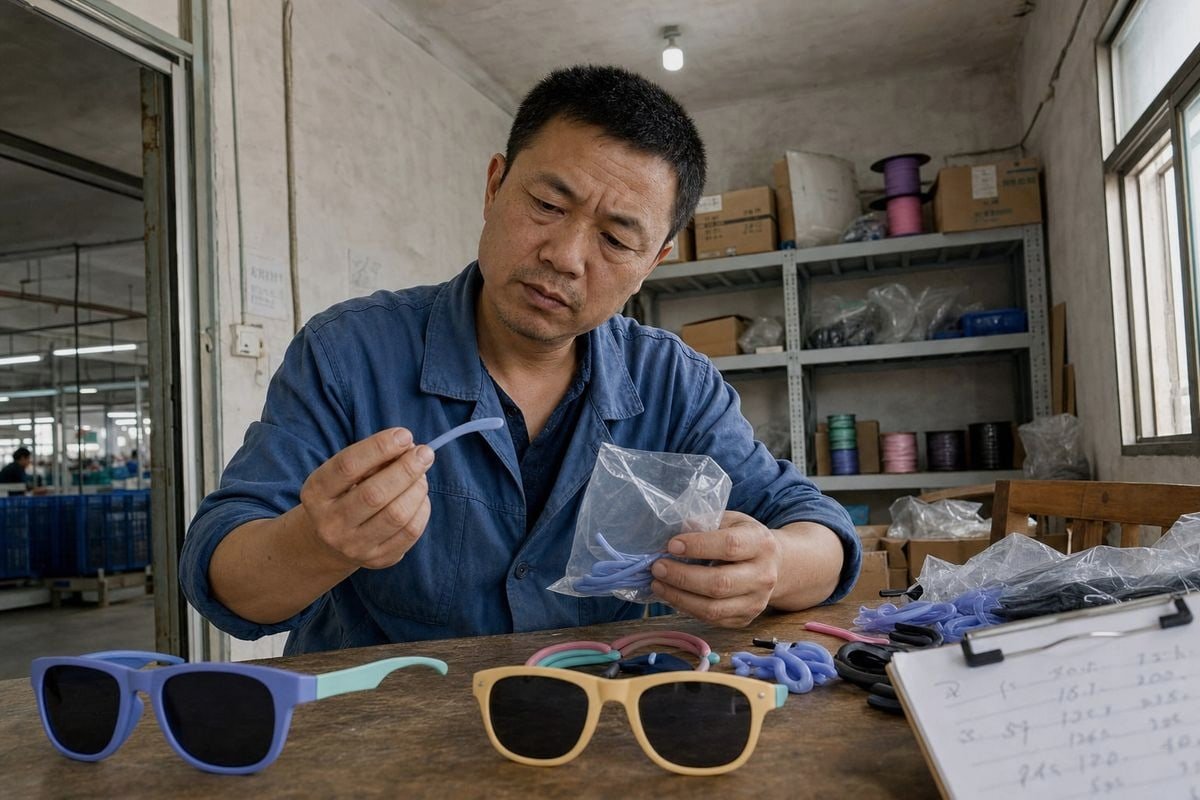
Phthalates are plasticizers — chemicals added to plastics 2, especially PVC, to make them soft and flexible. That flexibility is exactly what kids' eyewear needs at the temple tips 3, nose bridges, and rubberized grips. So the temptation to use cheap plasticized PVC is real, and it is where non-compliant product usually fails.
Unlike the nickel rule, there is no single eyewear-specific phthalate standard worldwide. The restrictions come from broader children's product rules. In the US, the Consumer Product Safety Commission enforces CPSIA compliance 4, which treats kids' eyewear like other children's products. In the EU, REACH restricts several phthalates in articles children can mouth or touch. Japan and Australia apply their own children's product frameworks. So your compliance answer depends on where you sell.
The cumulative exposure problem
Here is the nuance most ranking articles skip. Pediatric researchers now discuss the "cocktail effect": a child's total chemical load comes from eyewear, toys, clothing, and food packaging combined. Each product may individually pass its limit, yet the cumulative dose may still matter biologically. That is a strong argument for buyers to go beyond minimum legal thresholds — and it is why our factory chose TPEE, a flexible material that needs no phthalate plasticizers at all, rather than trying to formulate "compliant PVC."
Some buyers push back: "If the product passes the test, why pay more for phthalate-free materials?" Our answer is simple. Passing a batch test proves that batch. Choosing an inherently phthalate-free material removes the risk from every batch, forever. For a brand selling to parents, that difference shows up in recalls avoided, not in the unit price.
The industry trend supports this. Suppliers are shifting toward bio-based plasticizers derived from castor oil or wood pulp to replace traditional PVC formulations, giving frames the flexibility kids need without hazardous leaching.
What lab testing and certificates should I request from my eyewear manufacturer?
An Australian procurement manager once asked me for "the safety certificate" — singular. I had to explain, gently, that real compliance is a folder, not a page.
Request third-party test reports for nickel release under EN 16128 or EN 1811, CPSIA phthalate reports covering all eight restricted phthalates, REACH SVHC declarations, material composition sheets, and batch-level documentation. Reports should come from accredited labs and match your specific product and colorway.

Let me demystify the nickel test first, because buyers rarely see inside the lab. The reference method places the skin-contact parts in an artificial sweat solution 5 for a defined period, usually one week. The lab then measures how much nickel has migrated into that solution and compares the adjusted figure against the 0.5 µg/cm²/week threshold. In plain language: the frame is soaked in a sweat-like liquid to simulate real wear, and the lab checks whether nickel can leach out at a level that could trigger sensitive skin. EN 16128:2025 updated this method specifically for spectacle frames, sunglasses, and eye protection, which means documentation is becoming more uniform across suppliers — good news for buyers comparing factories.
Phthalate testing works differently. The lab solvent-extracts the plasticized parts and measures the concentration of each restricted phthalate against the 0.1% limit.
Your document checklist
| Document | What it proves | Red flag if missing |
|---|---|---|
| EN 16128 / EN 1811 nickel report | Metal parts pass migration limits | Supplier "guarantees" compliance verbally |
| CPSIA phthalate report | All eight phthalates under 0.1% | Report covers only three phthalates |
| REACH declaration | No restricted substances above limits | Generic letter with no product reference |
| Material data sheets | Actual polymer and additive identity | Vague "eco-friendly plastic" claims |
| Batch traceability records | Consistency across production runs | One old report reused for years |
Two practical warnings from our export experience. First, check that the report matches your exact SKU and colorway — pigments and coatings change chemistry. Second, ask how often the factory re-tests. We re-test when materials, suppliers, or platings change, not just once at launch. Looking ahead, Digital Product Passports 6 may soon let parents scan a QR code and verify a frame's chemical batch testing directly. Buyers who build clean documentation habits now will adapt easily.
How can I choose materials like TPEE and TR90 to stay compliant and safe?
Fifteen years of bending, freezing, and sweat-soaking sample frames in our QC room taught our team one thing: the safest compliance strategy is choosing materials that cannot fail these tests in the first place.
Choose inherently safe materials: TR90 (Grilamid) and TPEE are naturally free of nickel and phthalates, flexible without plasticizers, and lightweight for children's faces. Pair them with titanium or high-grade stainless steel for any necessary metal parts, and avoid plasticized PVC entirely.
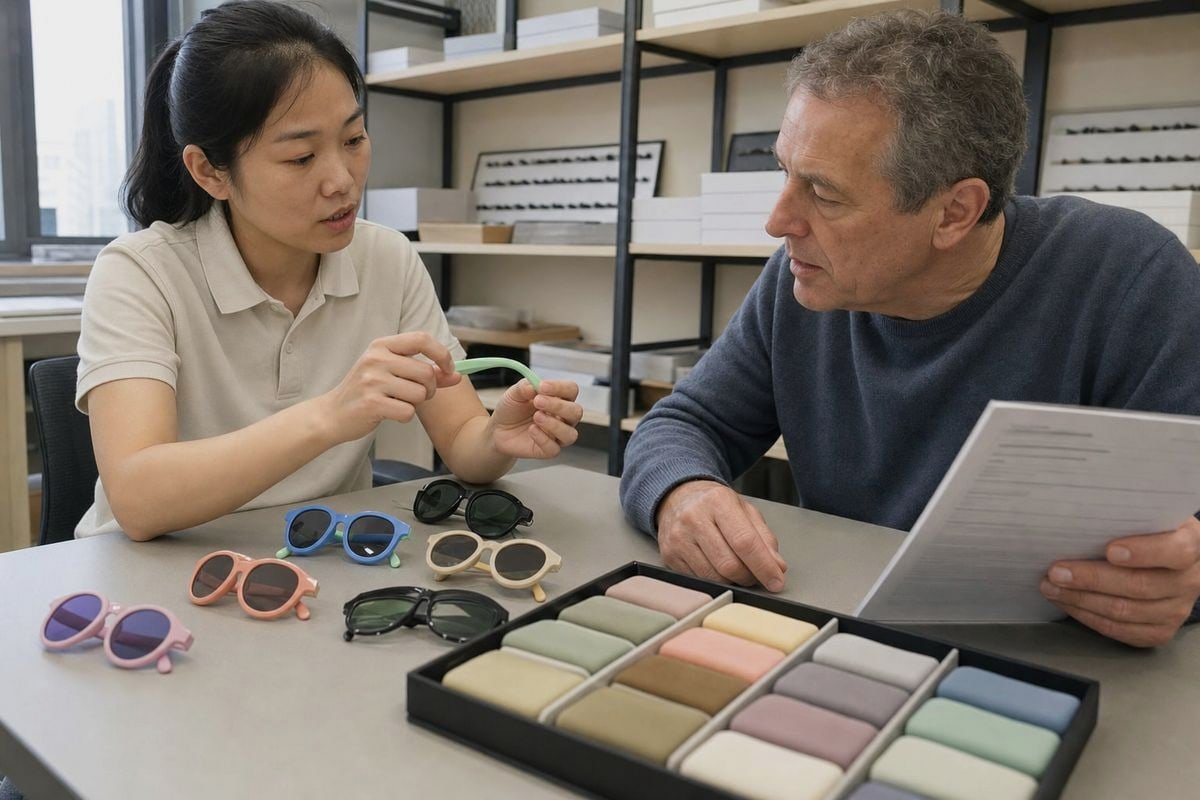
Material choice is your first and cheapest compliance decision. Everything downstream — testing costs, rejection risk, brand liability — flows from it. Here is how the common options compare for children's frames.
Material comparison for kids' eyewear
| Material | Nickel risk | Phthalate risk | Flexibility | Best use |
|---|---|---|---|---|
| TR90 (Grilamid) | None | None | High | Optical frames, sunglass fronts |
| TPEE | None | None | Very high | Temples, tips, baby frames |
| Cellulose acetate | None | Low (check plasticizer type) | Low | Premium fashion frames |
| Plasticized PVC | None | High | High | Avoid for kids |
| Stainless steel / titanium | Very low | None | Rigid | Hinges, screws, accents |
| Nickel-alloy metal | High without plating | None | Rigid | Requires strict release testing |
TR90 gives you the structural front: it snaps back after twisting, survives drops, and weighs very little. TPEE adds an even softer, rubber-like flexibility, which is why we often build kids' frames with a TR90 front and TPEE temples — the combination flexes where children grab and stays stable where lenses sit. Neither material needs plasticizers to be flexible, so the phthalate question largely disappears at the design stage.
A note on hypoallergenic frames as a marketing term: "hypoallergenic" is not a certification. A frame can carry that label and still hide a nickel-bearing screw, and a nickel allergy can be triggered by a single poorly plated part. Since nickel is the leading cause of allergic contact dermatitis 7 in children, insist on test data behind the claim, not the claim alone. Cellulose acetate deserves a similar caution — it is a fine material, but you should confirm which plasticizer the supplier uses.
One last practical point for new brands. With around 800 existing TR90 and TPEE styles on our shelves, buyers can launch a compliant line without investing in molds, then customize colors, logos, lenses, and packaging once the market responds. Starting from proven, tested materials shortens both your compliance path and your time to market.
Conclusion
Kids' eyewear safety is invisible chemistry, not just fit. Demand nickel and phthalate test reports, choose TR90 and TPEE, and partner with factories that document compliance batch by batch.
Footnotes
1. Official ECHA entry detailing the REACH restrictions and migration limits for nickel in consumer products. ↩︎
2. Authoritative NIEHS resource explaining phthalates and their use as additives in plastic products. ↩︎
3. Wikipedia entry describing the components of eyeglasses, including temple tips and frames. ↩︎
4. Official CPSC resource explaining the statutory requirements for children’s product safety under the CPSIA. ↩︎
5. Technical overview of the EN 1811 standard for testing nickel release using simulated perspiration. ↩︎
6. Official European Commission page on the Ecodesign regulation introducing Digital Product Passports for transparency. ↩︎
7. Medical guidance from the American Academy of Dermatology on nickel-induced skin reactions and prevention. ↩︎
More Articles You Might Like


Looking for a Reliable Kids Eyewear Partner?
Explore 800+ ready styles and full OEM/ODM support tailored to your brand.
Get in Touch English
 Español de México
 Deutsch
 Français
 日本語
 العربية
 Português do Brasil