Why Do Kids’ TR90 & TPEE Optical Frames Keep Sliding Down—And How to Fix It?
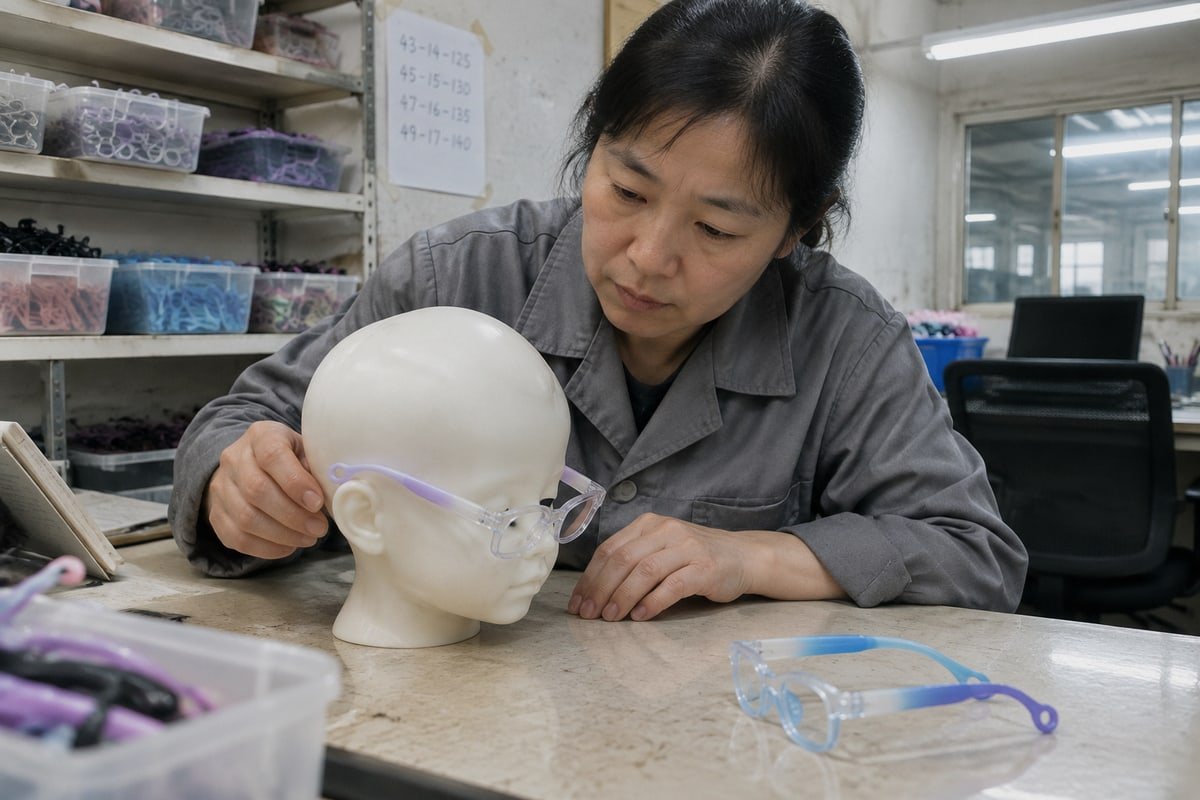
Parents complain kids’ TR90 & TPEE optical frames slide down mid-play. Returns pile up. On our Taizhou line, we trace almost every case to fit geometry, not polymer.
Kids’ TR90 & TPEE optical frames slide down mainly because the bridge width, temple length, or overall frame width does not match the child’s developing face, not because the material is weak. Fix it by matching bridge fit, shortening or re-curving temples, and adding silicone ear hooks for active kids.
Below, I break the problem into four parts. First, the causes. Then how to pick temples. Then the design features that hold. Finally, how to fix a live product line with your factory.
What causes my kids' TR90 frames to slide down so easily during play?
Last spring our QC team pulled a batch of small frames and set them on a child head form. Every pair slid within two forward nods.
Kids' TR90 frames slide during play because a child's low, still-developing nose bridge gives the fixed bridge little to grip, while an oversized front, loose or short temples, and shallow temple drop remove the tension that should anchor the frame behind the ears.

That head-form test taught us something simple. The frames were fine. The fit was wrong. Let me walk through why this happens so often with children.
Children's faces are not small adult faces
A child's nose bridge is flatter and lower than an adult's. It has not finished growing. So there is less surface for a fixed plastic bridge to rest on. Gravity pulls the frame forward. The nose does not push back.
Cheekbones sit higher on many children's faces. If the bridge is too wide, the frame drops until the lens rims touch the cheeks. Parents then see red marks and assume the frame is too tight. Actually, it is too loose at the bridge.
Growth makes this worse. A frame that fit in spring can be too narrow in the temples by autumn. Pediatric optometry guidance recommends rechecking fit after growth spurts 1, after a new sports season, and after any lens replacement. We tell our B2B buyers the same thing.
The five most common causes we see in returns
| Cause | What the parent sees | Why it happens |
|---|---|---|
| Bridge width too wide | Frame drops, rims touch cheeks | Weak contact on a low nose bridge |
| Front too wide | Frame slides forward and tilts | No lateral tension against the head |
| Temples too short or too long | Frame sits forward, or hangs loose | Tip cannot hook behind the ear |
| Shallow temple drop | Slides when child looks down | No posterior anchor behind the ear |
| Front-heavy lenses | Frame pivots forward | High prescriptions shift the center of gravity |
The material objection, addressed
Buyers often tell me the polymer is the problem. They say TR90 feels slick, or TPEE is too bendy. I understand the worry. Both materials are smooth and non-porous, and sweat or skin oil does make them more slippery in summer.
But here is what our head-form tests show. A frame with the right bridge width and a proper temple drop holds well even when wet. A frame with the wrong geometry slides even when dry. The flexible memory resin 2 gives comfort and survival against bending. It does not create grip on its own. Grip comes from contact points and tension.
One more cause deserves a mention. TR90 is a shape-memory material. If a parent cold-bends a temple at home, it creeps back toward its molded shape within days. Any lasting temple tip adjustment needs controlled heat, which an optician can apply.
A hidden cost for myopia control
Some children now wear myopia control lenses. These lenses have treatment zones 3 positioned for a fixed eye position. When the frame slides, the zones move away from the pupil. The lens cannot do its job. For those families, frame alignment is not a comfort issue. It is a treatment issue.
How can I choose TPEE temples that stay secure on my child's face?
Softer TPEE feels kinder on skin. Firmer TPEE holds the ear better. Every temple we mold forces us to pick a point between those two.
Choose TPEE temples by measuring temple length from hinge to ear top, then adding a curved or looped tip that drops behind the ear. Look for a medium-firm, hypoallergenic TPEE that resists sweat and sunscreen, and confirm the tip can be heat-adjusted by an optician.

TPEE is our favorite temple material for children. It bends far without snapping. It feels warm and soft on the skin. It is a hypoallergenic material for most kids. But the temple only works if you size it and shape it correctly. Here is how I approach that with buyers.
Start with length, not style
The temple has one job. It must reach past the top of the ear and then turn down behind it. Too short, and the tip sits on top of the ear. The frame pushes forward. Too long, and the curve lands behind the skull. The frame hangs loose.
Common temple lengths for children run from about 115 mm for toddlers up to around 145 mm for teens. Age is only a rough guide. We ask buyers to measure a sample of real children in their market when they can. A Japanese buyer and an Australian buyer may serve the same age group but need different temple lengths.
| Age group | Typical temple length | Notes |
|---|---|---|
| Toddler (1–3) | 115–120 mm | Looped tips strongly advised |
| Preschool (3–6) | 120–130 mm | Curved tip with deep drop |
| School age (6–12) | 130–140 mm | Standard curved tip works |
| Teen (12+) | 140–145 mm | Close to small adult sizing |
Pick the right tip shape
We produce two main tip styles for kids. The first is a fully looped ear hook. The TPEE curls all the way around the back of the ear. This is what you see on our clear front frames with gradient purple temples. Nothing slips off a looped tip during running or tumbling. The second is a curved, rubberized tip with a deep drop, like the one on our light blue frames. It is easier to put on and take off. It suits school-age children who handle their glasses many times a day.
A quick way to compare:
- Looped ear hook: best retention, slightly slower to put on.
- Deep-drop curved tip: good retention, easy for the child to manage alone.
- Straight or shallow tip: poor retention for kids; we avoid it.
Consider firmness and surface
Very soft TPEE feels wonderful in the hand. But it has low holding force. The temple bends away when the child moves. We aim for a medium-firm grade. Small perforated dots along the temple let a firmer grade still flex in the right places.
Surface care matters too. Some lipid-based sunscreens and lotions react with TPEE over time. The surface turns slimy and loses grip. We choose grades that resist this, and we recommend a fit guide in the packaging that tells parents to wipe the temples after sunscreen use.
What frame design features actually prevent slipping without sacrificing comfort?
A buyer from Melbourne once sent us three competitor frames and asked why hers slid and theirs did not. We put all four on the same head form.
Frame features that prevent slipping without hurting comfort include a low bridge fit with a wider, deeper saddle, anti-slip nose pads co-molded in soft TPEE, a front width matched to the child's face, and flexible looped temple tips that anchor behind the ears.

The answer for that buyer was simple. Her frame had a narrow, high bridge designed for a generic adult face, only shrunk. The others had bridges built for children. Below are the features that made the difference, and the trade-offs each one carries.
Features that hold, and what they cost you
| Feature | How it stops slipping | Trade-off |
|---|---|---|
| Low bridge fit (saddle bridge) | Spreads contact across a flat nose | Slightly heavier look at the front |
| Anti-slip nose pads in TPEE | Soft, tacky contact on skin | Needs a two-material mold |
| Adjustable nose pads | Optician can fine-tune width | Small parts; fewer brands use them for toddlers |
| Matched front width | Creates lateral tension against the head | Requires two or three sizes per style |
| Looped or deep-drop temple tips | Posterior anchor behind the ear | Slower to put on |
| Balanced weight distribution | Reduces forward pivot | Limits very thick rim designs |
Why low bridge fit comes first
A low bridge fit means the bridge sits lower and wider. It follows the shape of a flat nose. More skin touches more frame. That contact is what fights gravity. It also keeps the rims off the cheeks. Comfort and retention improve together. This is the one feature I ask every kids' brand to prioritize.
Fixed pads versus adjustable nose pads
Most TR90 kids' frames use a fixed, molded bridge. There is nothing to adjust. If the width is wrong, the frame is wrong. Adjustable nose pads solve that. An optician can move them in or out. But tiny pads on a toddler frame can bend or catch hair. So we usually recommend fixed bridges with anti-slip nose pads for children under six, and adjustable pads for older children with higher prescriptions.
Weight and balance
Lightweight is good, but light frames rely more on precise fit. A thick lens shifts the center of gravity forward. We counter this by keeping the front thin and moving mass into the temples. A slightly firmer TPEE temple also holds a front-heavy frame better.
Asymmetry is normal
Almost every child has one ear a little higher than the other. An injection-molded frame is perfectly symmetrical. The result is a diagonal slide. Our frames are designed so an optician can heat-set the temple on one side. Active kids eyewear that cannot be adjusted at all will always drift on one side.
How do I work with a manufacturer to fix a slipping issue in my existing eyewear line?
One lesson stuck with me after fifteen years of eyewear work: a slipping complaint is a data problem before it is a tooling problem.
Work with your manufacturer by sending returned frames, the child age range, and the slipping symptom. Ask for bridge and temple measurements, a comparison against existing molds, sample frames with alternative bridges or temples, and retention accessories before committing to a new mold.

When a buyer contacts us about a slipping issue, we do not start by quoting a new mold. New tooling is expensive and slow. Most problems can be fixed faster. Here is the process our team runs.
Step one: describe the symptom precisely
Different symptoms point to different fixes. We ask the buyer to sort complaints into groups:
- Slides forward while sitting still: bridge width is too wide.
- Slips only when the child looks down: temple drop is too shallow.
- Tilts to one side: asymmetry or one temple bent.
- Red marks on the nose or behind the ears: frame too small or temple too short.
- Rims touch the cheeks: bridge too wide or too high for a low nose bridge.
A photo of the child wearing the frame, taken from the front and side, helps more than any written note.
Step two: measure the returned frames
We measure bridge width, front width, and temple length on the returned pieces. We compare them against the original drawings. Sometimes the mold has drifted slightly. Sometimes the frame is exactly as designed, and the design itself was wrong for that market. Both answers are useful.
Step three: compare against existing molds
This is where our catalog of about 800 existing styles earns its keep. We often find an existing front with the same lens shape but a lower bridge, or a TPEE temple set that fits the same hinge with a deeper drop. We send samples within days. The buyer tests them on real children. No mold cost. Low risk.
Step four: choose the least invasive fix
| Fix | Lead time | Cost | When it works |
|---|---|---|---|
| Swap TPEE temples for a longer or looped version | Short | Low | Slipping when looking down, loose temples |
| Switch to an existing low bridge front | Short | Low | Rims touching cheeks, forward slide |
| Add silicone ear hooks or an eyeglass strap for kids as a packed accessory | Short | Low | Active sports use, toddlers |
| Add adjustable nose pads to an existing design | Medium | Medium | Older children with high prescriptions |
| New mold with revised bridge geometry | Long | High | Only when no existing style fits |
Step five: update the fit guide and QC checks
The fix is not finished at the factory. We help buyers add a simple fit card to their retail-ready packaging. It shows how the frame should sit level, how the temple should curve behind the ear, and when to visit an optician for temple tip adjustment. On our side, we add the corrected bridge and temple dimensions to the inspection sheet 4 in our 5S-managed workshop. Every later batch gets checked against them.
That is what a long-term partnership looks like. Not the cheapest quote. A factory that measures, samples, and fixes.
Conclusion
Slipping kids' TR90 & TPEE frames frustrate parents and drive returns. Fix geometry first: bridge width, temple length, temple drop. Then add retention accessories and choose a factory that measures.
Interested in sourcing the products mentioned in this article? See details and request a quote here:
Footnotes
1. Authoritative guidance on children’s vision milestones and the impact of growth on eye health. ↩︎
2. Technical explanation of memory resins used in engineering and manufacturing. ↩︎
3. Explains myopia and the clinical need for corrective treatment zones in lenses. ↩︎
4. Defines the 5S methodology used for quality control in manufacturing environments. ↩︎
More Articles You Might Like

Looking for a Reliable Kids Eyewear Partner?
Explore 800+ ready styles and full OEM/ODM support tailored to your brand.
Get in Touch English
 Español de México
 Deutsch
 Français
 日本語
 العربية
 Português do Brasil