What Does the Warranty for Kids Sunglasses Typically Cover?
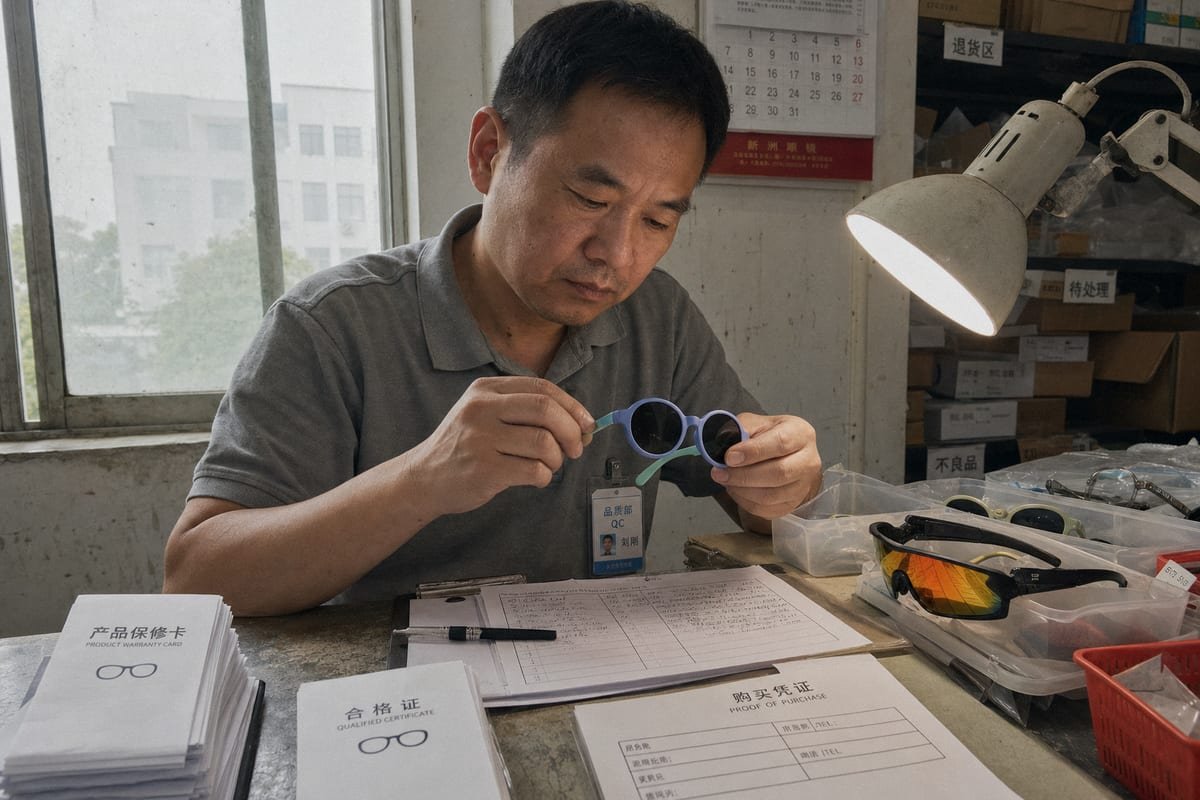
Buyers ask about the warranty for kids sunglasses in almost every quote request our factory receives. One broken hinge dispute can sour a partnership. Clear terms prevent that pain entirely.
A warranty for kids sunglasses typically covers manufacturing defects in frames, lenses, hinges, and coatings for one to two years, with proof of purchase. Accidental damage, scratches, loss, and normal wear and tear are usually excluded unless a separate protection or replacement plan is purchased.
That short answer hides a lot of detail. Coverage varies widely between brands, retailers, and factories. Let me walk you through what is really covered, what is not, and how B2B buyers can shape better terms.
What Defects or Issues Are Usually Included in a Kids Sunglasses Warranty?
Last year, a batch inspection 1 at our Taizhou workshop caught a hinge screw tolerance issue before shipping. That is exactly the kind of problem a proper warranty exists to cover.
A kids sunglasses warranty usually includes manufacturing defects such as hinge failure, warped or cracked frames without impact, peeling or bubbling lens coatings, lens delamination, loose temple arms, and faulty nose pads. Coverage applies only to flaws in materials or workmanship, not to damage caused by the child.
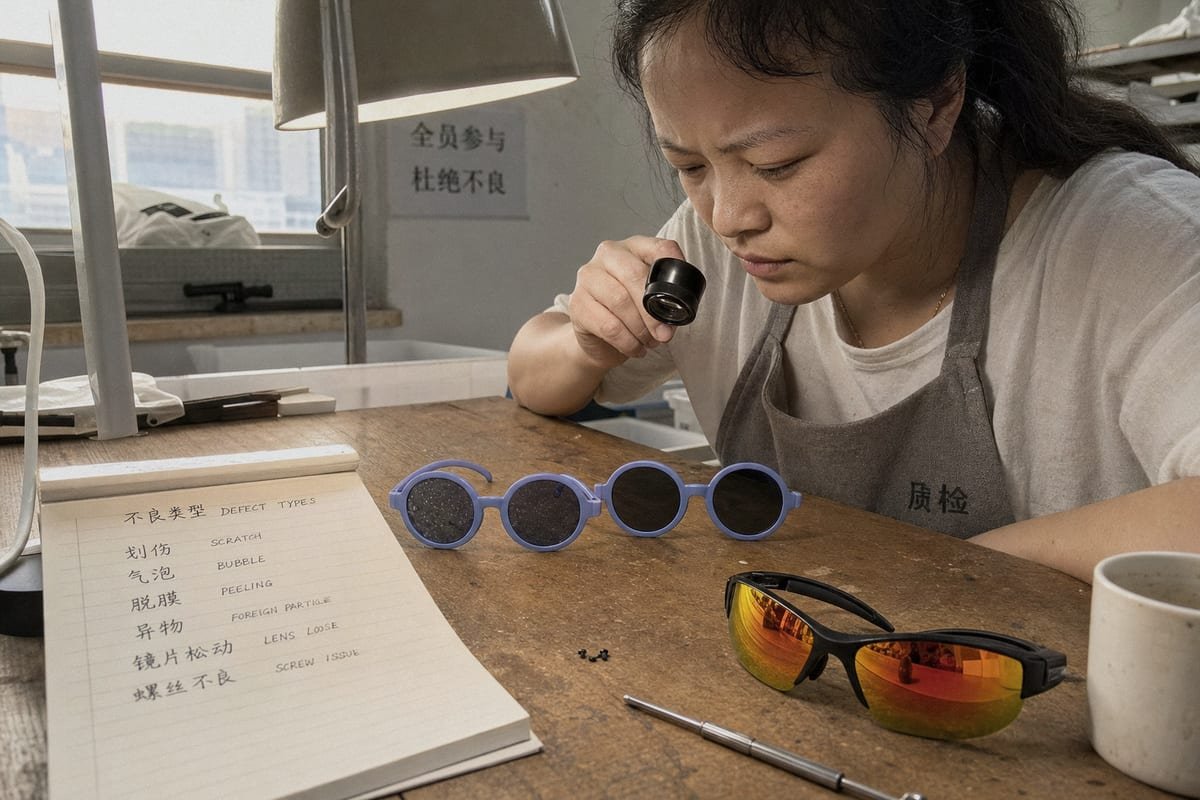
The core principle behind any standard warranty is simple. If the product fails because of how it was made, the maker is responsible. If it fails because of how it was used, the maker usually is not. That line sounds clean on paper. In practice, kids blur it every single day.
Common Covered Defects
From our fifteen years producing children's eyewear, these are the defect types most warranties reliably cover:
| Defect Type | What It Looks Like | Typically Covered? |
|---|---|---|
| Hinge failure | Screw loosens or joint snaps without impact | Yes |
| Coating failure | UV or anti-reflective layer peels, bubbles, or crazes | Yes |
| Frame warping | Frame twists or loses shape under normal conditions | Yes |
| Lens delamination | Layers of the lens separate on their own | Yes |
| Weld or joint flaws | Temple detaches at the connection point | Yes |
| Scratches from use | Surface marks from playgrounds or backpacks | Rarely |
| Bite marks | Toddler chewing on temple tips | No |
| Loss or theft | Sunglasses left at the beach | No |
Why Material Choice Changes the Defect Picture
Here is something many buyers miss. The defect rate depends heavily on the material. We build most of our children's frames in TR90 and TPEE precisely because rigid plastics 2 crack at stress points. Flexible frame durability means a frame bends and returns instead of snapping. A well-made TPEE temple can survive twisting that would shatter a cheap injection-molded frame. Fewer legitimate defects means fewer warranty claims, which matters enormously when you are selling thousands of units under your own brand.
Coatings deserve special attention too. A scratch-resistant coating 3 that fails on its own, by peeling or clouding, is a manufacturing defect. A scratch caused by sand in a beach bag is not. Warranties draw that distinction carefully, and so should your product documentation.
How Long Should I Expect a Warranty Period to Last for Children's Eyewear?
A distributor in Australia once asked us whether a longer warranty period would justify a higher retail price. Our answer surprised him: length matters less than what the period actually covers.
Children's eyewear warranties typically last one to two years from the purchase date. One year is the industry standard for kids sunglasses, while premium brands may extend to two years or offer a limited lifetime warranty on manufacturing defects only. Accidental damage plans usually run twelve months.
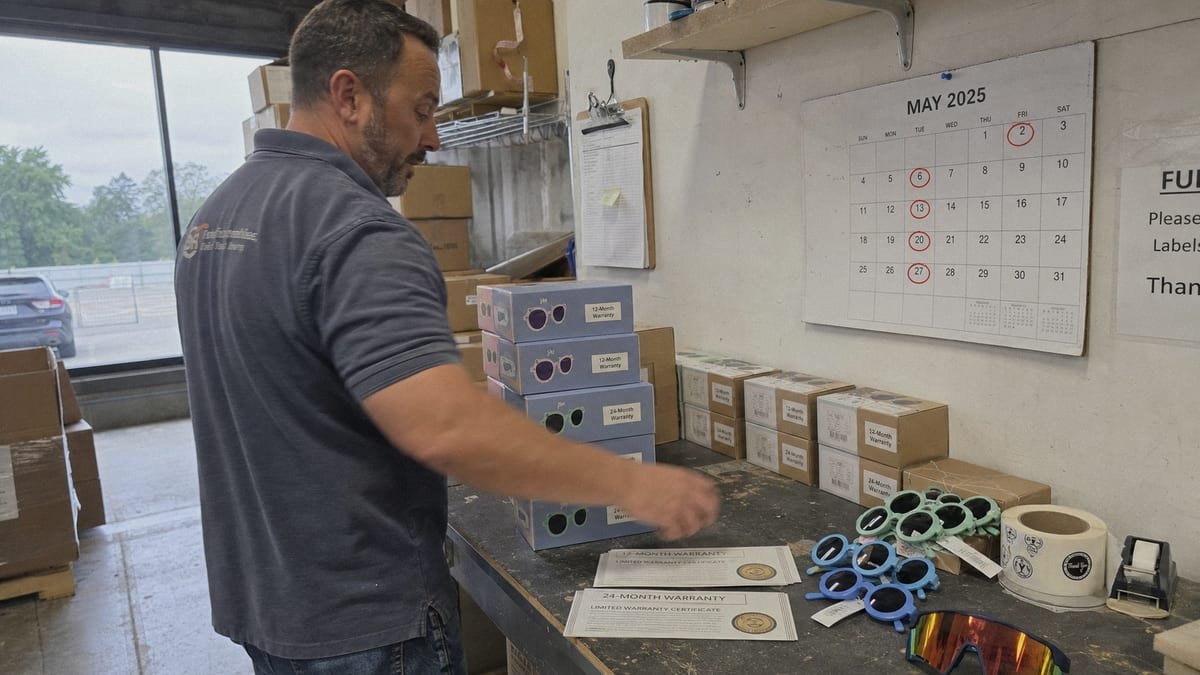
Time limits exist because materials age. UV exposure 4, sunscreen, sweat, and heat all degrade plastics and coatings over time. After a year or two of heavy use, it becomes nearly impossible to separate a genuine defect from normal wear and tear. So the industry settled on windows that are fair to both sides.
Typical Warranty Durations by Coverage Type
| Coverage Type | Common Duration | Notes |
|---|---|---|
| Standard defect warranty | 12 months | The baseline across most kids' eyewear brands |
| Extended defect warranty | 24 months | Common in EU markets due to consumer law |
| Limited lifetime warranty | Lifetime of product | Defects only; accidental damage still excluded |
| Accidental damage plan | 6–12 months | Often one replacement per period |
| Prescription change window | 60–90 days | Applies to kids optical frames, not plano sunglasses |
Why Kids' Products Sometimes Get Shorter or Different Terms
Interestingly, some youth lines carry shorter coverage than adult equivalents, capped at two years even when the adult line offers a limited lifetime warranty. The reasoning is blunt. Children outgrow frames, treat them roughly, and rarely keep a pair beyond two seasons. A lifetime promise on a product with a two-year usable life is mostly marketing.
There is one more timing detail buyers should know. Proof of purchase almost always starts the clock. Without a receipt or order record, most brands will refuse a claim outright. When we support our B2B clients, we recommend they build a simple registration step into their packaging insert. It protects the end customer and gives the brand a marketing touchpoint at the same time. Some brands even tie lost or stolen protection to that registration window, offering a discounted replacement only if the product was registered within thirty days.
Can I Negotiate Custom Warranty Terms When Ordering from a Manufacturer?
Negotiating terms is one of my favorite conversations with new brand clients, because it forces both sides to define quality in numbers rather than adjectives.
Yes, B2B buyers can negotiate custom warranty terms with a manufacturer. Common negotiable points include the defect rate threshold, replacement policy, spare parts allowance, claim evidence requirements, and who pays processing and shipping fees. Terms are typically written into the purchase agreement before production begins.
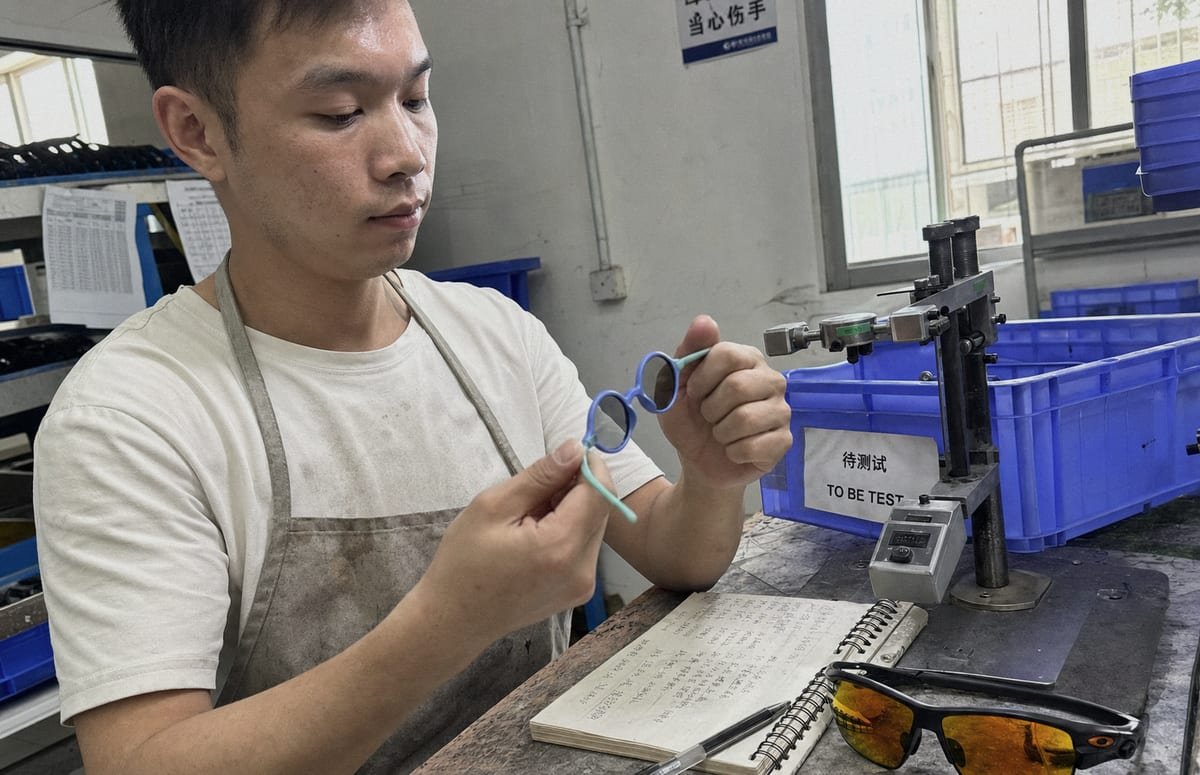
When you order from a factory rather than buy off a shelf, the warranty stops being a printed card and becomes a contract clause. That shift works in your favor. At our facility, warranty discussions happen during sampling, not after a problem appears. Here is how the negotiation usually unfolds.
The Five Levers You Can Negotiate
- Acceptable defect rate. Agree on an AQL standard for inspection. Anything above the threshold triggers factory responsibility.
- Remedy type. Decide whether defective units are replaced in the next shipment, credited against the next invoice, or refunded. Replacement in the next order is the most common and most efficient for both sides.
- Spare parts allowance. Many of our clients request a small percentage of extra units or spare temple arms shipped free with each order. This lets them handle end-customer claims instantly without waiting on international freight.
- Evidence standards. Define what counts as proof. Clear photos and batch numbers usually suffice. Requiring physical return of every broken pair across an ocean helps no one.
- Cost allocation. Specify who covers processing and shipping fees for replacements. Splitting freight on small claims and factory-paid freight on batch-level defects is a fair middle ground.
What a Factory Will and Will Not Accept
A serious factory will stand behind manufacturing defects without hesitation. Our QC process in a 5S-managed workshop 6 exists precisely so we can make that commitment confidently. What no honest factory will accept is open-ended liability for accidental damage coverage at the consumer level. If your brand wants to market a kid-proof one-time replacement promise, that is a smart retail strategy, but it should be priced into your margin, not pushed back onto the unit cost. We often help clients model this: a slightly higher landed cost with spare inventory built in usually beats chasing individual claims across borders.
One lesson from years of exporting to twenty-plus countries: put everything in writing before the deposit. Verbal assurances evaporate. A one-page warranty annex to the purchase order saves both sides from awkward emails later.
What Should I Look for in a Supplier's Warranty Policy Before Placing a Bulk Order?
Early in my career, I watched a promising importer lose a retail contract because their previous supplier's warranty policy was two vague sentences. The retailer's lawyers walked away.
Before a bulk order, verify the supplier's defined defect list, defect rate threshold, claim window, evidence requirements, remedy method, replacement lead time, and cost responsibility for shipping. Confirm the policy is written into the contract and check whether lens coatings and hinges are explicitly covered.
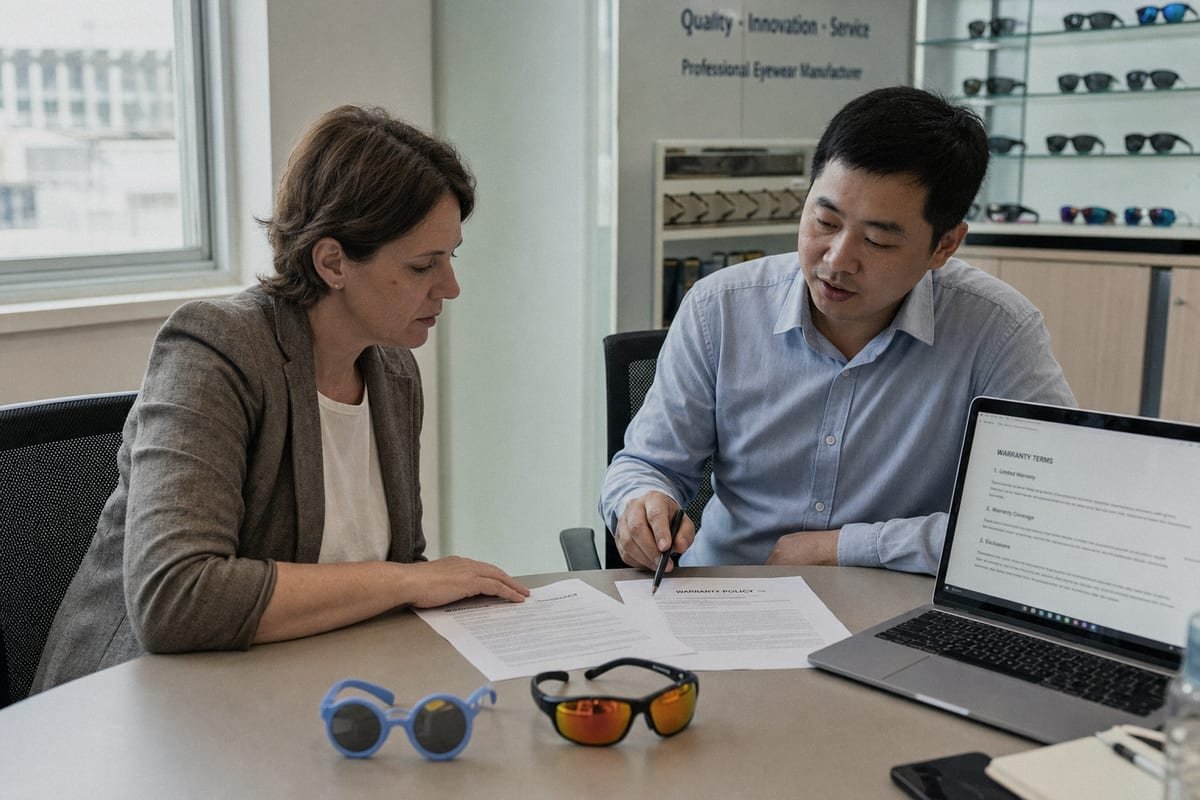
A supplier's warranty policy tells you more about their quality culture than any showroom visit. Vague terms usually signal a trader hoping problems never surface. Precise terms signal a factory that measures its own output. Use the checklist below when you compare quotes.
Bulk Order Warranty Evaluation Checklist
| Checklist Item | What Good Looks Like | Red Flag |
|---|---|---|
| Defect definition | Itemized list: hinges, coatings, frames, lenses | Defects handled case by case |
| Claim window | Stated in months from arrival, e.g., 12 months | No timeframe mentioned |
| Evidence required | Photos plus batch or PO number | Physical return of all units demanded |
| Remedy | Replacement, credit, or refund clearly stated | Discount on next order only |
| Lead time for replacements | Defined days for spare parts or reshipment | We will see |
| Cost responsibility | Processing and shipping fees allocated in writing | Silent on freight costs |
| Coating coverage | Scratch-resistant coating failure explicitly included | Coatings excluded entirely |
| Lens standards | Impact-resistant lenses 7 meeting your market's norms | No safety standard referenced |
Look Beyond the Policy to the Prevention
A warranty is compensation after failure. Prevention is cheaper than compensation, always. So ask how the supplier avoids claims in the first place. Do they perform incoming material checks on TR90 and TPEE pellets? Do they test hinge cycles? Do they verify UV400 performance 8 batch by batch? Do they use impact-resistant lenses suited for active children? At our factory, we would rather catch a problem at the workbench than settle it by wire transfer six months later.
Also check whether the policy distinguishes between frame and lens coverage. Some suppliers quietly cover the frame only and exclude broken lenses. For children's products, that gap matters, because lenses take the most abuse. Finally, ask how the supplier supports your consumer-facing promises. If you plan to offer parents a one-time replacement policy or a growth-fit exchange, a supplier with roughly 800 existing styles and steady repeat production can restock matching frames quickly. A supplier with one mold and irregular runs cannot.
Conclusion
Unclear warranties create disputes, lost retail contracts, and unhappy parents. The fix is knowledge plus documentation: know what defect coverage means, then write precise terms with your supplier.
A standard warranty for kids sunglasses protects against manufacturing defects, not the chaos of childhood. Scratches, chewing, loss, and playground accidents fall under normal wear and tear or need a separate accidental damage plan. Coverage typically runs one to two years, starts with proof of purchase, and varies in whether frames, lenses, or both are included. For B2B buyers, the real opportunity is upstream. Negotiate defect thresholds, replacement mechanics, spare parts, and shipping cost allocation before production starts. Then choose a factory whose materials and QC reduce claims at the source. That is the approach we take with every brand we partner with, and it is the difference between a warranty that sells trust and one that only manages complaints. If you are developing a children's eyewear line and want warranty terms you can confidently print on your packaging, we are glad to talk through the details.
Footnotes
1. Explanation of batch inspection and sampling procedures used to maintain quality standards in mass production. ↩︎
2. Overview of thermoplastic materials and their physical properties, including rigidity and stress-point failure. ↩︎
3. Professional overview of lens enhancement technologies, including scratch-resistant and anti-reflective coatings. ↩︎
<span id="
More Articles You Might Like


Looking for a Reliable Kids Eyewear Partner?
Explore 800+ ready styles and full OEM/ODM support tailored to your brand.
Get in Touch English
  Español de México
  Deutsch
  Français
  日本語
日本語  العربية
  Português do Brasil