How to Request Repair or Replacement for Kids Sunglasses Quality Issues?
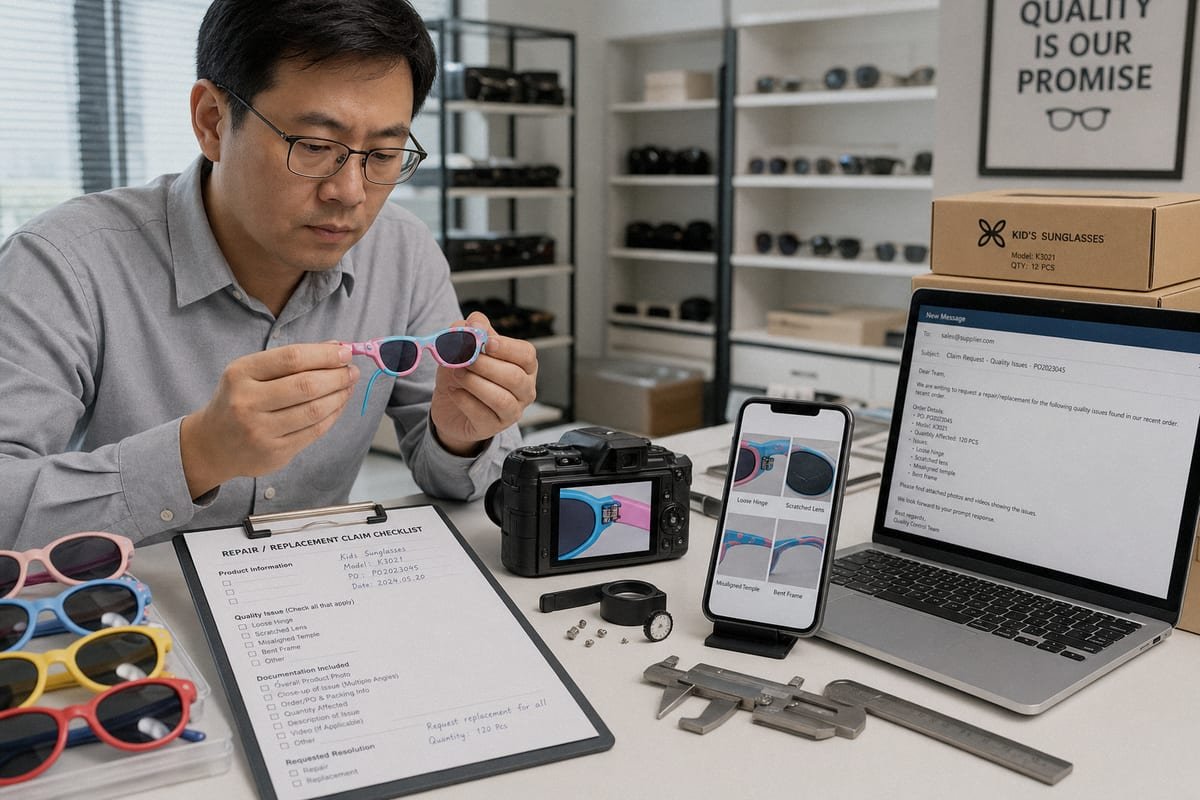
Kids sunglasses quality issues can stall a whole retail season material safety 1. On our Taizhou production line, I have seen how one lens defect turns into angry emails, stalled reorders, and lost shelf space. The good news: a clear, documented claim process solves most of it fast.
To request repair or replacement for kids sunglasses quality issues, document the defect with photos, gather proof of purchase, confirm the manufacturer warranty policy, then submit a written claim naming the defect, the affected quantity, and your requested remedy with a response deadline.
That is the short version. Below, I will walk through what qualifies as a defect, how to file a strong claim, what evidence to prepare, and how to pick a supplier who actually honors it.
What Quality Issues Qualify for a Repair or Replacement Request?
A buyer in Australia once sent me a photo of a warped periwinkle-blue frame and asked, "Is this a defect or did the child sit on it?" Our QC team could tell in seconds — and that distinction decides everything.
Manufacturing defects qualify for repair or replacement: warped frames, loose or failing hinges, peeling lens coatings, incorrect assembly, wrong colors or prints, and lenses that fail UV or impact resistance standards. Accidental damage, scratches from misuse, and normal wear-and-tear typically do not qualify under warranty.
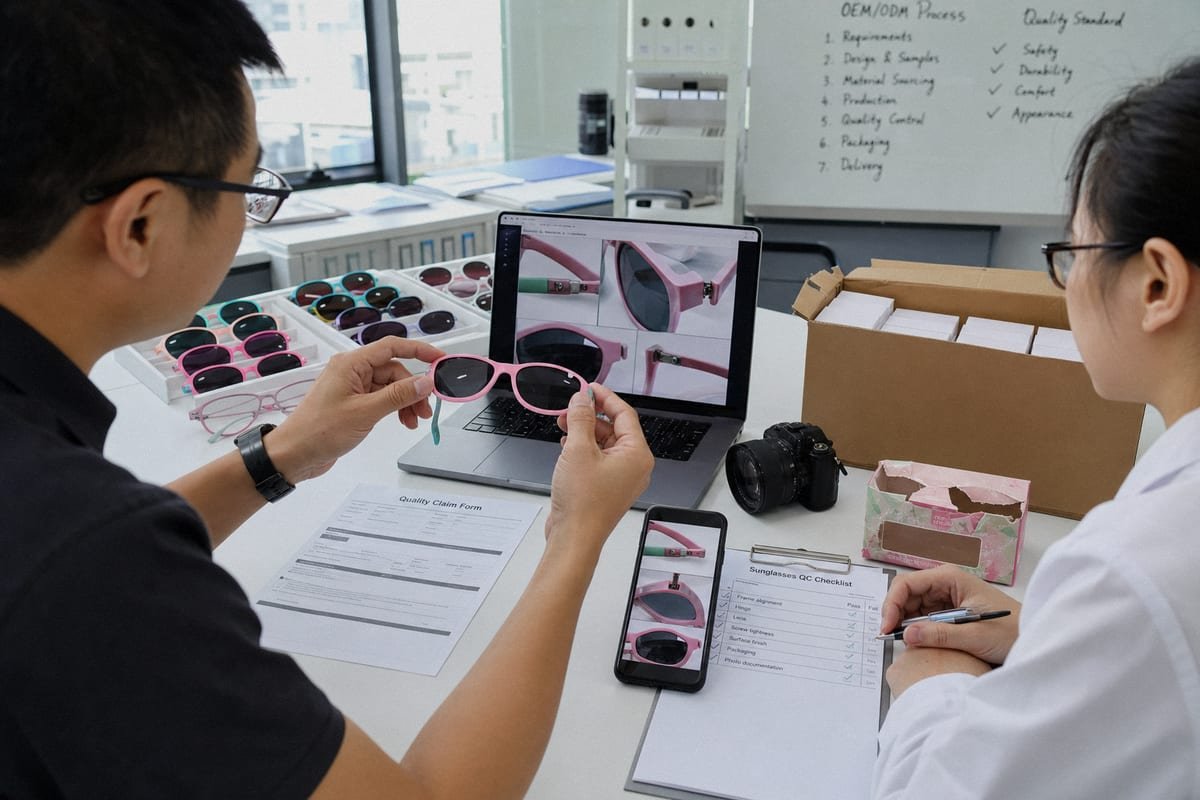
The line between a defect and damage matters because it determines who pays. In our fifteen years making children's eyewear, almost every claim dispute comes down to this one question. So let me break it down clearly.
Defects vs. Damage: The Practical Test
A manufacturing defect exists before the product is used, or appears under normal use. Damage happens because of an external event. A hinge screw that loosens after two gentle weeks of wear points to poor assembly. A snapped temple after a child stepped on it points to misuse — although with genuinely flexible frame durability, like the TPEE temples we mold, even that scenario should rarely end in breakage.
| Issue | Usually a Defect? | Typical Remedy |
|---|---|---|
| Frame warping out of the box | Yes | Replacement |
| Lens coating peeling or bubbling | Yes | Replacement |
| Hinge failure under normal use | Yes | Repair or replacement |
| Wrong Pantone color or logo print | Yes | Replacement or rework |
| Lens fails impact resistance standards 2 | Yes | Full batch replacement |
| Scratched lens from playground use | No | Paid scratched lens replacement |
| Bite marks, sat-on frames | No | Goodwill discount at best |
Why Kids Eyewear Has Stricter Standards
Children's sunglasses are not just small adult sunglasses. UV400 protection 3 claims, lens retention, and material safety carry regulatory weight in the EU, US, Japan, and Australia. If a lens pops out too easily or a coating flakes near a child's eye, that is a safety issue, not a cosmetic one. In our experience exporting to twenty-plus countries, safety-related defects give buyers the strongest position to request replacement rather than repair. Repair suits minor fixable issues like a loose screw. Structural or safety failures deserve replacement, and repeated failures across a batch justify a refund or a full remake.
How Do I Submit a Valid Claim to My Kids Sunglasses Supplier?
Speed and structure win claims. When one of our European distributor clients found a hinge issue on a sport wraparound style, they had photos, order numbers, and a clear ask in my inbox within a day — and replacements shipped within the week.
Submit a valid claim by emailing your supplier's customer support contact with the order number, product model, defect description, photos or video, affected quantity, and your requested remedy. Ask for a Return Merchandise Authorization if goods must ship back, and set a reasonable response deadline.
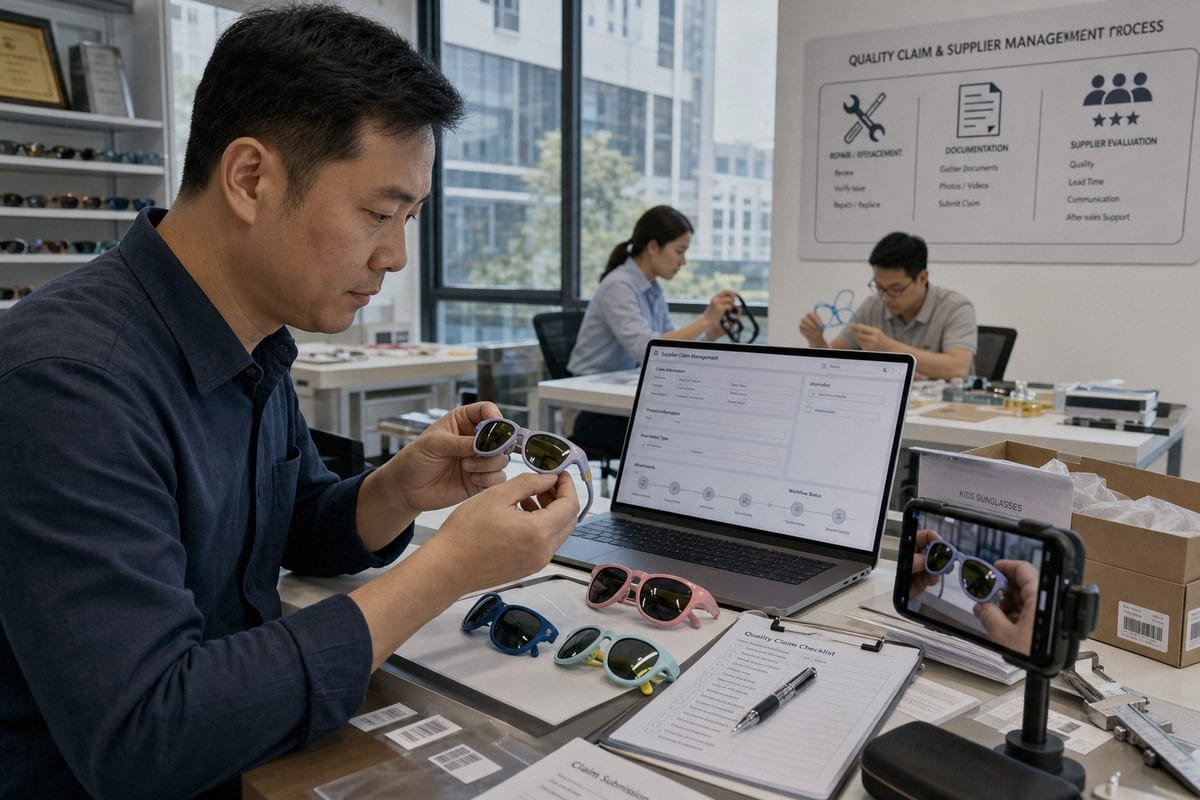
A valid claim is really just a well-organized message. Vague complaints get slow answers. Specific, documented claims get fast ones. Here is the process I recommend to every buyer, whether the issue involves one sample or a full container.
The Six-Step Claim Process
- Locate your proof of purchase. For B2B buyers, that means the purchase order, commercial invoice, or order confirmation. For consumers, a receipt or order ID from an authorized retailer.
- Photograph the defect before anything else changes. Close-up plus full-frame shots.
- Check the warranty terms. Confirm the coverage window and whether the manufacturer warranty policy covers your defect type. Note whether shipping and handling fees fall on you or the supplier.
- Contact the right party first. In-store purchases usually go back to the retailer. Direct factory orders go to your sales contact. Contacting only the brand when the retailer holds responsibility — or vice versa — is the most common mistake I see.
- State your remedy explicitly. Ask for repair, replacement, credit, or refund. Do not leave it open-ended.
- Set a deadline and track everything. Keep screenshots of portal submissions, emails, and any Return Merchandise Authorization 5 numbers issued.
A Template That Works
Keep the message polite and factual. Emotional language slows things down; objective evidence speeds them up.
Subject: Warranty Claim – PO#2024-0311, Model KS-208, Hinge Defect
Hello [Name], we received 3,000 units of Model KS-208 on [date]. During inbound inspection, 47 units show loose hinge assembly (photos attached, invoice attached). We request replacement of the affected units in the next shipment. Please confirm handling by [date + 7 days]. Regards, [Name, company, phone].
That structure — purchase details, defect, evidence, remedy, deadline, contact — covers everything a supplier's QC team needs to approve a claim without back-and-forth.
What Documentation and Photos Should I Prepare Before Filing a Claim?
Our inspection team reviews claim photos from buyers every month, and I can usually predict a claim's outcome from the first attachment. Blurry phone shots invite doubt. Sharp, well-lit images end the debate before it starts.
Prepare your proof of purchase, order number, product model name, a written defect description, and high-resolution photos showing both a close-up of the defect and the whole frame. Add video for functional issues like loose hinges, plus the affected quantity and batch details.
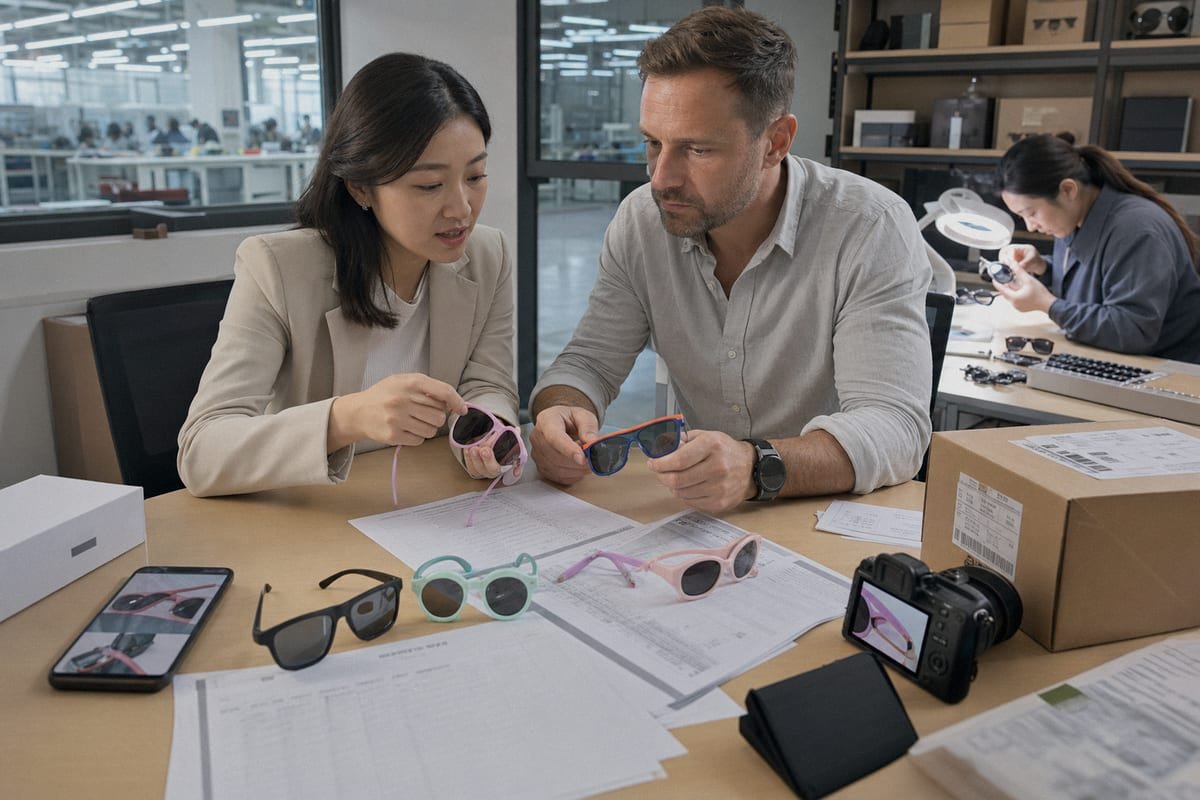
Good documentation does two jobs. It proves the defect exists, and it proves the defect is the supplier's responsibility. Weak evidence on either point gives a reluctant supplier room to argue. So build a small evidence pack before you send anything.
The Evidence Checklist
| Item | Why It Matters | Format |
|---|---|---|
| Proof of purchase / invoice | Confirms you are the original purchaser and the order is within warranty | PDF or scan |
| Order ID and model number | Lets the supplier trace the exact batch and mold | Text in email |
| Close-up defect photo | Shows the flaw itself — peeling coating, crack, misaligned hinge | High-res, well-lit |
| Full-frame photo | Rules out crush damage or misuse elsewhere on the frame | Multiple angles |
| Short video | Proves functional issues like wobbling temples or lens pop-out | 10–30 seconds |
| Quantity and lot data | Distinguishes an isolated flaw from a batch-wide problem | Simple count |
Photography Tips From Our QC Room
Shoot in daylight or under white light, against a plain background. For mirrored or gradient lenses — like the orange-to-gold shield lenses on sport styles — angle the light so the coating defect is visible, not the reflection. Photograph the hinge screw straight-on for assembly issues. If a lens has a coating flaw, include one photo through the lens so the supplier can assess optical impact. For pastel frames, a neutral grey background shows color deviation from the approved sample far better than a white one.
One more thing: keep a retained approved sample from every order. When a buyer can place a defective unit next to the golden sample in one photo, the claim is essentially self-approving.
How Can I Choose a Supplier Who Handles Quality Issues Reliably?
Here is a trade-off I weigh openly with new buyers: a slightly cheaper factory with no written claim process almost always costs more than our quote by the end of year one. Claim handling is where cheap suppliers get expensive.
Choose a supplier with a written manufacturer warranty policy, documented QC procedures, photo-based claim acceptance, defined response times, and a track record of resolving defects with replacements or credits. Ask for their defect-rate tolerance and claim process in writing before placing the first order.
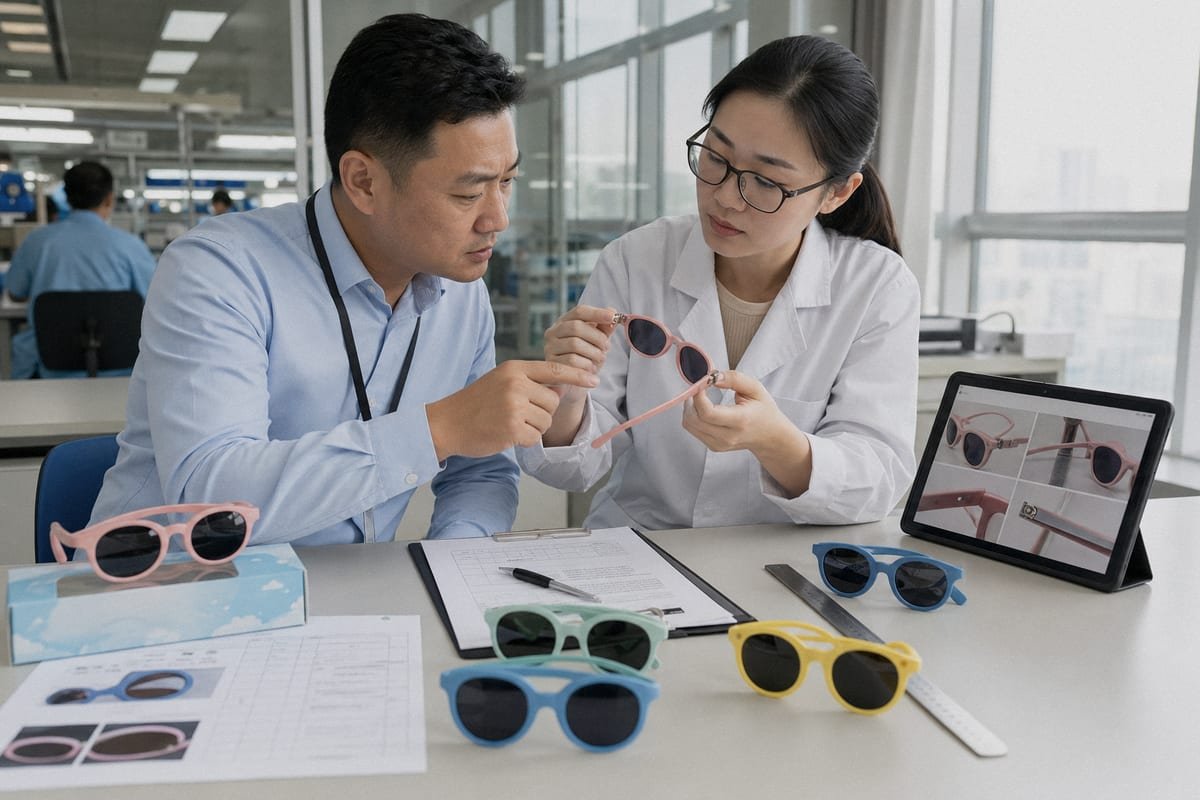
You cannot fully judge a supplier's after-sales behavior from a catalog. But you can test for it before you commit money. After fifteen years running a 5S-managed workshop 6 with around 120 workers, I know exactly which questions expose a factory's real attitude toward quality issues.
Questions to Ask Before You Order
- What is your accepted defect rate (AQL), and what happens above it?
- Do you accept photo-based claims, or must goods ship back for a Return Merchandise Authorization?
- Who pays shipping and handling fees on confirmed defects?
- What is your written response time for a claim? (We assess claims within days, not weeks; anything over ten business days is a warning sign.)
- Do you retain approved production samples for every order?
- Are your kids' lenses tested against UV400 and impact resistance standards?
Red Flags vs. Green Flags
| Red Flag | Green Flag |
|---|---|
| No written warranty terms | Clear manufacturer warranty policy in the contract |
| "Send everything back first" | Photo/video claims accepted for triage |
| Blames misuse by default | Investigates with retained samples and batch records |
| Trader with no factory access | Direct factory with in-house QC and 5S workshop |
| Vague answers on materials | Documented TPEE/TR90 sourcing 7 and flexible frame durability testing |
A supplier who offers something close to a limited lifetime guarantee on workmanship, or at least a firm replacement commitment on manufacturing defects, signals confidence in their own process. So does a large existing style library — when a factory has hundreds of proven molds in production, their defect patterns are known and controlled, rather than discovered on your order. Reliability in claims is really just reliability in production, made visible.
Conclusion
Quality issues cost brands trust fast. Document the defect, keep your proof of purchase, submit a specific claim with a clear remedy, and partner with suppliers who honor it.
Footnotes
1. CPSC regulates material safety standards for children’s products including eyewear. ↩︎
2. ISO sets internationally recognized impact resistance standards referenced for eyewear testing. ↩︎
3. Direct Wikipedia section explaining UV protection standards for sunglasses. ↩︎
4. Official FTC guide to the Magnuson-Moss Warranty Act and consumer product warranties. ↩︎
5. Defines the RMA process buyers reference when returning defective goods to suppliers. ↩︎
6. Background on the 5S methodology used to organize manufacturing quality control workshops. ↩︎
7. Authoritative Wikipedia overview of thermoplastic elastomers used in flexible eyewear frames. ↩︎
More Articles You Might Like

Looking for a Reliable Kids Eyewear Partner?
Explore 800+ ready styles and full OEM/ODM support tailored to your brand.
Get in Touch English
  Español de México
  Deutsch
  Français
  日本語
日本語  العربية
  Português do Brasil