What to Know About TR90 Kids Glasses for Infants & Toddlers, and How to Prevent Removal?

Buyers ask our Taizhou line the same thing every season: parents love TR90 kids glasses for infants and toddlers, yet frames keep hitting the floor BPA-free children’s glasses 1. Fit and retention fix that.
TR90 kids glasses for infants and toddlers use a lightweight, flexible nylon that bends without snapping, resists impact, and rarely irritates skin. To prevent removal, pair the frame with an age-appropriate strap or stay-put ear hooks, verify bridge and temple fit, and build a calm daily routine.
That answer sounds simple. The details are not. Below, I walk through material safety, the features that actually hold a frame on a moving baby, the behavior side of removal, and the questions I wish every buyer asked us before placing an order.
How do I know if TR90 material is truly safe for my infant's delicate skin and face?
Softness versus structure is the trade-off we weigh on every infant frame soft headband strap 2. Too soft, and lenses pop out. Too stiff, and a grabbing hand can hurt a cheek.
TR90 is a hypoallergenic, medical-grade nylon that contains no metal, stays temperature-stable, and has smooth edges, so it rarely irritates infant skin. Confirm safety by asking for material documentation, checking for BPA-free status, and inspecting the frame for sharp corners or small detachable parts.
What makes TR90 different from ordinary plastic
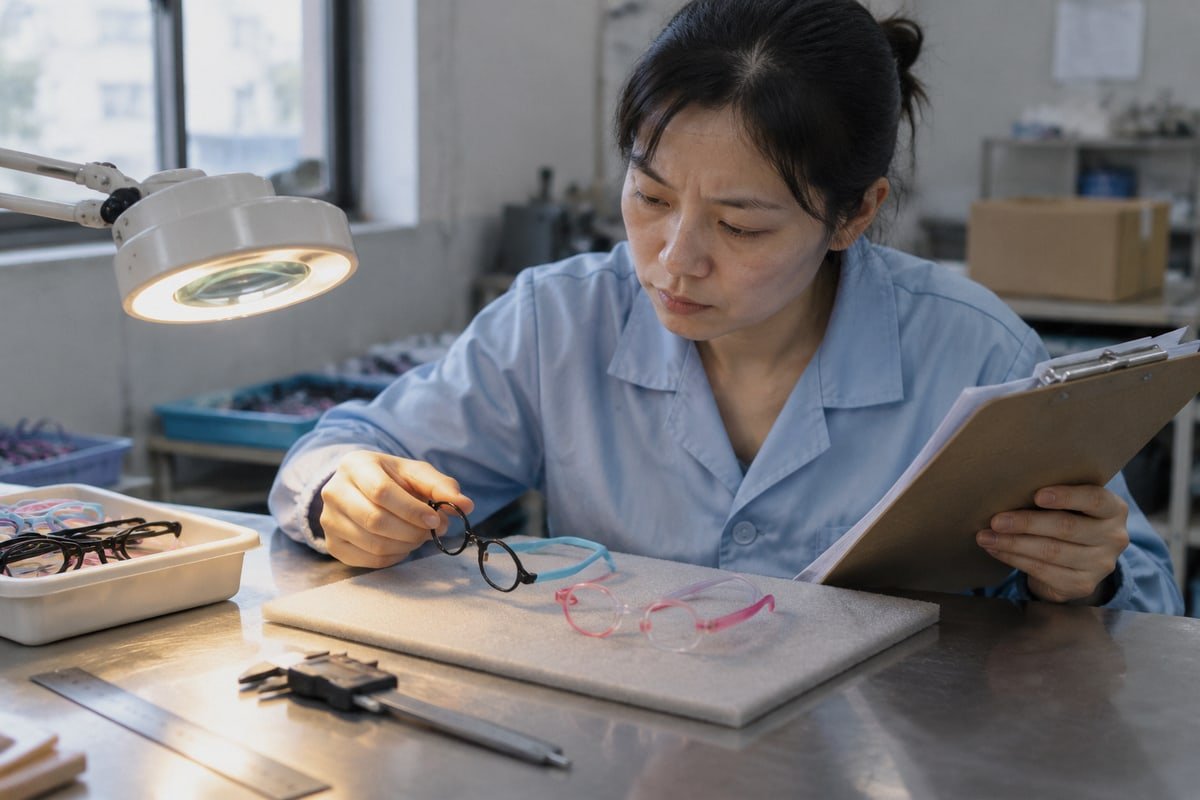
TR90 is often called a lightweight memory plastic. It is a nylon-type thermoplastic. You can twist it, bend the temples backward, and it springs back to its original shape. That behavior matters for babies because glasses get grabbed, dropped, and sat on many times a day. A brittle frame cracks. A cracked edge can cut skin. TR90 does not crack the same way, so the frame stays smooth through rough handling.
It is also a hypoallergenic frame material. There is no nickel and no metal contact on the face, which removes one common cause of rashes under the bridge 3 and behind the ears. TR90 keeps a stable surface temperature when a child moves from a heated room to a cold stroller. Parents rarely think about that. Toddlers do. A frame that feels icy or sweaty is a frame that gets pulled off.
How to verify safety before you order
I tell buyers to look at three things. First, ask for the raw material documentation 4 and confirm BPA-free children's glasses status in writing. Second, check the frame for small removable parts. For the 0–3 age group, nose pads that unscrew or temple tips that slide off are a choking risk. Third, run a thumb along every edge. Our workshop does this on sample sign-off, and I recommend buyers do it again when samples arrive.
| Frame material | Flexibility | Weight | Skin contact | Best age use |
|---|---|---|---|---|
| TR90 (nylon memory plastic) | High, springs back | Very light | Hypoallergenic, no metal | 12 months and up, all toddlers |
| TPEE / soft silicone | Very high, rubber-like | Light | Soft, gentle on cheeks | 0–18 months, strap-based frames |
| Acetate | Low, can snap | Medium to heavy | Fine, but hard edges | Older children only |
| Metal | Low, bends and stays bent | Medium | Nickel risk | Not recommended for this age |
Where TR90 alone is not enough
One objection I hear: very flexible frames let lenses pop out. That is true when the rim is thin and the groove is shallow. It is a design fault, not a material fault. We solve it with a proper lens groove depth and, on our youngest styles, TR90 fronts paired with softer TPEE temples. The front holds the lens. The temples take the abuse. Our materials are also environmentally friendly, which matters to many European and Japanese buyers we serve. But the honest point is this: material safety gets you to the starting line. Fit gets the glasses to stay on.
What features should I look for in toddler glasses that actually stay on during active play?
Our QC team once held a full toddler batch because the temple ends flared a few millimeters too wide. On a two-year-old, that gap decides whether frames stay on.
Toddler glasses that stay on during active play combine a lightweight TR90 or TPEE frame, a low saddle bridge, short temples, and a retention system: an adjustable elastic strap under about 18 months, or curved stay-put ear hooks and spring hinges for older toddlers. Correct sizing matters most.

The fastest way to compare features is by age, because a six-month-old and a three-year-old have different faces and different tolerance for pressure. I use this table with buyers during pediatric eyewear fitting discussions.
| Feature | 0–18 months | 18–36 months | Why it matters |
|---|---|---|---|
| Frame material | TPEE or silicone, or TR90 front with TPEE temples | TR90 flexible thermoplastic frames 5 | Softness for infants, structure for toddlers |
| Retention | Adjustable silicone straps or headband for baby glasses | Stay-put ear hooks, cable temples, or optional strap | Ears and bridge are not developed enough for hooks under 18 months |
| Bridge | Integrated saddle bridge | Saddle bridge or low keyhole bridge | Flat infant noses need weight spread across a wide area |
| Bridge width | Under 16 mm for most sizes | Under 16 mm for many sizes | Wider bridges slide down instantly |
| Temple length | Very short, or none with strap | Under 125 mm for many toddler sizes | Long temples push ears and lift the front |
| Hinges | Flexible or none | Spring hinges | Spring hinges reduce pressure at the temples |
| Lenses | Polycarbonate or Trivex | Polycarbonate or Trivex | Impact-resistant lenses protect eyes when the frame hits the floor |
Why the bridge is the first thing to check
Bridge fit for toddlers decides everything else. Infants have flat, undeveloped nasal bridges. Nose pads sit on two tiny points and slide. A saddle bridge spreads the weight across a larger surface. When the front stops sliding, the "slide-and-swipe" reflex stops too. A child who feels glasses moving down the nose will swipe them off. That is not a behavior problem. It is a fit problem.
Strap first or temples first?
Some parents dislike straps. They worry about heat, the look, or the extra step of adjusting the band. I understand that. But for children under about 18 months, the strap is the most reliable retention method, because nothing else has anatomy to grip. My suggestion to brands is simple: offer a strap-based style for infants and a temple-based style with stay-put ear hooks for older toddlers. That way parents choose, and the brand covers both stages. On our two-tone round frames, for example, the matte TR90 front stays rigid enough to hold prescription lenses, while the soft colored temples curve gently around the ear.
The mini-adult frame mistake
Fashion mini-frames look great in a catalog. They fail on babies. The bridge is too high, the temples too long, and the rims too heavy. Choose styles engineered for infant anatomy, not scaled-down adult designs. A frame that is unbreakable is still useless if it will not stay on the face.
How can I prevent my baby from constantly pulling off their glasses?
A baby-brand buyer from Australia told me her customers returned frames as defective because babies pulled them off. The frames were fine. The routine and the strap were missing.
Prevent a baby from pulling off glasses by first confirming the fit, then adding a soft headband strap or stay-put ear hooks, and building a low-drama routine: put glasses on at the same daily moments, pair them with visual activities, and calmly replace them each time. Expect weeks to months.

Removal is mostly reflexive. The sensation is new, so small hands push it away. It rarely means the prescription is wrong. Here is the order I recommend to the brands we work with, because each step removes one reason for removal before moving to the next.
A five-step approach that works
- Fix the fit first. Check for sliding, red marks on the nose or behind the ears, and tilting. If any appear, adjust before doing anything else. Discomfort drives removal more than most parents expect.
- Add the right retention. Under 18 months, use adjustable silicone straps. Over 18 months, try stay-put ear hooks or cable temples, and keep a strap as backup for car seats and playgrounds.
- Stack the habit. Put glasses on right after waking, or right before a favorite meal. The child learns that glasses come with a predictable, positive event.
- Link glasses to clarity. Introduce them during high-detail activities such as bubble blowing or high-contrast picture books. The child sees more with the glasses on, and the brain connects the two.
- Replace calmly, every time. No scolding, no big reaction. Put them back, smile, move on. Repetition wins over weeks to months.
What each type of removal is telling you
| What you see | Likely cause | What to change |
|---|---|---|
| Pulled off within seconds, every time | New sensation, or bridge sliding | Confirm saddle bridge fit, add strap, keep routine short at first |
| Pulled off after 10–20 minutes | Pressure behind ears or on temples | Shorten temples, use spring hinges, soften temple tips |
| Pushed up or tilted before removal | Frame too heavy or bridge too wide | Move to lighter TR90 frame, bridge under 16 mm |
| Removed only outdoors or in the car | Heat, cold, or strap discomfort | Temperature-stable frame, breathable strap material |
The comfort-versus-hold trap
Tighter is not better. A strap cranked down keeps glasses on for an hour, then the child removes them because the bridge hurts. We aim for what I call a soft-hug fit. On TR90 frames, an optician can micro-adjust the temple tips with a controlled warm-water bath so they curve gently inward. That curve is harder for small fingers to hook and pull, without adding pressure. Then recheck the fit every few weeks. Heads grow fast, and a frame that fit in spring can slide by summer.
What should I ask my manufacturer about fit and flexibility for infant eyewear?
Fifteen years of making flexible thermoplastic frames taught us one lesson: buyers who ask hard fit questions before ordering get fewer returns after launch. Silence about sizing costs money later.
Ask your manufacturer for exact bridge and temple measurements by age, the frame's flex and rebound behavior, hinge type, nose-bridge design, strap compatibility, lens material options, material safety documentation, and whether you can sample from existing molds before committing to custom tooling. Request retail-ready packaging and QC records too.
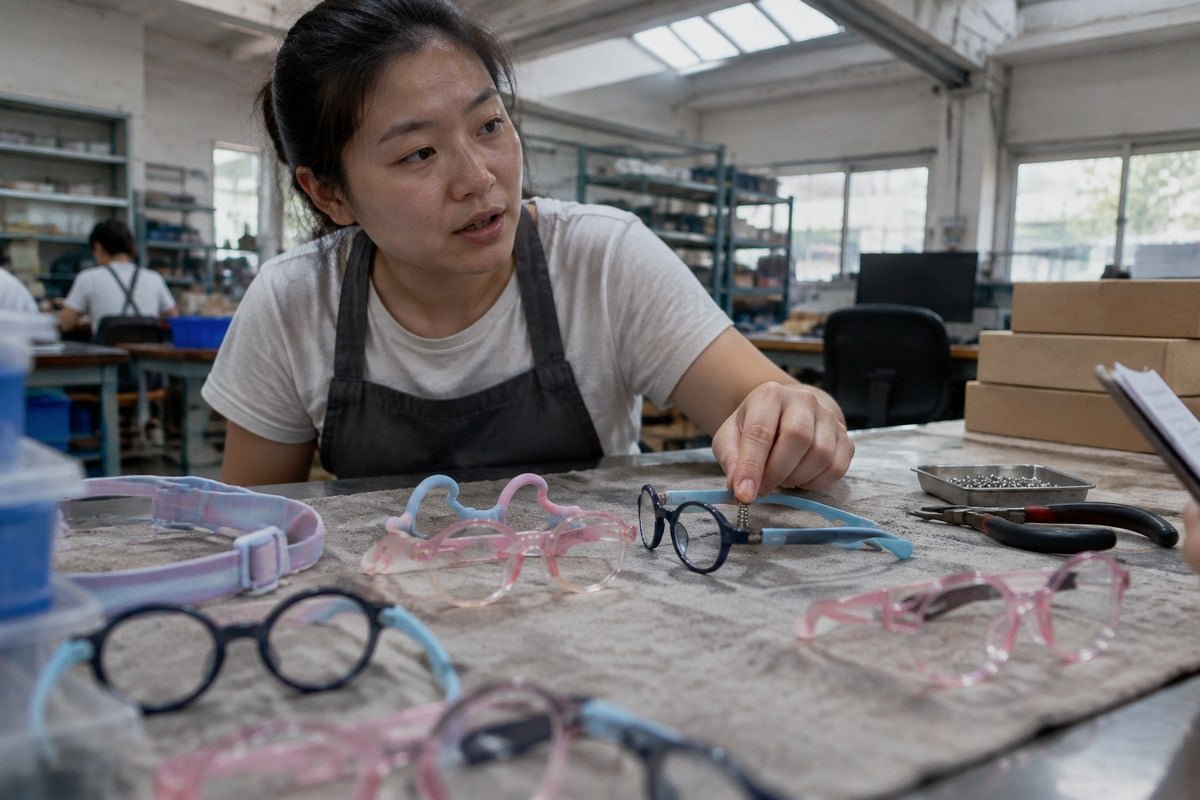
I have sat across the table from procurement managers who asked only about price and lead time. The samples looked fine. The frames reached shelves. Then the reviews came in: "slides off my baby's nose." Every one of those problems could have been caught with a better question list. Here is the list I now send buyers before we quote.
The questions and the answers you want to hear
| Question to ask | Why it matters | A good answer looks like |
|---|---|---|
| What are the bridge width and temple length for each size? | Bridge under 16 mm and temples under 125 mm suit many toddler sizes | Exact millimeters per SKU, not "small/medium" |
| How far does the frame bend, and does it return fully? | Confirms genuine TR90 or TPEE, not a cheap blend | A demonstration video or a physical sample you can twist |
| Is the bridge a saddle design or nose pads? | Infant noses are flat; pads slide | Saddle bridge for 0–18 months, low keyhole for older toddlers |
| Can this frame accept a strap, and is the strap age-rated? | Long cords are a strangulation risk | Short, adjustable, breakaway-style strap designed for infants |
| Are there any detachable parts? | Choking risk under age 3 | None, or parts that cannot be removed without tools |
| Which lens materials can you fit? | Flexible frames do not protect fragile lenses | Polycarbonate or Trivex impact-resistant lenses, UV400 or polarized for sun styles |
| Can I test existing styles first? | Custom molds are a big early spend | A catalog of ready molds to sample from |
| What does QC cover on each batch? | Consistency across reorders | Dimensional checks, flex tests, edge inspection, packaging checks |
Why existing molds reduce risk
Many new baby brands assume they need custom tooling from day one. I usually advise against it. With around 800 existing styles at our factory, a brand can select two or three infant and toddler frames, apply its own colors and logo, and test real market response before investing in a mold. The frame geometry is already proven on children's faces. What changes is the branding, the lens spec, the strap, and the packaging. Once sales data shows which bridge width and temple length sell in your market, custom development becomes a smart second step instead of a gamble.
Flexibility questions that reveal expertise
A supplier who works only in acetate cannot answer how TR90 behaves after a warm-water adjustment, or how a TPEE temple ages under sunlight. Ask those questions directly. Ask how the hinge is anchored inside the flexible front. Ask whether prescription infant goggles 6 or a strap-based sport style is available for children who cannot tolerate temples at all. The depth of the answer tells you whether you are talking to a factory that engineers children's eyewear or a trader that relabels it. Our 5S-managed workshop in Taizhou runs these checks as standard, and we welcome buyers from any of the 20-plus countries we serve to see the process.
Conclusion
Infant glasses fail on fit, not material. TR90 gives flexibility and light weight; the right strap, bridge, and routine keep them on. Contact us to sample from 800 existing styles.
Interested in sourcing the products mentioned in this article? See details and request a quote here:
Footnotes
1. FDA oversight on BPA in consumer products. ↩︎
2. Clinical advice on children’s eyewear retention. ↩︎
3. Research on skin irritation from eyewear materials. ↩︎
4. ISO standards for material quality and documentation. ↩︎
5. Technical definition of thermoplastic materials used in eyewear. ↩︎
6. Information on protective and specialized pediatric eyewear. ↩︎
More Articles You Might Like



Looking for a Reliable Kids Eyewear Partner?
Explore 800+ ready styles and full OEM/ODM support tailored to your brand.
Get in Touch English
 Español de México
 Deutsch
 Français
 日本語
 العربية
 Português do Brasil