What Are the Best TR90 Frame Shapes for Kids: Full-Rim, Half-Rim, or One-Piece?

Buyers visiting our Taizhou factory often ask which TR90 frame shapes for kids to stock impact resistance 1. Many pick by looks alone. Then lenses pop out on playgrounds, and returns follow.
Full-rim TR90 is the best frame shape for most kids aged 3–12 because it fully encloses the lens and handles stronger prescriptions. Half-rim suits careful older tweens who want a lighter look. One-piece hingeless TR90 fits toddlers and sports use where fewer parts mean fewer failures.
That is the short answer. The longer answer depends on the child’s age, activity level, and prescription. I will walk through each structure below, explain where it wins and where it fails, and show how to test shapes before you commit to a full collection.
How do I choose between full-rim, half-rim, and one-piece TR90 frames for my kids' collection?
A procurement manager from Australia once sent me a mood board of twelve frames. Eleven were half-rim. Her target age was four to seven. We talked for an hour.
Choose by age and use first, then style. Full-rim TR90 should anchor any kids' collection for ages 3–12. Add half-rim only for tweens with good habits, and one-piece for toddler or sports lines. Match eye size to age: low-to-mid 40 mm for younger children, high 40s for older kids.
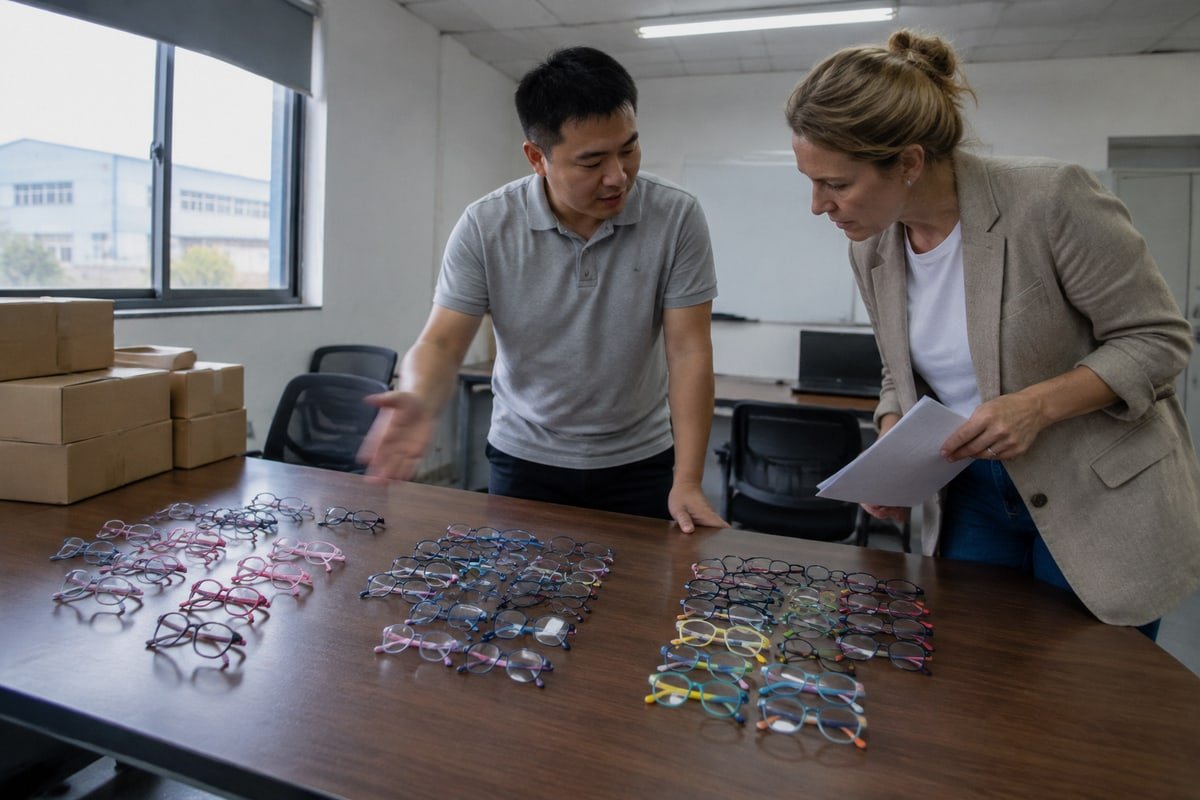
That Australian buyer ended up with nine full-rim styles, two half-rim styles for her oldest age band, and one one-piece sunglass for the beach range. Her mix reflects what we see across most of the 20+ countries we ship to. The kids' market rewards protection first and fashion second.
Structure is not the same as face shape
Many new brands mix up two different decisions. Full-rim, half-rim, and one-piece are structural categories. They describe how the frame holds the lens. Round, oval, rectangle, and rounded-square are face-shape styles. They describe how the frame looks on the child. You can have a round full-rim frame and a round half-rim frame. So ask two questions in order. First, what structure keeps the lens safe for this age? Second, what lens shape suits this child's face? Two of our most requested full-rim styles show this well: a matte black round front with sky-blue TPEE temples, and a translucent pink gradient rounded-square. Both are full-rim. Both are TR90 memory resin fronts. Only the face shape differs.
| Structure | Lens protection | Typical age fit | Prescription lens compatibility | Best use in a collection |
|---|---|---|---|---|
| Full-rim TR90 | Highest; lens enclosed on all sides | 3–12 | Excellent, including thicker high-index lenses | Core everyday optical line |
| Half-rim TR90 | Moderate; lower edge held by nylon cord | 9–12+ | Good for low to medium powers | Style option for older kids |
| One-piece TR90 | High; molded, hingeless design | 1–6, plus sports | Limited; mainly plano or sun lenses | Toddler and active or sun line |
A simple decision path
Here is the path I give buyers. Start with the youngest age you serve. If it is under six, put one-piece or full-rim first. If your line is school-age, make full-rim the default and choose face shapes across round, oval, and rounded rectangular. Then look at the top of your age range. If you sell to tweens, a half-rim style or two can lift the "grown-up" appeal. Finally, check the material spec. TR90 is a thermoplastic material 2, but grade and wall thickness vary. Ask for the frame weight. Good pediatric eyewear in TR90 often lands in the low-teens grams range, and a heavier sample is a warning sign.
Which TR90 frame shape offers the best comfort and safety for active children?
On our QC line we twist every TR90 temple hard before packing. The frames spring back. That flex test tells us more about comfort than any catalog photo.
One-piece hingeless TR90 offers the best safety for toddlers because it removes screws and small parts. For active school-age children, full-rim TR90 with spring hinges, silicone nose pads, and anti-slip temple tips offers the best balance of comfort, impact resistance, and lens retention. Half-rim ranks last for rough play.

Comfort and safety are linked in children's eyewear. A frame that hurts gets pulled off. A frame that gets pulled off gets dropped, sat on, or lost. So I judge comfort by how long a child forgets the glasses are on.
Why TR90 behaves like a shock absorber
TR90's molecular structure 3 spreads impact energy across the whole frame. It does not send a hard jolt straight into the nose bridge or the temples. When a ball hits a child's face, that matters. The material also keeps its flexibility in freezing weather. Standard acetate 4 can turn brittle and snap in the cold. TR90 does not, which is why we recommend it for winter sports and outdoor lines in northern Europe and Japan. It is also naturally hypoallergenic and BPA-free. Brands that have had rash complaints from metal or cheap plastic frames usually move to hypoallergenic frames in TR90 or TPEE and the complaints stop.
The comfort details that matter more than shape
| Feature | What it does | Which structure needs it most |
|---|---|---|
| Soft silicone nose pads | Spread weight, stop slipping on small noses | Full-rim and half-rim optical frames |
| Spring hinges | Let temples open wide without breaking | Full-rim and half-rim |
| Flexible temples in TPEE | Bend around the head and behind the ear without pinching | Full-rim; our TR90 front with TPEE temples design |
| Anti-slip temple tips | Grip behind the ear during running and jumping | All three structures |
| Adjustable silicone straps | Hold the frame on during sports or on toddlers | One-piece and full-rim sun frames |
Matching structure to the activity
For toddlers, I favor a one-piece hingeless design. There are no screws to loosen and swallow, and no hinge to pinch a finger. For a six-to-ten-year-old who plays football after school, a full-rim frame with a secure bridge fit and grippy temple tips is the best all-round choice. Bridge fit deserves extra attention here. Children have low, flat nose bridges, so a frame that fits an adult face will slide down and sit on the cheeks. We build our kids' fronts with a lower, wider bridge and offer a keyhole bridge on several round styles for this reason. For half-rim, comfort can be very good because the frame is light, but the open lower edge is less forgiving when a child grabs the glasses by the lens. I do not recommend half-rim for frequent sports use.
What are the durability differences between full-rim and half-rim TR90 kids' frames?
Whenever a brand's design team asks our factory for a nylon-cord half-rim for six-year-olds, I weigh two things: how the lens edge is held, and who pays when it isn't.
Full-rim TR90 kids' frames are more durable because the rim encloses the lens on all sides, supports thicker prescriptions, and hides edge chips. Half-rim frames hold the lower lens edge with a nylon cord that can loosen or snap. Both flex like memory resin; only full-rim protects the lens.
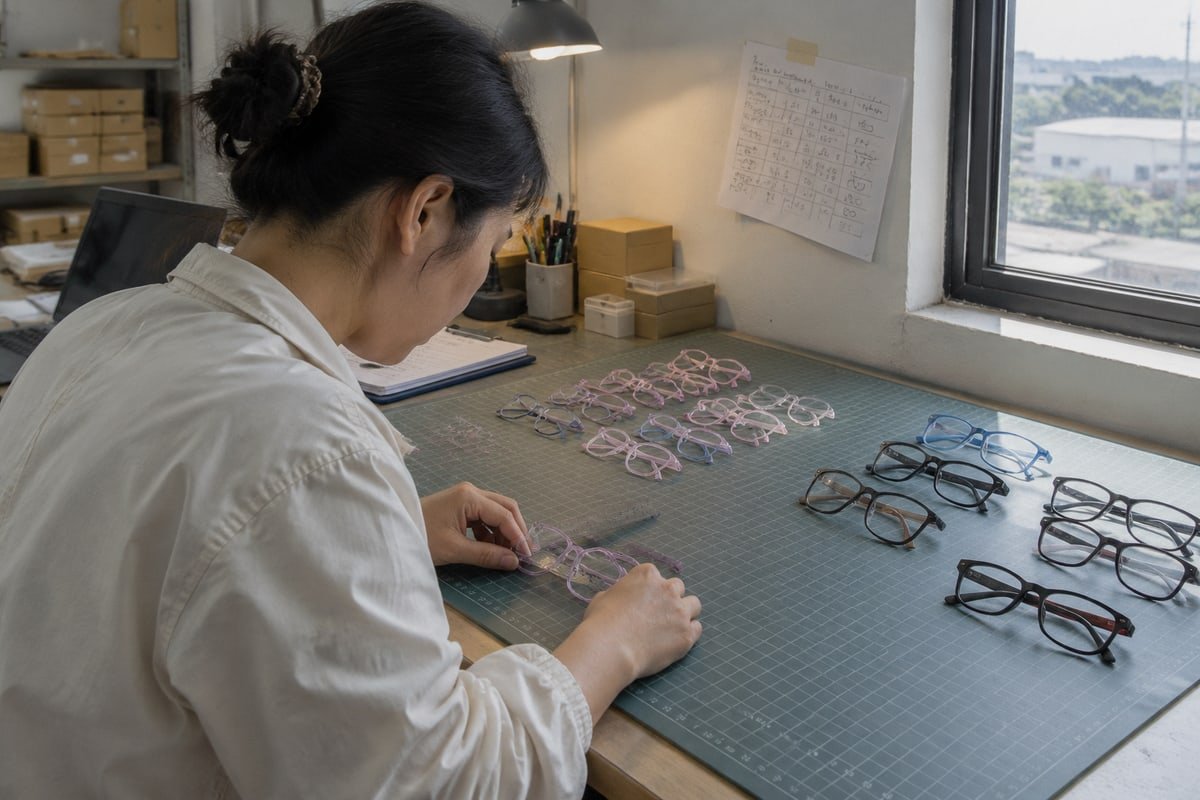
Both structures use the same base material. The difference is in what the material is asked to do. In a full-rim frame the TR90 does the flexing and the protecting. In a half-rim frame the TR90 flexes, but a thin cord and a groove in the lens do the holding.
Where each structure fails first
| Stress event | Full-rim TR90 response | Half-rim TR90 response |
|---|---|---|
| Child sits on the frame | Front and temples flex and return; lens stays seated | Frame returns, but cord tension can shift and loosen the lens |
| Frontal impact from a ball | Internal bevel lets the lens pop forward, away from the eye | Lens can dislodge downward or crack at the cord groove |
| Grabbed by one temple | Spring hinge and memory flex absorb the twist | Same flex, but the twist loads the cord |
| Small edge chip on the lens | Hidden inside the rim | Visible along the exposed lower edge |
| Thick high-index lens | Rim hides thickness and supports weight | Edge thickness is visible; cord groove weakens the lens |
| Body heat and sweat | TR90 resists frame stretch; PD alignment holds | Same material benefit, but cord can stretch over time |
The internal bevel is a safety feature, not a cosmetic one
One point often gets missed. In a well-made full-rim TR90 frame, the lens groove has an internal bevel. Under a strong frontal hit, this bevel lets the lens pop out forward. The lens moves away from the child's eye, not toward it. Our QC team checks groove depth on every full-rim production run because a groove that is too shallow lets lenses fall out in daily use, and a groove that is too deep can trap the lens against the eye in an impact. Half-rim frames cannot offer this behavior, because the lower edge is held only by the cord.
Frame stretch and prescription accuracy
Durability is not only about breaking. It is also about staying in shape. A frame that slowly stretches from body heat and sweat moves the optical center of each lens away from the child's pupil. TR90 resists this stretch far better than many low-cost plastics, so pupillary distance 5 alignment holds even after a hot school day. This is a real prescription lens compatibility benefit, and it applies to both full-rim and half-rim. The gap between them appears only when you add the cord, which is a second component that can relax.
Can I order small MOQs to test different TR90 frame shapes before committing to a full collection?
Fifteen years of eyewear taught us one thing: a brand that samples three shapes before launch beats a brand that tools one mold on a hunch.
Yes. Manufacturers with a large library of existing styles — OKAY EYEWEAR holds roughly 800 TR90 and TPEE designs — let buyers order small quantities across full-rim, half-rim, and one-piece shapes without new molds. Brands test sell-through by age band, then scale winners with custom colors, logos, and packaging.

New brands worry about two costs: mold investment and dead stock. An existing-style library removes the first. A staged test order shrinks the second. Here is the process I recommend to founders and product managers who want to test TR90 frame shapes for kids with low risk.
A five-step test program
- Pick shapes by age band, not by taste. Select two or three full-rim styles for ages 3–12, one half-rim for 9–12, and one one-piece for toddlers or sun. Use our library so no tooling is needed.
- Order small mixed quantities. Spread the order across the shapes and two or three colorways each. Translucent candy colors and two-tone fronts, like a matte black front with sky-blue temples, tend to photograph well for e-commerce.
- Request safety documentation with the samples. Ask for compliance evidence against the child product safety standards of your target market. This is a trust signal your retail buyers will ask for too.
- Measure sell-through and returns for one season. Track which structure and which face shape moves, and which comes back. Note reasons: fit, lens loss, breakage, or style.
- Scale the winners with OEM/ODM changes. Move to custom colors, logo on the temple, branded lens options such as UV400 or polarized, and retail-ready packaging. Only then consider a custom mold.
Why a real factory matters at the test stage
Trading companies can also sell small lots. The difference shows when something needs adjusting. When a Japanese buyer found the bridge fit too high on a round style for four-year-olds, our engineers reworked the nose pad position on the existing mold within the same development cycle. That is possible because the workshop, the molds, and the ~120 workers are under one roof with 5S management. It is also why small test orders and later bulk orders come out matching in color, flex, and finish.
What to expect at each stage
| Stage | Typical scope | Customization available |
|---|---|---|
| Sample round | A handful of frames per style | Stock colors, stock lenses |
| Small test order | Mixed shapes and colors in small quantities | Logo printing, lens choice, simple packaging |
| Scaled reorder | Winning styles in volume | Custom colors, custom packaging, accessories like straps and cases |
| Custom development | Brand-exclusive style | New mold, new shape, full ODM |
Conclusion
Frame structure decides whether kids' glasses survive the school year. Start with full-rim TR90, add half-rim and one-piece where they fit, and sample small before you scale.
Interested in sourcing the products mentioned in this article? See details and request a quote here:
Footnotes
1. Reference to international standards for mechanical requirements and testing of spectacle frames. ↩︎
2. Defines the material class of TR90, explaining its flexible and recyclable nature. ↩︎
3. Authoritative Wikipedia entry explaining molecular structure to replace the broken Nature link. ↩︎
4. Technical data on the properties and limitations of cellulose acetate in manufacturing. ↩︎
5. Explains the clinical importance of maintaining correct lens alignment for vision. ↩︎
More Articles You Might Like



Looking for a Reliable Kids Eyewear Partner?
Explore 800+ ready styles and full OEM/ODM support tailored to your brand.
Get in Touch English
 Español de México
 Deutsch
 Français
 日本語
 العربية
 Português do Brasil