TR90 & TPEE Kids Sunglasses: Detachable Strap or Regular Temple—Which Fits Your Use Case?
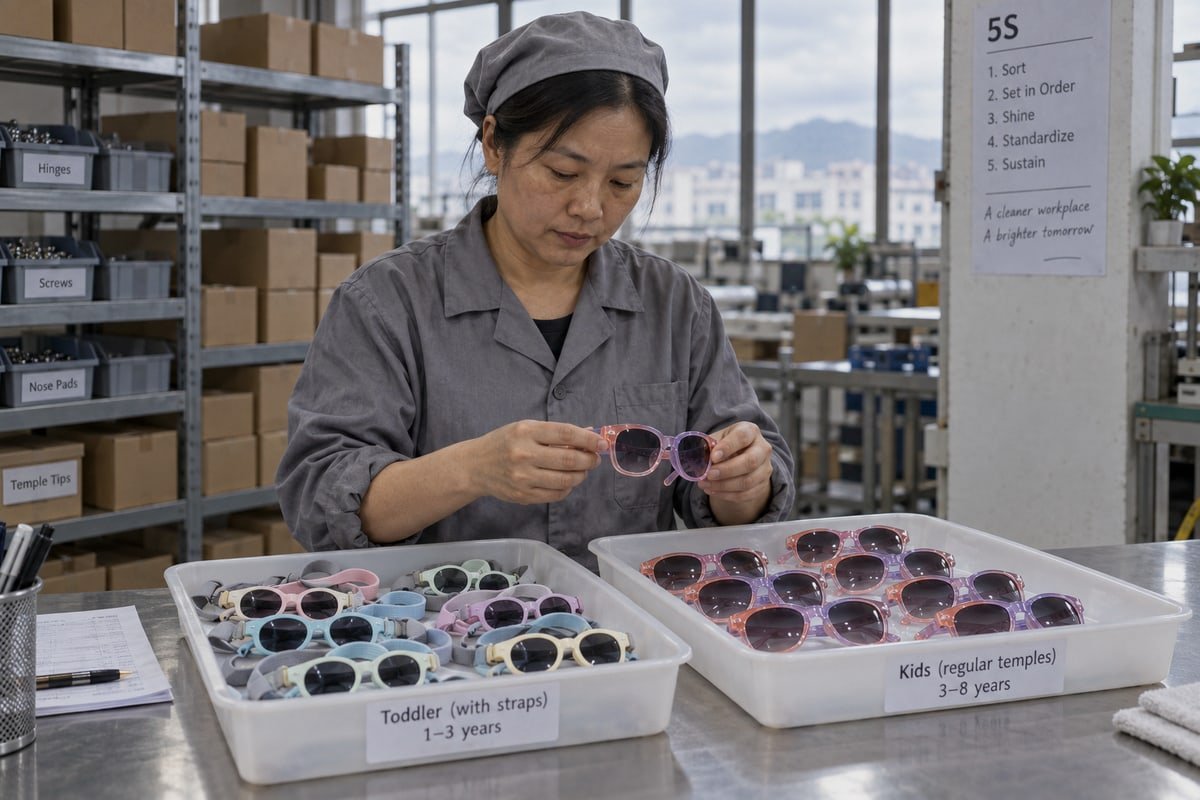
TR90 and TPEE kids sunglasses raise one question our production line hears constantly: strap or temple? Choose wrong, and parents return glasses that toddlers refuse to wear.
TR90 and TPEE kids sunglasses fit different use cases: choose TPEE with a detachable strap for babies, toddlers, and high-loss situations where retention matters most; choose TR90 with regular temples for school-age kids who want a lighter, more grown-up frame they can wear independently.
That short answer hides real trade-offs. Material, retention, age band, and retail positioning all interact. Let me walk you through each decision the way we walk our B2B buyers through it.
How do I decide between a detachable strap and regular temples for my kids' sunglasses line?
A buyer from Australia once asked me to put straps on every SKU in her range. Our engineers pushed back, and her sell-through data later proved why.
Decide by age and behavior: use a detachable strap for children under about 4 who cannot reliably keep glasses on, and regular temples for kids roughly 6 and older who wear frames independently. For ages 4–6, a removable strap covers both stages without forcing a choice.
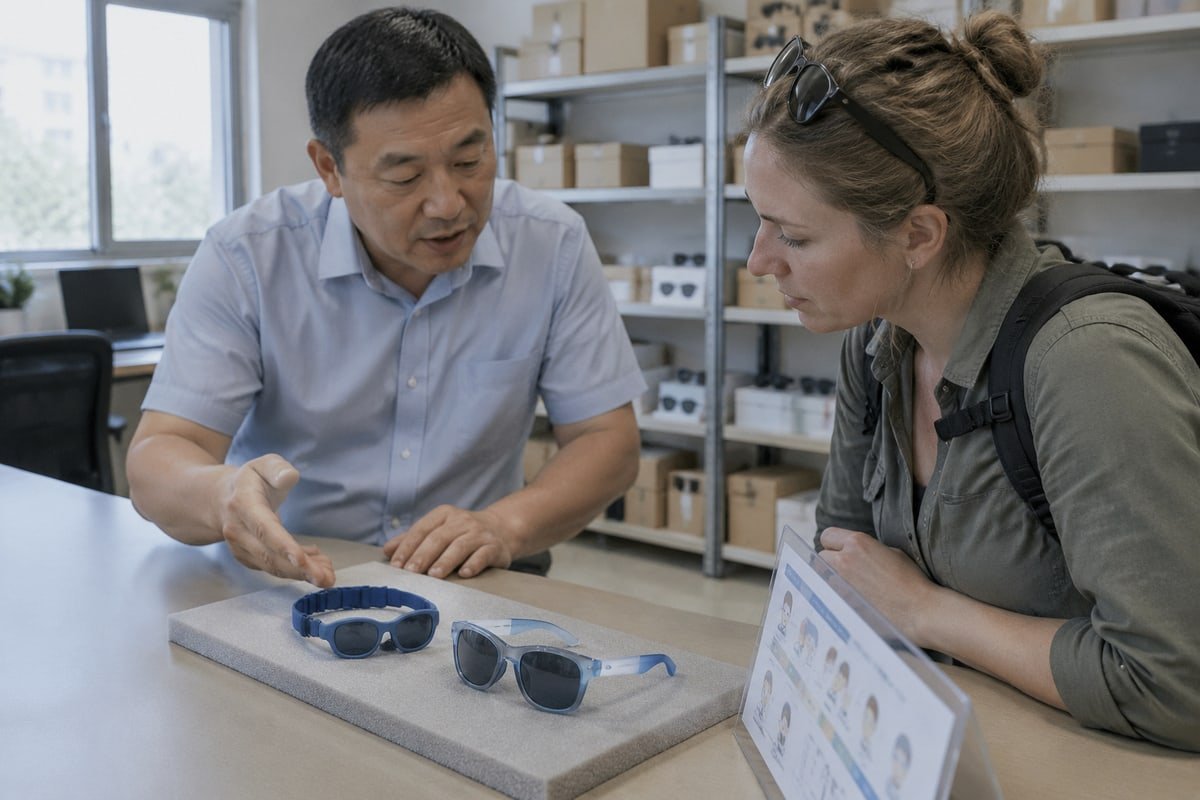
The fastest way to make this decision is to map retention style against the wearer, not the parent. Here is the comparison we share with new buyers before they pick styles from our catalog of roughly 800 existing designs.
| Factor | Detachable Strap | Regular Temples |
|---|---|---|
| Best age band | 0–4 years | 6+ years |
| Retention on small heads | Excellent — head tension keeps lenses centered | Moderate — relies on ear and nose fit |
| Nose bridge dependence | Low — works on flat, underdeveloped bridges | Higher — needs a defined bridge |
| Style perception | Practical, "baby gear" | Grown-up, everyday sunglasses |
| Loss prevention | Strong | Weaker during active play |
| On/off convenience | Slower | Fast and child-managed |
Why the nose bridge changes everything
Infants and toddlers have underdeveloped nose bridges. Regular temples alone let frames slide down constantly. An adjustable elastic headstrap solves this by using gentle head tension to keep polarized UV400 lenses centered over the eyes. That is not a styling choice. It is a fit requirement.
The behavior test
We tell buyers to ask one question: will the child yank the glasses off by one temple? If yes, you need a strap and a frame built from flexible memory polymer 1 that survives the yanking. TR90 has strong shape memory, so it returns to its original form even after being twisted or squashed. TPEE bends even further without stress. Either works, but the retention system decides whether the glasses stay on long enough to matter.
The transitional middle
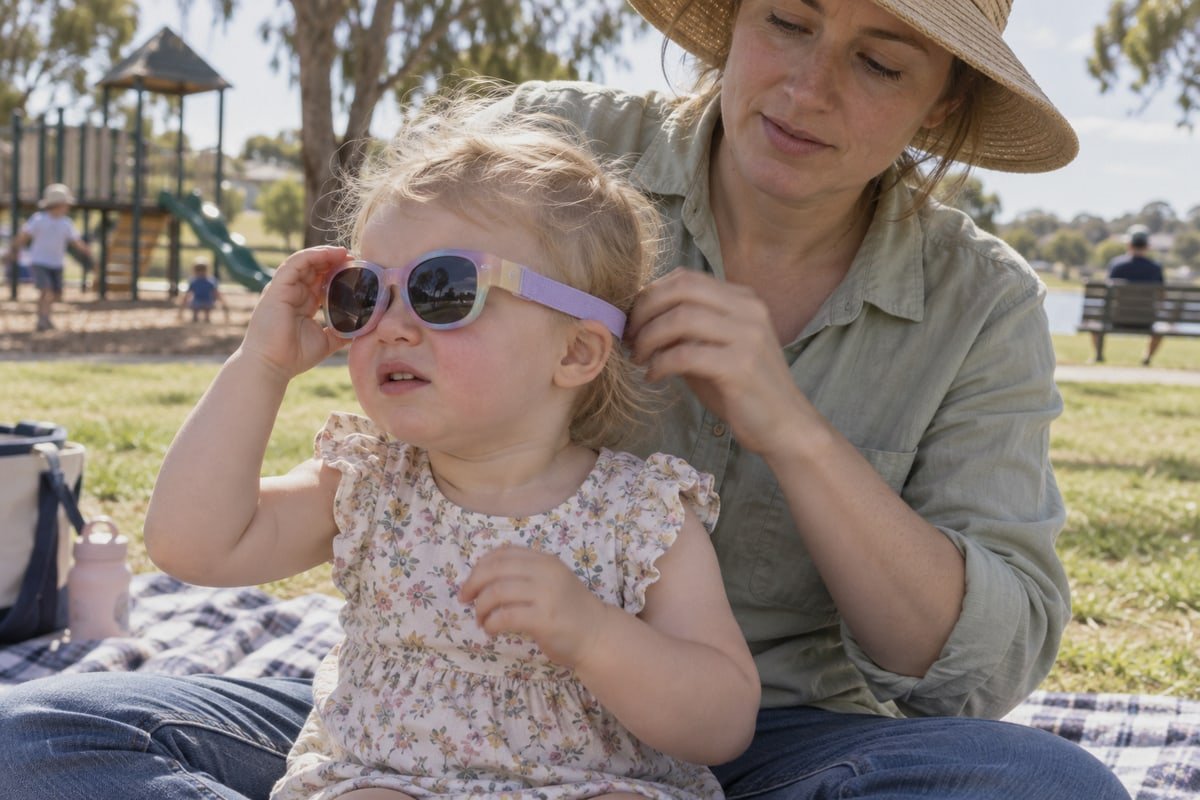
Preschoolers sit between both worlds. A detachable strap lets parents remove it as compliance improves. Several of our best-selling styles ship with the strap as an optional accessory for exactly this reason.
What safety and comfort factors should I consider for active toddlers and babies?
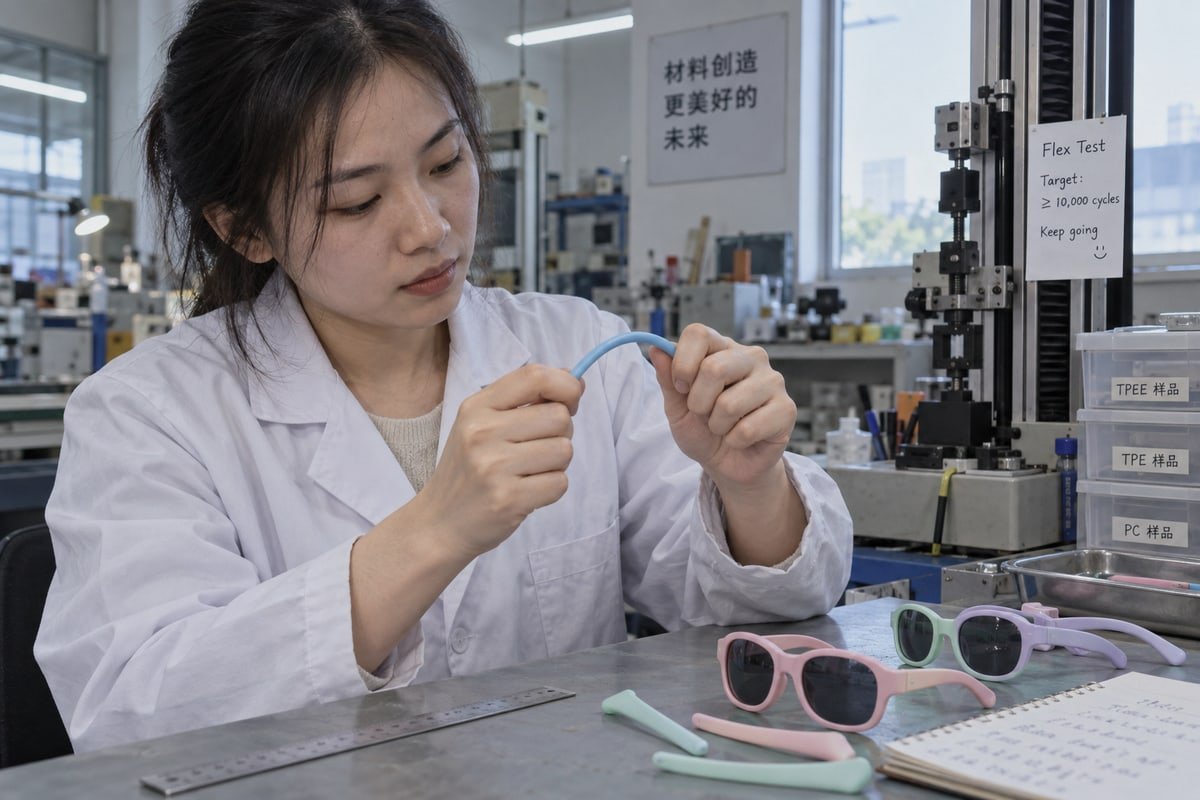
During drop-testing at our Taizhou workshop, we bend sample temples backward past ninety degrees. The frames that snap never reach our catalog. That standard shapes everything below.
Prioritize flexible, hypoallergenic materials that bend instead of snapping, shatterproof polycarbonate lenses with UV400 protection, chew-safe BPA-free construction for mouthing toddlers, low weight under roughly 20 grams, and a secure fit that avoids pressure points on the nose, ears, and temples.
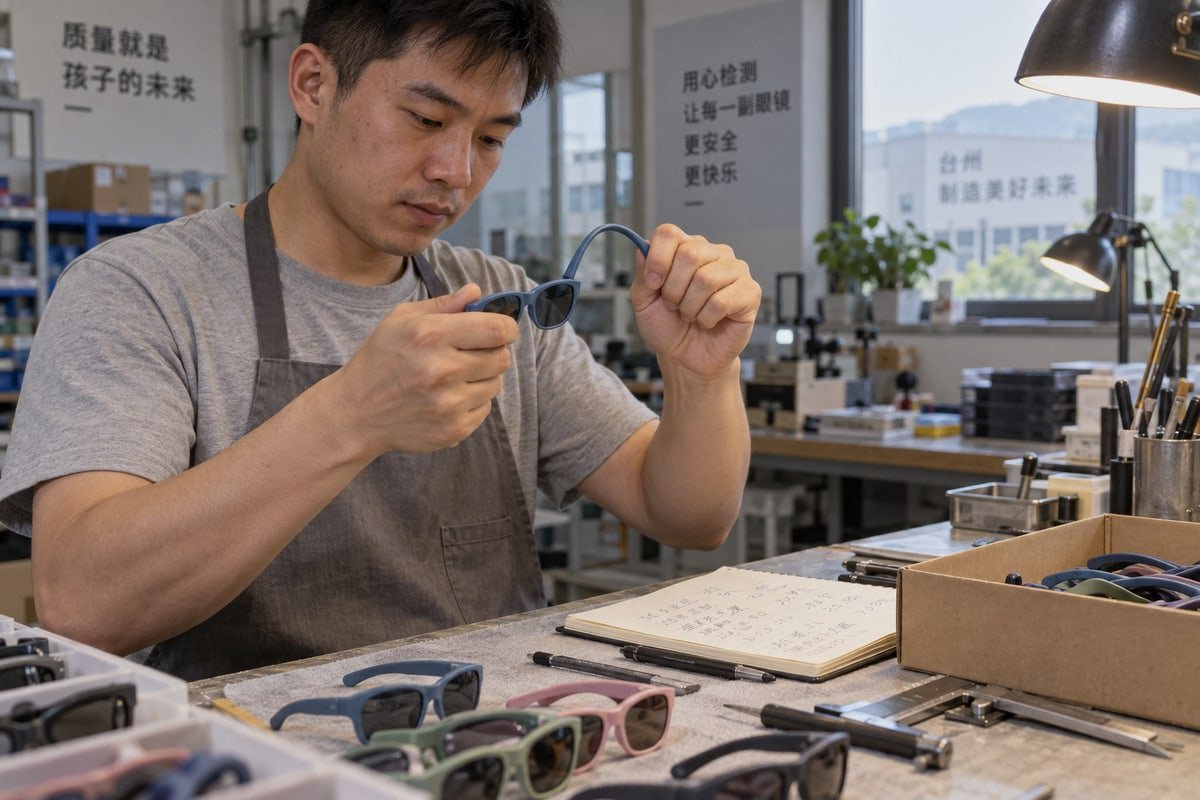
Toddler eyewear safety starts with what happens during failure, not during normal wear. Rigid plastic frames snap into sharp shards near a child's eyes. Flexible frames do not. Both TR90 and TPEE are engineered for impact-flex: they bend under twisting and pulling, absorb the energy, and recover. That is the core safety argument for this material category, and it is why we built our factory around these two polymers instead of cheap rigid acrylics.
Where TPEE pulls ahead for the youngest wearers
TPEE has a rubber-like molecular matrix that dissipates kinetic energy more effectively than TR90. In a front-on fall — a stroller tip, a playground stumble — that shock absorption protects small facial bones better. TPEE's naturally high-friction surface also acts as a built-in anti-slip mechanism. That tactile grip means parents can loosen the strap, avoiding the tight, headache-inducing tension that makes babies pull glasses off.
There is one more factor buyers of baby products care deeply about. Toddlers chew everything. Medical-grade TPEE is chemically stable with zero toxic migration 2, so a "mouther" who uses the bendable temple tips as a teething toy is not at risk. We specify BPA-free materials across our children's range for the same reason, and both polymers qualify as hypoallergenic thermoplastic for sensitive skin.
The lens and hardware side
Frames are only half the safety story. We pair frames with shatterproof polycarbonate lenses 3 — polarized UV400 lenses on premium SKUs — because glass or brittle acrylic lenses have no place near a toddler's face. On the smallest sizes, a screwless hinge design removes tiny metal screws that can loosen, fall out, and become a choking hazard. Impact-resistant frames plus retained lenses plus no loose hardware: that is the full safety checklist we run before any style ships.
Can I offer both strap and temple versions without doubling my minimum order quantity?
One European importer nearly walked away from our quote because she assumed two retention systems meant two molds and two MOQs. The solution was already sitting in our showroom.
Yes. A modular design with a shared front frame lets one SKU convert between strap and temple versions. The detachable strap ships as an accessory, so you order one frame at one MOQ and merchandise it as a toddler goggle or a big-kid sunglass without new tooling.
This is where sourcing strategy matters more than material science. Tooling a new frame mold is the biggest cost barrier for a young brand. Our answer has always been the same: start from existing styles, then customize. With around 800 open styles, a buyer can pick a TR90 front, add TPEE bendable temple tips for grip, include an adjustable elastic headstrap in the box, and launch without any mold investment at all.
How the modular lifecycle works commercially
The "modular lifecycle" concept is simple. One frame evolves with the child. Strap on for the daycare years. Strap off when the child hits school age and wants to look like mom or dad. For your brand, that extends product ROI and gives parents a reason to feel the purchase lasts longer.
Here is how the ordering math typically compares:
| Approach | Molds Needed | Effective MOQ Burden | Retail Flexibility |
|---|---|---|---|
| Two separate frame designs | 2 | Doubled | Two rigid SKUs |
| One modular frame + optional strap | 1 | Single | One SKU, two use cases |
| Existing catalog style + custom strap color | 0 | Lowest | Fast market test |
What we customize without new tooling
Within one MOQ, our OEM/ODM process covers custom frame colors, strap colors and prints, logo placement on temples and straps, lens upgrades to polarized UV400, and retail-ready packaging. In our experience exporting to 20+ countries, the strap-in-box format also simplifies retail: one hang card, one barcode, one planogram slot. Your buyer at the retail chain sees a single clean SKU, while the parent sees a product that adapts. That is the difference between selling sunglasses and selling parent convenience.
Which style will perform better for my target market and retail positioning?
Fifteen years of eyewear production has taught our team a blunt lesson: the best-built frame still fails if it lands in the wrong retail channel for its age band.
Match style to channel: TPEE strap versions perform best in baby stores, travel retail, and outdoor categories where parents buy for retention. TR90 temple versions perform best in fashion, optical, and lifestyle channels where school-age kids choose frames for looks and lightness.
Retail performance follows age segmentation, and the market is segmenting harder every year. Brands now split ranges explicitly into toddler, junior, and youth bands. Strap solutions cluster at the youngest ages; TR90 temple frames dominate junior and youth. Frame guides commonly position TPEE as ideal for roughly ages 0–5 and TR90 for roughly ages 6 and up. Your assortment should mirror that split rather than fight it.
Positioning by scenario
| Use Case | Recommended Setup | Retail Message |
|---|---|---|
| Babies and toddlers | TPEE + detachable strap | Soft, chew-safe, stays on |
| Active preschoolers | TPEE or TR90 + strap | Durable, loss-proof play |
| School-age everyday | TR90 + regular temples | Under 20g, all-day comfort |
| Sports, beach, travel | Wrap-around sports style + strap option | Locked-on protection |
| Style-conscious kids | TR90 + regular temples | Real sunglasses, kid-sized |
The weight and style story for older kids
Weight sells in the junior segment. TR90 kids frames often weigh under 20 grams — many listings sit around 15–21 grams depending on age band — and that "virtually weightless" feel is what converts kids who resist eyewear. Pair that with translucent candy colors, gradient frames, and a classic rounded-square shape, and you have the fashion-forward look our buyers request most for ages six and up. These kids want to imitate adults. A strap undermines that instantly.
The retention story for sports and travel
For high-intensity activities like soccer or gymnastics, a strap is a genuine safety fail-safe. It keeps the frame locked to the face during sudden head movements, preventing both loss and ocular injury from a dislodged frame. A wrap-around sports style with an adjustable elastic headstrap owns this niche. Position it as gear, not fashion, and it sits comfortably next to helmets and swim goggles at retail.
Some buyers worry a strap makes the product feel like "too much gear" and hurts voluntary wear. They are right — for older kids. That objection is exactly why the detachable format wins: the strap exists when the scenario demands it and disappears when it does not.
Conclusion
There is no universal winner. TPEE with a detachable strap wins for babies, toddlers, and high-loss scenarios. TR90 with regular temples wins for older, style-conscious kids.
The costly mistake is treating this as a material debate when it is really a use-case decision. Get the age band wrong, and even perfect frames come back as returns. At OKAY EYEWEAR, we help brands avoid that trap: pick from our 800 existing TR90 and TPEE styles, add a modular strap where your market needs it, and customize colors, lenses, logos, and packaging — all without mold investment. If you are building a children’s eyewear line, send us your target age bands and channels, and we will map the right frame-and-retention combinations to each one.
Interested in sourcing the products mentioned in this article? See details and request a quote here:
Footnotes
1. Technical properties of Nylon 12, the high-performance polymer used in TR90 eyewear frames. ↩︎
2. FDA’s safety assessment and regulatory stance on BPA in consumer and food-contact products. ↩︎
3. Overview of polycarbonate’s high impact resistance and its use in safety eyewear lenses. ↩︎
More Articles You Might Like

Looking for a Reliable Kids Eyewear Partner?
Explore 800+ ready styles and full OEM/ODM support tailored to your brand.
Get in Touch English
 Español de México
 Deutsch
 Français
 日本語
 العربية
 Português do Brasil