Which Ages and Scenarios Suit TR90 Kids Sunglasses: Elastic Strap vs Regular Temples?
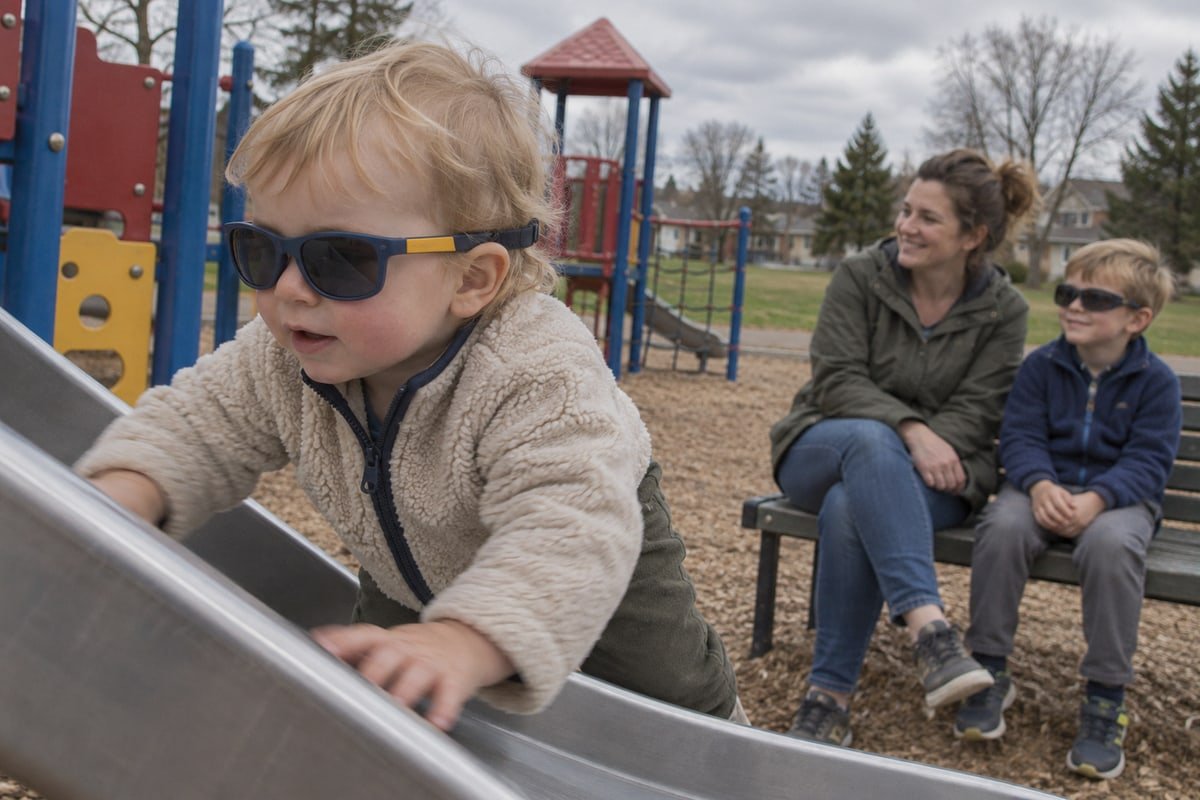
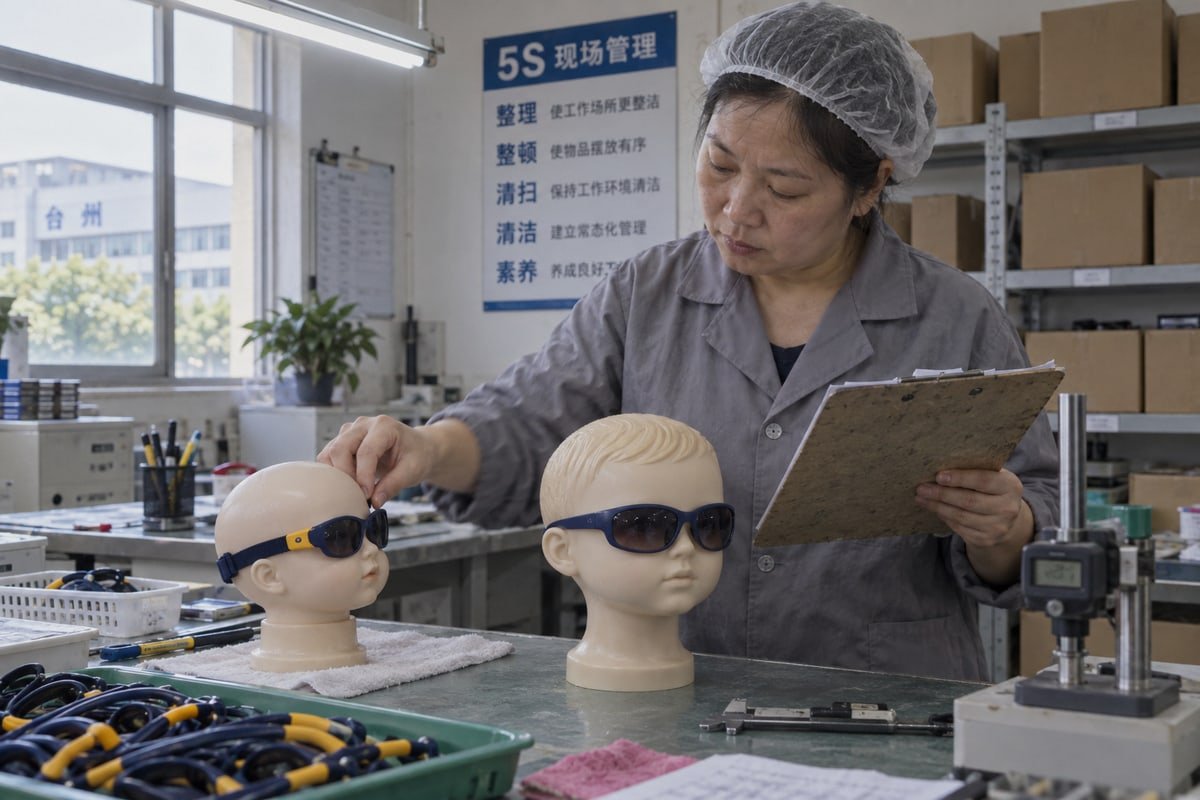
TR90 kids sunglasses only protect eyes if they stay on. Our Taizhou production line sees the failure daily: good frames sliding off small faces. Retention design is the fix.
TR90 kids sunglasses with an elastic strap suit infants, toddlers under 3, and active play where frames must stay put. Regular temples suit children about 4 and older, everyday school wear, and calmer outings. Choose by age, face development, and activity level, not by style alone.
The frame material and the retention system are two separate decisions. Below, I walk through both, age band by age band and scenario by scenario, so you can build a range that children actually keep on.
What age range is best suited to elastic strap sunglasses versus regular temples?
During a fit check last season, our QC team put the same TR90 frame 1 on a 14-month-old and a 5-year-old. It stayed on one face and fell off the other.
Elastic straps are best from birth to about 3 years, and remain helpful up to age 6 for active children. Regular temples suit most children from about 4 to 8 as the nose bridge and ears develop, and become the default for tweens aged 8 to 12.
Why an infant's face defeats a regular temple
A newborn has almost no nose bridge. The ears sit low and the cartilage is soft. A regular temple 2 relies on three contact points: the bridge and the two ears. Under 18 months, two of those points barely exist. That is why an adjustable elastic strap is the only reliable retention method for infant eye protection at this age. The strap wraps the head and does the holding job the face cannot do yet.
The age bands we use when we spec a frame
| Age band | Recommended retention | Why it works |
|---|---|---|
| 0 to 18 months | Adjustable elastic strap, essential | No bridge, soft ears, temples cannot grip |
| 18 months to 3 years | Strap as default; soft TPEE temples possible for calm children | Bridge is forming, but the child pulls at anything loose |
| 3 to 6 years | Both viable; strap for runners and habitual glasses-removers | One buying guide places peak strap use at ages 3 to 6 |
| 4 to 8 years | Regular temples become practical | Temple length and bridge fit now matter most |
| 6 to 8 years | Regular temples as default for school wear | One guide rates TR90 temple frames ideal from age 6 |
| 8 to 12 years | Regular temples preferred | Independence, appearance, and comfort win |
The overlap between 3 and 6 is real, not a mistake
Buyers often ask me why the guides seem to disagree. One source says straps work best for ages 3 to 6. Another says kids 4 to 8 should move to temples. Both are right, because age is only a proxy. The true variables are bridge height, ear position, and how often the child rips the glasses off. So my advice is simple. Use age bands for merchandising and packaging. Use fit and activity for the final product choice. A calm four-year-old with a defined bridge is a temple child. A wild five-year-old at daycare is still a strap child. When we develop TR90 kids sunglasses for a brand, we usually keep both options alive in that middle band rather than forcing one answer.
How do I choose between strap and temple styles for active outdoor scenarios?
Every strap we add trades some convenience for security. We weigh that trade-off whenever a sports brand asks us to spec a wrap-around frame for kids' cycling.
For high-motion scenarios such as playground play, soccer, gymnastics, cycling, beach, and pool, choose an elastic strap or a hybrid strap-ready temple. For strollers, walks, school, and travel with older kids, regular temples with a stable bridge fit work well and are easier to manage.
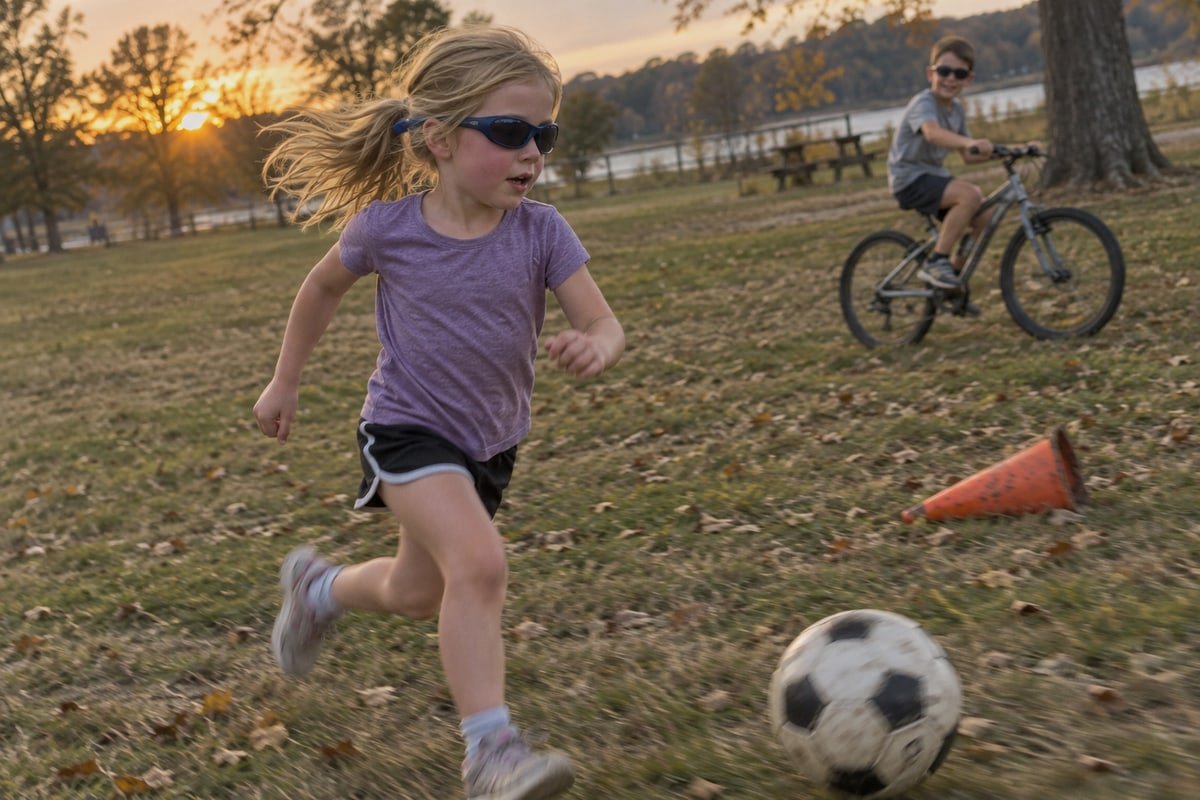
Scenario map for strap versus temples
| Scenario | Best retention | What drives the choice |
|---|---|---|
| Playground and daycare | Elastic strap | Bending, running, and frequent removal |
| Beach, pool, water play | Elastic strap | Wet skin, head movement, slipping |
| Soccer, gymnastics, cycling | Strap, or non-slip grippy temples on a wrap-around frame | Sweat, impact, side glare |
| Stroller, walks, errands | Regular temples, if fit is correct | Low motion, easy on and off |
| School and classroom | Regular temples | Self-donning and social acceptance |
| Travel | Strap under age 4; temples for older kids | Loss prevention versus meal and nap convenience |
A five-step check I run with buyers
- Rate the motion level of the intended use. Running and tumbling point to a strap.
- Ask whether the child tends to pull glasses off. Frequent removal points to a strap.
- Check for sweat and water. Both reduce temple grip on skin, so grippy tips or a strap help.
- Decide who puts the glasses on. If the child does it alone, temples are easier.
- Match the lens. Polarized lenses for kids cut water glare at the beach, while impact-resistant lenses matter most for ball sports.
Why the wrap-around frame design matters for sport
Our matte navy sport style is a good example of how the front and the retention work together. The lens curves close to the temple, which blocks side light 3 and gives a strap a stable base to seat against. The temple arms taper and curve slightly, so even without a strap they hug the head better than a flat wayfarer arm. This is the shape we recommend most for active sports sunglasses for children.
Some buyers push back here. They argue TR90's flexibility and low weight are the real value, so retention is secondary. I agree the material is the base. But a light frame on a loose fit still ends up in the sand. Material earns durability. Retention earns wear time. You need both.
Can I offer both strap and temple versions within the same collection for different age groups?
A baby-product buyer from Australia once asked us for one collection that covered newborns through age ten. We answered with two retention systems on shared frame fronts.
Yes. A single collection can offer strap versions for ages 0 to 3, hybrid strap-compatible temples for ages 3 to 6, and regular temple versions for ages 6 and up. Shared frame fronts, colors, and lens specs keep the range coherent while each age band gets the right retention.

Three tiers, one design language
| Tier | Age band | Retention system | Example front from our range |
|---|---|---|---|
| Tier 1 | 0 to 3 years | Adjustable neoprene strap fixed to the frame | Compact glossy black oval with a low bridge |
| Tier 2 | 3 to 6 years | Hybrid: soft TPEE temples with strap-compatible tips | Dual-tone wayfarer in navy with yellow-orange arms |
| Tier 3 | 6 to 12 years | Regular TR90 temples | Matte navy wrap-around sport style |
This tiered approach follows two market trends at once. More brands now publish age-banded sizing guidance for infants, toddlers, kids, and tweens. And more brands offer hybrid retention, where a regular temple accepts a head strap through a slot or loop at the tip. Modular frames that swap between temples and a strap let one pair move from a classroom to a soccer field. We build that option into Tier 2 because it removes the awkward choice parents face at ages 3 to 6.
How we build this without heavy tooling
- Start from our library of roughly 800 existing styles. A brand can pick fronts for each tier without paying for new molds, which lowers launch risk.
- Fix one lens spec across the collection. UV400 protection on every tier, with polarized lenses for kids as an upgrade on Tier 3.
- Size the fronts down for Tier 1 and up for Tier 3, keeping the same silhouette so the shelf looks like one family.
- Apply the brand: custom colors, temple logos, strap prints, retail-ready packaging, and a cleaning pouch.
- Run the same QC checks at every tier. In our 5S-managed workshop the strap tier gets an extra pull test on the strap attachment, since a detached strap is both a loss and a safety issue.
One caution I share with new brands: do not let the strap tier look like an afterthought. Parents shop the youngest child first and then trade up. If Tier 1 looks cheap, they never reach Tier 3.
What safety and comfort factors should I consider when matching TR90 styles to toddlers versus older kids?
One lesson stuck with us after fifteen years of kids' eyewear: a frame that pinches a toddler will be pulled off within seconds, no matter how good the lens.
For toddlers, prioritize a soft flexible frame, an adjustable strap with even tension, UV400 lenses, and BPA-free materials with no small detachable parts. For older kids, prioritize correct temple length, a stable bridge, impact-resistant lenses, and a look they will accept and wear all day.
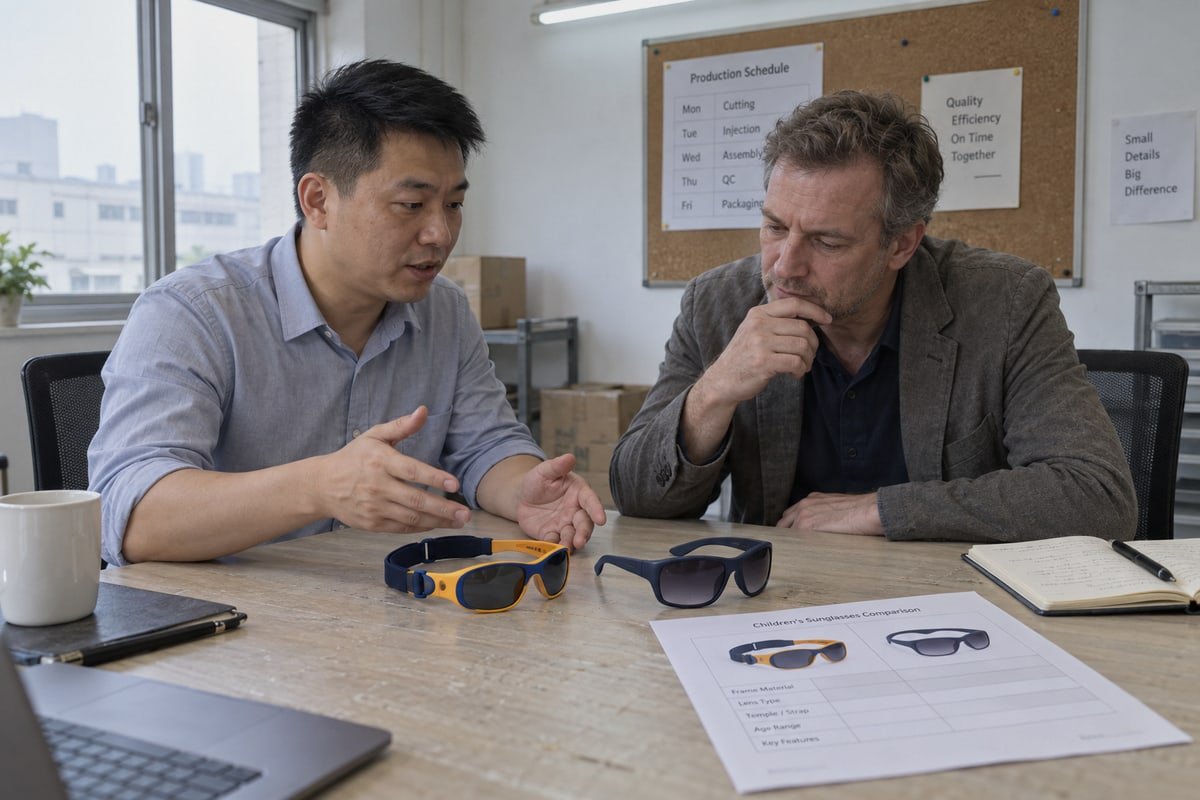
Safety and comfort checklist by age
| Factor | Toddlers, 0 to 3 | Older kids, 6 to 12 |
|---|---|---|
| Frame material | Ultra-soft TPEE or flexible TR90, about 12 to 15 grams | TR90 with memory flexibility for rough handling |
| Retention | Wide-band adjustable strap, even tension | Correct temple length, grippy tips, stable bridge |
| Lenses | UV400 protection, impact-resistant | UV400, impact-resistant, polarized option |
| Materials | BPA-free eyewear materials, phthalate-free, hypoallergenic | Same standard, no exceptions |
| Small parts | No detachable pieces on frame or strap | Hinges checked for pinch points |
| Acceptance | Pull-off behavior | Look, comfort, and peer approval |
Why weight is the first comfort factor
Flexible thermoplastic frames earn their place because they are light. TR90 can be 20 to 25 percent lighter than standard plastic, and kids' TR90 frames in the 12 to 15 gram range simply have less mass to slide down a small nose. A lighter frame also puts less load on a strap, so the strap can sit loose enough to be comfortable while still holding the frame steady.
Special cases where a strap beats temples at any age
Age is not the only reason to specify a strap. We see several situations where a full-head strap is the right answer even for school-age children:
- Children with developmental or motor challenges, where a strap keeps the lenses aligned and prevents accidental loss.
- Children with heavy, high-prescription lenses, where a strap spreads the weight and avoids pressure points on the nose.
- Neurodivergent children with tactile sensitivities, where a wide-band strap on an ultra-light TR90 frame gives a low-pressure fit with no temple contact behind the ears.
- Children with minor cranial asymmetry, where adjustable strap tension keeps the lenses centered for clear vision.
- Myopia management programs 4 that require daily outdoor hours, where a strap improves compliance by keeping the sunglasses on.
For the temple tier, our engineers focus on the hinge. A flexible TR90 temple should bend outward without snapping, because kids grab glasses by one arm. We also check that the temple tip does not dig in behind the ear during long wear.
Conclusion
Sunglasses that fall off protect nobody. Match straps to young and active kids, temples to older ones, and build both on light TR90 frames with real UV400 protection.
Interested in sourcing the products mentioned in this article? See details and request a quote here:
Footnotes
1. Official ISO standard for sunglasses and related eyewear requirements. ↩︎
2. Technical overview of eyeglass frame components and temple designs. ↩︎
3. Professional medical guidance on selecting sunglasses to block peripheral light. ↩︎
4. WHO fact sheet supports claims about outdoor time and myopia management in children. ↩︎
More Articles You Might Like



Looking for a Reliable Kids Eyewear Partner?
Explore 800+ ready styles and full OEM/ODM support tailored to your brand.
Get in Touch English
 Español de México
 Deutsch
 Français
 日本語
 العربية
 Português do Brasil