How to Judge Kids’ Eyewear Quality by Appearance and Feel?
Kids’ eyewear quality is something I can judge in about two minutes on our factory floor — but most buyers receive samples with no idea what to check first.
You can judge kids’ eyewear quality by flexing the frame and watching it snap back without stress marks, running a finger over every edge for smoothness, checking hinge tension and symmetry, and confirming the lenses show even coatings with no distortion or peeling.
That short answer covers the basics. But each of those checks has a right way and a wrong way to do it. Let me walk you through what our QC team actually looks for, so you can screen any sample — from any supplier — with confidence.
What should I look for when checking a frame's flexibility and bend-back resistance?
Last year, a buyer from Australia sent back a competitor's sample with the temple snapped clean off. One twist test on arrival would have caught it. Here is how we run that test in our Taizhou workshop.
A quality children's frame should bend significantly — temples flexing well past 90 degrees, the bridge twisting gently — and return instantly to its original shape with no white stress marks, cracking sounds, or permanent warping. TR-90 and TPEE frames that resist this test are unsafe for active kids.
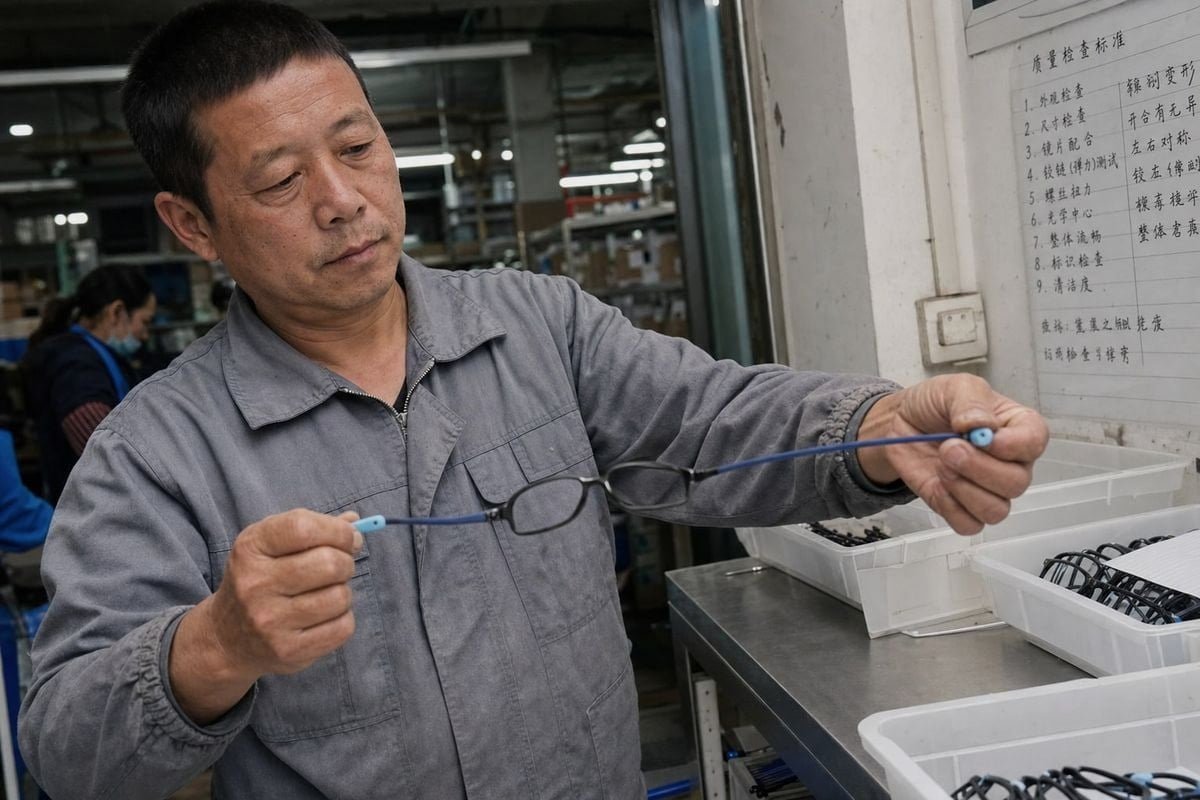
Flexibility is the single most honest quality signal in children's eyewear. Kids sit on glasses. They pull them off with one hand. They stuff them into backpacks. A rigid frame fails within weeks, no matter how good it looks in a photo.
The three-point flex test
Our QC inspectors run this same sequence on every batch before shipment:
- Temple flex. Open both temples and push them gently outward past their natural stopping point. A frame with 180-degree spring hinges will give smoothly and spring back. A cheap friction hinge will resist, creak, or crack at the joint.
- Bridge twist. Hold the frame at both lens rims and twist in opposite directions, like wringing a towel — gently. Genuine TR-90 frame material 1 flexes and recovers. Low-grade blends show white stress lines at the bridge, which means the polymer is already micro-fracturing.
- Temple fold-back. Fold one temple across the front of the frame. It should curve, not kink. TPEE temples, which we pair with TR90 fronts on most of our children's styles, can bend almost flat and recover completely.
What the material tells you
| Material behavior | What it suggests | Verdict |
|---|---|---|
| Bends far, snaps back instantly | Genuine TR-90 or TPEE | Good for kids |
| Bends but stays slightly warped | Recycled or blended polymer | Reject |
| White marks appear at stress points | Brittle, degraded material | Reject |
| Barely bends at all | Rigid acetate or hard PC frame | Wrong choice for young children |
One nuance worth raising: some buyers worry that a very flexible frame feels "cheap" or unstable. That is a fair concern, but the answer is controlled flex, not rigidity. A well-engineered frame bends under abuse yet holds its shape perfectly during normal wear. Memory metal frames 2 achieve the same goal in metal styles, though for toddlers and young children we still recommend polymer builds because they carry no risk of sharp exposed wire if damaged. When we develop a new style from our 800-model catalog, we tune the temple thickness until the frame passes all three flex checks without feeling floppy on the face.
How can I tell if the lenses are truly UV400 or polarized just by inspecting them?
A distributor once asked me why two "identical" sunglasses had a forty-cent price gap. The answer was in the lenses — and you can spot most of the difference without any lab equipment.
Check lens quality by looking through them at a screen or reflection: real polarized lenses darken an LCD screen when rotated 90 degrees, quality coatings show a uniform color sheen with no rainbow patches, and edges should be polished with zero bubbles, waves, or peeling film.

Let me be honest about one limitation first. True UV400 protection 4 cannot be fully confirmed by eye — it requires a UV transmission meter, which is why we test every lens batch on ours before assembly. Dark tint alone proves nothing. A dark lens without UV blocking is actually worse than no glasses, because it dilates the child's pupil while letting UV through. But visual inspection still reveals a lot about whether a factory took lenses seriously.
The LCD screen test for polarization
Hold the sunglasses in front of a phone or laptop screen. Rotate the frame slowly to 90 degrees. If the lens is genuinely polarized, the screen behind it will go dark or black. If nothing changes, you are holding a plain tinted lens sold at a polarized price. This test takes ten seconds and catches one of the most common lens frauds in the market.
Visual clues that separate good lenses from cheap ones
| What to inspect | Quality lens | Cheap lens |
|---|---|---|
| Surface reflection | Even, subtle color sheen from anti-reflective coating | Patchy rainbow blotches or oily smears |
| Look through at a straight line | Line stays straight edge to edge | Line bends or ripples near the lens edge |
| Lens edge | Smooth, polished, evenly seated in the rim | Rough, chipped, or gapping from the frame |
| Water droplet behavior | Beads into tight spheres and rolls off | Spreads flat and streaks |
| Film layers | Fully bonded, invisible | Peeling or bubbling at the corners |
That water test deserves a note. A scratch-resistant hard coat with good surface tension makes droplets bead up and roll away cleanly. On uncoated lenses, water flattens and smears. It is a quick proxy for coating quality that any buyer can run at a trade show booth.
For optical frames, distortion matters even more. Polycarbonate safety lenses 5 and Trivex lens material 6 are the only two options we recommend for children, because both are virtually shatterproof under impact. Hold the demo lenses up and sweep them slowly across a window frame or door edge. Any waviness means poor molding — and a prescription lab will struggle to match that frame accurately later.
What surface details reveal whether a factory follows real quality control standards?
The difference between a 5S-managed workshop and a chaotic one shows up in millimeters. After fifteen years running production lines, I can usually name a factory's discipline level from a single sample's edges.
Real quality control shows in the details: hand-polished surfaces with no mold seams or flash, perfectly symmetrical temples, crisp and aligned logo printing, screws seated flush with no stripped heads, and hinges that open with smooth, silent, consistent tension on both sides.
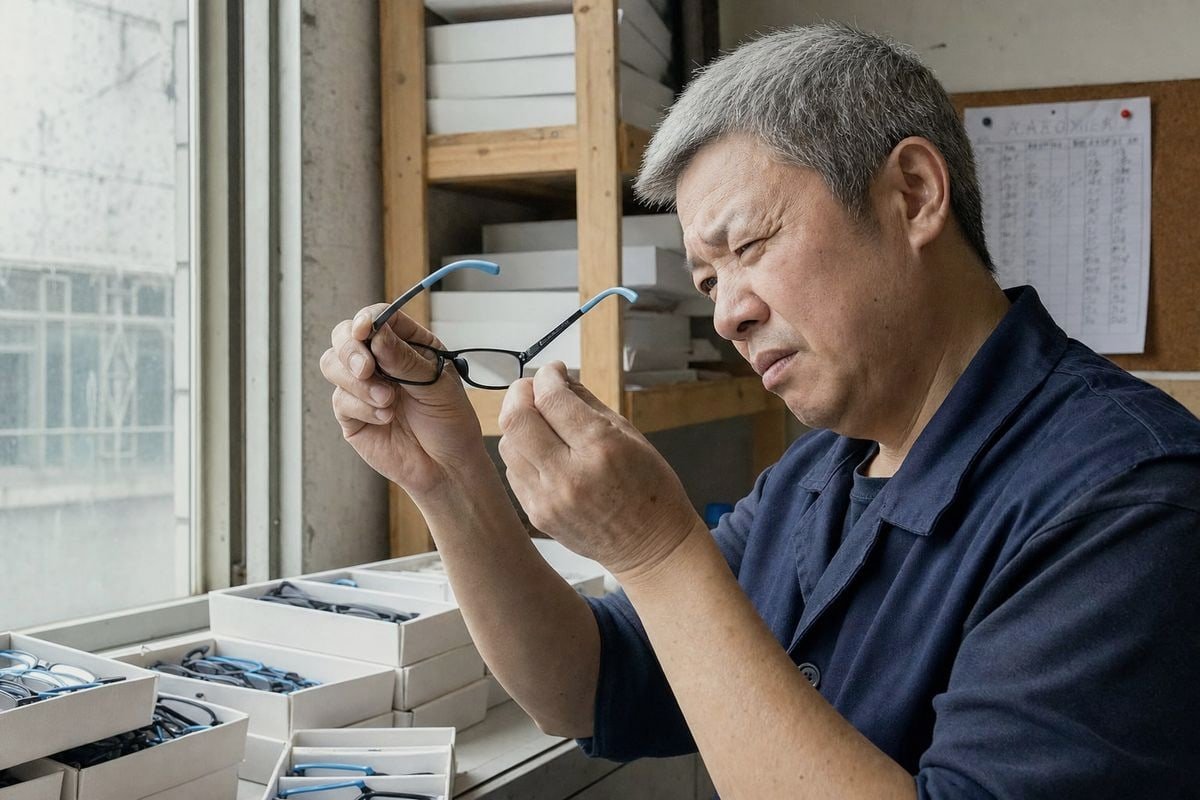
Injection molding always leaves seams. The question is whether anyone removed them. On our line, every frame passes through polishing and a final touch inspection before packing — because a leftover flash seam on a child's frame is not a cosmetic flaw, it is a skin abrasion waiting to happen.
A five-point surface audit anyone can run
- Run a fingernail along every edge. Trace the inner rim, the bridge underside, and the temple edges. Your nail will catch on burrs your eye misses. A clean frame feels seamless everywhere your finger travels.
- Check symmetry from the front. Lay the frame on a flat table. Both temples should touch down evenly, and both lens rims should sit level. A twisted frame means poor mold tolerance or careless assembly.
- Listen to the hinges. Open and close each temple slowly. Quality hinges give a consistent, muted resistance. A high-pitched squeak or gritty grinding signals cheap friction-based plastic joints instead of precision-milled components.
- Inspect the screws. Heads should be flush and unmarked. Better factories use self-locking screws with a nylon patch so temples cannot vibrate loose during a child's daily activity. Stripped or protruding screw heads mean rushed assembly.
- Examine color and printing. Color should be uniform across both temples, with no swirls or pale spots. Logos should be sharp and identically placed on every unit in a batch.
That last point matters more than most buyers realize. One sample can be cherry-picked. Batch consistency cannot. When our OEM customers 7 audit us, we encourage them to pull five random units and compare them side by side — matched color, matched hinge tension, matched logo placement. Master samples and batch inspection records back that up on paper, but your fingers and eyes can verify it in minutes. If two "identical" frames feel different in the hand, the factory's tolerance control is weak, and your third and fourth reorders will drift further still.
How do I judge if the materials are genuinely safe and comfortable for a child's face?
We once redesigned a temple tip three times because a two-year-old tester kept tugging at her ears. Comfort complaints from children rarely come in words — they come in behavior, and materials drive that behavior.
Safe, comfortable kids' eyewear uses lightweight, hypoallergenic materials like TR90 and TPEE, feels smooth and warm rather than hard or scratchy, weighs almost nothing in the hand, has rounded corners everywhere, and leaves no red pressure marks on the nose, temples, or ears after wear.
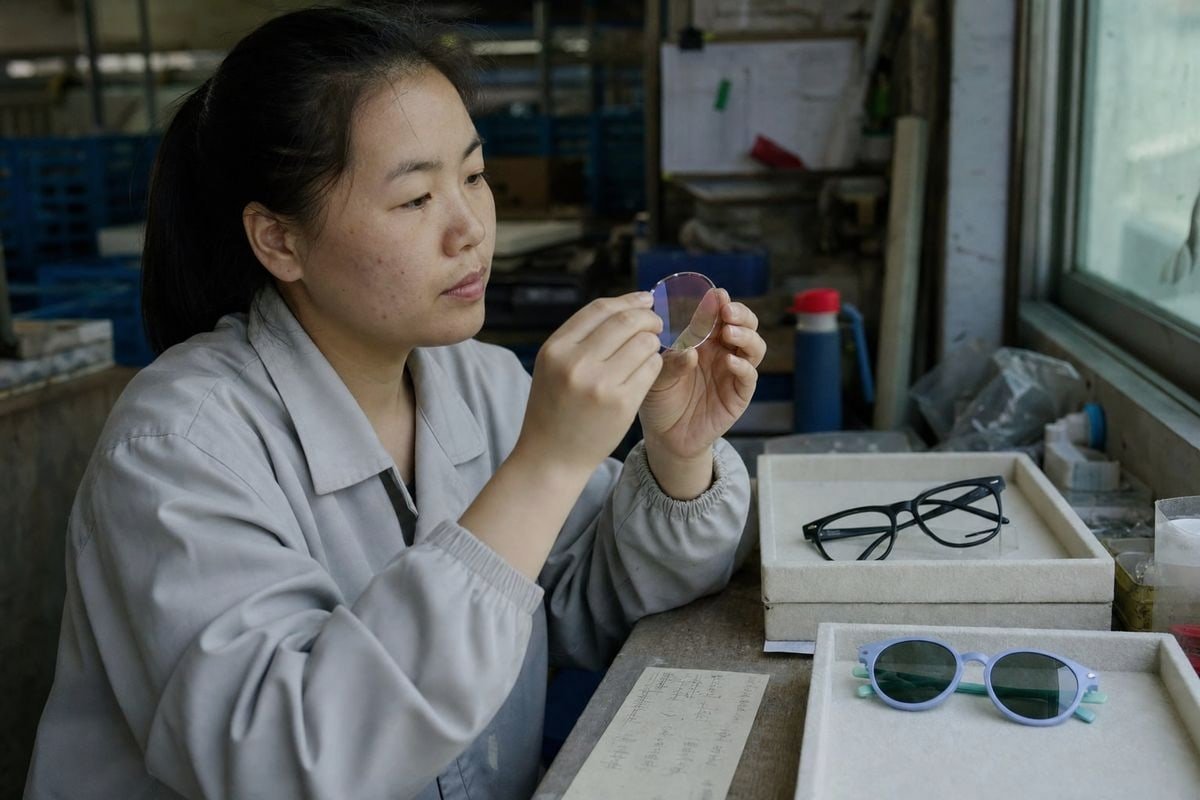
Weight is the first check. Place the frame on your open palm. A well-built children's frame in TR-90 frame material or TPEE feels almost weightless. Heavy frames slide down small noses constantly, and a front-heavy build guarantees red marks on the bridge within an hour. Balance matters as much as total weight — hold the frame by the temple tips and see whether the front dips sharply.
Contact points: where comfort is won or lost
The frame touches a child's face in three zones. Each one deserves a deliberate touch test:
| Contact zone | What to feel for | Red flag |
|---|---|---|
| Nose bridge | Wide, soft saddle-style contact that spreads weight | Narrow, hard ridge that concentrates pressure |
| Temple sides | Smooth inner surfaces, gentle even grip | Sharp inner edges or pinching pressure |
| Behind the ears | Soft, slightly grippy tips that curve naturally | Hard plastic ends or hooks that overshoot the ear |
Bridge design deserves nuance, because buyers often ask us about adjustable silicone nose pads. For older children and metal styles — including hypoallergenic titanium frames 8 — nose pads add useful adjustability. But most young children's nose bridges are not developed enough for adult-style pads to sit properly. For that age group, a molded saddle bridge in soft polymer distributes weight across more surface area and stays put better. The right answer depends on the child's age and anatomy, which is why our catalog carries both approaches rather than forcing one.
For sport and toddler styles, look at retention. Flexible cable temples that curl behind the ear, or silicone-tipped temples with textured grip zones, keep glasses centered during running and play without squeezing. Finally, do the on-face test if you can: the child should look down, shake their head, and smile. No slipping, no cheek contact, no pushing the frame back up. And ask about the material's safety documentation — food-contact-grade and environmentally friendly polymer certifications are reasonable requests, and any serious children's eyewear factory will provide them without hesitation.
Conclusion
Trust your eyes and hands over the label. Flex the frame, test the lenses, trace the edges, and check the fit — quality kids' eyewear proves itself before you ever read a spec sheet.
Footnotes
1. Authoritative Wikipedia section detailing various plastic frame materials including polyamides like TR-90. ↩︎
2. Explains the shape-memory alloy science behind flexible metal eyewear frame technology. ↩︎
3. Authoritative Wikipedia entry explaining the physical phenomenon of crazing which causes stress whitening in polymers. ↩︎
4. FDA confirms UV protection requires testing, not just visual inspection, matching the article’s caution. ↩︎
5. Explains polycarbonate’s shatter-resistant properties that make it suitable for children’s lenses. ↩︎
6. Background on Trivex as an impact-resistant optical polymer used in children’s eyewear lenses. ↩︎
7. Alibaba.com represents the global sourcing platform connecting brands with OEM manufacturing partners. ↩︎
8. NIH resource on nickel allergy explains why hypoallergenic titanium reduces skin reactions in children. ↩︎
More Articles You Might Like

Looking for a Reliable Kids Eyewear Partner?
Explore 800+ ready styles and full OEM/ODM support tailored to your brand.
Get in Touch English
 Español de México
 Deutsch
 Français
 日本語
 العربية
 Português do Brasil