What Weight Range Makes TR90 Kids Optical Frames Lightweight and Comfortable?

Parents often tell our Taizhou team the same story: their child’s [TR90](https://okayeyewear.com/?p=12425) kids optical frames slid, pinched, and ended up in a backpack. Weight is usually the culprit.
TR90 kids optical frames feel lightweight and comfortable when the finished frame weighs about 12–18 grams for small children and 15–22 grams for older kids or larger sizes. Ultra-light designs reach 7–15 grams, but comfort depends on frame size, hinges, and nose-pad design, not weight alone.
Those numbers are a starting point, not a rule. Below, I walk through how to spot a frame that is too heavy, what weight to specify when sourcing, how light frames stay tough, and how to compare supplier claims fairly.
How Do I Know If a TR90 Frame Is Too Heavy for My Child's Face?
On the fit-check bench in our 5S workshop, we press every new sample onto a child-size head form and note where the bridge marks appear first.
A TR90 frame is too heavy for your child's face if it leaves red marks on the nose bridge, slides down within minutes, or if the child keeps pushing it up or taking it off. For small faces, anything above roughly 18 grams finished weight deserves a closer look.
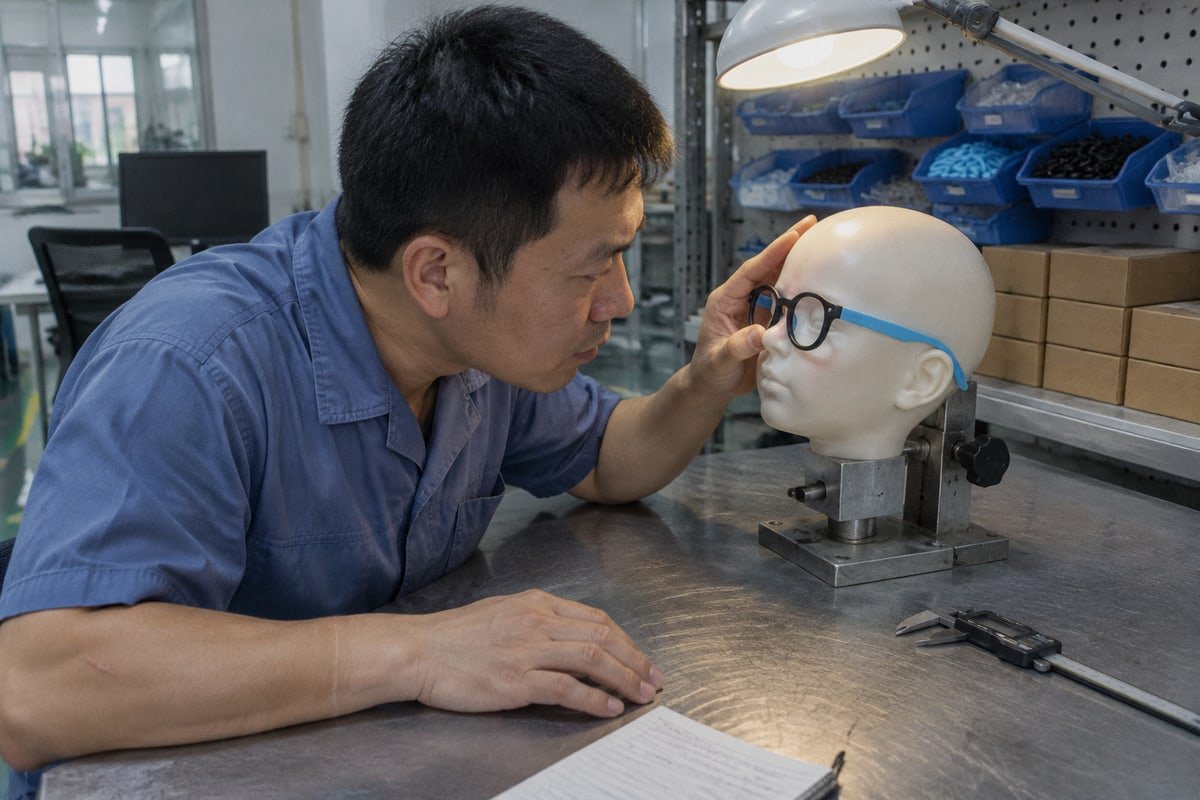
Children rarely say "these are heavy." They show it instead. So I tell buyers to watch behavior, not listen for complaints. A frame that is too heavy for a small face produces a predictable set of signs. The table below lists the ones we see most often during sample reviews.
| Sign | What is usually going on | First thing to check |
|---|---|---|
| Red marks on the nose after 20–30 minutes | Too much load on a small bridge | Frame weight in grams and pediatric bridge fit |
| Frame slides down repeatedly | Center of gravity sits too far forward | Lens weight, temple taper, and temple grip |
| Child pushes the frame up constantly | Bridge width too wide or nose pads too hard | Bridge width and silicone nose pads |
| Child removes glasses during play | Pressure builds behind the ears | Temple tip shape and flexible temple tips |
| Frame sits crooked | Uneven weight or a loose hinge | Hinge tension and frame symmetry |
Weight only matters relative to size
A 13-gram frame in a compact size can feel lighter on the face than an 18-gram frame in a large, chunky design. Both are TR90. Both may be called "lightweight" by a seller. The difference is where the grams sit. A wide front with thick rims loads the bridge. A slim front with slightly thicker temples 1 spreads the load toward the ears. That is why I always ask for the eye size and bridge width before I judge a frame weight in grams.
The lens-weight paradox
There is a trap here that catches many first-time buyers. A very light frame can become front-heavy once a high-minus prescription lens 2 goes in. The frame itself was fine. The finished pair is not. Modern TR90 designs solve this with tapered temple geometry. The temple starts thicker near the hinge and thins toward the ear. This shifts the center of gravity backward and reduces sliding. If your brand serves children with stronger prescriptions, ask your supplier whether the temple profile was designed with this in mind.
Skin contact matters too
A child with sensitive skin will react to a heavy frame faster than a child without it. TR90 helps because it is a hypoallergenic material 3 and is used in BPA-free eyewear. But even the best material cannot fix a frame that simply weighs too much for the face wearing it.
What Weight Should I Look for When Sourcing TR90 Optical Frames for Kids?
A procurement manager from Australia once asked our team for the lightest frame we make. We answered with a question of our own: lightest for which face size?
When sourcing TR90 optical frames for kids, target 12–15 grams for the smallest sizes, 15–18 grams for mid-size school frames, and no more than 20–22 grams for the largest teen sizes. Always request finished frame weight in grams without lenses and judge it against eye size and bridge width.

Before we talk about targets, it helps to see where TR90 sits against the other common frame materials. This is the comparison I share with new buyers who are choosing a material for a first collection.
| Material | Typical frame weight | Flexibility | Notes for kids' use |
|---|---|---|---|
| TR90 (kids sizes) | 12–15 g, ultra-light 7–15 g | High | Bends and recovers, hypoallergenic, BPA-free |
| TR90 (standard sizes) | 15–20 g, some 18–22 g | High | Weight climbs with size and rim thickness |
| Cellulose acetate | 25–40 g | Low | Attractive finish, but heavier on small noses |
| Metal | 20–35 g | Medium | Adjustable, but nose pads can dig in |
Why TR90 lands where it does
TR90 is a thermoplastic memory polymer 4, and the well-known grades trace back to Swiss technology from EMS-Grivory. Its density is about 1.14 g/cm³. That low density is the reason TR90 comes in roughly 20% to 50% lighter than traditional cellulose acetate. It also means we can mold a slightly thicker rim for lens stability without a big weight penalty. In our injection molding process, the same tool can produce a frame that is both sturdier and lighter than an acetate equivalent.
Set the target by size, not by age label
I prefer to specify weight next to a frame size. A useful way to write a spec line is: eye size, bridge width, temple length, then target grams. For example, a compact round style like our matte black front with sky-blue temples sits at the low end of the range because the front is small and the temples are slim. A rounded-square translucent style in a medium size sits a little higher because the front is wider. Both are comfortable. Both are TR90. The grams differ because the geometry differs.
A note on Bio-TR90
Eco-conscious brands often ask about castor-oil-based Bio-TR90. In practice, it matches the weight performance of standard TR90. The choice is about sustainability and story, not about grams.
Use existing styles to test before tooling
Many brands want to test the market before paying for molds. That is exactly why we keep around 800 existing styles ready to sample. You can order a small run, weigh the frames, put them on real children, and then decide what to customize.
Can Lightweight TR90 Frames Still Be Durable Enough for Active Children?
Every time we thin a temple by a fraction of a millimeter to save a gram, we weigh that saving against the twist test the frame must pass afterward.
Yes. Lightweight TR90 frames stay durable because TR90 is a thermoplastic memory polymer with high impact resistance and flexibility, so it bends and recovers instead of snapping. Frames at 12–18 grams handle playground falls well, provided temples, hinges, and bridge are not thinned to the point of losing fit stability.

Buyers sometimes raise a fair objection here. They say durability matters more than shaving off a few grams, so why chase lightness at all? I agree with the first half. For a very active child, a frame that survives is better than a frame that is light. But the two are not enemies. The trick is to remove weight in the right places and keep it in the places that carry stress.
Where weight can be removed safely
Here is the order we follow when a customer asks us to bring a style under a target weight.
- Slim the lens rim slightly, since the lens itself adds rigidity once fitted.
- Taper the temple from the hinge toward the tip, which cuts grams and moves the balance toward the ears.
- Keep hinge screws and hinge blocks at full size, because that is where twisting force concentrates.
- Keep the bridge thickness, because the bridge is the part that breaks first on a hard drop.
- Retest for flex, twist, and recovery before the change is approved.
Dual-density construction
The most useful recent development is co-molding. With dual-density TR90, the front chassis stays rigid for lens stability, while the temple tips are infused with softer elastomers for grip. Our own TR90-front-with-TPEE-temple styles follow the same logic. The flexible temple tips grip gently behind the ear without pressure points, and they bend a long way before anything gives.
Holding shape in hot and cold weather
Active children move between air-conditioned classrooms and hot playgrounds. Next-generation TR90 grades are engineered for thermal-stability optimization 5, which keeps the clamping force consistent across temperature swings. A frame that loosens in the heat slides more, and a sliding frame gets knocked off more. Stable clamping force is a durability feature as much as a comfort feature.
| Part of the frame | Cut weight here? | Reason |
|---|---|---|
| Lens rim | Yes, slightly | Lens adds stiffness once fitted |
| Temple mid-section | Yes, by tapering | Improves balance, low stress area |
| Hinge block | No | Main twist stress point |
| Bridge | No | First to fail in a drop |
| Temple tips | Use softer material | Grip and comfort matter more than grams |
How Do I Compare TR90 Frame Weights Across Different Suppliers Before Ordering?
One lesson from fifteen years of exporting kids' eyewear: two spec sheets can both say 14 grams and describe two completely different frames.
Compare TR90 frame weights by requesting the same data from every supplier: finished frame weight in grams without lenses, eye size, bridge width, temple length, and hinge type. Then weigh physical samples yourself on a 0.1-gram scale and compare weight per millimeter of frame width, not the headline number.
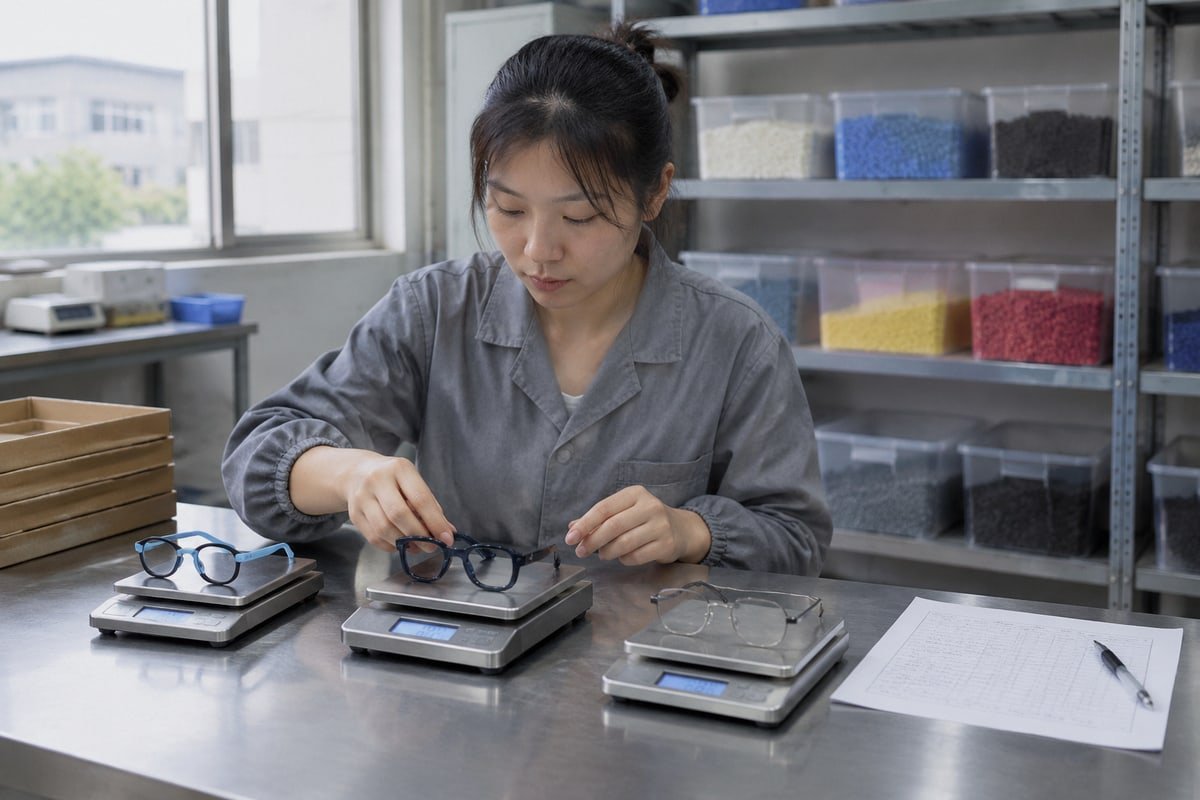
"Ultra-light" is a marketing word. Some brands attach numbers in the 9–15 gram range to it, and many of those numbers are honest. The problem is that they are not always measured the same way. One supplier weighs a bare frame. Another weighs it with demo lenses. A third weighs a small size and lists it for the whole range. So the first step is to remove those differences before you compare anything.
Ask every supplier the same questions
I recommend sending a short, identical list to each factory. It keeps the answers comparable and it shows a supplier how seriously you take the details.
| Question to ask | Why it matters |
|---|---|
| Frame weight in grams, without lenses, for each size | Removes the lens variable |
| Eye size, bridge width, temple length | Lets you judge weight relative to size |
| Hinge type: standard, spring, or screwless | Hinges add grams and change flex |
| Nose pad type: integrated, silicone nose pads, or adjustable | Affects bridge load and pediatric bridge fit |
| Temple construction: solid TR90 or TPEE temples | Changes both weight and grip |
| Material grade and source | Confirms the polymer is what the sheet claims |
Weigh the samples yourself
Spec sheets tell you what was intended. A scale tells you what was made. When samples arrive, weigh each frame without lenses, then again with the lens blanks you expect to use. Write both numbers next to the frame size. Then divide by the total frame width to get a rough weight-per-millimeter figure. This simple ratio exposes the difference between a truly light design and a light number that only applies to the smallest size.
Look beyond the number
Two frames at the same weight can behave very differently on a child. So I suggest a quick fit round with real children whenever possible. Watch for sliding and red marks after twenty minutes. Check that flexible temple tips grip without pinching. Confirm the frame is a hypoallergenic material and BPA-free, since a small child's skin sits against it for hours. Finally, consider the working relationship. A factory with a stable workforce, a managed workshop, and clear communication will hold its weight tolerance from the first order to the twentieth. That consistency is worth more than a single gram on paper.
Conclusion
Heavy frames end up in backpacks. Aim for 12–18 grams, match weight to face size, and keep the fit features that make TR90 kids optical frames worth wearing.
Interested in sourcing the products mentioned in this article? See details and request a quote here:
Footnotes
1. Reference for eyeglass frame components and how temple dimensions affect fit and balance. ↩︎
2. Authoritative clinical information on high refractive errors and the corrective lenses required. ↩︎
3. Medical research database for biocompatibility and hypoallergenic properties of polymers in medical devices. ↩︎
4. Official technical resource for Grilamid TR90, the industry-standard thermoplastic memory polymer. ↩︎
5. Scientific overview of how polymers maintain structural integrity and stability under varying temperatures. ↩︎
More Articles You Might Like



Looking for a Reliable Kids Eyewear Partner?
Explore 800+ ready styles and full OEM/ODM support tailored to your brand.
Get in Touch English
 Español de México
 Deutsch
 Français
 日本語
 العربية
 Português do Brasil