Why Do Nickel Release and Azo Dye Tests Matter for TPEE Kids Sunglasses Compliance?
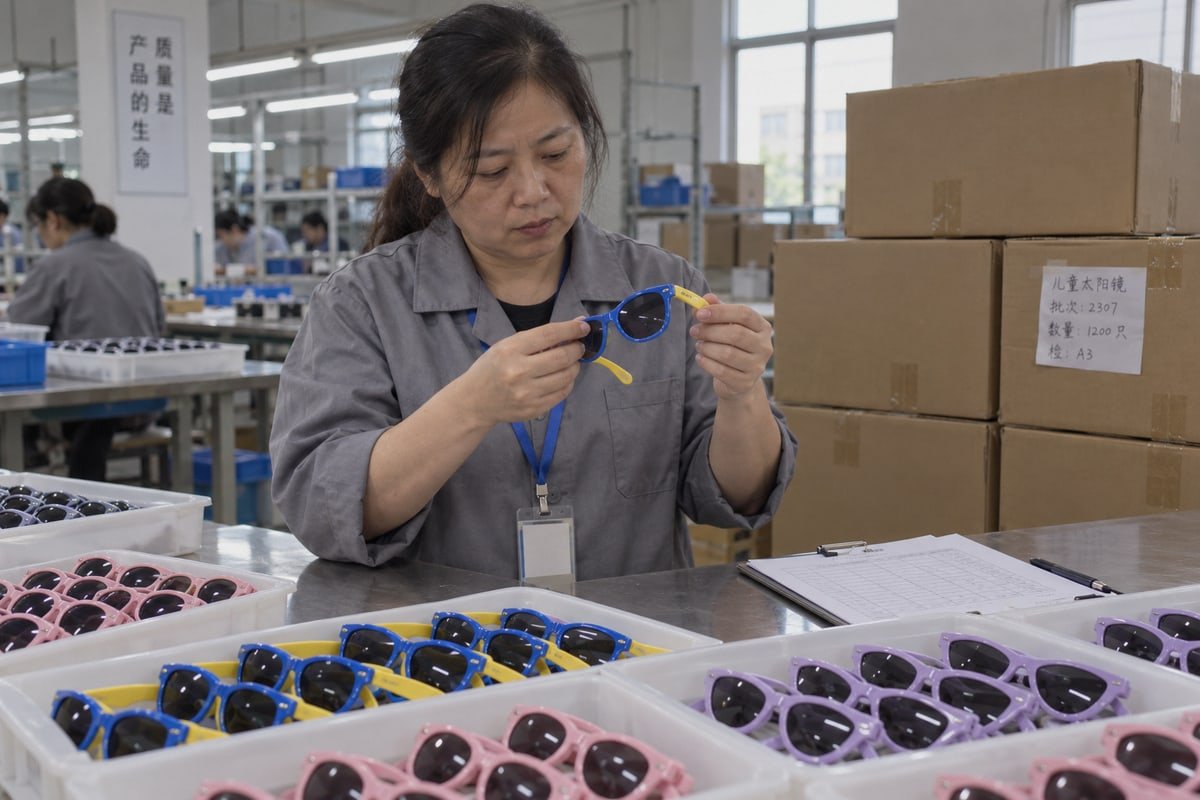
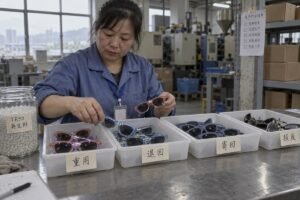
Nickel release and azo dye tests for [TPEE kids sunglasses](https://okayeyewear.com/tpee-kids-sunglasses-follow-toy-safety-standards-should/) compliance feel like paperwork—until a shipment stalls at customs. On our Taizhou production line, we build styles to avoid that.
Nickel release and azo dye tests matter for TPEE kids sunglasses compliance because every part touching a child’s skin—hinges, screws, plated accents, dyed straps—must stay within REACH Annex XVII limits: 0.5 μg/cm²/week for nickel and 30 mg/kg for restricted aromatic amines. They prove the product is marketable and safe.
A kids sunglass looks like one simple object. In reality, it is a small assembly of different materials. Each material carries its own chemical rules. Below, I walk through when each test applies, which markets demand it, and how to check the paperwork your supplier hands you.
How do I know if my TPEE kids sunglasses need nickel release testing?
Last season our QC team pulled a royal-blue frame with yellow temples off the line. The silver hinge rivets had a plating batch change nobody flagged. That started this checklist.
Your TPEE kids sunglasses need nickel release testing if any component in prolonged skin contact contains or is coated with metal—hinges, screws, temple cores, rivets, decorative inlays. Under REACH Annex XVII, release must stay below 0.5 μg/cm²/week, measured by EN 16128 for spectacle frames and sunglasses.
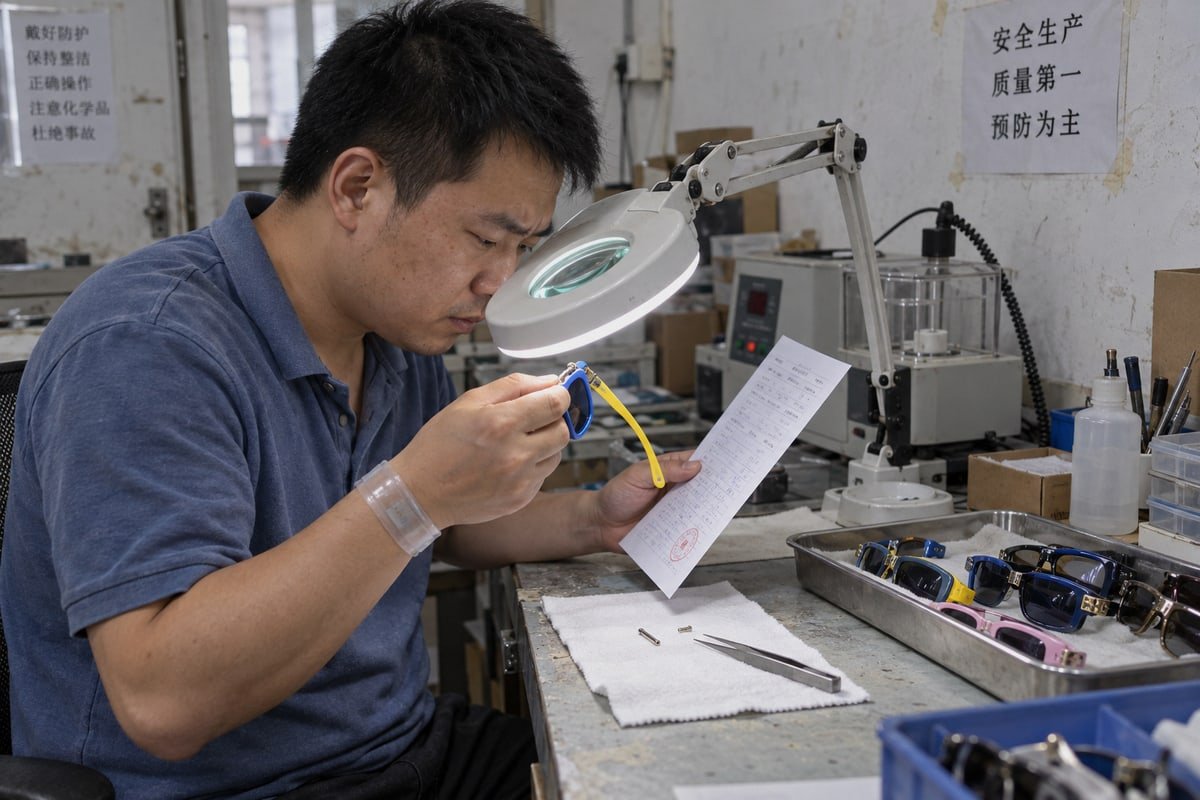
The most common objection I hear from new buyers is simple. "The frame is TPEE. There is no metal. Why test for nickel?" I understand the logic. TPEE is a soft, bendable polymer. It has no nickel in it. But the frame is not the whole product.
Where metal hides in a bendable frame
Even our most flexible children's styles include small metal parts. Some are visible. Many are not. The table below shows where they usually sit.
| Component | Typical material | Skin contact? | Nickel risk |
|---|---|---|---|
| Hinge pins and rivets | Steel, plated alloy | Yes, behind the ear and at the temple joint | High if plated |
| Screws | Stainless or plated steel | Yes, at the hinge | Medium to high |
| Temple core wires | Spring steel inside TPEE | Indirect, but exposed if TPEE wears | Medium |
| Decorative inlays or logo plates | Zinc alloy, plated | Yes, on the temple outer face | High if plated |
| Painted or metallic-look accents | Coating over polymer | Yes | Low, but coating must be checked |
Any one of these parts can push a "plastic" sunglass into the scope of nickel release testing. The blue-and-yellow style I mentioned above has silver hinge details. Those details are small. They still touch a child's skin every time the glasses are worn.
What the test actually measures
Nickel release testing does not ask how much nickel is inside the part. It asks how much nickel migrates out of the surface over one week of simulated wear 1. The reference method for eyewear is EN 16128. Labs also use EN 1811:2023 for general skin-contact articles, and the 2023 update tightened how results are interpreted. Coated parts get extra scrutiny. Labs often run wear and corrosion simulation first, because a plating layer that looks fine today can thin or crack after months of rough handling. This is a form of chemical migration testing, and it can fail on a part that looks completely non-metallic.
Why children raise the stakes
Kids sweat more during play. They chew temple tips. Saliva and sweat both speed up heavy metal leaching from plated surfaces. Nickel is one of the best-known triggers of allergic contact dermatitis 2, and children's skin is thinner and more permeable than adult skin. So a hinge that would never bother an adult can sensitize a child for life. That is why we treat skin sensitivity testing on hinges as a core step, not an optional extra, on every kids style we develop.
What azo dye regulations should I check before importing children's sunglasses?
A procurement manager in Australia once asked me why her sunglass order needed a textile test. Her order included branded neoprene straps and microfiber pouches. That answered it.
Before importing children's sunglasses, check REACH Annex XVII entry 43, which bans azo dyes that release listed aromatic amines above 30 mg/kg in textile and leather articles with prolonged skin contact. It applies to straps, cases, pouches, cords, and dyed trims, not just the TPEE frame.
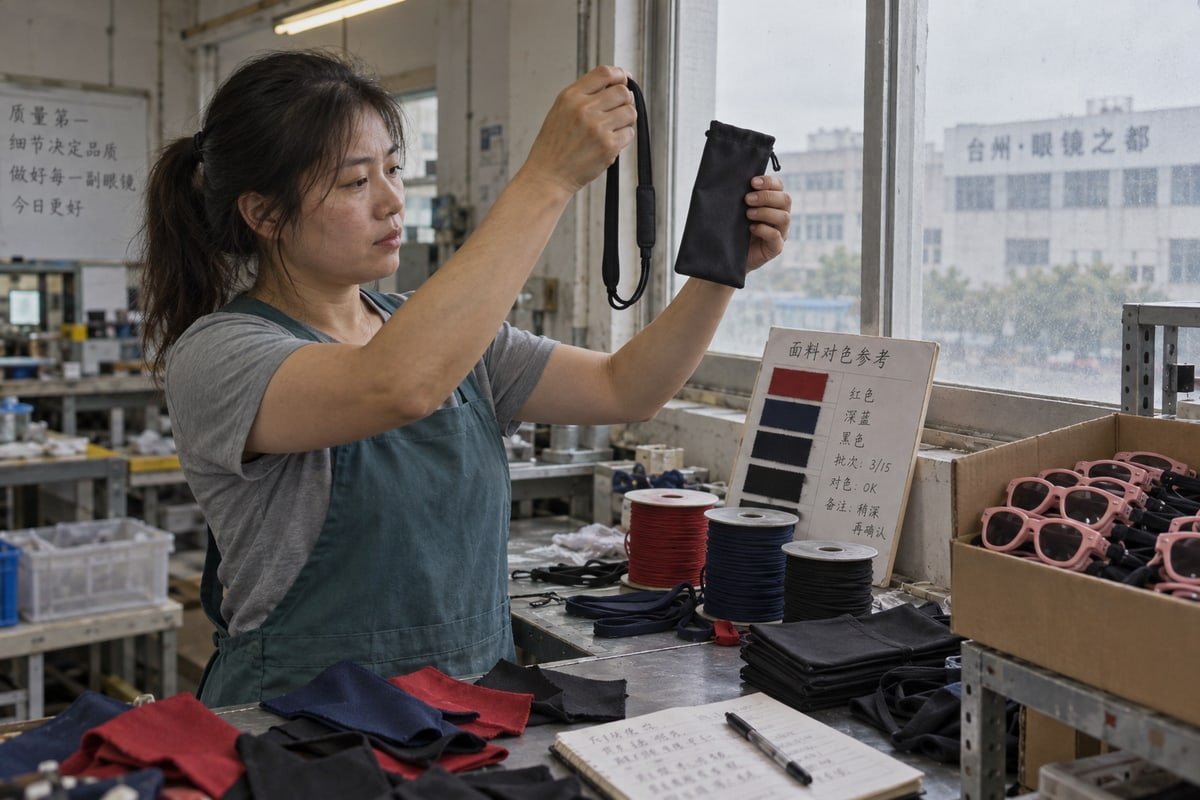
The second objection I hear is a mirror of the first. "Sunglasses are not textiles. Azo dye rules do not apply." Again, the frame alone supports that view. The full retail product usually does not.
What the test looks for
Azo colorants are cheap, bright, and stable. That is why they are common in dyed fabrics and coated leathers. The problem is that some azo dyes 3 can break apart under reducing conditions—for example, in contact with sweat or saliva. When they break, they can release arylamines. Some of those arylamines in dyes are classified as carcinogens. The lab test simulates that breakdown and measures the amines that appear. If any listed amine exceeds 30 mg/kg, the article fails REACH entry 43.
Which parts of a kids sunglass SKU fall in scope
When we prepare an OEM order, we list every soft or dyed component separately. This is what that list usually looks like.
| Part | Common in kids eyewear? | In scope for azo testing? | Notes |
|---|---|---|---|
| TPEE or TR90 frame | Always | Usually not a textile article | Pigment safety is checked separately |
| Retainer strap or sports band | Very common for toddlers | Yes | Neoprene, polyester, or elastic webbing |
| Microfiber cleaning cloth | Common | Yes | Often printed with a brand logo |
| Pouch or soft case | Common | Yes | Dyed fabric or PU leather |
| Woven labels and hang tags with cord | Common | Yes, if worn or handled | Low weight, still dyed |
| Printed logo on temple | Sometimes | Not textile, but pigment declaration needed | Ink chemistry review |
So a single SKU can need nickel release and azo dye tests plus a separate pigment review. There is no one "product-level" pass. Each material must stand on its own.
Beyond the legal minimum
Many of our European and Japanese brand customers go past REACH. Their Restricted Substances List 4 often adds tighter limits for children's products and requires periodic re-testing. Some also ask for a short toxicological risk assessment on new colorways. Two emerging topics come up in those discussions. One is photo-allergic behavior, where UV exposure may help break stable dyes into reactive compounds on the skin—relevant because sunglasses live in sunlight. The other is "cocktail effect" research, which suggests trace nickel and certain azo dyes may interact with chemical filters in children's sunscreens. Neither is a law yet. Both are reasons to keep dyed accessories clean from the start.
Which markets require nickel and azo dye compliance for kids eyewear?
Every new market we ship to forces a choice: test to the strictest rule once, or test market by market. With customers in 20+ countries, we usually pick the first.
The EU is the clearest case: REACH Annex XVII covers nickel release and azo dyes, and CE marking for sunglasses builds on ISO 12312-1 compliance. The United States applies CPSIA requirements to children's products, while major retailers in Australia, Japan, and Europe add their own Restricted Substances Lists.

Not every market writes the same rule in the same words. But the direction is the same everywhere: children's products get more scrutiny, not less. Here is how I explain the landscape to buyers who are launching in several regions at once.
| Market or channel | Core legal reference | Nickel release | Azo dyes | What a buyer usually asks for |
|---|---|---|---|---|
| European Union | REACH Annex XVII; CE mark 5ing with ISO 12312-1 compliance for sunglasses | Entry 27, 0.5 μg/cm²/week, EN 16128 | Entry 43, 30 mg/kg | Full REACH test set plus EN 71-3 safety standards on toy-like designs |
| United Kingdom | UK REACH mirrors EU limits | Same threshold | Same threshold | UKCA plus the same lab reports |
| United States | CPSIA requirements for children's products | No federal nickel release limit; retailer RSLs apply | No federal azo ban; retailer RSLs apply | CPSIA third-party testing, phthalate-free certification, lead in coatings |
| Australia and New Zealand | Sunglass standard aligned with ISO 12312-1 | Not a national limit; buyer RSLs common | Buyer RSLs common | EU-style reports accepted as proof |
| Japan | Buyer-driven chemical programs | Retailer-specific | Retailer-specific | Often the strictest internal limits for kids |
Why retailer programs matter more than you think
Laws set the floor. Retailers set the real bar. A large children's chain in Europe or Australia may require re-testing every twelve months, on every colorway, from an accredited lab. Some require both nickel and azo results even for markets where the law is silent. In practice, this means a brand selling in Sydney can be held to REACH limits by its own retailer. That is why we treat the EU thresholds as our baseline for all kids styles, regardless of destination. It is cheaper to test once to the strictest rule than to explain a gap later.
Digital Product Passports and circularity
Two trends are changing how this data is used. First, the EU is moving toward Digital Product Passports. A parent may soon scan a QR code on a temple and see nickel-free and azo-free status directly. Second, recyclers care about the same data. Contaminated polymers are excluded from high-quality recycling streams. So a clean TPEE frame with compliant hinges has better circularity potential than one that fails. Compliance is starting to affect end-of-life value, not just market entry.
How can I verify my supplier's test reports are accurate and up to date?
The hardest lesson from fifteen years in eyewear: a report is only as good as its sample. We match every report to a specific color, batch, and bill of materials.
Verify supplier test reports by confirming the lab is accredited, the report number matches the lab's database, the sample matches your color and bill of materials, the standard cited is current (EN 16128, EN 1811:2023, REACH entry 43), and nothing in materials or coatings changed after the test date.
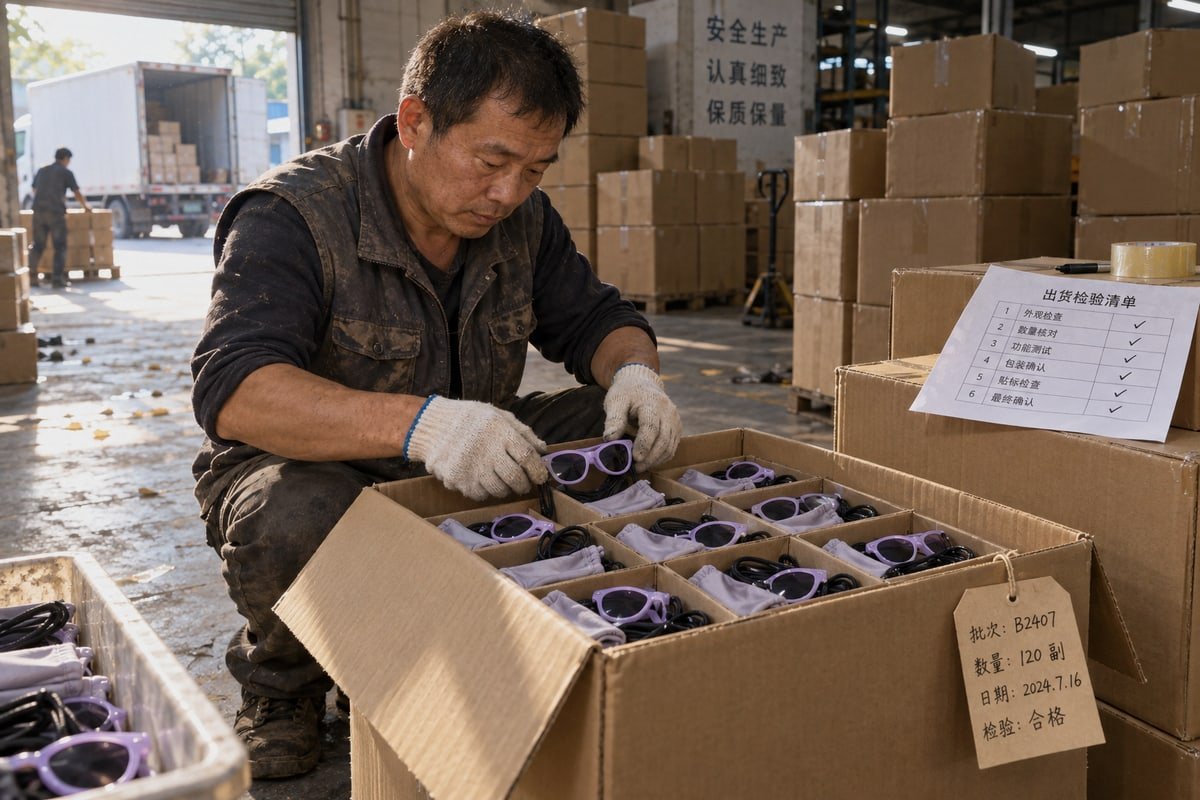
A common misconception is that a CE mark engraved on the inner temple—like the one on our lavender cat-eye style—proves chemical compliance. It does not. The mark is a declaration. The evidence behind it lives in the reports. Here is the process I recommend to every procurement manager who works with us.
A five-step verification process
- Check the lab. Look for an accreditation body and scope on the report. Then confirm the report number on the lab's online verification portal. Fake or edited PDFs are more common than most buyers expect.
- Match the sample. The report should name the style number, the color, and the components tested. A report on a blush-pink round frame does not cover a royal-blue frame with different hinges.
- Read the standards line. Nickel results should cite EN 16128 for eyewear or EN 1811:2023 for general articles. Azo results should cite REACH Annex XVII entry 43 and the amine list. If the report cites an old version, ask why.
- Check the date against the bill of materials. Ask the supplier for the current BOM and coating supplier. If the plating shop, dye lot, or strap fabric changed after the test date, the report is stale.
- Look at the full package. For kids products, nickel and azo reports rarely travel alone. Expect ISO 12312-1 compliance for lens and frame performance, EN 71-3 safety standards for heavy metal leaching where the design is toy-like, and phthalate-free certification for soft parts.
Red flags I watch for
| Red flag | What it usually means | What to ask |
|---|---|---|
| Report older than 12–18 months | Materials may have changed | Request re-test or a change log |
| No component breakdown | Only the frame was tested | Ask for hinge, screw, and strap results |
| Report from a trading company, not a factory | Sample origin unclear | Ask who made the tested batch |
| "Non-toxic" or "hypoallergenic" claim with no report | Marketing, not evidence | Request lab data |
| Generic REACH statement without entry numbers | Not specific to nickel or azo | Ask for entries 27 and 43 by name |
Why ongoing supplier control matters
Our factory runs about 800 existing kids styles under a 5S-managed workshop with roughly 120 workers. That catalog helps new brands launch without mold investment. But it only helps if each style carries current, matched documentation. When a buyer requests a custom color, logo inlay, or strap through our OEM service, the chemistry changes. So the test file must change too. A reliable partner tells you that before you ask.
Conclusion
Mixed materials make kids sunglasses risky. One missed hinge or strap can stall a launch. Test every skin-contact part, verify the reports, and choose a partner who does both.
Interested in sourcing the products mentioned in this article? See details and request a quote here:
Footnotes
1. ISO is the global authority for standards involving product testing and simulated wear performance. ↩︎
2. NIH provides authoritative medical information on nickel-induced allergic contact dermatitis and skin sensitivity. ↩︎
3. Wikipedia provides a detailed chemical overview of azo dyes and their industrial applications. ↩︎
4. Official ECHA page explaining the REACH restrictions and the list of substances subject to limitation. ↩︎
5. Official EU resource for business regulations, including CE marking and product compliance requirements. ↩︎
More Articles You Might Like


Looking for a Reliable Kids Eyewear Partner?
Explore 800+ ready styles and full OEM/ODM support tailored to your brand.
Get in Touch English
 Español de México
 Deutsch
 Français
 日本語
 العربية
 Português do Brasil