What Is the Nickel Release Limit Standard for Kids’ Optical Frames?

The [nickel release](https://okayeyewear.com/?p=5649) limit standard for kids’ optical frames confuses many buyers who contact our factory in Taizhou. They worry a single failed test could trigger a recall, destroy retail trust, and end a product line overnight. That fear is valid — nickel allergic contact dermatitis 1 affects millions of children, and regulators do check. The good news is that the rule is clear, testable, and manageable once you understand it, which is exactly what I will walk you through here.
The nickel release limit standard for kids’ optical frames in Europe is 0.5 µg/cm²/week, set by REACH Annex XVII, Entry 27, and tested under EN 16128:2025. It applies to all metal frame parts in direct, prolonged skin contact, regardless of the wearer’s age.
That short answer hides a lot of practical detail. Below, I break down how to verify compliance, which tests to request, which materials sidestep the problem, and how to keep every batch consistent.
How do I know if my kids' optical frames meet nickel release safety standards?
A procurement manager from a European baby brand once asked me a simple question during a factory visit: how would she actually know a frame was safe? Paperwork alone did not reassure her, and I understood why.
Kids' optical frames meet nickel release safety standards when metal skin-contact components release less than 0.5 µg/cm²/week of nickel, verified by an accredited lab using the EN 16128 test method, with results documented in a test report referencing REACH Annex XVII, Entry 27.

The first thing to understand is that there is no separate, children-only rule in the European standard text. Children's frames are covered because they are spectacle frames 2 with metal parts in prolonged skin contact. And "prolonged contact" has a precise legal definition: skin contact exceeding 10 minutes on three or more occasions within two weeks, or 30 minutes continuously. A child wearing glasses all day at school clears that bar easily.
The second thing to understand is the difference between the limit value and the test method. The limit — the nickel migration limit of 0.5 µg/cm²/week — comes from REACH Annex XVII 3, Entry 27. The test method — how a lab actually measures release — is EN 16128, updated in 2025 to replace the 2015 version. ISO 12870 requirements add an international layer: it is the benchmark standard for spectacle frames, and it requires metal-containing models to meet nickel release standards as part of biocompatibility.
Which parts of the frame are covered?
Only the skin-contact components matter for this test. In our experience, these are the risk points:
| Component | Skin Contact? | Typical Risk Level |
|---|---|---|
| Nose pads and bridge hardware | Yes, constant | High |
| Temple arms and tips | Yes, constant | High |
| Hinges and screws | Sometimes (behind hinge covers) | Medium |
| Decorative metal inlays on the front | Rarely | Low |
| Internal wire cores in plastic temples | Only if exposed | Low, unless coating wears |
So when you audit a supplier, ask which specific components were tested — not just whether "the frame" passed. A frame can contain nickel and still comply, because the rule regulates nickel release, not nickel content alone.
What testing methods should I request from my frame supplier to verify nickel compliance?
There is a real trade-off we weigh every time we quote a new metal-detail design: a quick screening test is cheap and fast, but only a full lab protocol gives buyers documentation that stands up to EU market surveillance.
Request an EN 16128 nickel release test from an accredited third-party lab, preceded by EN 12472 wear-and-corrosion simulation, plus a dimethylglyoxime spot test for fast screening. The report must state results in µg/cm²/week against the 0.5 limit and reference REACH Annex XVII.

Testing works in a defined sequence, and each stage answers a different question. Here is the process I recommend buyers write into their purchase agreements:
- Screening: the dimethylglyoxime spot test. A DMG-soaked swab is rubbed on the metal part. A pink color indicates significant nickel release. It is not a legal pass/fail method, but it catches problems in minutes and costs almost nothing.
- Wear simulation: EN 12472. Coated parts are tumbled with an abrasive medium to simulate roughly two years of typical use. This matters because a fresh nickel-free plating can pass easily — the question is whether it still passes after the coating wears.
- Release measurement: EN 16128. The part is immersed in artificial sweat for one week, and the released nickel is measured. EN 16128:2025 is the current reference method for spectacle frames; EN 1811 covers most other skin-contact articles, so make sure your lab uses the eyewear-specific method.
- Reporting. The report should identify the exact components tested, the batch, and the result against 0.5 µg/cm²/week.
One honest caveat on wear testing
Standard EN 12472 tumbling may not fully capture the micro-abrasion caused by children frequently dropping their frames, which can create localized hotspots of higher nickel release. History shows why vigilance matters: one older screening study found 96% of used metal frames and 24.5% of new frames tested positive for nickel leaching. That data predates modern compliance regimes, but it explains why standards evolved — and why we favor designs that avoid exposed metal entirely.
Which materials can I choose to avoid nickel release issues in children's eyewear altogether?
Fifteen years of building kids' frames taught our team one durable lesson: the easiest nickel problem to manage is the one you design out. That is why most of our roughly 800 existing styles use flexible polymers instead of metal.
Choose all-polymer frames — TR90, TPEE, acetate, or silicone — with no exposed metal skin-contact parts to eliminate nickel release entirely. Where metal is unavoidable, specify titanium, surgical stainless steel, or verified nickel-free plating on hinges, screws, and nose-pad arms.
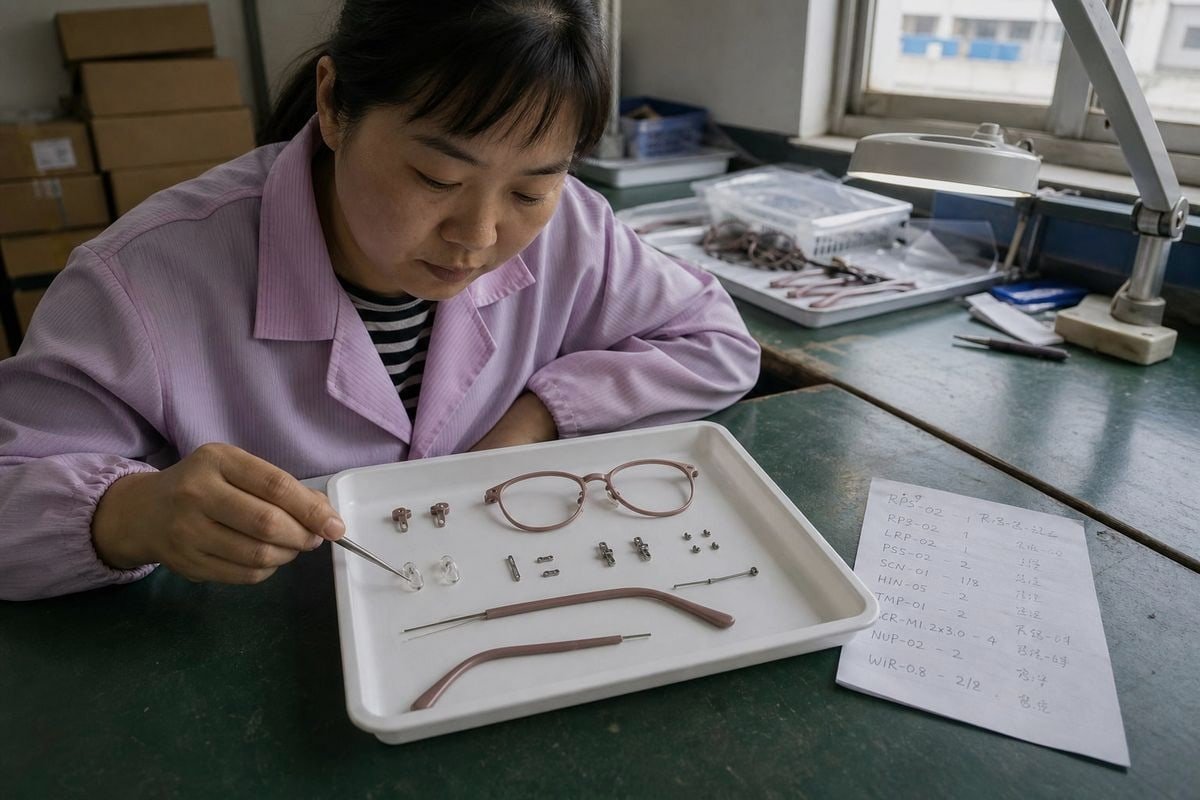
There is an important distinction to raise here, because it confuses shoppers and buyers alike. "Nickel-safe" means the part meets the release limit. "Nickel-free" means zero nickel content. Pediatric brands are increasingly shifting toward genuine nickel-free construction, because deep scratches from playground drops can bypass surface coatings that a lab tumble test never fully replicates. Marketing terms like hypoallergenic spectacle frames 4 sit somewhere in between — "hypoallergenic" has no legal definition, so always ask what material claim backs it up.
Here is how the common material options compare for pediatric eyewear safety:
| Material | Nickel Risk | Flexibility | Weight | Best Use in Kids' Frames |
|---|---|---|---|---|
| TR90 | None (polymer) | High | Very light | Full frames, fronts |
| TPEE | None (polymer) | Very high | Very light | Temples, flexible frames |
| Acetate | None (polymer) | Medium | Light | Fashion-forward frames |
| Silicone | None (polymer) | Very high | Very light | Baby frames, temple tips |
| Titanium | None (nickel-free metal) | Medium | Light | Premium metal frames |
| Monel / nickel silver alloys | High without plating | Low | Heavier | Avoid for children |
Take the two styles we frequently ship as examples. Our glossy black rectangular-rounded frame pairs a TR90 front with navy TPEE temples ending in soft sky-blue silicone ear hooks — every skin-contact surface is polymer. Our translucent pale-pink acetate style keeps its small hinge hardware recessed inside the temple, away from the skin. Children's sweat also tends to be more acidic than adults', which accelerates coating degradation and nickel ion migration — one more argument for polymer-first design in this category.
How do I ensure every batch stays consistent with nickel release limits over time?
A lesson I learned the hard way early in my export career: a perfect first-article test means little if the plating shop quietly changes its bath chemistry in month six. Consistency is a process, not a certificate.
Ensure batch consistency by locking approved material specifications, requiring supplier change notifications, running DMG spot checks on incoming metal components, scheduling periodic EN 16128 retests annually or per material change, and keeping traceable batch records tied to each test report.

Nickel compliance drifts for predictable reasons: a sub-supplier substitutes a cheaper alloy, a plating thickness drops below spec, or a new decorative finish gets added without retesting. Your control system should target exactly those failure modes. In our 5S-managed workshop, we treat metal components — screws, hinges, wire cores — as controlled inputs with locked specifications, because those small parts are where surprises hide.
A practical batch-control framework
| Control Point | Frequency | Method | Who Owns It |
|---|---|---|---|
| Material specification lock | At order confirmation | Signed spec sheet naming alloys and platings | Buyer + factory |
| Incoming component screening | Every metal component lot | Dimethylglyoxime spot test | Factory QC |
| Full compliance retest | Annually, or on any material/supplier change | EN 16128 at accredited lab | Factory, report to buyer |
| Change notification clause | Ongoing | Written notice before any substitution | Contract |
| Batch traceability | Every shipment | Lot codes linked to test reports | Factory QC |
You should also watch the regulatory horizon. EN 16128:2025 is the current reference method, intended to become the national standard across EU member states by April 2026, with conflicting national standards withdrawn. Some regulatory experts anticipate a future move toward a 0.2 µg/cm²/week limit for children's eyewear, matching the stricter threshold currently reserved for piercing posts. Nothing is finalized, but a smart brand builds margin now. Frames that test at 0.4 µg/cm²/week pass today and fail tomorrow; polymer-first frames with nickel-free hardware pass under any plausible future limit. That is the resilience we design for when we develop new styles with our OEM/ODM clients — it protects their brand, not just this season's shipment.
Conclusion
The nickel release limit standard is clear: 0.5 µg/cm²/week under EN 16128 and REACH. Verify it, design around it with polymers, and control every batch consistently.
Footnotes
1. Authoritative medical overview of the skin condition caused by nickel exposure in consumer products. ↩︎
2. Official ISO standard page for spectacle frames, covering technical requirements and biocompatibility. ↩︎
3. Official ECHA page explaining the REACH regulation which restricts hazardous substances like nickel. ↩︎
4. General reference explaining the term hypoallergenic and its application to consumer goods and materials. ↩︎
More Articles You Might Like

August 5, 2026
Bio-Based vs Regular Cellulose Acetate: What's the Difference for Kids' Frames?

August 5, 2026
How Recyclable Are Kids' Optical Frame Materials, and What Eco-Friendly Alternatives Exist?
August 5, 2026
Do Kids Optical Frames Whiten or Age in Storage, and How to Control Warehouse Conditions?
Looking for a Reliable Kids Eyewear Partner?
Explore 800+ ready styles and full OEM/ODM support tailored to your brand.
Get in Touch English
  Español de México
  Deutsch
  Français
  日本語
日本語  العربية
  Português do Brasil