What Nose Bridge Types Exist for TR90 & TPEE Kids Frames: Asian vs Western Fit?
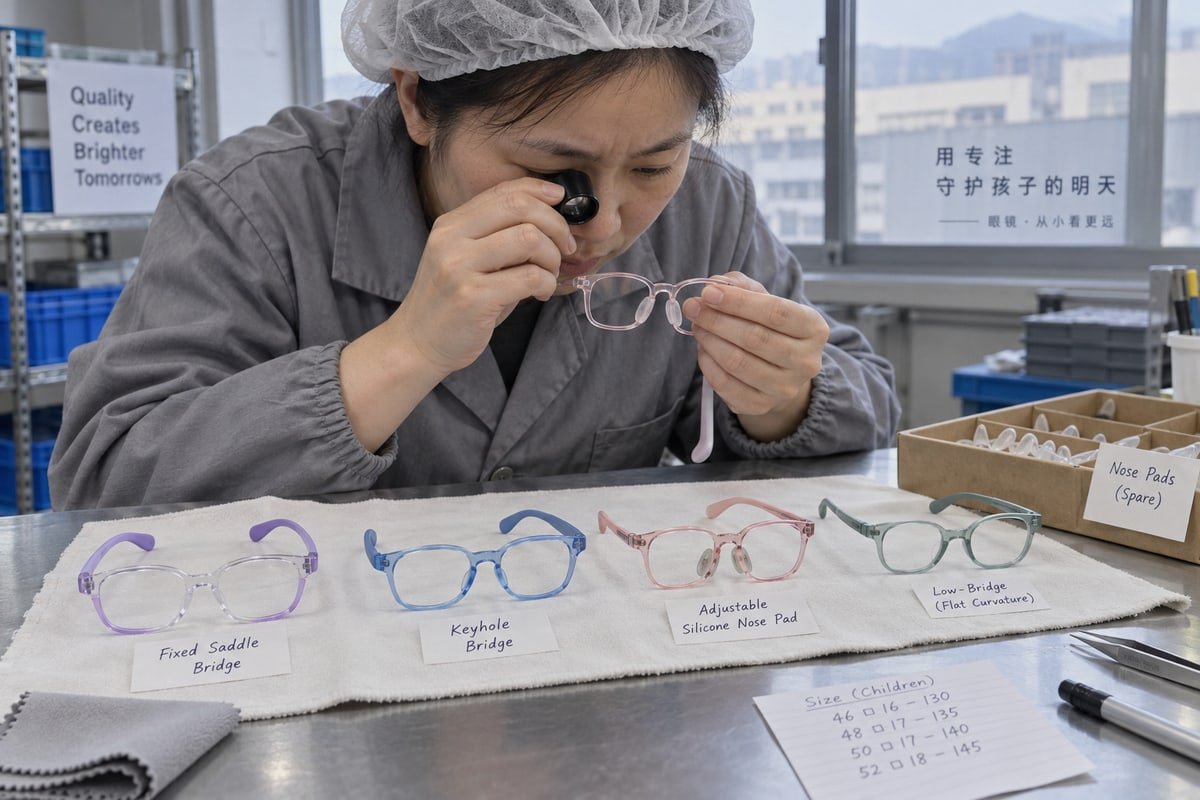
Nose bridge types for TR90 and TPEE kids frames 1 decide whether glasses stay on. Slipping frames frustrate kids and parents. On our Taizhou line, the fix starts with bridge geometry.
Nose bridge types for TR90 and TPEE kids frames fall into four groups: fixed saddle bridges, keyhole bridges, adjustable silicone nose pads, and low bridge or Asian fit designs with deeper pads and flatter curvature. Western fit uses a higher, narrower bridge for more prominent nasal roots.
Below, I walk through each bridge type. I explain how Asian fit and Western fit differ. I show which bridge suits which age. And I list what to ask a factory before you place an order.
How do I choose between Asian fit and Western fit nose bridges for kids' frames?
A procurement manager from Melbourne once asked us for a single bridge that fit every child in her range. We showed her two sample sets instead.
Choose Asian fit nose bridges when your market's children have flatter, lower nasal bridges and wider heads; choose Western fit when nasal roots are higher and narrower. Judge by facial morphology and cheekbone clearance, not ethnicity, and offer low bridge fit as a labeled option.
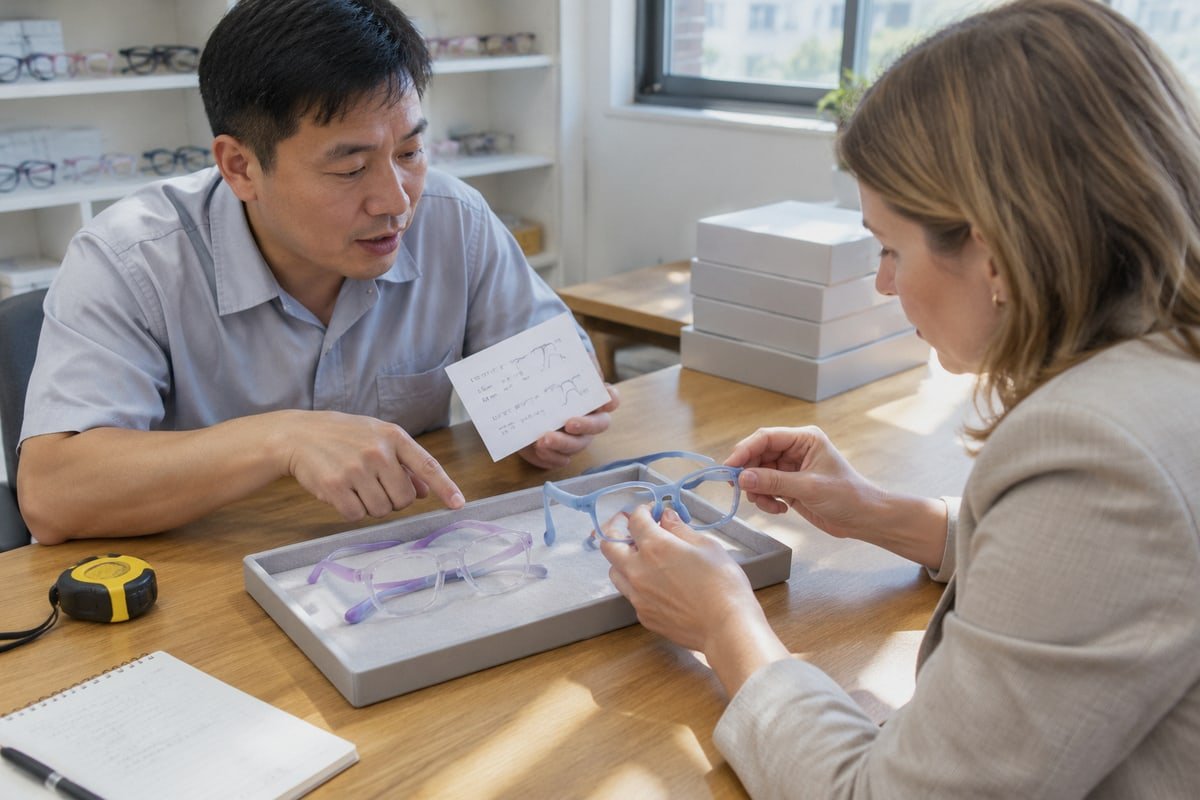
The fastest way to see the difference is side by side. This is the table we use in sample reviews with buyers.
| Feature | Asian fit / low bridge fit | Western fit / standard fit |
|---|---|---|
| Bridge height | Lower, sits closer to the lens line | Higher, set farther above the lens |
| Nose pads | Thicker and deeper for extra lift | Thinner pads or an integrated saddle |
| Bridge width | Often wider to match a flatter nose | Narrower for a more prominent nasal root 2 |
| Frame curvature | Flatter, so temples do not pinch wider heads | More wrap at the front |
| Pantoscopic tilt 3 | Reduced, to avoid lens-to-cheek contact | Standard tilt |
| Common retail labels | Low bridge fit, Asian fit, global fit eyewear | Standard fit, regular fit |
What the labels really mean
The words "Asian fit" and "Western fit" are shorthand. Eyewear brands use them to describe facial proportions and bridge heights. They are not strict statements about ethnicity. In our experience exporting to 20+ countries, we see huge variation within every market. A child in Osaka may need a standard bridge. A child in Munich may need a low bridge fit. That is why many of our buyers now prefer neutral terms like "low bridge fit" or "global fit." These terms tell the parent what the frame does, not who it is for.
Here is a common objection. "If the label is imprecise, why use it at all?" My answer is that a label still helps a shopper narrow the search fast. The fix is not to drop the label. The fix is to pair it with real numbers, such as bridge width in millimeters, so the label is a starting point and not a promise.
A simple decision path
I ask buyers three questions during development:
- Where does the nasal root sit on your typical customer? Lower means deeper pads or a lower bridge.
- How wide is the head at the temples? Wider means flatter frame curvature.
- Do the lenses touch the cheeks when the child smiles? If yes, reduce the pantoscopic tilt.
Pediatric optometry practices in mixed markets often stock both fits. If your brand sells into one of those markets, plan for two bridge variants of your best style rather than one compromise.
Why does nose bridge shape matter for children's comfort and slippage prevention?
One lesson from our 5S workshop stuck with me: a frame can pass every drop test and still fail on a child's nose within a minute.
Nose bridge shape matters because children's noses are flatter and lower-set than adults'. A bridge that is too high or narrow lets the frame slide, touch the cheeks, or sit too close to the eyes. Correct bridge height, width, and pad contact stop frame slippage.

A child's nasal bone 4 is still developing. The bridge sits lower on the face than it will at age fifteen. If we copy an adult bridge and shrink it, the frame rests on the wrong spot. Weight then pulls the frame forward every time the child looks down at a book or a tablet. The child pushes it back up. The parent gets tired of watching. That cycle is what buyers call "constant adjustment," and it drives returns.
Reading the size numbers
Most kids frames carry a code like 42-15-110. The first number is lens width. The middle number, 15, is the bridge width in millimeters. The last number is temple length. Bridge width is the number I ask buyers to look at first. One kids guide recommends bridge widths of around 14 to 16 mm for toddlers, with low bridge designs for flatter nasal bridges. If your target child has a 14 mm bridge and the frame is 18 mm, no material will save the fit.
Bridge shapes and weight distribution
The saddle bridge design is the most common shape in TR90 and TPEE kids frames. It spreads the frame's weight across a larger area of the nose. Less pressure per square millimeter means less red marks and less complaint. A keyhole bridge rests on the sides of the nose and leaves the top open. It looks classic, but it needs a defined nasal root, so we use it less for young kids. In toddler frames made of thermoplastic polyester elastomer 5, we often move the bridge lower on the frame front. This "lowered bridge" position matches an underdeveloped nasal bone and keeps the lenses centered on the eyes.
Weight helps too. TR90 kids frames on our line usually land near 12 to 15 g, and some full frames reach 15 to 20 g. Guides for children's frames often treat anything under about 17 g as especially comfortable. Lighter frames need less grip to stay in place.
The shake test
Here is the fit check we run on every wear-test sample.
| Check | What you see | What it means |
|---|---|---|
| Look down for five seconds | Frame slides forward | Bridge too high or too narrow; pads too shallow |
| Shake head side to side | Frame shifts on the nose | Poor pad contact or wrong bridge width |
| Big smile | Lens rim touches cheek | Pantoscopic tilt too steep; needs cheekbone clearance |
| Side view | Visible gap between frame and face | Light leakage on sunglasses; unstable fit |
| After 20 minutes | Red marks on nose | Pressure too concentrated; consider saddle bridge or softer pad |
A buyer will sometimes tell me, "We chose TPEE because it is soft, so slipping is solved." I push back on that. Softness helps comfort and helps hypoallergenic frames feel gentle on skin. It does not change bridge geometry. A soft frame with the wrong bridge still slides. Material and bridge shape have to be chosen together.
Can I customize TR90 and TPEE nose bridges for my target market's face shapes?
During a sampling run last spring, our mold team cut the same TR90 front with three bridge inserts. The buyer picked one for Japan and another for Germany.
Yes. TR90 and TPEE nose bridges can be customized by bridge width, bridge height, pad depth, frame curvature, and pantoscopic tilt. Options include interchangeable pad sizes, co-molded TPEE bridges on TR90 fronts, and low bridge versions of existing molds, often without full new tooling.
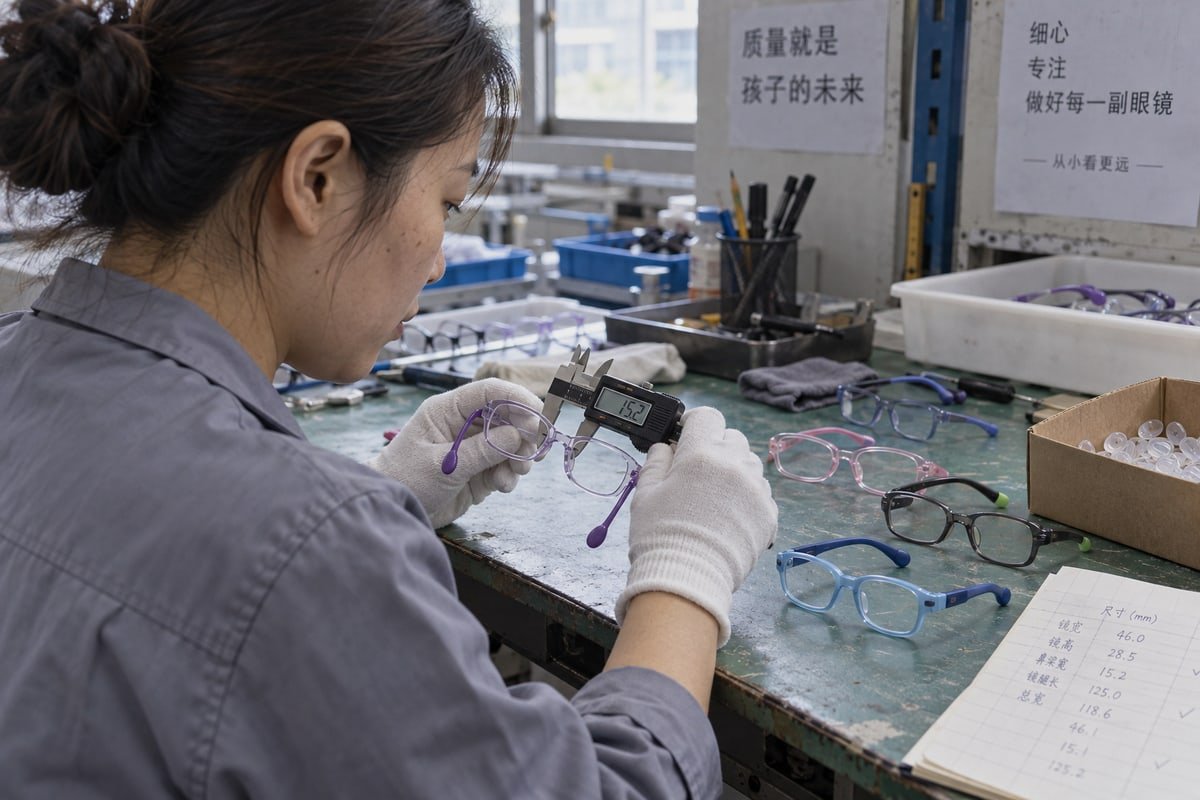
Customizing the bridge is the most valuable ODM change a kids brand can make. It is also less expensive than most buyers expect. Our approach follows a fixed order.
Our five-step bridge customization process
- Pick a base style. We start from our library of around 800 existing styles. This lets a new brand test a market without heavy mold investment.
- Define the target fit in numbers. We ask for bridge width, target age range, and whether the market leans toward a low bridge fit. If a buyer has no data, we send fit samples in two bridge widths.
- Choose the bridge approach. Small changes go into a bridge insert. Bigger changes use interchangeable pads or a co-molded TPEE bridge.
- Sample and wear test. We run the shake test and cheekbone clearance check on children in the target age range.
- Lock the spec. Bridge width, pad size, and tilt go into the QC sheet so every production lot matches.
Which customization fits which goal
| Customization | Tooling impact | Best for |
|---|---|---|
| Interchangeable pad sizes (baby, low bridge, wide) | Low; one frame, several pad sets | Toddler-to-teen lines with one hero style |
| Adjustable nose pads on TR90 or metal-hybrid fronts | Low to medium | School-age kids with uneven or evolving fit |
| Co-molded TPEE bridge on a rigid TR90 front | Medium; over-molding tool | Sports and active wear that needs non-slip grip |
| Low bridge version of an existing mold | Medium; modified insert | Markets with flatter nasal bridges |
| Variable-width bridge using TR90 elasticity | Medium to high | Frames meant to grow with the child over several years |
Newer options worth asking about
Hybrid over-molding is growing fast. A rigid TR90 front gives structure, impact resistance, and lens retention. A fused TPEE bridge gives a soft, almost suction-like grip on the nose. We like this combination for active kids because it removes the need for separate pads that can come loose. Some brands are also moving the bridge slightly higher on the rim. This keeps the optical center aligned when a child tilts their head down for long tablet sessions. And a few suppliers are exploring antimicrobial additives in the TPEE bridge zone, since the nose area collects sweat and skin oil. I treat that one as emerging rather than standard, so ask for material documentation before you build marketing claims on it.
One trade-off comes up often. Adjustable nose pads give fine-tuning, but they add small parts and can be less durable in the hands of a two-year-old. For children under about three, I recommend a one-piece molded TPEE bridge. For school-age kids, adjustable or interchangeable pads usually win. You do not have to pick one for the whole range.
What nose bridge options should I request when sourcing kids' eyewear from a manufacturer?
Every sourcing brief forces a trade-off we weigh with buyers: fine-tuning from adjustable pads versus the toddler-proof simplicity of a one-piece molded bridge.
Request the bridge width in millimeters, a low bridge fit variant, adjustable or interchangeable nose pads, frame weight under about 17 g, cheekbone clearance data, and shake-test results. Also ask for age-specific bridge options for toddlers, school-age kids, and sports use.
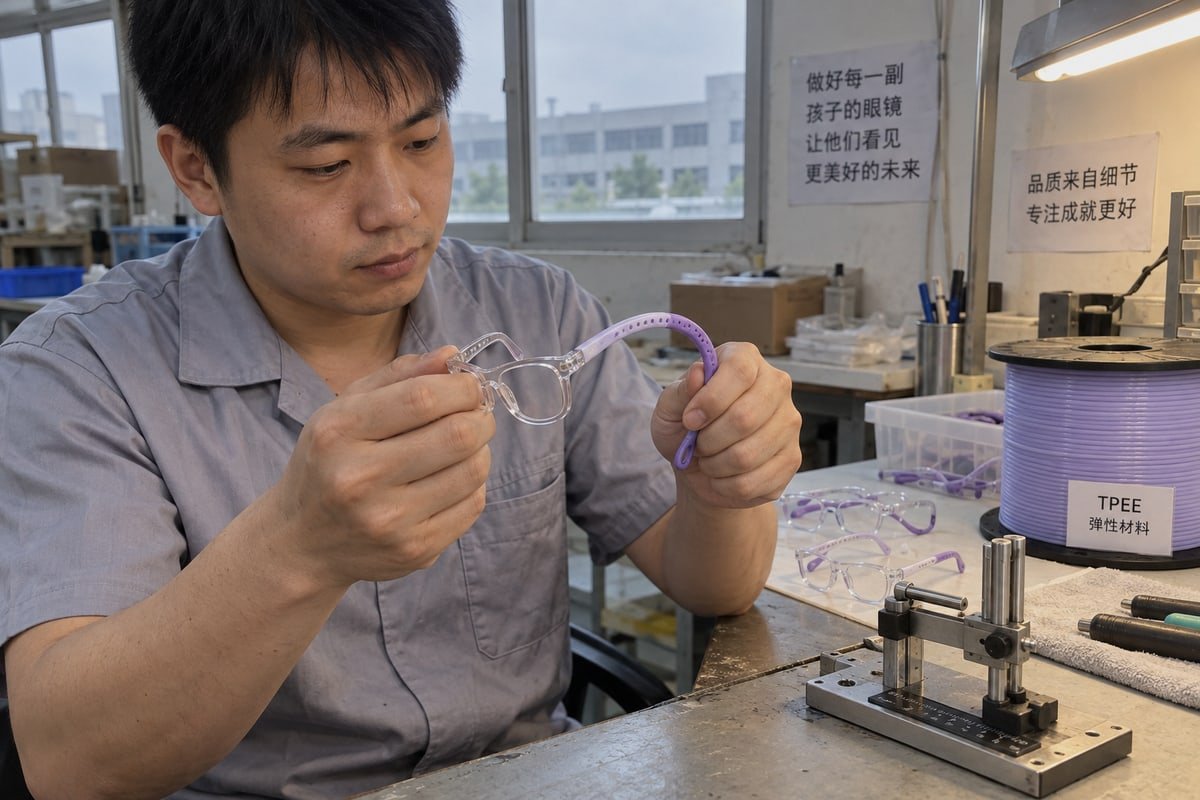
A clear brief saves weeks of sampling. Below is the checklist I hand to new B2B buyers. It covers the bridge and the retention system, because the two work together.
The bridge sourcing checklist
| What to request | Why it matters | What a good answer looks like |
|---|---|---|
| Bridge width in mm for each size | Middle number in codes like 42-15-110 sets the fit | Specific figures per size, e.g. 14 to 16 mm for toddlers |
| Low bridge fit or global fit eyewear variant | Serves flatter nasal bridges in your market | Same style offered with deeper pads or lower bridge |
| Adjustable nose pads or interchangeable pad sets | Lets one frame serve a wider age range | Pad sizes listed; retention method explained |
| Frame weight | Lighter frames need less grip | Kids TR90 near 12 to 15 g; under about 17 g preferred |
| Cheekbone clearance and pantoscopic tilt | Prevents lens-to-cheek contact and light leakage | Wear-test photos showing clearance on a smile |
| Shake-test results | Confirms frame slippage is controlled | Frame stays put on head shake and downward gaze |
| Material spec | Softness, impact resistance, hypoallergenic frames | TPEE for toddlers; TR90 or TR90 with TPEE temples for older kids |
| Retention system | Bridge is not the only anchor | Looped ear hooks, cable temples, or straps for toddlers and sports |
What to request by scenario
The right nose bridge types for TR90 and TPEE kids frames change with age and use. I usually frame the request this way:
- Toddlers (about 1 to 3 years): Ask for a soft, low, one-piece TPEE saddle bridge. Pair it with looped ear hooks or a strap. On our translucent toddler optical frames, the looped TPEE temple tips do as much retention work as the bridge does.
- School-age kids: Ask for TR90 fronts with adjustable nose pads or interchangeable pad sets. This is the sweet spot for weight, comfort, and adaptability across a growing face.
- Active or sports use: Ask for a low bridge fit with anti-slip pads or a co-molded TPEE bridge, plus a flatter curvature so temples do not pinch during play. Wraparound or strap-based designs stay put, but they look less versatile for everyday wear. Decide which matters more for your line.
- Sensitive low bridge markets: Ask for reduced pantoscopic tilt, deeper pads, and a wider bridge on your hero styles. Label them clearly so parents can find them.
OEM/ODM details to lock in early
Bridge fit is the technical core, but the retail package sells the frame. On the same order, we handle custom colors on the front and temples, logo placement, UV400 or polarized lenses, and retail-ready packaging. Our translucent crystal fronts with gradient TPEE temples are a good example. The clear front hides nothing, so a clean bridge line and smooth pad edges become part of the visual quality a parent judges in the store. Ask your factory to show the bridge area in the pre-shipment photos, not just the front view.
Conclusion
Slipping frames cost you returns and trust. The wrong bridge, not the material, is usually why. Choose bridge geometry by age and face, and your kids' frames stay on.
Interested in sourcing the products mentioned in this article? See details and request a quote here:
Footnotes
1. TR90 is a high-performance polyamide (Nylon 12) known for its extreme flexibility and durability in eyewear. ↩︎
2. Clinical guidance on frame selection based on pediatric facial anatomy and the development of the nasal bridge. ↩︎
3. Professional standards for lens orientation and tilt, ensuring optimal visual clarity and physical comfort for the wearer. ↩︎
4. Information on the physiological development of the nasal bridge in children and its impact on eyewear fitting. ↩︎
5. Scientific data on TPEE, a flexible polymer used for soft-touch components and hypoallergenic bridges in children’s frames. ↩︎
More Articles You Might Like



Looking for a Reliable Kids Eyewear Partner?
Explore 800+ ready styles and full OEM/ODM support tailored to your brand.
Get in Touch English
 Español de México
 Deutsch
 Français
 日本語
 العربية
 Português do Brasil