What’s the Difference Between Infant/Toddler and Children’s Sunglasses?
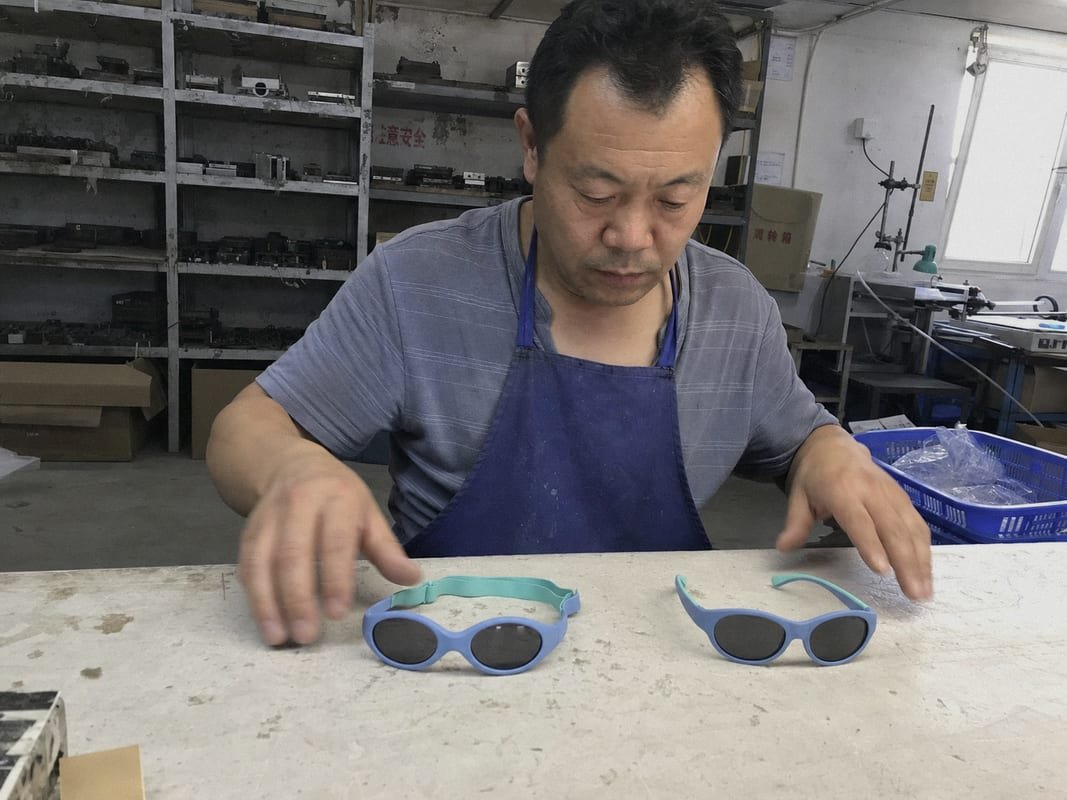
The difference between infant/toddler and children’s sunglasses trips up many buyers. On our production line in Taizhou, I’ve seen brands order one size for all ages — and watch returns pile up. Babies pull off frames built for six-year-olds. Older kids snap frames designed for babies. The fix is understanding what actually changes between age groups.
Infant/toddler sunglasses use ultra-small, soft, flexible frames with adjustable head straps and wrap-around coverage to stay on tiny faces. Children’s sunglasses use larger frames, standard temple arms, and tougher impact-resistant builds for active play. Both must deliver 100% UV protection.
That is the short answer. But if you are sourcing kids’ eyewear for a brand, the details matter. Let’s break down sizing, materials, lenses, and sourcing, one section at a time.
What Are the Key Sizing and Fit Differences Between Infant, Toddler, and Children's Sunglasses?
Last year, a buyer from Australia sent me a competitor's "one-size kids" frame and asked why parents complained. I put it on our infant head form. It slid straight off the nose.
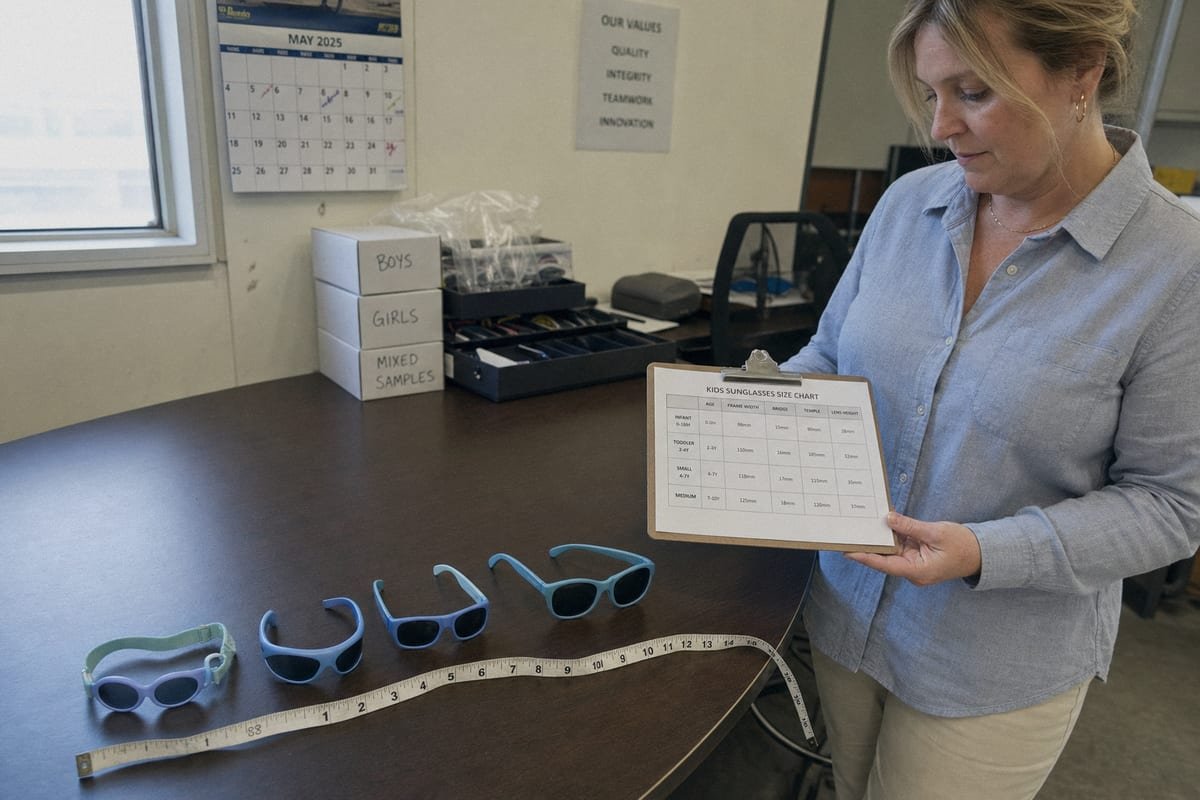
Infant and toddler sunglasses (roughly ages 0–3) are sized 100–115mm wide with flat, narrow nose bridges and elastic head straps. Children's sunglasses (roughly ages 4–10) run 115–130mm wide, use conventional temple arms, and fit a more developed nose bridge and wider face.
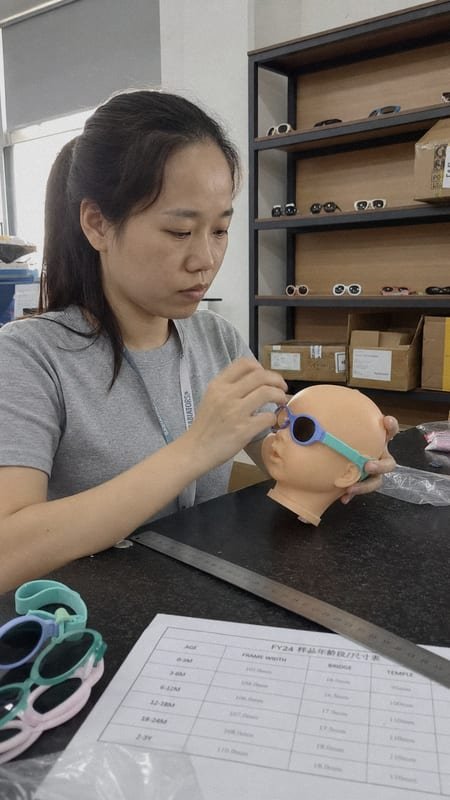
The core issue is facial anatomy. A baby has almost no nose bridge. The face is round, the ears sit differently, and the head grows fast. So an infant frame cannot simply be a shrunken adult frame. It needs a different geometry entirely. In our fifteen years making kids' eyewear, sizing errors are the number one reason a first production run disappoints a new brand.
Typical Sizing by Age Group
Here is the sizing framework we use when advising buyers who are building a full age-range collection:
| Age Group | Approx. Frame Width | Nose Bridge | Retention Method | Typical Fit Style |
|---|---|---|---|---|
| Infant (0–12 months) | 95–105mm | Very flat, wide-set | Adjustable head strap | Soft wrap-around style |
| Toddler (1–3 years) | 105–115mm | Low, soft contact | Strap or short flexible temples | Wrap-around or rounded |
| Young child (4–6 years) | 115–122mm | Slightly raised | Standard temple arms | Mini classic shapes |
| Older child (7–10 years) | 122–130mm | More defined | Temple arms or sport fit | Scaled-down adult styles |
Why Retention Matters More Than Style
For babies and toddlers, the honest priority is simple: the sunglasses must stay on. That is why an adjustable head strap is standard on infant models. Toddlers tug, chew, and throw things. A strap keeps the frame in place through all of it. By age four or five, most kids tolerate normal temple arms, and the design can start to look like scaled-down adult eyewear. The transition point — usually around ages three to four — is where many of our buyers add a "crossover" style with removable straps, so one SKU covers both fit needs.
Which Materials Are Safest for Infant and Toddler Eyewear Compared to Older Kids' Frames?
Material choice is the trade-off I discuss most with product managers. Softer materials survive chewing and bending but feel flimsy to older kids; rigid materials feel premium but can hurt a baby's face.
Infants and toddlers need ultra-soft, bendable, BPA-free materials like TPEE or silicone that flex without snapping and are safe if mouthed. Older children's frames shift to tougher TR90 or impact-resistant plastics that survive sports, drops, and rough daily wear while staying lightweight.
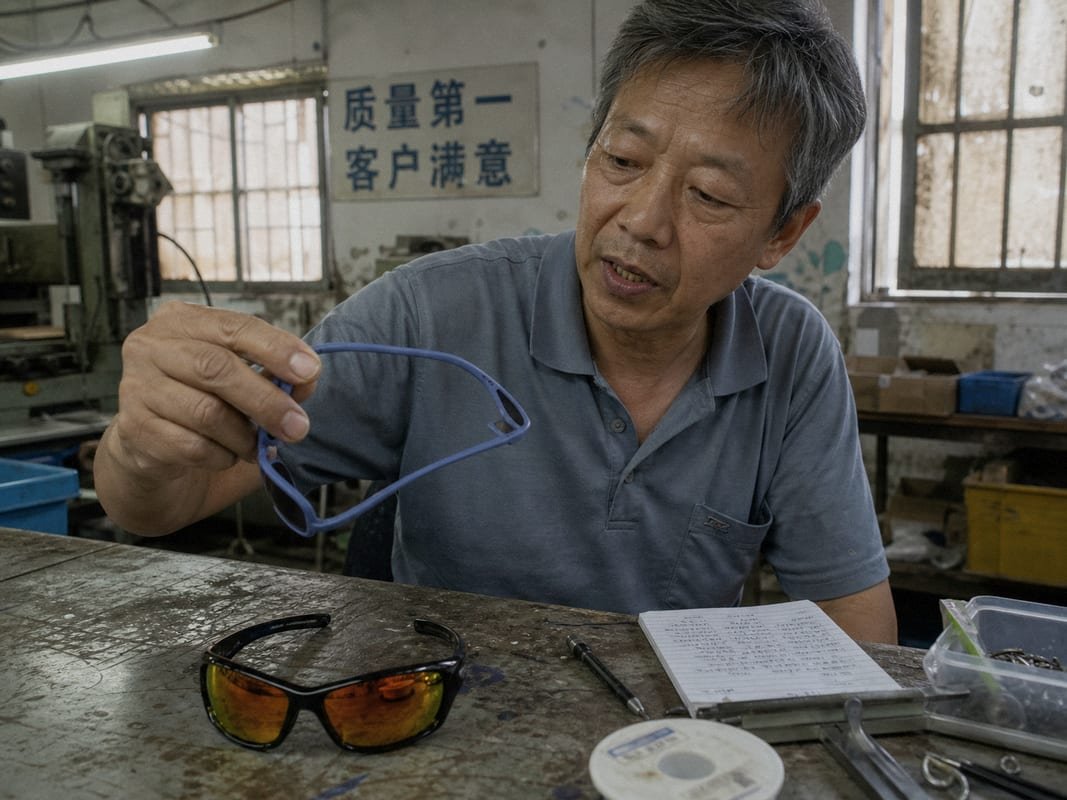
Our factory specializes in exactly this split. We build most infant and toddler frames in TPEE, a flexible, environmentally friendly polymer, and most children's frames in TR90 — often with TPEE temples 1 so the parts touching skin stay soft. This hybrid approach came from a simple observation on our QC bench: frames almost always fail at the hinge or temple, where a child twists them. Flexible frames absorb that twist instead of cracking.
Material Comparison at a Glance
| Feature | Infant/Toddler Frames | Children's Frames |
|---|---|---|
| Core material | TPEE, silicone, soft TPE frame material | TR90, impact-resistant plastics |
| Flexibility | Extreme — can fold and rebound | High, but firmer for structure |
| Chew/mouth safety | Critical; must be BPA-free and non-toxic | Still BPA-free, but chewing is rare |
| Hinges | Screwless or one-piece molds preferred | Reinforced hinges, sometimes spring hinges |
| Weight | Ultra-light to prevent slipping | Light, with added durability |
| Skin contact | Soft, thermally stable, no pinch points | Comfortable, but tolerance is higher |
Small Details That Prevent Big Problems
Two engineering details deserve attention for the youngest wearers. First, screwless hinges 2 and one-piece molded frames remove tiny parts that could become choking hazards, and they eliminate the skin-pinching points found on standard hinged frames. Second, thermally stable materials matter more than most buyers expect. A dark frame left in a stroller in summer heats up fast, and infant skin is highly sensitive. We select materials that resist heat buildup for exactly this reason.
For older kids, the calculation flips. Durability leads. School-age children drop sunglasses on concrete, shove them into backpacks, and wear them for sports. TR90 gives the impact resistance and shape memory to handle that abuse while staying flexible enough to be safe in a fall.
How Do UV Protection and Lens Requirements Change Across Infant, Toddler, and Children's Age Groups?
A pediatric fact shaped how we spec every lens we produce: a young child's crystalline lens 3 is far more transparent than an adult's, so more UV radiation reaches the retina during early eye development.
All age groups need the same non-negotiable baseline: 100% UV protection against UVA and UVB rays, usually labeled UV400. What changes by age is coverage and features — infants benefit from wrap-around lenses and maximum coverage, while older kids may add polarized lenses for glare-heavy activities.
UV protection does not scale with age — it starts at maximum and stays there. This is the single most important point in pediatric eye health for eyewear buyers. Because an infant's lens filters UV less efficiently than an adult's, and because protective macular pigment 4 is still developing, unfiltered exposure in the early years carries a disproportionate long-term risk. Every lens we ship, whether for a six-month-old or a ten-year-old, is specified as UV400.
What Changes by Age
While the UV baseline is fixed, several lens factors do shift across age groups:
- Coverage. Infant and toddler lenses should be wrap-around style with side coverage. Little eyes are also exposed to reflected light from below and the sides — sand, water, snow, and pavement all bounce UV upward.
- Lens category. For extreme-glare environments like beaches or snow, darker Category 4 lens options 5 exist for infants who cannot squint or shield their own eyes well. Everyday children's sunglasses typically standardize on Category 3 for a good balance of protection and visibility.
- Polarization. Polarized lenses cut reflected glare and are genuinely useful near water and snow. But they are a comfort upgrade, not a safety requirement. UV protection is the mandatory feature; polarization is the bonus. We offer both UV400-only and polarized options so brands can tier their product lines.
- Impact resistance. Every kids' lens should be shatterproof. Shatterproof polycarbonate lenses 6 are the industry standard because they will not fragment into sharp pieces when a child falls or throws the glasses.
- Blue light and HEV. Some infant lenses now also filter High-Energy Visible blue light 7, compensating for the low macular pigment in early development. This is an emerging spec that premium baby brands increasingly request.
There is one more benefit worth mentioning for the youngest group. During the hand-to-face motor skill phase, infants poke at their own faces constantly. A well-fitted wrap-around frame acts as a physical barrier for the eyes — a small but real everyday protection that parents notice.
Age-Based Buying Guidance
For babies under six months, most pediatric guidance 8 emphasizes shade, hats, and avoiding direct sun rather than relying on sunglasses. From around six months onward, well-fitted sunglasses with full coverage become appropriate — which is exactly where the infant strap-style category begins.
How Can I Source a Full Range of Infant, Toddler, and Children's Sunglasses from One Manufacturer?
A procurement manager from Japan once told me her biggest headache: buying baby sizes from one supplier and kids' sizes from another meant two quality standards, two color-matching problems, and two shipping schedules.
Choose a specialized children's eyewear factory that offers ready-made styles across all age groups, proven flexible-material expertise, and full OEM/ODM support. This lets one supplier deliver consistent quality, matched colors, and unified packaging from infant straps to school-age frames.
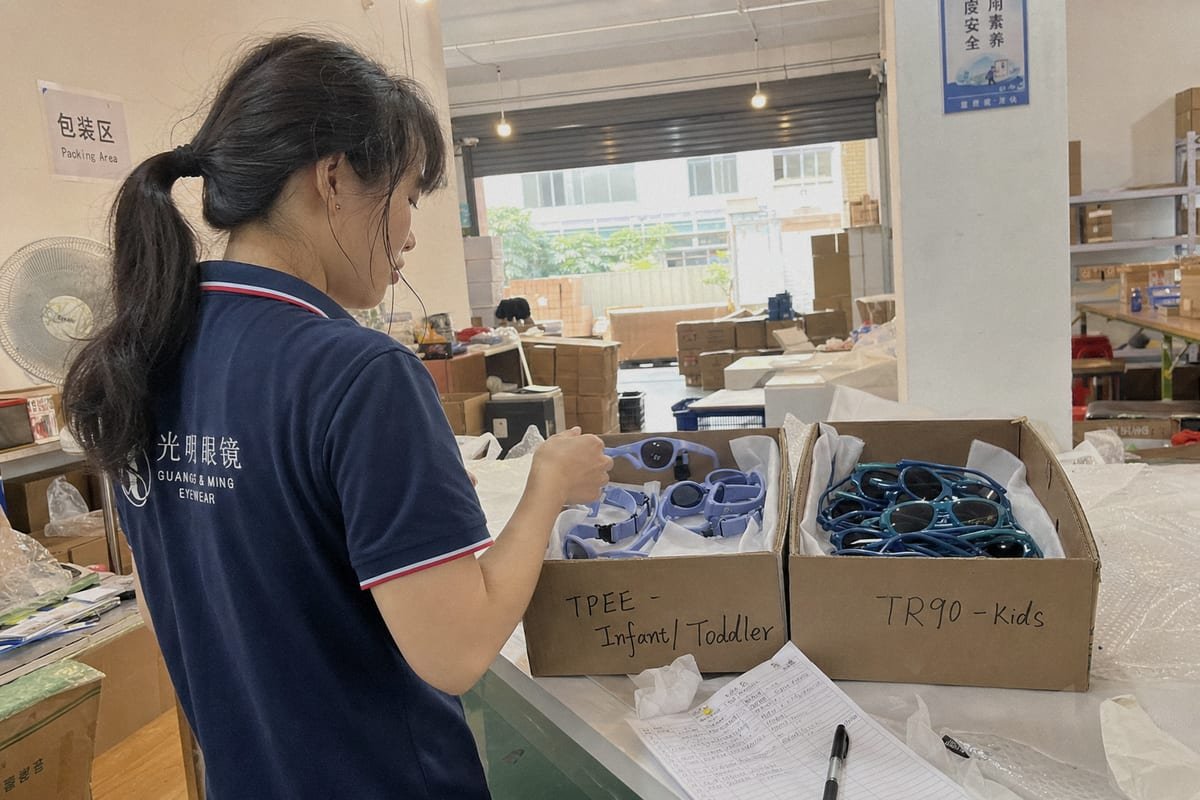
Consolidating your age range with one factory solves more problems than most buyers realize. At our workshop in Taizhou — about 120 workers, fifteen years focused on eyewear, run under 5S management — we build infant, toddler, and children's lines side by side. That means a brand can launch a coordinated collection where the baby strap style and the seven-year-old's frame share the same Pantone colors, the same lens spec, and the same retail-ready packaging.
What to Check When Evaluating a Supplier
| Sourcing Factor | Why It Matters | What to Ask For |
|---|---|---|
| Existing style library | Launching without mold investment lowers risk | We offer ~800 existing styles across age groups |
| Material expertise | Flexible frames require real TPEE/TR90 know-how | Sample frames you can twist-test yourself |
| Lens options | Tiering your line needs choices | UV400 standard, polarized upgrades |
| Customization | Your brand, not a generic product | Custom colors, logos, lenses, packaging, accessories |
| Factory vs. trader | Direct control of quality and timelines | Factory audit, production photos, QC process |
| Age-range coverage | One quality standard across the collection | Infant, toddler, and children's samples together |
A Practical Sourcing Path
The lowest-risk route for a new brand is a three-step process. First, select from an existing style library — with roughly 800 styles available, most brands find infant, toddler, and children's models that fit their positioning without paying for new molds. Second, customize: colors, temple logos, lens tints, straps, cases, and packaging turn a factory style into your branded product. Third, scale into custom development once sales data proves demand. Several of our long-term partners across our twenty-plus export markets started exactly this way — a small mixed-age trial order, then repeat orders, then their own molds.
One more practical note: when you source all age groups from one factory, your quality conversations get simpler. One QC standard, one contact person, one consolidated shipment. For buyers who care about consistent quality and on-time delivery more than squeezing the last cent from unit price, that consolidation is usually worth more than any discount.
Conclusion
Getting the age split wrong costs brands returns, reviews, and trust. Infant/toddler sunglasses prioritize soft flexible frames, straps, and coverage; children's sunglasses prioritize size and durability. Both demand 100% UV protection — and one specialized factory partner can deliver the full range.
Footnotes
1. Wikipedia explains thermoplastic elastomer chemistry underlying the flexible TPEE material. ↩︎
2. CPSC guidance on small-parts choking hazards supports the screwless hinge safety rationale. ↩︎
3. Background on the eye’s crystalline lens explains why children need more UV protection. ↩︎
4. NIH explains eye development and macular pigment relevant to children’s UV risk. ↩︎
5. ISO defines sunglass lens category standards referenced for infant eyewear darkness. ↩︎
6. Explains the impact-resistant polymer properties used in shatterproof kids’ lenses. ↩︎
7. NIH resource on protecting eyes from light exposure relevant to HEV blue light filtering. ↩︎
More Articles You Might Like

Looking for a Reliable Kids Eyewear Partner?
Explore 800+ ready styles and full OEM/ODM support tailored to your brand.
Get in Touch English
  Español de México
  Deutsch
  Français
  日本語
日本語  العربية
  Português do Brasil