Why Are Kids’ Sunglasses Specially Designed for Children’s Vision Development?
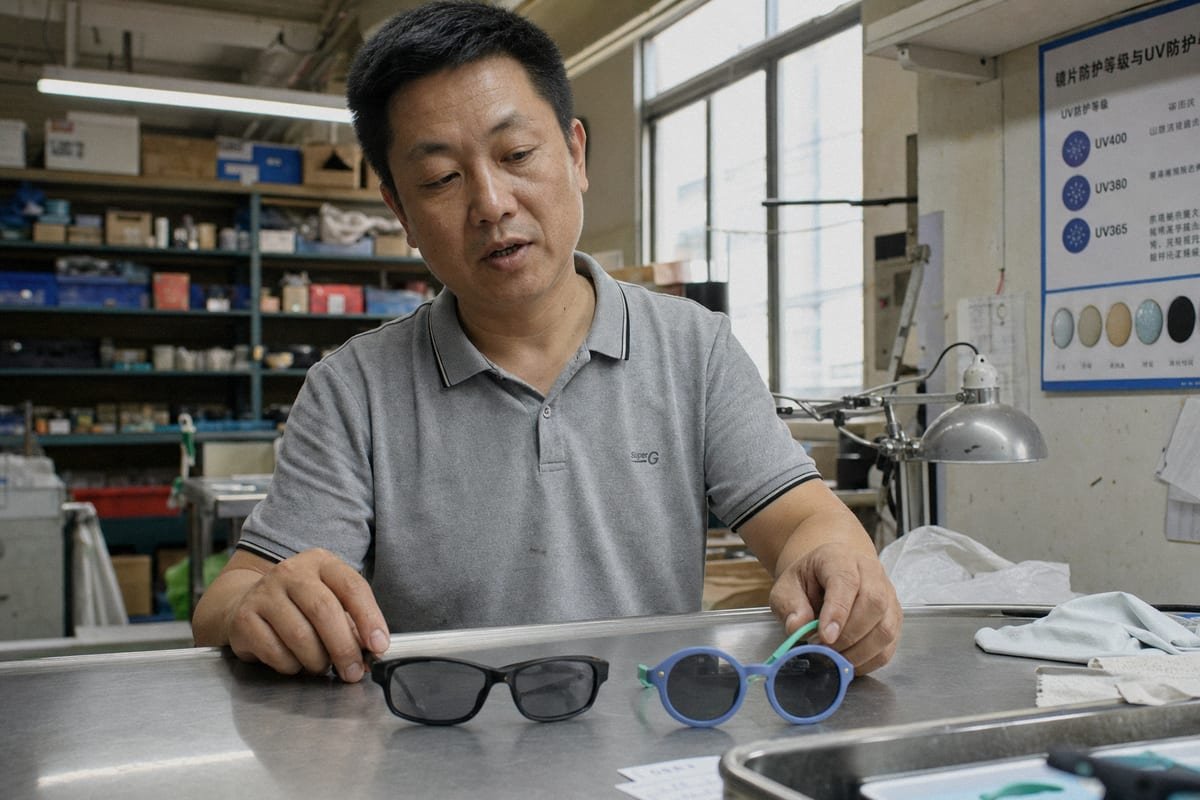
Kids’ sunglasses land on our inspection tables every day, and one thing worries me: too many brands still sell shrunken adult frames that fail children’s developing eyes completely.
Kids’ sunglasses are specially designed because children’s eyes transmit far more UV radiation than adult eyes, their visual system is still maturing, and they need flexible, secure, impact-resistant frames with 100% UVA/UVB protection that survive active play and stay on small faces.
Let me walk you through the science and the design details. I will also share what we have learned building children’s eyewear for buyers in more than 20 countries.
How does children's vision development actually shape sunglasses design?
During a product review with a Japanese baby-brand buyer 1 last year, she asked me a simple question: why can't kids just wear small adult sunglasses? The answer changed her whole product line.
Children's visual systems develop through roughly the first 7–12 years of life, and their crystalline lens transmits over 75% of UV radiation versus about 10% in adults over 25. Sunglasses design must therefore prioritize true UV filtering, secure fit, and safe materials during this vulnerable window.
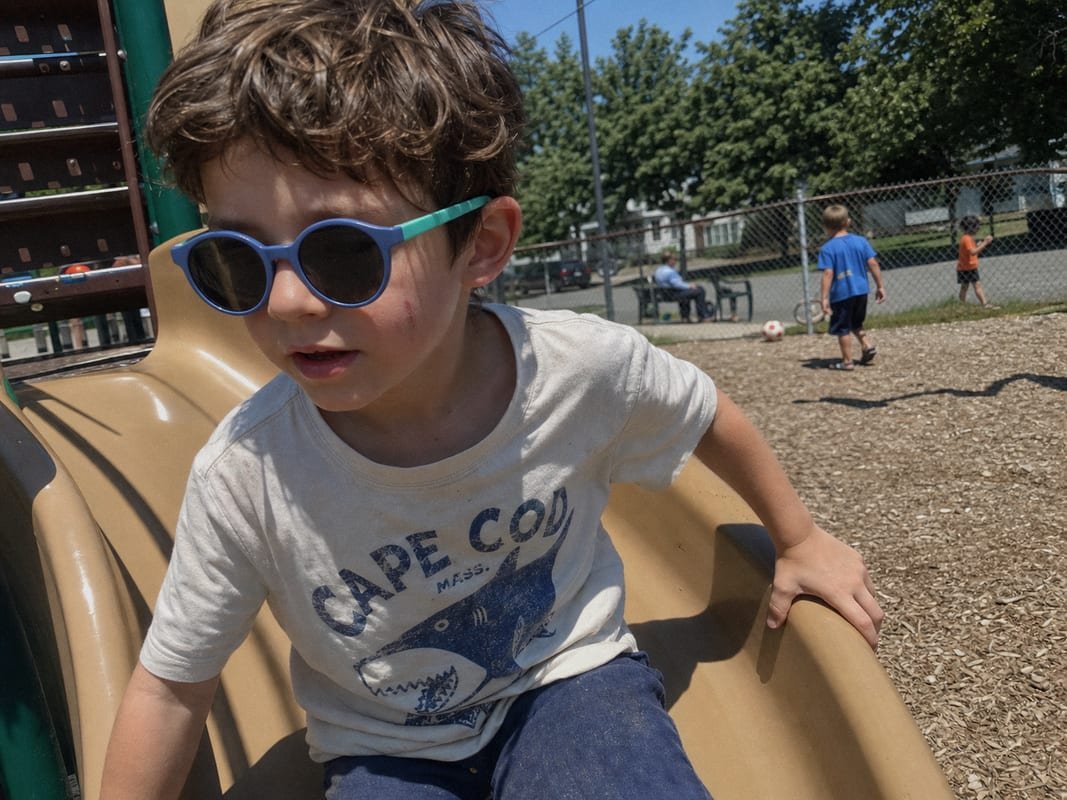
The developmental facts here are not marketing talk. They come from pediatric ophthalmology research, and they drive real engineering decisions on our production line every single week.
Why young eyes let more UV through
A child's crystalline lens clarity 2 is much higher than an adult's. The lens has not yet developed the natural yellowing that filters high-energy light in mature eyes. So more UV passes straight through to the retina. Children also have larger pupils on average. That means a greater total volume of light — and radiation — enters the eye. Combine those two factors, and retinal UV exposure in a child can be dramatically higher than in an adult standing in the same sunlight.
There is a third factor: time. Kids spend more hours outdoors than most adults. Research suggests up to 80% of lifetime UV exposure 3 happens before age 18. Ocular sun damage is cumulative. It does not show up next week. It shows up decades later as cataracts or macular degeneration.
How these facts translate into design
| Developmental fact | Design response |
|---|---|
| Crystalline lens transmits over 75% of UV before age 10 | UV400 lenses blocking 100% UVA/UVB, not just dark tint |
| Larger pupils admit more light | Proper lens coverage and wrap-around frame design |
| Visual system matures until age 7–12 | Optically clear, distortion-free lenses that support healthy visual input |
| Thin, delicate eyelid skin | Wider lens area shielding the orbital zone |
| Rapidly changing facial structure | Adaptive bridge and temple geometry for growing faces |
One important clarification for parents and brand buyers alike: sunglasses protect development, they do not correct it. Prescription glasses handle refractive errors 4 and amblyopia. Sunglasses handle harmful light. Both matter, but they do different jobs.
What UV protection do I need to protect my child's developing eyes?
The trade-off we weigh most often when specifying lenses is not cost versus quality — it is tint darkness versus actual UV filtering, because buyers frequently confuse the two.
Children need lenses that block 100% UVA/UVB radiation up to 400 nanometers, labeled UV400. Lens darkness alone does not indicate protection; a properly rated clear-looking lens protects better than an unrated dark lens that lets UV through.
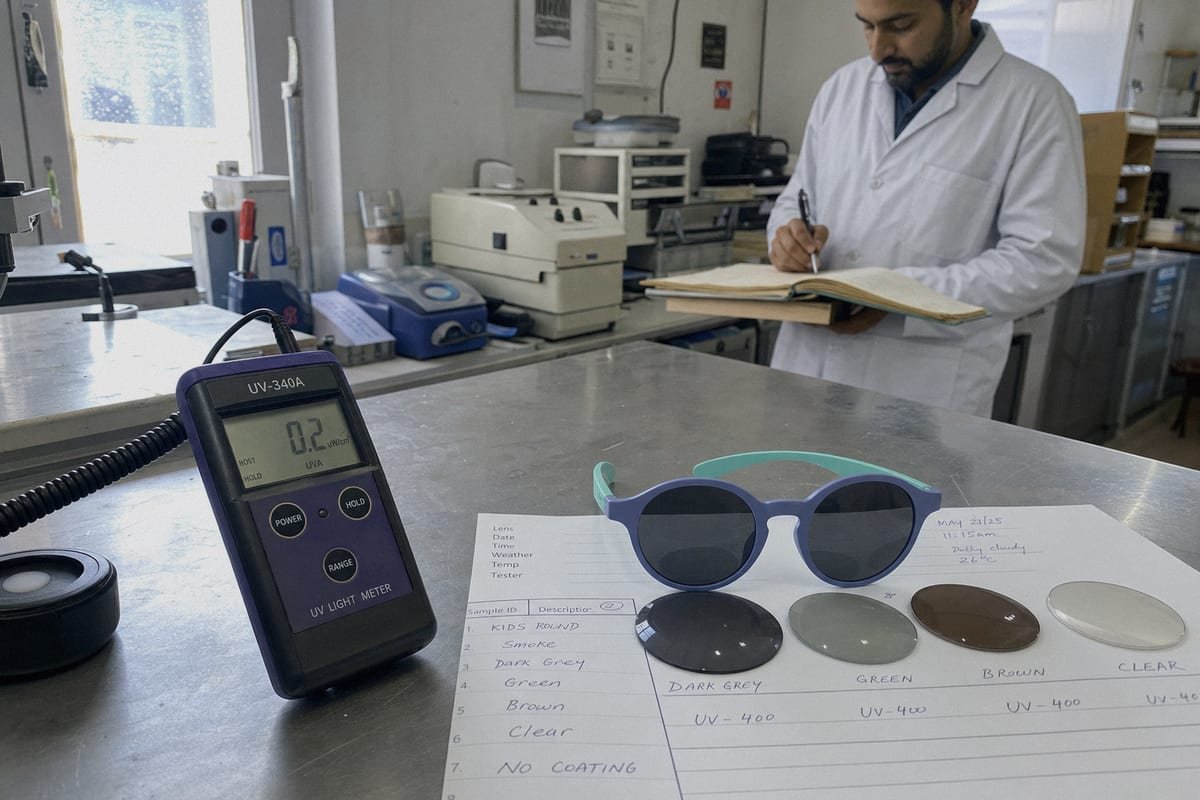
This distinction matters more than any other spec on a children's sunglasses order sheet. A dark tint without UV filtering can actually be worse than nothing. The dark lens makes the pupil dilate, opening the door wider, while unfiltered UV pours through. That is why we test every lens batch for UV400 compliance before assembly, regardless of how dark or light the tint looks.
Understanding the UV protection labels
| Label or spec | What it means | Good enough for kids? |
|---|---|---|
| UV400 | Blocks wavelengths up to 400 nm, covering all UVA and UVB | Yes — this is the benchmark |
| 100% UVA/UVB protection | Equivalent full-spectrum claim | Yes, if verified by testing |
| "UV protective" (vague) | No defined standard | No — ask for test data |
| Dark tint, no UV rating | Cosmetic only | No — potentially harmful |
| Polarized, no UV rating | Glare reduction only | Not on its own |
What UV protection actually prevents
Short-term, strong UV can cause photokeratitis — essentially sunburn of the cornea. Photokeratitis prevention 5 matters most around reflective surfaces like water, sand, and snow, where UV bounces up into the eyes from below. Long-term, cumulative retinal UV exposure raises the later-life risk of cataracts and macular degeneration. Because so much lifetime exposure happens in childhood, the protective habit has to start early.
Are polarized lenses necessary?
Polarized lens benefits are real: less glare off water and pavement, less squinting, more comfort during sports and beach days. But polarization is a comfort feature, not a safety feature. UV filtering is the non-negotiable. In our catalog, we offer both UV400-only and UV400 polarized options, and we always tell buyers to secure the UV rating first, then decide on polarization based on the end use.
Why does frame flexibility matter more for kids than adults?
A drop-test session in our 5S-managed workshop taught me this lesson vividly: an adult-style acetate frame snapped at the hinge on the third impact, while our TPEE-temple sample bounced, flexed, and went straight back into shape after fifty.
Frame flexibility matters more for kids because children fall, twist, sit on, and yank their eyewear constantly. Flexible TPEE and TR90 frames bend instead of snapping, preventing sharp broken edges near the eyes while surviving daily active play.
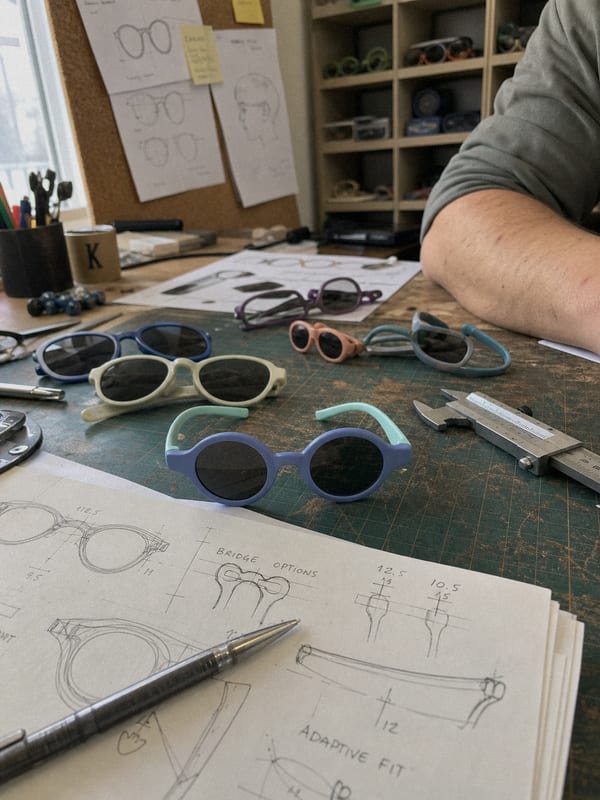
Adults treat sunglasses carefully. Children do not, and they should not have to. So the material science 6 has to absorb the abuse instead. After fifteen years of building children's frames, we have settled firmly on two flexible materials — TR90 and TPEE — often combined, with TR90 fronts and softer TPEE temples.
Why rigid frames fail children
A rigid frame under stress does one of two things: it deforms permanently, or it breaks. Both outcomes are bad. A broken frame can leave sharp plastic edges millimeters from a child's eye. A deformed frame slides down the nose, misaligns the lens optical center with the pupil, and gets abandoned in a backpack. Sunglasses only protect eyes when they are actually worn, and children abandon anything uncomfortable within minutes.
The flexible-material advantage
- Impact resistance. TR90 and TPEE flex on impact and return to shape, and paired with polycarbonate lenses that will not shatter into shards, the whole unit survives falls and ball sports.
- Lightweight comfort. Flexible polymers weigh noticeably less than acetate. Less nose pressure means longer voluntary wear time.
- Secure, gentle fit. Soft temple tips grip without pinching. Our round two-tone styles use gently curved, tapered temples exactly for this reason.
- Safety in failure. Even under extreme force, these materials tear or bend rather than fragmenting.
- Environmentally friendlier chemistry. The TPEE and TR90 grades we use avoid the additive concerns of some cheap plastics touching children's skin all day.
Growing faces add another layer. A child's head width, bridge height, and ear position change fast. Flexible frames tolerate that change far better, keeping the optical center reasonably aligned with the pupil across a wider fit range. For sport styles — like wrap-around shield designs with mirrored polycarbonate lenses — flexibility also lets the frame hug the face during running and cycling without pressure points.
How do I choose a manufacturer that understands children's vision needs?
One of the first questions I ask new buyers who contact our Taizhou factory is not about quantity — it is about which safety standard their target market enforces, because that answer reveals whether their previous supplier ever thought about children's eyes at all.
Choose a manufacturer with proven children's eyewear specialization: verified UV400 and 100% UVA/UVB lens testing, flexible child-safe materials like TPEE and TR90, relevant safety-standard compliance, real factory quality control, and OEM/ODM depth to build a retail-ready branded product.
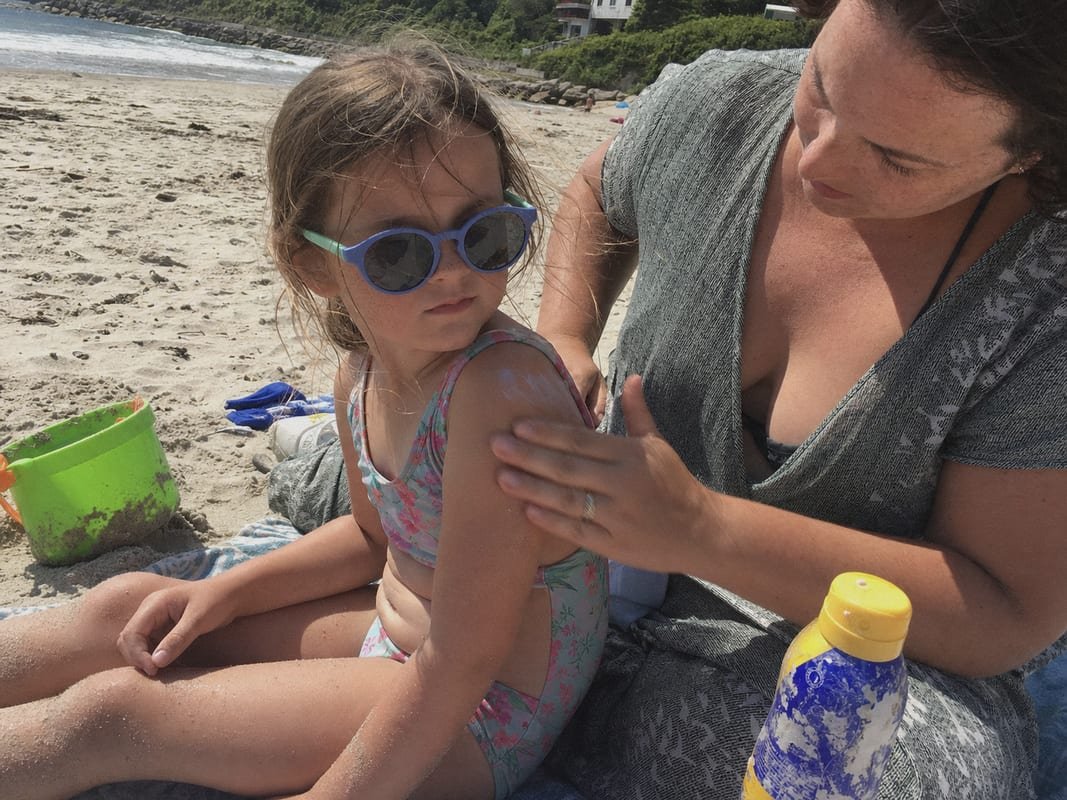
Not every eyewear factory is a children's eyewear factory. The tooling, materials, testing mindset, and even the aesthetic sensibility 7 are different. Here is the evaluation framework I would use if I were sitting on the buyer's side of the table.
A practical supplier checklist
| Evaluation area | What to verify | Red flag |
|---|---|---|
| Lens safety | UV400 test reports, polycarbonate lenses, impact resistance data | "Trust us, it's UV protective" with no documents |
| Materials | TPEE/TR90 flexibility, non-toxic and environmentally friendly grades | Brittle generic plastic, no material spec sheet |
| Manufacturing depth | Actual factory with in-house QC, organized workshop | Trading company reselling unknown factories' goods |
| Product range | Broad existing style library to launch without mold costs | Only a handful of adult styles "resized" for kids |
| Customization | Custom colors, logos, lenses, packaging, accessories | Sticker-logo-only "customization" |
| Communication | Clear technical answers about pediatric ophthalmology basics | Vague replies, price-only conversation |
Why an existing style library lowers your risk
New kids' brands often underestimate mold costs. Opening a fresh frame mold is a significant investment before you have sold a single pair. That is why we maintain roughly 800 existing styles — from playful matte periwinkle round frames with mint-teal temples to white wrap-around sport shields with iridescent mirrored lenses. A brand can pick proven shapes, customize colors and branding, and test the market with far less capital at stake. Once a style proves itself, custom development makes sense.
Look for children-first thinking, not adult leftovers
Ask the supplier why their bridge sits where it does. Ask how their temples accommodate a growing head. Ask what happens to the lens in a drop test. A specialist answers immediately and specifically. A generalist changes the subject to price. In our experience exporting to buyers across Europe, Australia, and Japan, the brands that succeed long-term are the ones whose suppliers can defend every design decision with a child-safety reason.
Conclusion
Children's eyes admit more UV, develop for years, and face constant play impacts. Specially designed kids' sunglasses — flexible, UV400-rated, child-fitted — are preventive health tools, not accessories.
Footnotes
1. Authoritative guidance on why children need sunglasses, relevant for brands targeting this demographic. ↩︎
2. Technical explanation of the crystalline lens structure and its role in light transmission. ↩︎
3. Authoritative medical source confirming that a significant portion of lifetime UV exposure occurs before age 18. ↩︎
4. Global health authority defining refractive errors and their impact on vision. ↩︎
5. Detailed information on photokeratitis, also known as ultraviolet keratitis or sunburn of the cornea. ↩︎
6. Technical details on polycarbonate, a key material used for impact-resistant children’s eyewear. ↩︎
7. Official international standard for sunglasses, ensuring safety and quality beyond just visual appeal. ↩︎
More Articles You Might Like

Looking for a Reliable Kids Eyewear Partner?
Explore 800+ ready styles and full OEM/ODM support tailored to your brand.
Get in Touch English
  Español de México
  Deutsch
  Français
  日本語
日本語  العربية
  Português do Brasil