How Does Flexible Frame Material Make Kids’ Sunglasses Drop-Resistant?
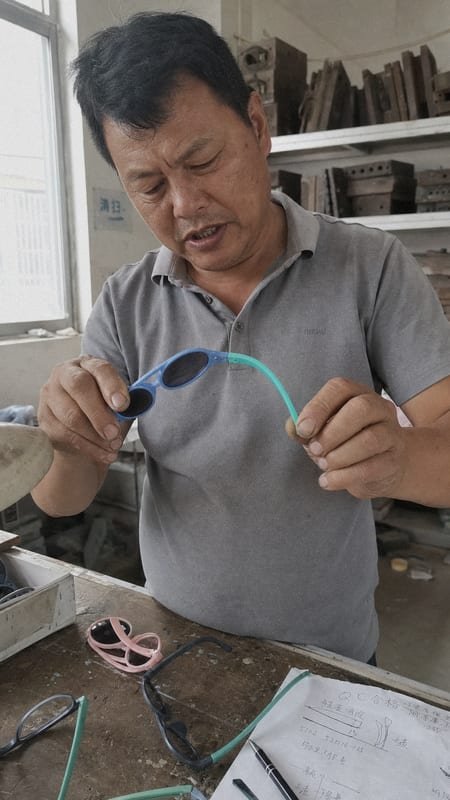
Kids drop everything. On our production line in Taizhou, flexible frame material is the reason kids’ sunglasses survive it — and rigid frames simply don’t.
Flexible frame materials like TPEE and TR90 make kids’ sunglasses drop-resistant by bending under impact instead of cracking. They absorb and disperse shock across the whole frame, then spring back to their original shape thanks to built-in shape memory technology, surviving repeated drops, twists, and rough play.
That is the short answer. But if you are building a children’s eyewear line, you need to know why this works, which material fits which age group, and where the marketing hype ends. Let me walk you through it.
What Makes TPEE and TR90 Different from Regular Plastic Frames?
During a QC session last year, one of our inspectors folded a TR90 kids frame completely in half, held it for a few seconds, and let go. It snapped straight back. Try that with a standard acetate frame and you get two pieces.
TPEE and TR90 differ from regular plastic because they are engineered flexible polymers, not brittle thermoplastics. TR90 is a memory polymer that bends up to 180 degrees and returns to shape, while TPEE is a soft thermoplastic elastomer that absorbs impact. Regular plastic concentrates stress and cracks.
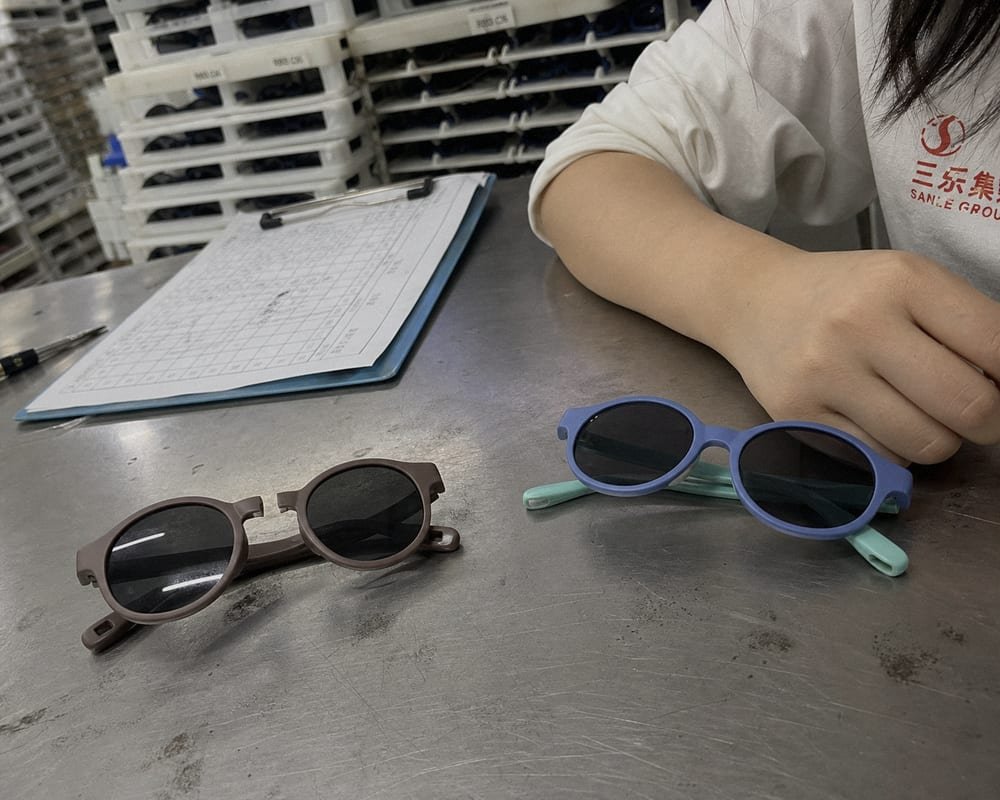
The difference comes down to molecular structure. Regular injection plastics and acetate are rigid. When a child drops sunglasses onto concrete, the impact energy travels through the frame and concentrates at the weakest points — usually the bridge or the hinge area. The material has no way to release that energy, so it fractures.
TR90, a memory polymer in the Grilamid-type nylon family 1, behaves differently. Its long polymer chains can stretch, slide, and recover. The frame flexes, converts a portion of the kinetic energy into negligible heat within the material, and then the shape memory pulls everything back into alignment. TPEE, which behaves much like a TPE thermoplastic elastomer 2, goes one step further on softness. It is why we often pair TR90 fronts with TPEE temples: the front stays dimensionally stable so lenses seat properly, while the temples take the twisting abuse from small hands.
A Quick Material Comparison
| Property | Regular Plastic / Acetate | TR90 Memory Polymer | TPEE Flexible Polyester |
|---|---|---|---|
| Flexibility | Low, brittle | High, bends without breaking | Very high, extremely pliable |
| Shape recovery | None — deforms or snaps | Excellent | Excellent |
| Weight | Moderate to heavy | Very light | Very light |
| Failure mode | Cracks at bridge/hinges | Rarely fails under normal use | Rarely fails under normal use |
| Cold-weather behavior | Turns brittle | Stays flexible | Stays flexible |
| Best kids' use | Fashion adult styles | Ages 4–14, active kids | Toddlers, ages 2–8 |
One more practical point: both materials keep their impact resistance at low temperatures. Standard plastics have a higher glass transition point 3, so they become brittle in winter conditions. Flexible polymers hold their shock absorption properties 4 even in sub-zero weather — something buyers in Northern Europe ask us about regularly. Both materials we use are also BPA-free non-toxic materials, which matters for eyewear that ends up in toddlers' mouths more often than any of us would like.
Can Flexible Frames Really Survive Everyday Drops and Rough Play?
A distributor in Australia once shipped us back a sample pouch with a note: "My five-year-old wore these for a full season. Sat on them twice. Still fine." That kind of feedback tells us more than any lab bench does — though we run the bench tests too.
Yes. Flexible frames survive everyday drops because they act as built-in shock absorbers. The material dampens impact energy before it reaches the lenses, spreads stress across the whole structure, and recovers its shape after being sat on, stepped on, twisted, or thrown into a school bag.
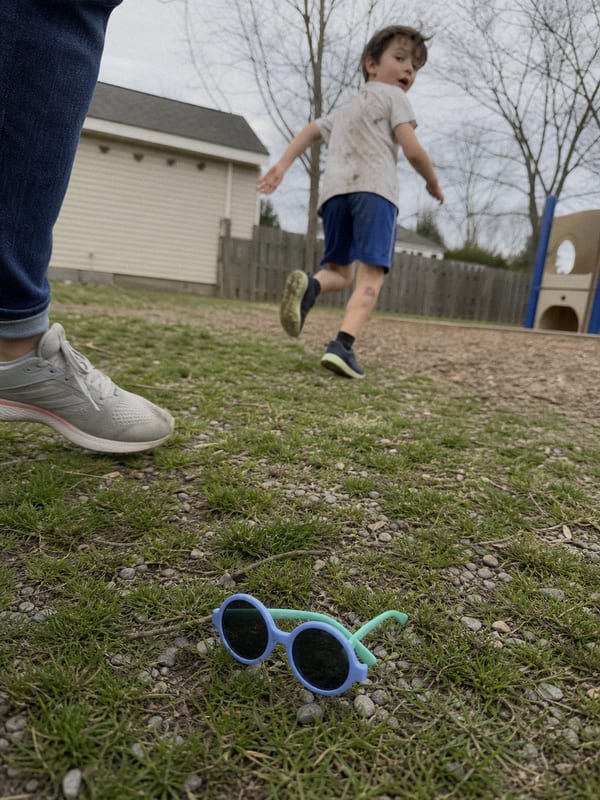
Let me break down what actually happens during a drop, because understanding the mechanics helps you evaluate any supplier's claims — including ours.
The Four Ways Flexible Frames Beat Impact
- Stress distribution. A flexible polymer spreads impact force across the entire frame instead of channeling it to one crack point. No single spot takes the full hit.
- Elastic recovery. Shape memory technology means the frame deforms momentarily, then pulls itself back. This is why the same pair survives dozens of drops, not just one.
- Energy dissipation. The polymer chains flex internally and convert kinetic energy into tiny amounts of heat. The energy literally disappears into the material.
- Lens protection. A softer frame transmits fewer high-frequency stress waves into the lens. The frame's slight elastic expansion on impact also cushions the lens seat, which reduces the chance of lenses cracking or popping out.
There is a fifth factor people overlook: weight. TPEE and TR90 frames are extremely light. Less mass means less momentum during a fall, so the impact itself is smaller before any absorption even starts.
What "Drop-Resistant" Does Not Mean
I want to be honest here, because we position ourselves as a long-term partner, not a slogan factory. Drop-resistant does not mean indestructible. A determined toddler with scissors, or a car door, will still win. The defensible claim — and the one we recommend our B2B clients print on packaging — is that flexible frames are dramatically more resistant to breakage than standard rigid frames under normal wear and tear. In fifteen years of making children's eyewear, the return rate difference between our flexible styles and old-style rigid samples is not subtle. It is the entire reason our catalog moved almost fully to TPEE and TR90.
Why Does Frame Flexibility Matter for My Child Safety Standards?
Safety documentation is usually the second question a serious buyer asks us — right after MOQ. Brands selling into Europe, Japan, or Australia know that a broken frame is not just a warranty claim. It is a potential injury and a liability problem.
Frame flexibility matters for child safety because a frame that bends cannot shatter into sharp shards near a child's eyes. Flexible, hinge-less designs also eliminate small screws and pinch points, reduce facial injury during falls, and support compliance with children's impact resistance standards.
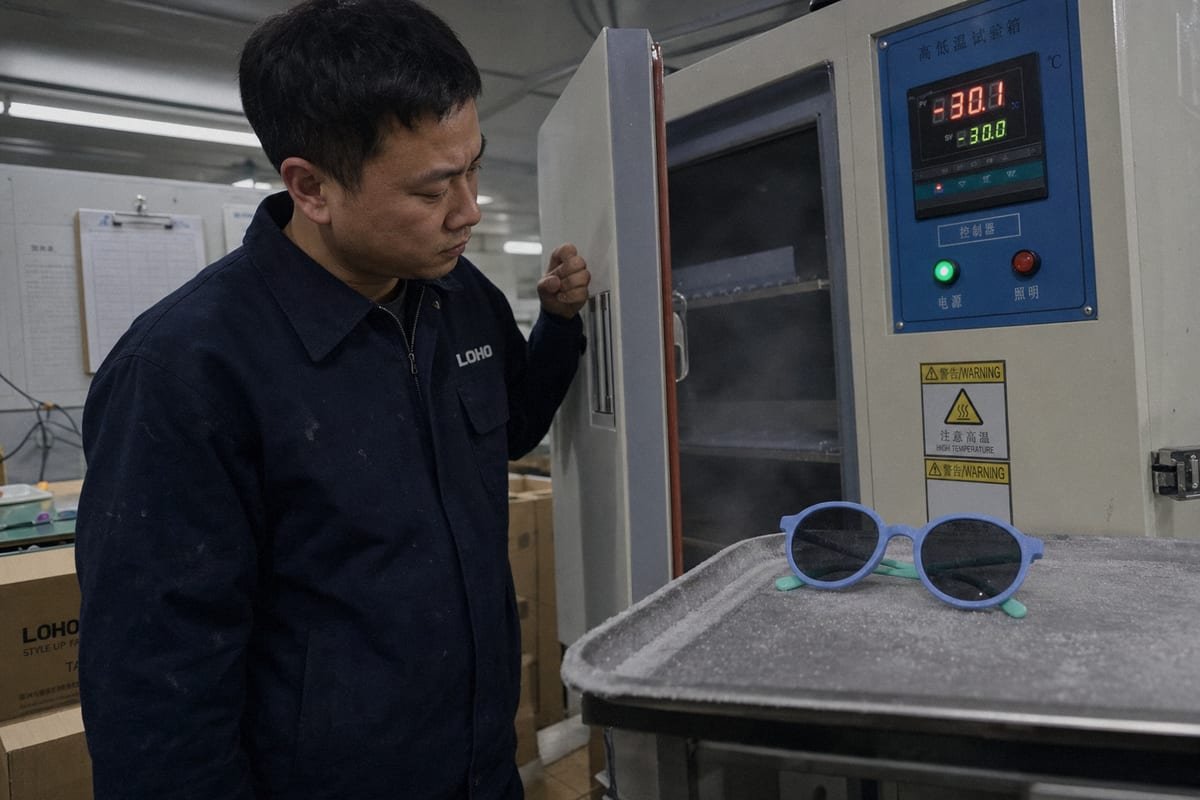
Think about how children actually fail eyewear. It is rarely a clean drop onto a soft carpet. It is a fall face-first on the playground while wearing the glasses. It is a sibling yanking the temples sideways. It is the frame living at the bottom of a backpack under a water bottle. Each scenario creates a specific hazard with rigid frames — and flexible construction addresses each one.
Hazard-by-Hazard Breakdown
| Real-World Scenario | Rigid Frame Risk | Flexible Frame Outcome |
|---|---|---|
| Child falls while wearing glasses | Frame snaps; sharp edges near the eye | Frame flexes with the face; no shards |
| Temples pulled or twisted | Hinge screws fail; small parts detach (choking risk) | Hinge-less frame design or robust molded hinges flex and recover |
| Frame stepped on | Bridge fractures | Frame compresses and springs back |
| Lens impact | Lens cracks or pops out | Frame cushions the lens; shatterproof polycarbonate lenses 5 resist impact |
| Chewing (toddlers) | Material and coating concerns | BPA-free non-toxic materials, soft edges |
Two design details deserve special attention. First, hardware reduction. Traditional metal screws and stiff hinges are the primary mechanical failure points in children's eyewear. When they break, they also release small parts. Reduced-hardware and hinge-less frame design removes those failure points entirely, which is why bendable toddler eyewear for ages two to four in our range typically has no metal components at all.
Second, the frame is only half the safety story. We always specify shatterproof polycarbonate lenses with UV400 protection 6 for children's sunglasses. A drop-proof frame around a fragile lens misses the point. Polycarbonate resists impact far better than standard lens materials, and full UV400 protection matters because children's eyes admit more UV than adult eyes do. When our clients audit our 5S-managed workshop, lens impact checks and material safety documentation are standard parts of the review — and they should be for any supplier you evaluate.
How Do I Choose the Right Flexible Material for My Kids' Eyewear Line?
The trade-off we discuss most often with new brand clients is softness versus structure. Push too soft and the frame will not hold prescription lenses or a precise fit. Push too stiff and you lose the toddler-proof resilience. After fifteen years and roughly 800 developed styles, we have a fairly reliable decision framework.
Choose by age and use case: TPEE or soft TPE thermoplastic elastomer for toddlers ages 2–4, TR90 or TR90-with-TPEE-temples for active kids ages 4–14, and TR90 with sport wraparound shields for performance lines. Always pair the frame with polycarbonate UV400 lenses.

Here is the framework we walk buyers through, whether they are a baby-product brand in Japan or an outdoor label in Europe.
Match Material to Age and Activity
| Segment | Recommended Material | Why It Works | Style Direction |
|---|---|---|---|
| Toddlers (2–4) | TPEE, full flexible construction | Maximum pliability, chew-safe, no hardware | Round retro frames, soft matte two-tone colors |
| Kids (4–8) | TR90 front + TPEE temples | Stable lens seat plus flexible temples where kids grab | Playful casual shapes, rounded hinges |
| Active kids (8–14) | TR90 memory polymer | Light, tough, holds sporty geometry | Wraparound shield lenses, mirrored coatings |
| Kids optical | TR90 optical frames | Holds prescription alignment, survives school life | Clean, lightweight everyday designs |
You can see this logic in real products. A soft matte periwinkle round frame with mint-teal TPEE temples suits a toddler and preschool line — friendly curves, no sharp edges, flexible everywhere a child grabs. A glossy black or white wraparound with a mirrored orange-to-teal shield lens targets the sporty 8–14 segment, where TR90's structural stability keeps the single-piece lens aligned during cycling or playground sprints.
Practical Buying Checklist
- Confirm the actual polymer, not just "flexible plastic." Ask for TR90 or TPEE by name.
- Request a bend test on samples — fold the temples flat and check recovery.
- Verify shatterproof polycarbonate lenses and UV400 protection certificates.
- Check for BPA-free non-toxic material documentation 7 for the toddler range.
- Ask about hinge construction: molded flexible hinges 8 or hinge-less for the youngest ages.
- Start from existing molds if you are testing the market. This is exactly why we maintain a large existing-style library — a new brand can launch with custom colors, logos, lenses, and retail-ready packaging without funding new tooling.
One caveat from experience: very flexible frames are harder to adjust precisely at retail. If your channel includes optical shops doing fine fitting, lean toward TR90 fronts rather than fully soft constructions. Comfort completes the durability story, too — a lightweight pair a child actually keeps on their face gets lost and damaged far less often than one they constantly take off.
Conclusion
Flexible frames bend, absorb, and recover where rigid plastic cracks. Match TPEE and TR90 to your age segments, insist on polycarbonate UV400 lenses, and your kids' line survives real childhood.
Footnotes
1. Explains the nylon polymer family underlying TR90’s molecular flexibility and recovery properties. ↩︎
2. Authoritative overview of TPE properties, molecular structure, and manufacturing applications. ↩︎
3. Defines the material science concept explaining why plastics become brittle in cold weather. ↩︎
4. Scientific explanation of material toughness and its role in energy absorption and impact resistance. ↩︎
5. Background on polycarbonate’s impact resistance properties used in shatterproof children’s lenses. ↩︎
6. WHO explains UV radiation risks, supporting why UV400 protection is critical for children’s eyes. ↩︎
7. Official FDA documentation regarding the safety and regulation of BPA in plastics. ↩︎
8. Technical definition of living hinges, the engineering term for molded flexible plastic hinges. ↩︎
More Articles You Might Like
Looking for a Reliable Kids Eyewear Partner?
Explore 800+ ready styles and full OEM/ODM support tailored to your brand.
Get in Touch English
  Español de México
  Deutsch
  Français
  日本語
日本語  العربية
  Português do Brasil