Como Medir a Largura do Rosto e a Distância Pupilar para o Tamanho de Óculos de Sol TR90 para Crianças?
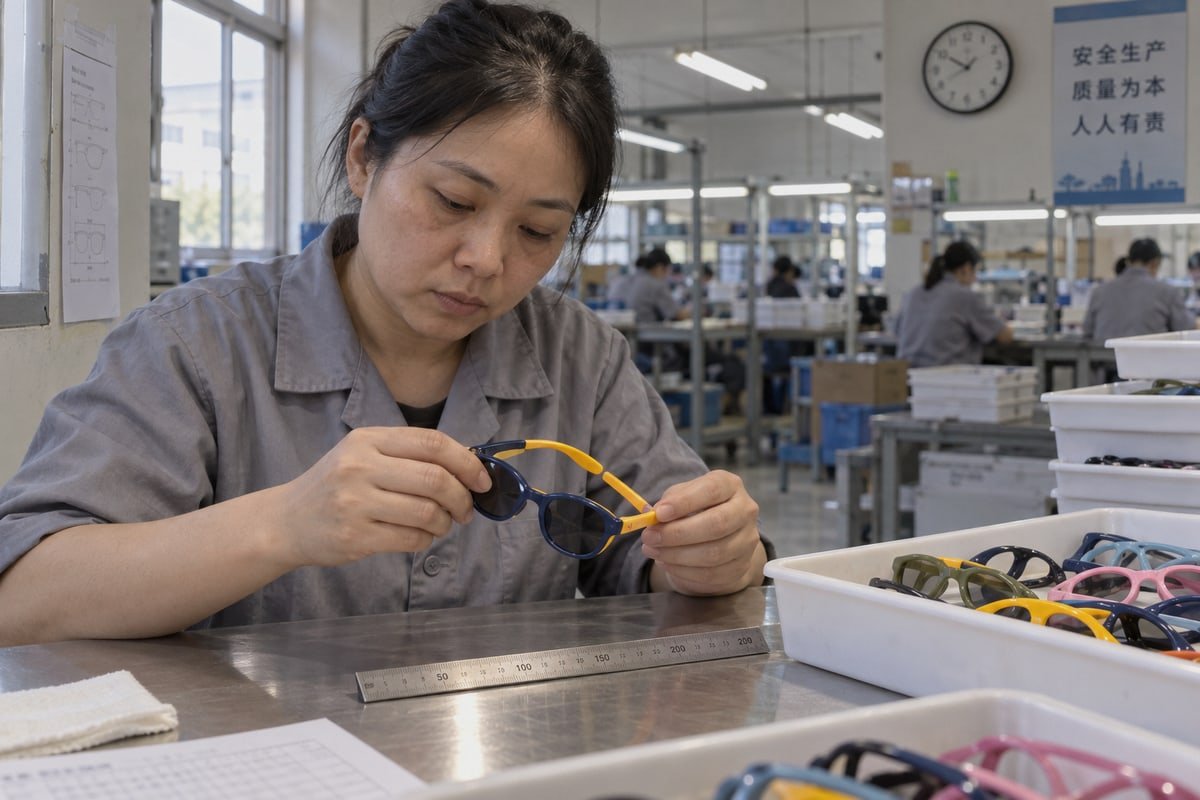
Largura do rosto e distância pupilar 1 para o dimensionamento de óculos de sol TR90 para crianças confunde muitos compradores que visitam nossa fábrica em Taizhou. Errar, e as devoluções se acumulam. Medir primeiro resolve isso.
Para dimensionar óculos de sol TR90 para crianças, meça a largura do rosto de têmpora a têmpora com uma régua milimétrica rígida, depois meça a distância pupilar de centro de pupila a centro de pupila enquanto a criança olha para frente. Compare ambos os números com a largura da lente, largura da ponte e largura total da armação, usando a flexibilidade do TR90 para uma pequena tolerância.
Dois números fazem a maior parte do trabalho. Este guia mostra como obter ambos, como ler uma tabela de tamanhos e onde [pedidos em massa](https://okayeyewear.com/how-size-kids-sunglasses-age-head-circumference-to/) geralmente dão errado.
Como meço a largura do rosto do meu filho com precisão em casa antes de encomendar óculos de sol?
Durante uma rodada de CQ, observei nosso inspetor verificar um wayfarer juvenil em um manequim. Passou, mas a tabela do comprador confundiu a largura da lente com a largura do rosto.
Meça a largura do rosto do seu filho segurando uma régua milimétrica rígida nivelada sobre o rosto no ponto mais largo, de têmpora a têmpora, logo à frente das orelhas. Mantenha-a justa sem pressionar a pele, repita três vezes e registre a média em milímetros.
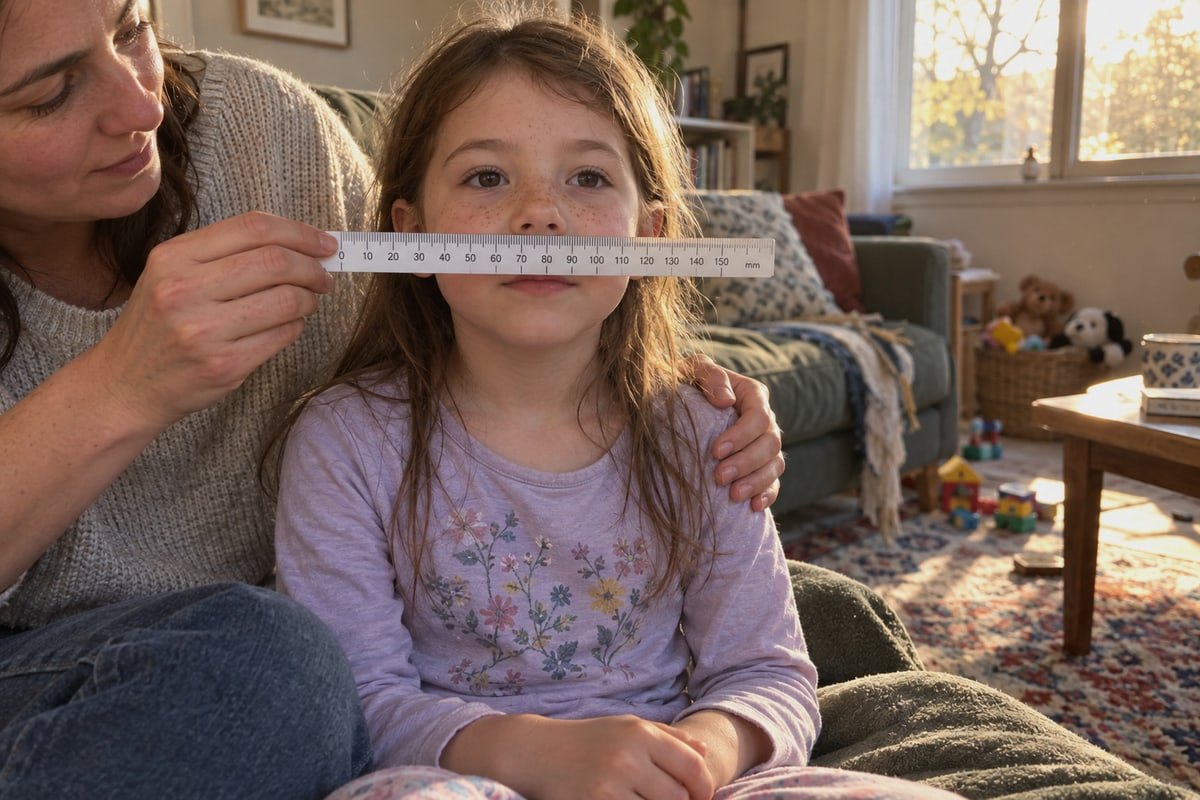
A largura do rosto é o número que a maioria dos pais pula. Eles olham a idade na caixa e esperam. Em nossa experiência, é aí que começam a maioria das reclamações de ajuste. Então, deixe-me detalhar a medição em passos simples.
O que a largura do rosto realmente significa para óculos de sol
A largura do rosto é a distância de têmpora a têmpora. É a linha horizontal na parte mais larga do rosto, aproximadamente na altura dos olhos e logo à frente das orelhas. Este número deve corresponder à largura total da armação 2 dos óculos de sol. Não é a largura da lente. Uma armação com uma lente de 45 mm pode facilmente ter 120 mm de largura depois de adicionar a ponte e as hastes. Essa lacuna é o motivo pelo qual tantas tabelas enganam as pessoas.
Um método simples passo a passo
- Sente a criança em boa luz, de frente para você.
- Segure uma régua milimétrica 3 régua.
- rígida.
- nivelada sobre o rosto nas têmporas.
- Mantenha a régua justa contra a pele. Não aperte.
Leia o número onde a régua encontra a têmpora mais distante.
Repita duas ou três vezes e tire a média dos resultados.
| Método | Uma fita métrica de costura mole se curva ao redor do rosto. Essa curva adiciona vários milímetros. Uma régua rígida permanece reta, então ela lê as verdadeiras dimensões da armação que a criança precisa. | Três maneiras de obter o número | Melhor para |
|---|---|---|---|
| O que você precisa | Precisão | Alto | Régua rígida nas têmporas |
| Régua milimétrica, boa iluminação | A maioria das crianças a partir de 4 anos | Alto | Óculos existentes bem ajustados |
| Um par que já serve | Crianças que já usam óculos | Médio | Foto com uma moeda para escala |
Câmera de celular, moeda.
Bebês muito jovens ou inquietos.
Que ferramentas preciso para medir a distância pupilar para armações TR90 infantis?
Uma fita métrica mole fornece uma largura de rosto mais precisa porque segue a forma do rosto.
Você precisa de uma régua milimétrica rígida ou régua de DP impressa, um espelho ou um ajudante, boa iluminação e um ponto de foco fixo do outro lado da sala. Ferramentas opcionais incluem um aplicativo de DP para smartphone calibrado com um cartão de crédito ou um medidor de DP digital de um ótico.
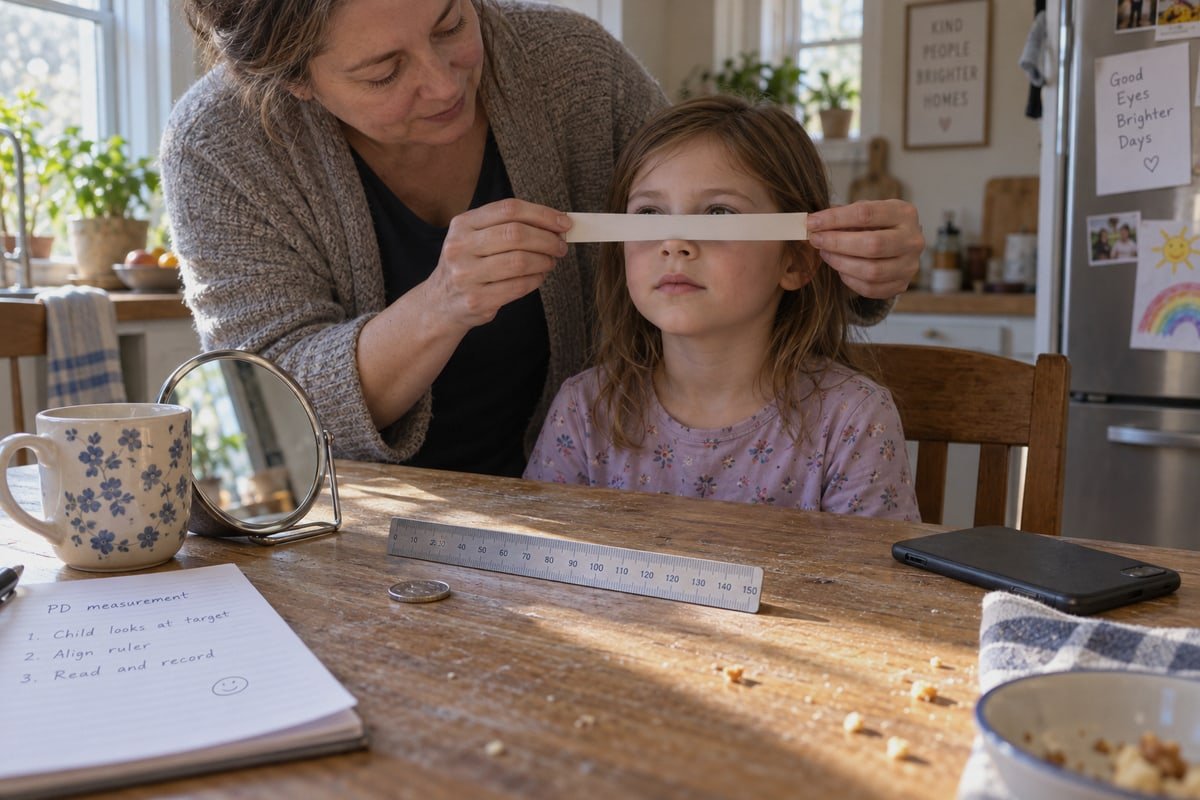
Envolver o rosto adiciona comprimento à curva, então uma fita mole lê vários milímetros a mais; uma régua milimétrica rígida mede a distância em linha reta que uma armação realmente abrange. centro óptico 4 Escolher entre uma régua milimétrica simples e um aplicativo de celular é um compromisso que pondero com nossos compradores de marcas com frequência. A régua não custa nada, mas uma criança de quatro anos se mexendo testa a paciência.
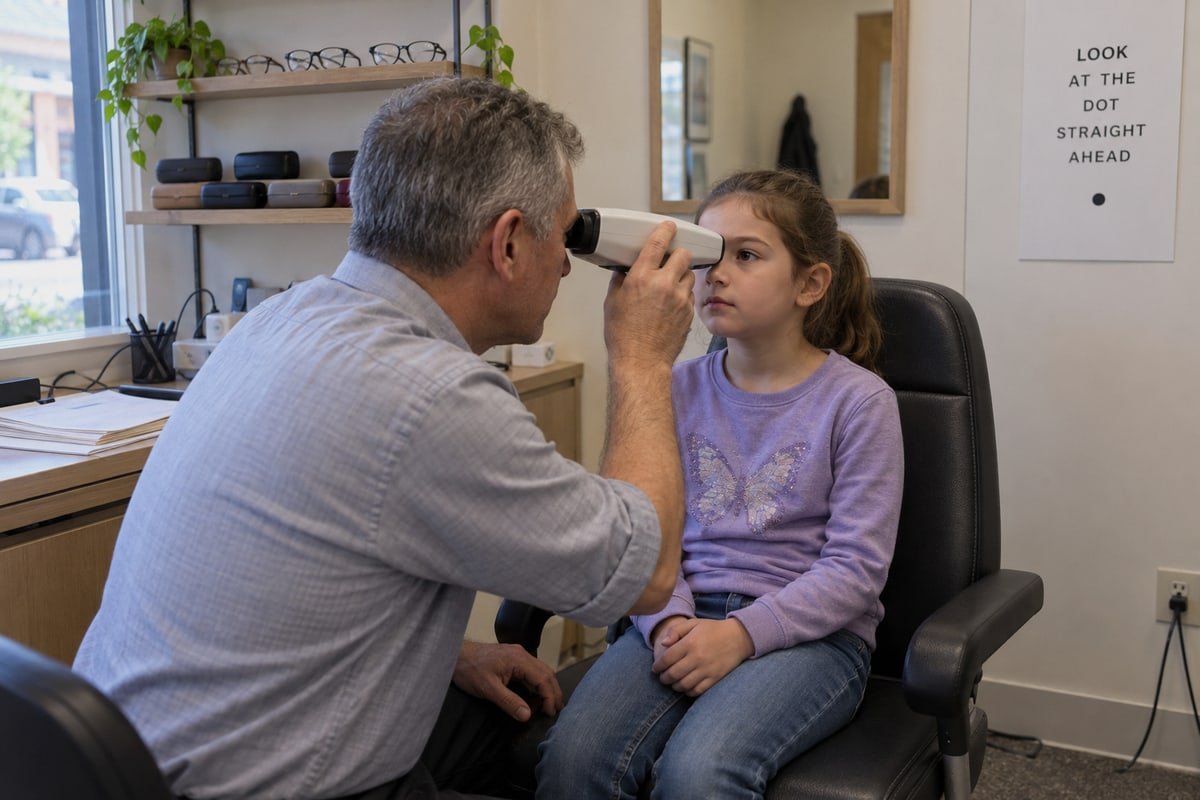
A distância pupilar, ou DP, é a distância entre os centros das duas pupilas. É sempre escrita em milímetros. Quando organizamos as posições das lentes em um novo molde TR90, este é o número em torno do qual projetamos. Ele decide se o
| Ferramenta | Custo | Observações |
|---|---|---|
| de cada lente fica sobre o olho. | Muito baixo | O kit de ferramentas básico. |
| Régua milimétrica rígida | O padrão. Qualquer régua reta com marcações em mm funciona. | Régua de DP impressa. |
| Mirror | Usually at home | For the self-measure method on older kids. |
| Helper | O padrão. Qualquer régua reta com marcações em mm funciona. | The most useful tool for young children. |
| Smartphone PD app | Free to low | Uses a credit card or coin for scale calibration. |
| Digital PD meter | Optician only | Very accurate, but not needed for non-prescription sunglasses. |
The helper method, step by step
I prefer this method for anyone under about eight years old.
- Have the child sit and look at a fixed point across the room. A picture on the wall works well.
- Stand in front of the child and hold the ruler flat across the bridge of the nose.
- Line up the zero mark with the center of the right pupil.
- Without moving the ruler, read the mark at the center of the left pupil.
- Repeat the reading 2 to 4 times and average them.
Children fidget. Averaging smooths out those small shifts. If the child keeps looking at you instead of the wall, ask a second adult to hold up a toy behind your shoulder.
The mirror method for older kids
An older child can do this alone. They hold the ruler against the bridge of their nose, look into a mirror, close the right eye, and line zero up with the left pupil. Then they open the right eye, close the left, and read the mark at the right pupil. It takes practice. I still suggest a helper for a check.
What numbers to expect
Retailer guides commonly place children's PD between 43 and 58 mm. Some charts narrow that to 42 to 54 mm for younger kids. A toddler often sits in the low 40s. A ten-year-old may be near 55 mm. The exact number depends on head size, not just age.
Does PD really matter for sunglasses without prescription?
Some buyers push back here. They tell me PD only matters for optical lenses. I understand the point, but I disagree in practice. Poor optical center alignment on tinted lenses 5 means the child sees more frame edge and less lens. The sunglasses feel off, and kids take off things that feel off. Comfort and coverage matter as much as strict optics, and PD serves both.
Como combinar as medidas do meu filho com o tamanho certo do gráfico de tamanhos de óculos de sol TR90?
A procurement manager from Australia once emailed me a child's face width and PD and asked which of our 800 styles would fit. A size chart answered her.
Combine as medidas lendo o código de tamanho da armação como largura da lente – largura da ponte – comprimento da haste, dobrando a largura da lente e adicionando a largura da ponte para estimar a largura total da armação, em seguida, escolhendo a faixa etária cuja largura total esteja a poucos milímetros da largura do rosto e cujos centros das lentes se alinhem com o DP.
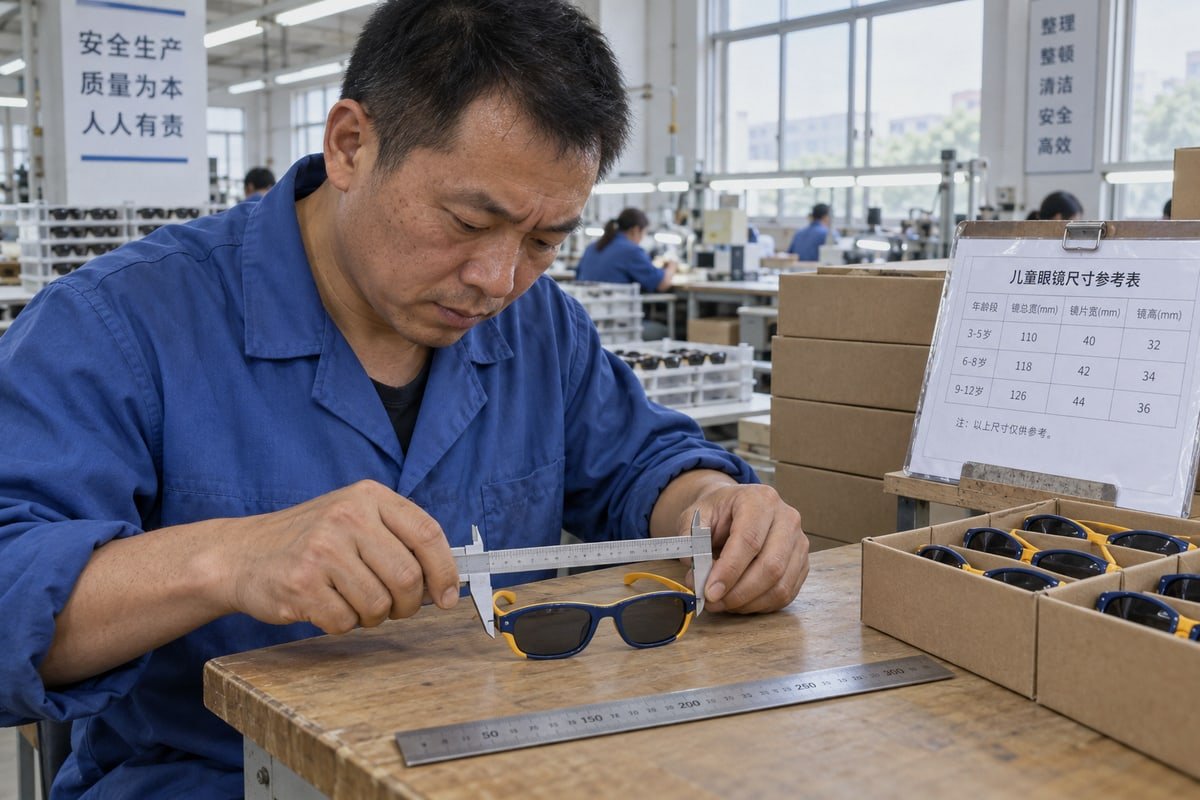
Once you have face width and pupillary distance, the chart does the rest. The trick is knowing what each number on the chart means. Here is how we explain it to new brand partners.
Decoding a size code like 49-16-130
Most kids' TR90 frames carry a three-part code. Take 49-16-130.
- 49 is the lens width in millimeters.
- 16 is the bridge width, the gap between the lenses at the nose.
- 130 is the temple length, from hinge to the tip behind the ear.
A smaller frame might read 45-16-125. Same bridge, smaller lens, shorter temple. Some listings add a fourth number for lens height, which matters for coverage on round toddler faces.
Two quick calculations
Primeiro, estimate frame PD. Add lens width and bridge width. For 49-16-130, that is 65 mm. Hmm, that seems large for a child, and it is. It tells you this frame suits an older youth with a PD in the mid-50s to high-50s, because a few millimeters of tolerance is normal. For 45-16-125, frame PD is 61 mm, closer to a child in the low 50s.
Second, estimate total frame width. Double the lens width, add the bridge, then add roughly 6 to 10 mm for the two end pieces. For 45-16-125, that gives about 106 to 116 mm. Compare that to the child's temple-to-temple distance.
A working kids' TR90 sizing chart
| Faixa etária | Largura da lente | Largura da ponte | Comprimento da haste | Faixa típica de DP |
|---|---|---|---|---|
| Toddler (approx. 1–3) | 40–44 mm | 12–14 mm | 105–115 mm | 42–47 mm |
| Kids (approx. 4–7) | 44–48 mm | 14–16 mm | 115–125 mm | 46–52 mm |
| Junior (approx. 8–10) | 48–52 mm | 15–17 mm | 125–135 mm | 50–55 mm |
| Youth (approx. 11+) | 52–56 mm | 16–18 mm | 130–140 mm | 53–58 mm |
Treat the age labels as loose guides. The face width and PD columns are the ones that decide the sale. A large five-year-old may sit in the junior row. A small nine-year-old may sit in the kids row. Age is a rough proxy. Measurements are the real answer.
When the numbers fall between sizes
This happens often. My advice is simple. Choose the smaller size if the child's PD is closer to that frame's PD. Choose the larger size if the face width is more than 5 mm over the smaller frame's total width. TR90 bends outward a little at the temples. Our frames with TPEE temples flex even more. That flex gives you a few millimeters of grace, not a full size.
Bridge width deserves its own check
Bridge width often gets ignored. A bridge that is too wide lets the frame slide down the nose. The lenses then sit low, and the child looks over the top. Compare the middle number in the code to the child's nose. If an existing pair fits well at the nose, copy its bridge number.
Que erros de dimensionamento devo evitar ao encomendar óculos de sol TR90 para crianças a granel?
One lesson fifteen years of eyewear production taught our team: bulk sizing errors multiply. A single wrong chart on a container order becomes a container of returns.
Evite confundir a largura da lente com a largura total da armação, dimensionamento apenas pela idade, usando uma fita métrica flexível em vez de uma régua rígida, ignorando a largura da ponte, pulando o comprimento da haste, confiando na flexibilidade do TR90 para corrigir um ajuste básico inadequado e pedindo um tamanho para uma ampla faixa etária sem testes de amostra.
Bulk buying changes the math. A parent who mis-measures loses one pair. A brand that mis-sizes loses a whole run. Here are the mistakes I see most, and what we do on our production line to help buyers avoid them.
The mistakes that cost the most
| Erro | Why it hurts | Correção |
|---|---|---|
| Reading lens width as frame width | Frames arrive 20–30 mm wider than expected | Always calculate total width from the full size code |
| Sizing by age only | Same-age kids vary by 10 mm or more in face width | Build your chart around face width and PD |
| Ignoring bridge width | Frame slides down, lenses sit low | Match the middle number to nose width |
| Skipping temple length | Temples too short pinch; too long slip | Check the third number against ear-to-hinge distance |
| Relying on "flex-fit" | Flex hides a few mm, not a full size | Set a baseline fit first, then let TR90 add tolerance |
| No sample test | Errors are found after the container lands | Test samples on real children before mass production |
The flex-fit objection, answered
Buyers sometimes tell me that TR90 is flexible, so exact sizing is less important. There is some truth in that. TR90 is a flexible thermoplastic material with strong resistência ao impacto 6 and hypoallergenic properties, and it does give a wider fit window than rigid acetate. But flex is a cushion, not a cure. A frame 15 mm too wide will still slide off a small face, no matter how well it bends. Use the flex to cover growth and small variance. Do not use it to skip measuring.
The warm fit test
Here is a simple check we suggest before any brand finalizes a size range. Have a child wear the sample for five to ten minutes. TR90 softens slightly with body heat and settles onto the face. After that time, look at three things. Do the lenses sit centered over the eyes? Do the temples touch the head without leaving marks? Does the frame stay put when the child looks down? If all three pass, the size is right.
One size does not fit ages 3 to 12
A single "kids" size covering toddlers through pre-teens almost always fails at one end. Spread the range. Even two sizes, a kids and a junior, cut return rates sharply. With around 800 existing styles in our catalog, a brand can pick a toddler eyewear sizing chart, a kids band, and a youth band without paying for new molds. That keeps the first order low-risk.
A short pre-order checklist
- Confirm face width and pupillary distance ranges for each target faixa etária.
- Decode every código de tamanho into lens width, bridge width, temple length, and total width.
- Request samples in each planned size, then run the warm fit test on real children.
- Ask your supplier for lens height, since round toddler faces need taller coverage.
- Confirm UV400 or polarized lens specs alongside the frame dimensions.
- Lock the size chart into the packaging artwork so retail shoppers measure before buying.
Conclusão
Guessing sizes costs brands returns and trust. Measure face width and PD, match them to real frame dimensions, and let TR90 flex handle the rest. We can help.
Interessado em adquirir os produtos mencionados neste artigo? Veja detalhes e solicite um orçamento aqui:
Notas de rodapé
1. Official American Academy of Ophthalmology guide on measuring PD. ↩︎
2. Detailed explanation of eyeglass frame components and sizing dimensions. ↩︎
3. NIST official reference for SI length units including millimeters. ↩︎
4. Technical definition of the optical center within a lens system. ↩︎
5. Professional explanation of lens types and their impact on visual performance and protection. ↩︎
6. International standard for sunglasses safety and impact performance requirements. ↩︎
Mais Artigos que Você Pode Gostar

28 de setembro de 2026
Óculos de Sol Infantis TR90 e TPEE Podem Usar Materiais Reciclados ou de Base Biológica?

28 de setembro de 2026
Óculos de Sol Infantis TR90 e TPEE São Recicláveis? Dicas de Descarte Explicadas?

28 de setembro de 2026
Como Evitar Deformação e Arranhões ao Enviar Óculos de Sol Infantis TR90 e TPEE?
Procurando um Parceiro Confiável em Óculos Infantis?
Explore mais de 800 estilos prontos e suporte completo OEM/ODM adaptado à sua marca.
Entre em Contato English
 Español de México
 Deutsch
 Français
 日本語
 العربية
 Português do Brasil