How Long Do TR90 & TPEE Kids’ Optical Frames Last Before Replacement?

Buyers ask us this every week: how long do TR90 and TPEE kids’ optical frames really last traditional acetate and metal frames 1? Buy wrong, and your line gets returns. Our Taizhou workshop has the answer.
TR90 and TPEE kids’ optical frames typically last 1–3 years in everyday school use, and well-made TR90 frames can reach 3–5+ years with care. Most are replaced earlier because of children’s facial growth, prescription changes, or hinge wear, not because the material itself expires.
That short answer hides a lot of detail. Below, I will walk through the [replacement signals](https://okayeyewear.com/how-avoid-common-return-reasons-tr90-tpee-kids-optical-frames/), the factors that shorten or extend frame life, how these two polymers compare to older materials, and what to check before you pick a supplier.
How can I tell when my kids' optical frames need replacing?
Last month our QC team pulled a returned sample apart BPA-free hypoallergenic materials 2. The TR90 front was perfect. The hinge had loosened, and the temples splayed. That frame was done.
Kids' optical frames need replacing when they no longer sit square, temples spread or pinch, hinges wobble, the bridge no longer fits a growing face, or you see cracks, warping, or stress whitening. Frequent repairs and complaints of slipping or pressure points are also clear replacement signals.

The key idea I want every buyer to hold onto is this: material lifespan and replacement lifespan are two different things. A polymer can stay sound for years. The glasses on a child's face usually get replaced much sooner. Here is how I break the signals down.
Structural signals you can see
These are the signs a parent or an optician can spot in a few seconds.
| Signal | What it usually means | Replace or repair? |
|---|---|---|
| Frame sits crooked on the face | Temple misalignment or a warped front | Repair once; replace if it returns |
| Temples spread wide or pinch | Hinge fatigue or stretched temple material | Replace |
| Hinge wobbles or clicks | Worn screw or worn hinge barrel | Repair early; replace if repeated |
| Cracks, stress whitening, or chalky surface | Material fatigue or UV aging | Replace |
| Lenses pop out easily | Bridge or eyewire has stretched | Replace |
Fit signals that have nothing to do with damage
This is the part many brands overlook. Children's facial growth is the single most common reason a frame leaves service. A frame that fit a five-year-old will ride too narrow on the same child at seven. Prescription lens changes also drive replacement. If the new lens is thicker or a different shape, an optician may recommend a fresh frame rather than reglazing a stretched one. So a frame can be mechanically fine and still be "finished."
Material-specific signals for TR90 and TPEE
The two polymers age differently, and I think buyers should know this.
TR90 is a stiff, tough nylon-based resin. It rarely fails suddenly under normal use. But in heavy school-sport use, repeated high-impact stress can create micro-fissures. Some ranking sources put that risk at roughly 18 months of hard use. The frame may look fine, then crack at a stress point. Stress whitening near the bridge or hinge is the early warning.
TPEE behaves like a flexible memory resin. It bends and returns. Its failure mode is different. After two or more years of frequent outdoor use, strong UV can cause surface "chalking," which dulls colour and changes grip. Because the material is so elastic, the bridge can also stretch over time. That leads to loose lenses and lenses drifting away from the child's pupillary distance. Some opticians also suggest a hygiene-based swap around 18–24 months, because softer, slightly more porous surfaces can hold skin cells and biofilm. I treat that as a practical guideline, not a strict rule.
What factors affect the lifespan of TR90 and TPEE frames?
There is a trade-off we weigh on every new mold: more flex means more comfort, but softer temples also stretch sooner. Balancing those two decides how long a frame lasts.
The lifespan of TR90 and TPEE frames depends on the child's age and growth rate, activity level, heat exposure, cleaning habits, hinge quality, and frame construction. Material grade matters too: TR90 resists sweat and sunscreen, while TPEE tolerates a wider temperature range but can stretch or chalk with UV.

When I talk to a procurement manager about pediatric eyewear durability 3, I split the factors into three groups: how the child uses the frame, how the frame is built, and how the family cares for it. Only the second group is fully in a supplier's control. But a good supplier designs for the other two.
Usage intensity sets the baseline
| Use case | Typical replacement window | Main driver of replacement |
|---|---|---|
| Light, supervised use (younger child, indoor) | TR90 can reach 3–5+ years | Growth and prescription changes |
| Everyday school use | About 1–3 years | Growth, hinge wear, minor damage |
| Heavy active or sports use | Often 12–24 months, sometimes less | Impact, repeated bending, loss |
These are practical ranges drawn from sourcing guides and optician advice, not guarantees. A toddler who chews temples and a ten-year-old who plays football both shorten the window, for different reasons.
Construction decisions that matter
Hinge design is the quiet killer. Many TR90 frames use a standard metal-to-plastic hinge. It works well, but the screw can back out over months of daily opening and closing. Screwless hinge technology, which is common on TPEE frames and on our TR90 fronts paired with TPEE temples, removes that failure point. On our production line, we check hinge tension on every batch, because a hinge that feels tight at the factory but loosens after weeks of use is the most common complaint we hear from importers.
Temple thickness also matters. On our clear frames with gradient purple temples, the small perforated dot pattern along the temple lets the arm flex without thinning the section too far. That is a deliberate balance between comfort and tensile strength.
Environment and care
Heat is the enemy of TR90. A frame left on a car dashboard in summer can warp, and a warped TR90 front rarely comes back to true. TPEE handles a wider temperature range, but sunscreen and harsh cleaners can still dull its surface. Here is the care routine I share with our brand customers to print on packaging inserts:
- Store the glasses in a hard case when they are off the face.
- Keep them away from dashboards, radiators, and hot water.
- Clean with mild soap and water or a lens spray; avoid solvents.
- Book a professional adjustment every 6–12 months.
- Replace worn nose pads and temple tips instead of the whole frame.
One objection I hear: "You market these frames as unbreakable, so why does care matter?" My honest answer is that "unbreakable" is marketing language. No frame is truly indestructible. TR90 and TPEE are far more forgiving than standard plastics, and that is the real claim. Care still decides whether a frame reaches the top or the bottom of its range.
How does TR90 and TPEE durability compare to traditional frame materials?
A product manager from Australia once asked me why we don't just use acetate like everyone else. I handed her two samples and asked her to twist them both.
TR90 and TPEE outlast traditional acetate and metal frames in children's use because they bend instead of snapping, weigh less, and resist skin oils and sweat. TR90 offers higher stiffness and impact resistance; TPEE offers greater flex and memory; acetate and metal crack or deform under rough handling.

The acetate sample in that story held its shape, then cracked at the hinge. The TPEE sample bent flat and sprang back. That small demonstration explains most of the comparison below.
| Material | Flexibility | Impact resistance | Weight | Heat tolerance | Typical kids' use case |
|---|---|---|---|---|---|
| TR90 | High, with good stiffness | Very high | Very light | Moderate; warps in hot cars | Everyday optical, school |
| TPEE | Very high, 180-degree memory bend | High | Very light | Wide range | Toddlers, sports, active kids |
| Acetate | Low | Moderate; cracks at hinges | Medium | Moderate | Fashion styles, older kids |
| Thin metal | Low to moderate | Low; bends and stays bent | Light | Good | Older children, supervised use |
| Titanium | Moderate | High | Very light | Excellent | Premium, allergy-sensitive |
| Ultem | High | High | Very light | Good | Sport and rimless designs |
Where TR90 wins
TR90 is a nylon-based thermoplastic with a strong evidence base. Sourcing guides report that it survives 5,000+ flex cycles in standardized testing 4 without cracking. Some flexible frame vendors quote 50,000+ cycles for selected models, though I treat vendor-specific numbers with caution until I see the test method. TR90 also resists chemical corrosion from skin oils, sweat, and sunscreen. Acetate can yellow or go brittle over time; TR90 tends not to. That is why we use it for the front of most of our optical frames, including the light-blue translucent style with softly rounded corners.
Where TPEE wins
TPEE is a thermoplastic elastomer. In plain language, it is a rubber-like plastic that stretches and recovers. A TPEE temple can bend 180 degrees without snapping and return to shape. For toddlers who pull glasses off sideways, that memory property 5 is worth more than raw stiffness. TPEE also tends to keep its flexibility across a wider temperature range than TR90.
The honest caveat on evidence
A fair objection: most TR90 durability data comes from manufacturers and distributors, not independent long-term field studies, and public TPEE lifespan data is thinner still. I resolve that objection the same way for both. Ask the factory for its own flex-cycle and drop-test records on the actual model you plan to buy, and run your own wear trial with a small group of children before scaling.
Why we combine them
The best pediatric eyewear durability we have achieved in fifteen years comes from a hybrid: a TR90 front for lens retention and optical stability, paired with TPEE temples for comfort and flex. Both materials also share hypoallergenic properties and are made from BPA-free materials, which matters for brands selling into Japan and Europe where parents read labels closely.
How can I choose a supplier whose frames will last through everyday kids' use?
We learned this the hard way years ago: a frame that passes a lab test can still fail in a school bag. That lesson reshaped our 5S workshop.
Choose a supplier that is a real factory with proven flexible-material expertise, documented flex and impact testing, consistent hinge quality, BPA-free hypoallergenic materials, and full OEM/ODM support. Ask for physical samples, test reports, an existing style library, and clear quality-control steps before committing to a mold.

Supplier choice decides frame life more than most buyers expect. Two frames can be described identically on a spec sheet and behave completely differently after six months on a child. Here is the process I recommend, based on what our long-term customers in 20+ countries actually do.
Step 1: Confirm you are dealing with a factory
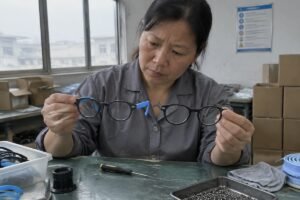
Trading companies resell what they can find. A factory controls material grade, molding parameters, and hinge assembly. Ask for a workshop video, a headcount, and a description of the QC stations. Our own site runs about 120 workers under 5S management, and we show buyers exactly where hinge tension and temple alignment are checked.
Step 2: Ask the right durability questions
| Question to ask | Why it matters | What a good answer looks like |
|---|---|---|
| Which TR90 or TPEE grade do you use? | Material grade drives flex life and UV aging | A named grade with a supplier data sheet |
| What flex and drop tests do you run? | Lab results predict field life | Test method plus cycle count on the actual model |
| How do you control hinge tension? | Hinges fail before materials | A documented check per batch |
| Are materials BPA-free and hypoallergenic? | Parent trust and regulatory review | Material declarations on request |
| Can I test the market without a new mold? | Molds are expensive and risky for new brands | A large existing style library |
Step 3: Reduce your launch risk
New brands often assume they must invest in tooling before they can sell. That is not true. Our library of around 800 existing styles lets a brand pick a proven frame, apply its own colours, logo, lens spec, and packaging, and test demand with a modest first order. If the style sells, the brand can move to a custom mold with real data behind the decision. That is the core of the OEM/ODM support we offer: colours, logos, UV400 or polarized lenses, cases, and retail-ready packaging, all under one quality-control chain.
Step 4: Validate with a wear trial
Before you scale, put samples on real children for a few weeks. Check the hinge, the temple alignment, and the bridge stretch afterwards. This one step catches most problems that spec sheets miss.
The final objection I hear is about price. Yes, a flexible frame from a proper factory costs more than a generic sunglass frame. But TR90 and TPEE kids' optical frames that survive everyday use protect your brand from returns and one-star reviews. Reliability is the cheaper option over a product's life.
Conclusion
Frames fail from growth, heat, and hinges before the polymer does. Choose materials and a partner wisely, and your kids' line will earn repeat orders instead of returns.
Interested in sourcing the products mentioned in this article? See details and request a quote here:
Footnotes
1. Wikipedia provides a comprehensive overview of the components and materials used in eyeglass frames. ↩︎
2. NIH provides scientific information on the health benefits of using BPA-free materials in consumer products. ↩︎
3. The FDA regulates eyeglass frames as medical devices to ensure safety and biocompatibility. ↩︎
4. ISO provides international standards for testing the durability and quality of spectacle frames. ↩︎
5. Wikipedia explains the chemical properties of thermoplastic elastomers like TPEE used in flexible products. ↩︎
More Articles You Might Like


Looking for a Reliable Kids Eyewear Partner?
Explore 800+ ready styles and full OEM/ODM support tailored to your brand.
Get in Touch English
 Español de México
 Deutsch
 Français
 日本語
 العربية
 Português do Brasil