How to DIY Test Kids’ Eyewear Lenses for Impact Resistance Standards?

Wondering how to DIY test kids’ eyewear lenses for impact resistance Polycarbonate and Trivex material 1? On our production line, buyers ask this before every bulk order — because one shattered lens can end a brand.
You can DIY test kids’ eyewear lenses using a home version of the FDA drop ball test: drop a 5/8-inch steel ball from 50 inches onto the lens center and check for fractures. However, DIY tests only screen samples; official compliance requires accredited lab testing to 21 CFR 801.410, ANSI Z87.1, or EN standards.
Let me walk you through the tools, the standards, the limits of home testing, and why a good factory partner still matters. I will keep everything practical and honest.
What tools and methods can I use to DIY test lens impact resistance before ordering in bulk?
A buyer from Australia once dropped one of our TR90 sample frames onto his warehouse floor and stepped on it. It survived. That crude check told him something, but not everything, so we showed him a better routine.
Use a 5/8-inch steel ball (about 16 grams), a 50-inch drop tube, and a padded lens support to mimic the FDA drop ball test. Add a bright-light visual inspection, a lens retention push test, and a frame flex check to screen samples before committing to a bulk order.
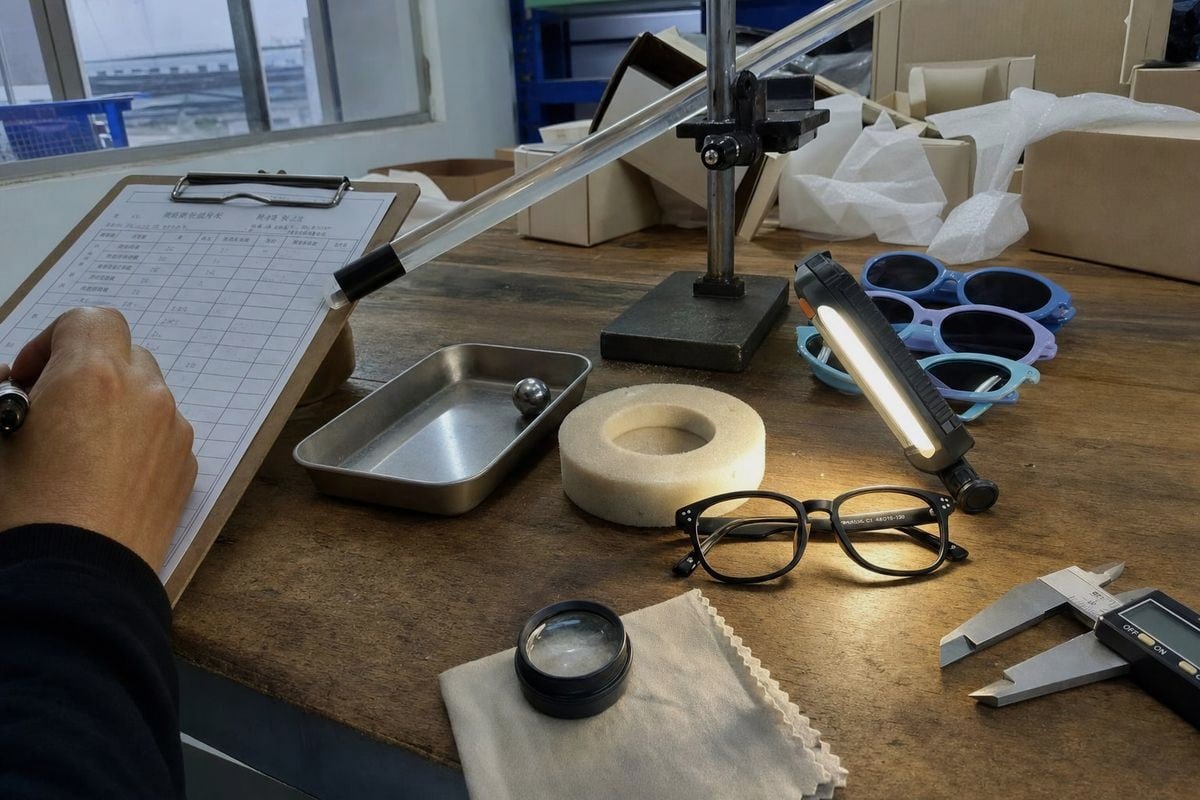
Before you order thousands of units, you want confidence that the lenses will not fracture in a child's hands. A structured DIY screening gives you that first layer of confidence. Here is the kit I recommend to buyers who visit our Taizhou factory and want to test samples on their own desk.
The basic DIY testing toolkit
| Tool | Purpose | Approximate Cost |
|---|---|---|
| 5/8-inch steel ball (~0.56 oz / 16 g) | Simulates the FDA drop ball impact | Very low |
| Clear tube or guide, 50 inches tall | Keeps the drop height and aim consistent | Low |
| Foam or neoprene lens support ring | Holds the lens center exposed, edges supported | Low |
| Bright LED lamp or flashlight | Reveals cracks, chips, crazing, delamination | Low |
| Digital calipers | Checks center thickness (aim for 2.0 mm minimum on prescription lenses) | Moderate |
| Magnifier or loupe | Inspects edges and coating damage after impact | Low |
A simple five-step method
- Inspect the lens under bright light first. Scratches and pits act as stress concentrators and weaken impact resistance before you even start.
- Mount the lens on the padded support with the front surface facing up.
- Drop the steel ball from 50 inches onto the geometric center of the lens.
- Examine the lens for cracks through the full thickness, separated pieces, or any detached material. Any of these means failure.
- Push firmly on the back of the lens with your thumb. A safe frame should have a lens retention bevel that stops the lens from popping inward toward the eye.
One caution I always give buyers: do not repeat drop tests on the same lens many times as a validation method. Cumulative fatigue can hide internal stress fractures, and repeat hits do not duplicate the regulated setup anyway. Test a few dedicated samples, record the results, and keep the tested lenses out of your sellable stock. Also test cold samples if your market includes winter sports — thermal embrittlement can make even tough materials more brittle in sub-zero conditions.
Which impact resistance standards should I check for children's eyewear lenses like ANSI or EN?
In our fifteen years exporting children's eyewear to more than 20 countries, the single most common confusion we see is buyers mixing up everyday eyewear rules with sports protection standards. They are not the same thing.
For the US, everyday kids' lenses must meet the FDA drop ball test under 21 CFR 801.410. Sports eyewear needs ASTM F803, and safety eyewear needs ANSI Z87.1 high-velocity impact testing. In Europe, check EN ISO 12312-1 for sunglasses and EN 166 for protective eyewear.
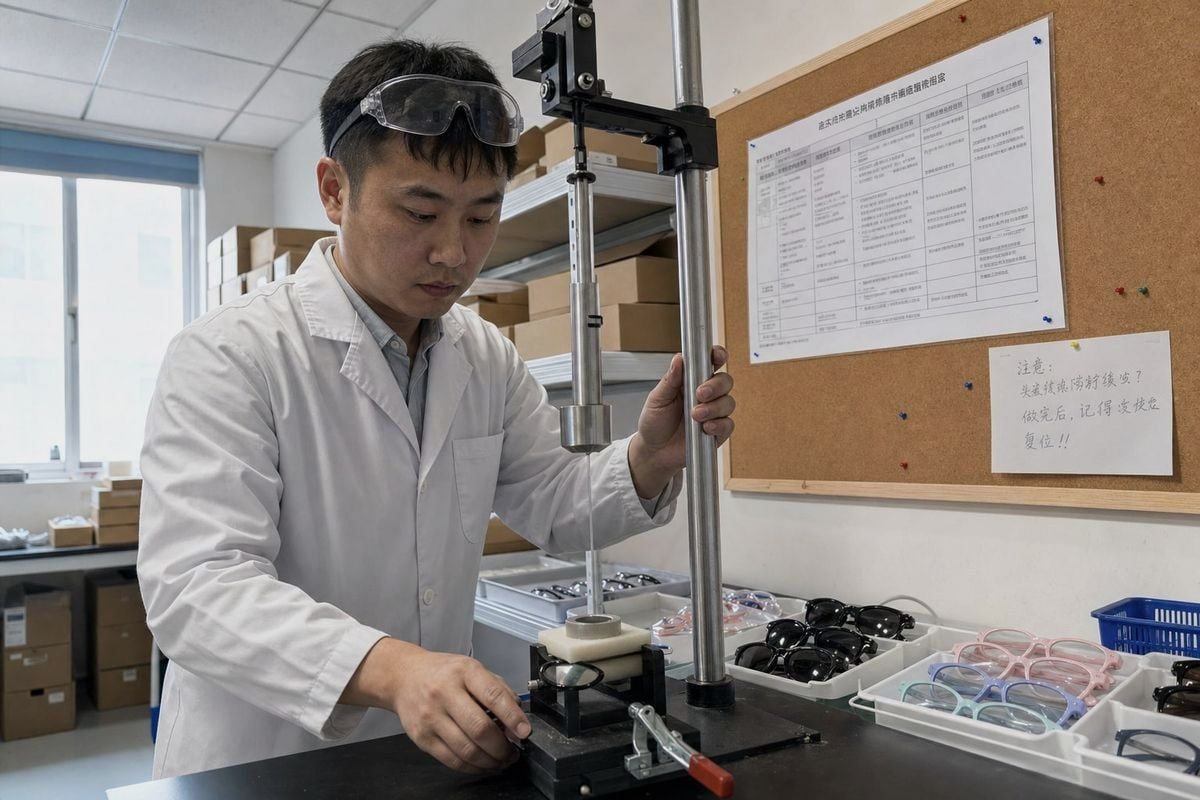
Knowing which standard applies to your product is half the battle. A pair of everyday optical frames, a fashion sunglass, and a sports shield each fall under different rules. Get this wrong, and you either over-spend on testing you do not need or under-protect the children wearing your product.
The main standards at a glance
| Standard | Region | Applies To | Core Impact Test |
|---|---|---|---|
| FDA 21 CFR 801.410 | USA | All everyday ophthalmic lenses | 5/8-inch steel ball dropped from 50 inches; lens must not fracture |
| ANSI Z87.1 2 | USA | Safety/protective eyewear | High mass impact plus high-velocity impact (projectile at up to 150 ft/s for some tests) |
| ASTM F803 3 | USA | Sports eye protectors | Sport-specific projectile impacts at realistic game speeds |
| EN ISO 12312-1 | Europe | Sunglasses | Robustness and, optionally, enhanced impact requirements |
| EN 166 4 | Europe | Personal eye protection | Graded impact levels including high-speed particles |
How to read the differences
The FDA drop ball test 5 is a baseline. It confirms a lens is shatter-resistant enough for daily wear — nothing more. ANSI Z87.1 goes much further with high mass impact and high-velocity impact tests, which is why Z87+ markings signal a genuinely tougher product. ASTM F803 is different again: it is sport-specific, testing eyewear against balls and impacts at speeds seen in racquet sports or basketball.
Here is the objection I hear often: "Polycarbonate 6 lenses are unbreakable, so any standard is fine." I push back on that every time. Polycarbonate and Trivex material 7 are excellent choices for active kids — far tougher than CR-39 or glass — but material alone does not equal sports-grade protection. Lens retention, frame geometry, and center thickness all matter. A polycarbonate lens in a weak frame can still be pushed into the eye. That is why the standard you certify against must match the real use case, not just the lens material on the invoice.
Look for permanent markings too. Z87+ or ASTM F803 engravings on the lens or frame indicate the product passed high-velocity testing, not just the basic drop ball requirement.
How do I know if my DIY test results are reliable enough to trust for safety compliance?
There is a trade-off we weigh in our 5S-managed workshop every week: fast internal screening versus slow formal verification. Both have a place, but only one holds up when a retailer or regulator asks for proof.
DIY test results are reliable for screening but never for safety compliance. They lack calibrated equipment, standardized support fixtures, controlled conditions, and statistically significant sample sizes. Treat a DIY pass as permission to proceed to accredited lab testing — not as a substitute for it.
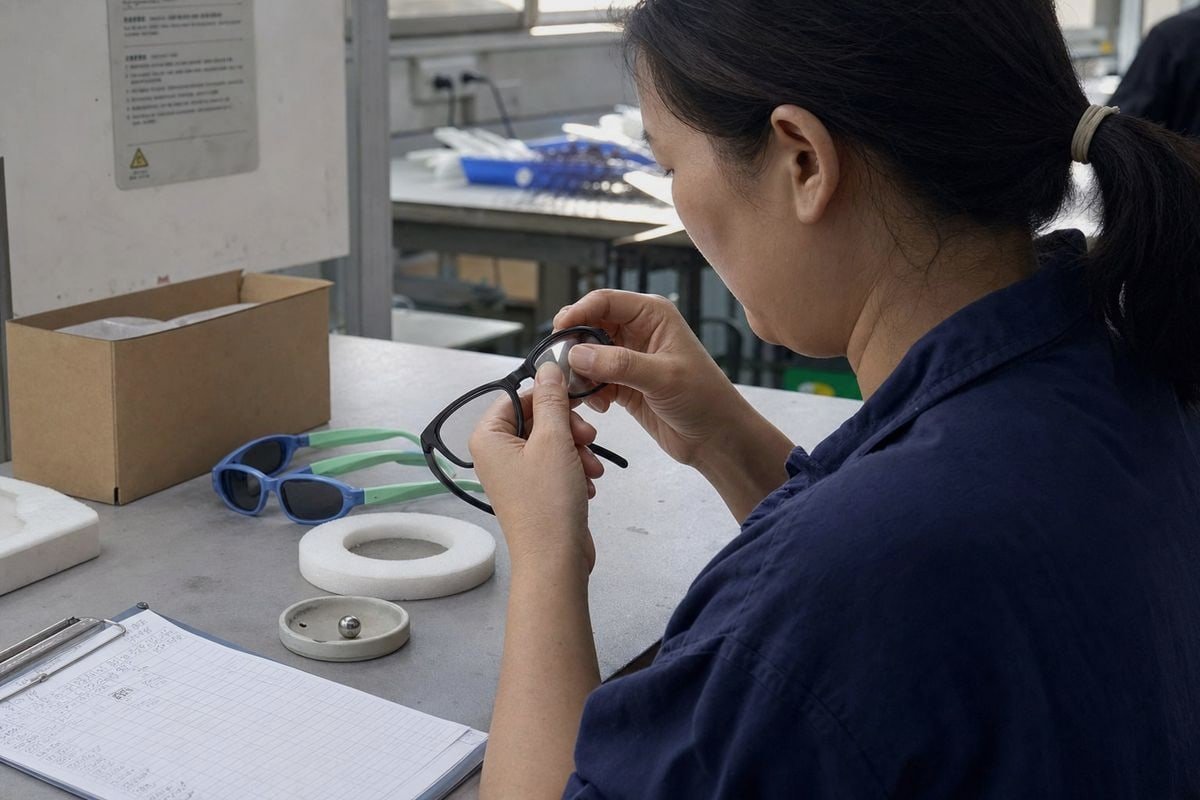
Let me be direct about what your kitchen-table test can and cannot tell you. This honesty matters, because I have seen buyers treat a lucky DIY pass as a green light and skip lab verification. That is a risk no children's brand should take.
Where DIY testing falls short
| Factor | DIY Test | Regulated Compliance Test |
|---|---|---|
| Ball weight and dimensions | Approximate | Calibrated to specification |
| Drop height accuracy | Tape-measure precision | Fixed, verified apparatus |
| Lens support fixture | Improvised foam or rubber | Standardized geometry per the rule |
| Sample size | One or two lenses | Statistically significant sampling for applicable lens types |
| Environmental control | Room conditions vary | Controlled and documented |
| Documentation | Informal notes | Traceable test reports accepted by regulators |
Signals that improve DIY reliability
You can raise the value of home screening. Test multiple lenses, not one. Test after the lenses are fully processed — the FDA guidance itself notes that testing should happen after edging and coating, because processing changes lens strength. Measure center thickness with calipers; high-minus prescriptions ground too thin can fail even in strong materials. Watch for chemical crazing from alcohol cleaners or hairspray, which creates microscopic cracks that let a "safe" lens fail under low force.
Also beware of the word "shatter-resistant" on supplier paperwork. It is often an unregulated marketing term. "Impact-rated" tied to a named standard — 21 CFR 801.410, ANSI Z87.1, or ASTM F803 — is what carries weight. If your goal is legal compliance or a retail listing, the answer is documentation: manufacturer test reports, permanent markings, and lab certificates. Your DIY results are a useful filter that saves you from paying lab fees on obviously bad samples. Nothing more, and nothing less.
Why should I still partner with a factory for professional lab testing even after DIY testing?
Early in our export history, a European distributor asked us for lab reports on a TR90 optical frame he had already drop-tested himself. His DIY results were fine — but his retail chain would not stock the product without accredited documentation. That order taught both of us where the real gate sits.
A factory partner provides accredited third-party lab testing, batch-level quality control, traceable documentation, and legally recognized compliance under FDA, ANSI Z87.1, or EN standards. DIY testing screens samples; only manufacturer-backed lab reports satisfy regulators, retailers, and liability insurers for children's eyewear.
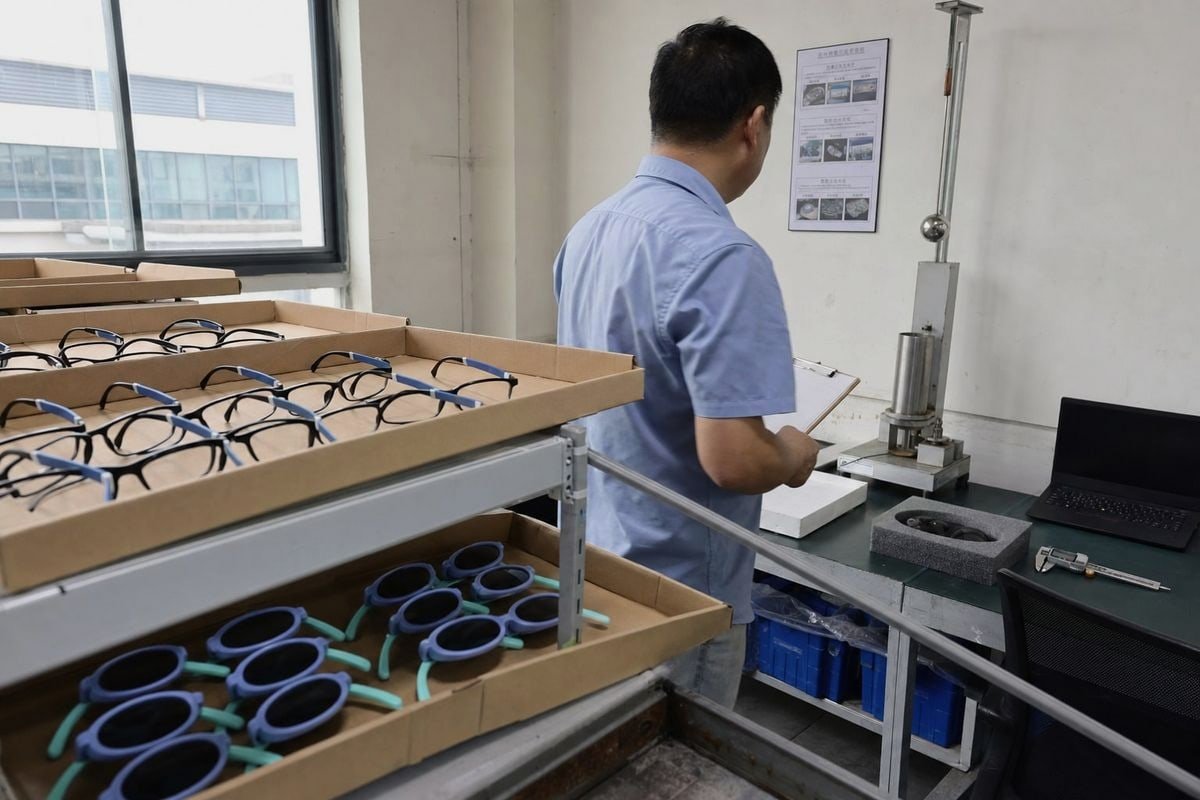
Under the FDA framework, impact testing is explicitly the manufacturer's responsibility. That is not a technicality — it shapes who carries the risk. When we produce a batch of kids' optical frames or UV400 sunglasses at our Taizhou facility, we test lenses after full processing and keep records tied to the production lot. If a question ever comes back from customs, a retailer, or a parent, that paper trail is what protects your brand.
What a real factory partnership adds beyond testing
First, sampling discipline. Compliance testing for many lens types uses a statistically significant sample from each batch, not a single lucky lens. A factory with proper QC — ours runs a 5S-managed workshop with around 120 workers — builds that sampling into the production flow, so consistency is not left to chance.
Second, material control. We work in TPEE and TR90 because flexible materials handle impact and bending on children's faces far better than rigid budget plastics. But material specs drift if no one watches suppliers. A committed factory verifies incoming resin and lens stock every time, so the product you tested in month one matches the product shipped in month twelve.
Third, lower launch risk. With roughly 800 existing styles available, a new brand can pick proven, pre-validated designs instead of investing in molds and re-testing from zero. You can still customize colors, logos, lenses, and packaging through OEM/ODM 8, while building on frames whose impact behavior is already known.
Finally, honest guidance on standards. If your buyer needs everyday eyewear, we align documentation with the FDA drop ball test or the relevant EN rule. If they need sports protection, we tell you plainly that ordinary frames are not the answer, and the product must be built and certified for ASTM F803. That clarity — knowing when to say no — is what a long-term manufacturing partner owes you.
Conclusion
DIY testing with a steel ball, bright light, and calipers screens kids' lenses well. But real safety compliance needs the right standard, accredited labs, and a factory partner who documents everything.
Footnotes
1. Background reference on the polymer properties that give these lens materials impact resistance. ↩︎
2. Background on the safety eyewear standard mentioned as an alternative compliance path. ↩︎
3. Explains the standards body behind the sports eyewear impact test referenced. ↩︎
4. ISO reference for personal eye protection standards used in European markets. ↩︎
5. Links directly to the official federal regulation defining this mandatory impact test. ↩︎
6. Background on the impact-resistant lens material discussed as superior to CR-39. ↩︎
7. Explains the alternative lightweight impact-resistant lens material named in the article. ↩︎
8. Clarifies the manufacturing partnership model referenced for custom eyewear production. ↩︎
More Articles You Might Like
Looking for a Reliable Kids Eyewear Partner?
Explore 800+ ready styles and full OEM/ODM support tailored to your brand.
Get in Touch English
  Español de México
  Deutsch
  Français
  日本語
日本語  العربية
  Português do Brasil