Fixed or Adjustable Nose Pads: Which Suits Your Child’s TR90 Frames?
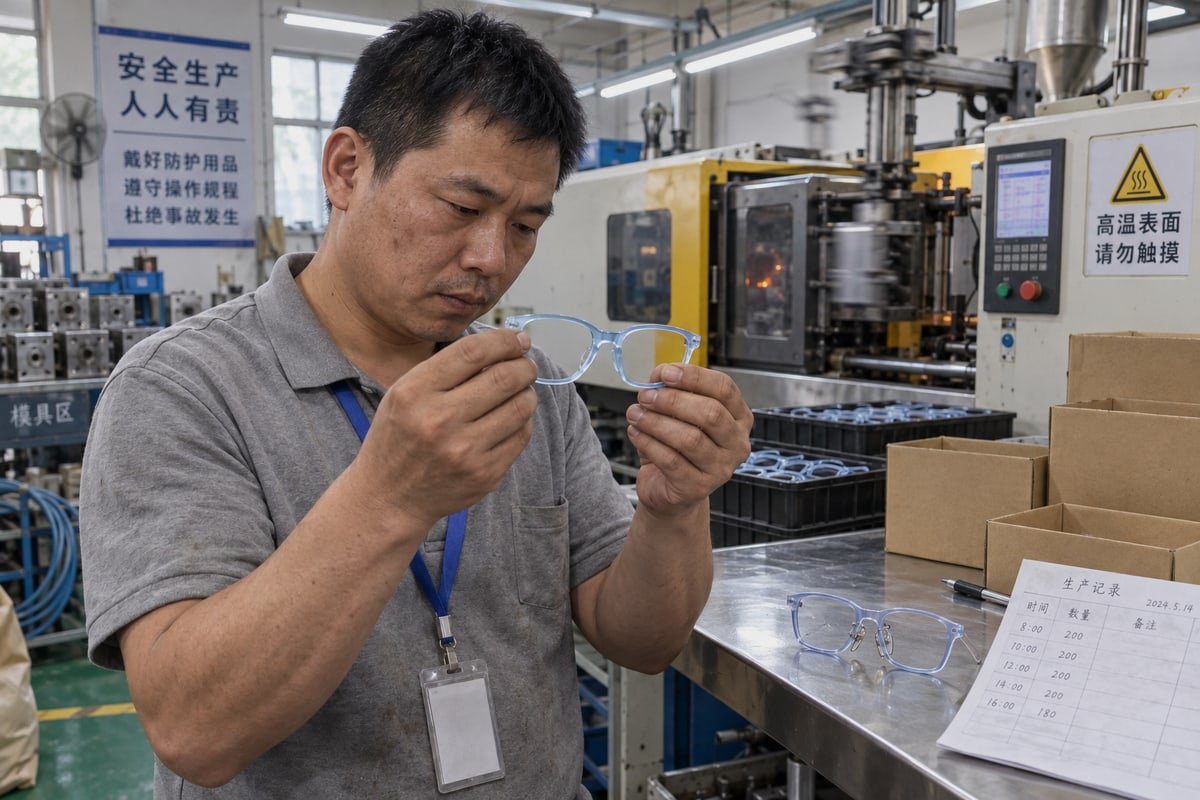
Kids’ glasses sliding within a week frustrate parents. Fixed or adjustable nose pads on TR90 frames decide that outcome, and our production line settles it at the mold stage.
Fixed nose pads suit most children’s TR90 frames because TR90 is injection-molded, and a molded bridge stays lighter, tougher, and simpler for active kids. Adjustable nose pads win when a child has a flat nasal bridge, facial asymmetry, or a strong prescription that needs precise centering.
That is the short answer. The full answer depends on the child’s face, activity level, and prescription. Below, I explain how we weigh fixed or adjustable nose pads when we develop TR90 frames in Taizhou, and what that means for the frames you buy, brand, or sell.
How do I know if my child needs fixed or adjustable nose pads for daily comfort?
A buyer in Australia once sent us three photos of the same child wearing glasses with red marks. That conversation changed how we talk about daily comfort.
Check three signs: frame slippage during normal head movement, red pressure marks on the nose after an hour, and lashes touching the lenses. If none appear, fixed nose pads are enough. If any persist after optician adjustments, your child needs adjustable nose pads.

Daily comfort is easy to judge if you know what to look for. Most parents notice slipping first. Pressure marks come second. Lashes touching lenses often go unnoticed until the child complains. I like to break it down by sign, because each sign points to a different cause.
What the daily signs tell you
| Daily sign | What it usually means | Better nose pad choice |
|---|---|---|
| Frame slides when the child looks down | Bridge width is too wide, or the bridge sits too high | Smaller fixed saddle bridge, or adjustable pads narrowed inward |
| Two small red spots on the nose | Concentrated pressure from small pads | Fixed integrated bridge that spreads weight over a larger area |
| One long red line across the bridge | Bridge is too narrow, or the frame is too heavy | Wider fixed bridge size, or a lighter TR90 front |
| Lashes brush the lenses | Frame sits too close to the eyes | Adjustable pads pushed forward, or a keyhole bridge with more depth |
| Frame tilts to one side | Uneven ear heights or a deviated septum | Adjustable pads, raised on one side |
Why pediatric facial anatomy changes the answer
Children are not small adults. Pediatric facial anatomy 1 usually includes a flatter, less developed nasal bridge, softer cartilage, and fuller cheeks. A frame designed for an adult bridge will simply slide. This is why we design our TR90 fronts with saddle or keyhole bridges. These shapes are engineered to rest on a flat nasal bridge and spread the load. When we test a new mold on children's head forms, we look at the contact patch, not just the bridge measurement.
Consistency matters for sensitive children
Some children have sensory processing sensitivities. For them, a fixed bridge often works better. It gives the same proprioceptive feedback every day. Nothing shifts, nothing clicks, nothing feels different from yesterday. Adjustable pads can move slightly during play, and that small change can bother a sensitive child. In our experience, parents of these children ask for the simplest possible frame, and a molded TR90 bridge is exactly that.
Which nose pad type offers better durability for active kids wearing TR90 frames?
In our workshop drop checks, the parts that fail first are rarely the TR90 fronts. They are usually the small metal pad arms on mixed-material samples.
Fixed nose pads are more durable for active kids in TR90 frames. The bridge is molded from the same memory resin as the front, so there are no metal pad arms to bend, loosen, or snap during play. Adjustable pads add parts, and every part is a failure point.
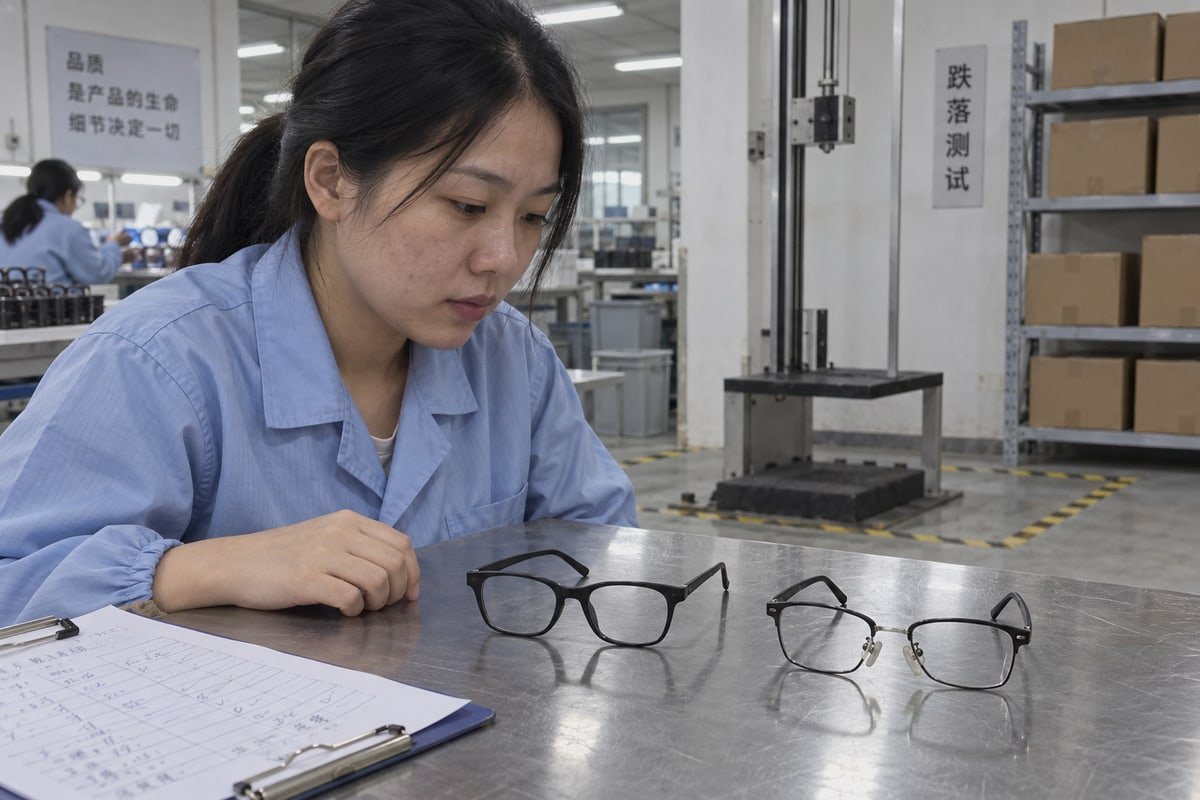
Durability is where the two designs separate most clearly. TR90 is a thermoplastic material 2 with high shape memory. When a child sits on the frame, the front flexes and returns. A fixed bridge shares that behavior because it is part of the same molded piece. Adjustable pad arms do not. They are thin metal. They bend, and they stay bent until someone fixes them.
Where frames actually break
| Durability factor | Fixed TR90 bridge | Adjustable pad arms |
|---|---|---|
| Parts that can bend out of shape | None | Two metal arms |
| Parts that can fall off | None | Two pads, two screws |
| Recovery after being sat on | Memory resin returns to shape | Arms need re-bending by hand |
| Sweat and heat during sport | Molded silicone insert keeps grip | Pads can loosen at the screw |
| Repair frequency | Rare | Regular re-adjustment |
The mechanical fuse argument
Some buyers push back here. They tell me adjustable pad arms act as a mechanical fuse. In a collision, the arms bend and absorb energy instead of sending it into the nasal bone. That is a fair point for a rigid metal frame. But TR90 changes the picture. The whole front flexes on impact, and our TPEE temples flex even more. The frame itself becomes the fuse. So in a TR90 children's frame, the extra metal arms add failure points without adding real protection.
A warning about narrow fixed bridges
Fixed bridges have one durability trap. If the bridge is too narrow for the child, TR90's shape memory works against you. The bridge sits high, the front bows, and the temples splay outward. The lenses tilt and the child sees peripheral distortion. The frame does not break, but it never sits right. This is why we offer more than one bridge width across our TR90 range, and why I always ask buyers which age band they are targeting before we lock a mold.
Pad material matters as much as pad type
Whatever style you choose, the contact surface should be silicone. Silicone nose pads have hypoallergenic properties 3, and they keep grip when a child sweats. Hard plastic pads slide as soon as the skin gets damp. On our fixed-bridge TR90 frames, we mold soft inserts into the bridge so the durability of a one-piece front comes with the grip of silicone.
Can adjustable nose pads improve the fit for children with different face shapes?
Every new style forces us to weigh one trade-off: a molded bridge that fits most faces cleanly, or pad arms that fit nearly everyone but add fiddly parts.
Yes. Adjustable nose pads let an optician change pad height, width, and angle, which levels frames on children with uneven ear heights, a deviated septum, or a very low bridge. For the common flat nasal bridge of young children, a well-designed fixed saddle bridge often fits just as well.
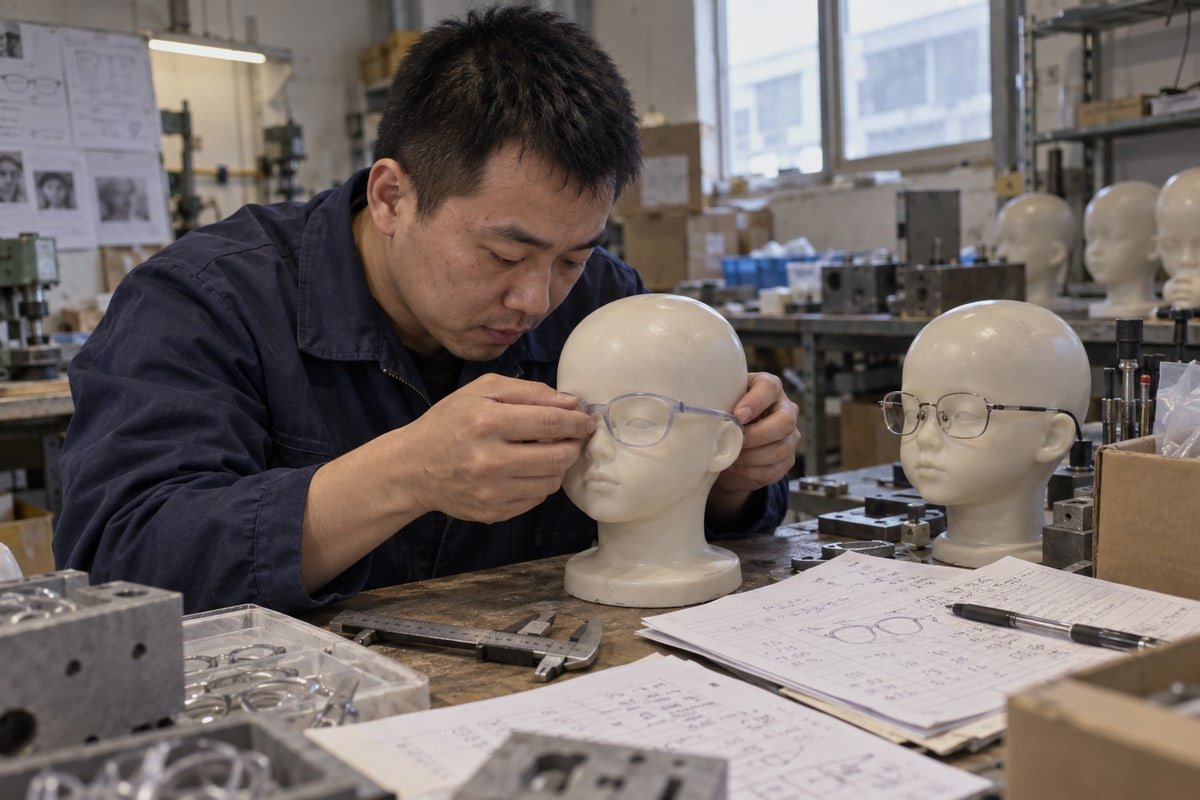
Face shape is the strongest argument for adjustable pads. It is also the argument buyers overstate most. Let me separate the cases where adjustment truly helps from the cases where a better fixed bridge solves the problem.
Fit problems by face profile
| Face profile | Common fit problem | Fixed bridge solution | Adjustable pad solution |
|---|---|---|---|
| Flat nasal bridge, younger child | Frame slides; lower rim touches cheeks | Low keyhole or saddle bridge with silicone insert | Pads set wide and low |
| Narrow, higher bridge | Frame sits too high and pinches | Smaller bridge width size | Pads narrowed |
| Facial asymmetry or uneven ears | Frame tilts | Limited; only temple bending helps | One pad raised, one lowered |
| Full cheeks | Rim rests on cheeks, fogs, irritates | Deeper bridge drop, shorter lens height | Pads angled to lift the front |
The table shows the pattern. Symmetry problems favor adjustable pads. Size problems favor a fixed bridge in the right size. The key phrase is "the right size". A universal fit bridge does not exist in children's eyewear, and any supplier who promises one is guessing.
Prescription strength changes the answer
Fit is not only about comfort. It is about where the lens sits over the pupil. For children with high prescriptions or complex astigmatism, adjustable pads give the optician a way to center the optics precisely. Small changes in pad height move the optical center 4. That is a real benefit.
Myopia management lenses 5 flip the logic. These lenses have treatment zones that must stay centered over the pupil all day. Adjustable pads can drift with every knock. A fixed bridge that fits well holds its position and prevents that optical drift. So for myopia control, I recommend a fixed TR90 bridge chosen carefully by bridge width, not an adjustable frame that fits at pickup and drifts by lunchtime.
How we handle this across roughly 800 styles
Our catalog covers about 800 existing styles, and the breadth exists partly for this reason. Instead of one bridge that tries to fit everyone, buyers can pick styles by bridge shape, bridge width, and lens height for each age band. The frames pictured in this article, one with a crystal-clear front and purple gradient temples and one in translucent light blue, use molded bridges sized for young children. Optician adjustments still happen at the temples and ear hooks, but the bridge does not need to move because it was chosen to fit from the start.
What should I ask my manufacturer before choosing nose pad style for my eyewear line?
Fifteen years of building children's frames taught us one lesson: buyers who ask about the bridge before asking about color end up with fewer returns.
Ask five things: which bridge widths and saddle shapes the TR90 mold offers, whether pads are silicone and hypoallergenic, how the frame flexes in a collision, whether the style works with myopia management lenses, and what sample and quality checks confirm fit before you commit.
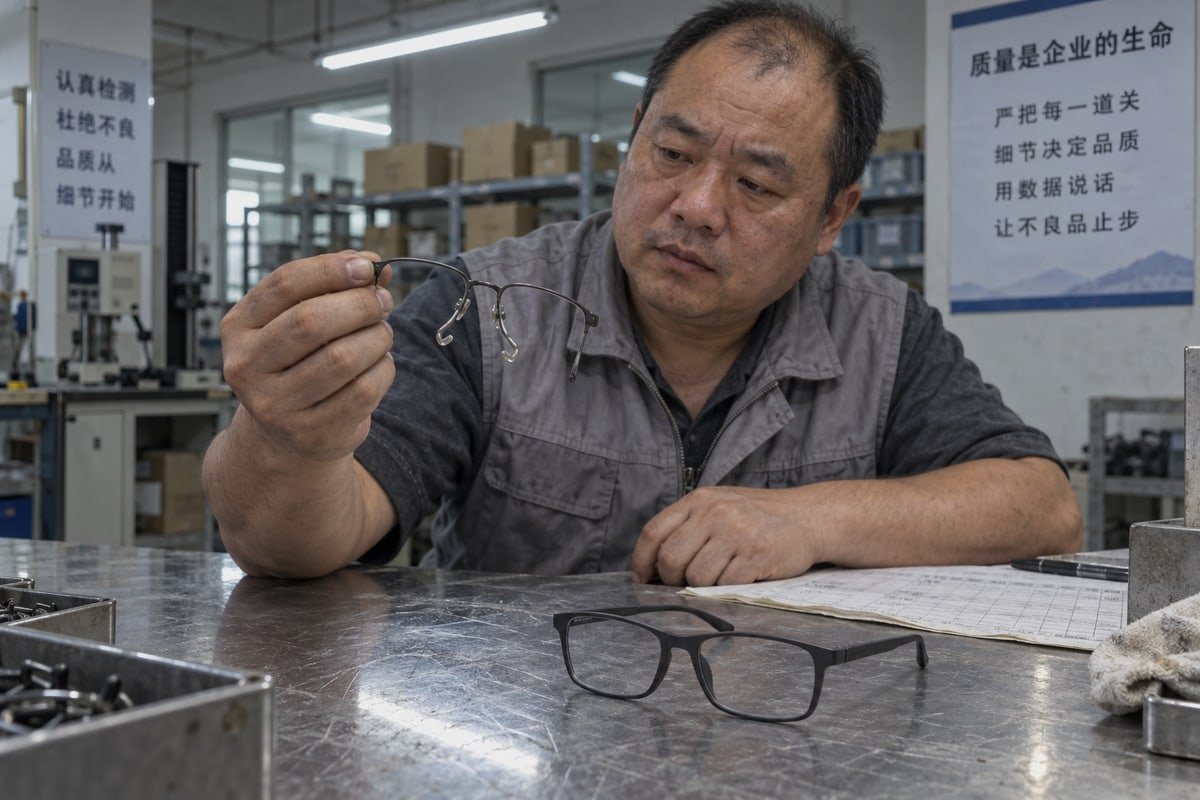
Choosing fixed or adjustable nose pads for a whole line is different from choosing for one child. You are choosing for thousands of faces you will never see. The questions below help you make that choice with data from the factory, not guesses from a catalog photo.
The five questions, and why each one matters
- Which bridge widths and bridge shapes does this TR90 style come in? One bridge cannot serve ages three to twelve. Ask for the bridge width range and whether the mold uses a saddle or keyhole shape. If the answer is one size, the style will slide on some children and pinch on others.
- What is the nose pad material, and is it hypoallergenic? Silicone should be the default. Ask whether the silicone is molded into the bridge or glued on. Glued pads peel in hot weather.
- How does the frame behave in a collision? For TR90 with TPEE temples, the front and temples should flex and recover. If a style uses metal pad arms, ask what protects the nasal bone and how often arms need re-bending.
- Is this style suitable for myopia management or high prescriptions? The answer tells you whether the supplier understands optical centering and optical drift, or only thinks about looks.
- What checks confirm the fit before mass production? Ask for wearing samples, head-form checks, and a clear quality control routine. In our 5S-managed workshop, fit checks are part of the standard flow, not an extra service.
Answers that signal a reliable partner
| Question | Answer you want | Red flag |
|---|---|---|
| Bridge width options | Two or more sizes, mapped to age bands | One size described as universal fit |
| Pad material | Molded silicone, hypoallergenic properties confirmed | Hard plastic, or unsure |
| Impact behavior | Front and temples flex; no rigid metal at the nose | No test process described |
| Optical suitability | Clear guidance on which styles hold centering | Never considered |
| Fit verification | Samples, head-form checks, documented QC | Photos only |
What full OEM/ODM support should include
Nose pad style should be one decision inside a complete development process. When a brand comes to us, we start with existing styles so they can test the market without heavy mold investment. Then we adjust colors, logos, lenses, and packaging. Bridge and pad decisions happen early, because they affect the mold and the silicone tooling. A partner that lets you decide the bridge after the sample stage is a partner that will cost you a second round of tooling. Ask about this sequence directly. The answer tells you whether you are talking to a real factory or a trading company passing your questions along.
Conclusion
Slipping glasses cost you returns and trust. Choose fixed nose pads for most TR90 kids' frames, adjustable for tricky faces, and let real fit guide the decision.
Interested in sourcing the products mentioned in this article? See details and request a quote here:
Footnotes
1. Authoritative medical database providing research on children’s craniofacial development and nasal bridge anatomy. ↩︎
2. Scientific overview of thermoplastic properties like shape memory and durability used in eyewear manufacturing. ↩︎
3. Regulatory authority standards for biocompatibility and hypoallergenic materials in medical-grade consumer products. ↩︎
4. Technical explanation of lens optics and the necessity of precise alignment for corrective eyewear. ↩︎
5. Global health organization data on vision impairment and the clinical importance of myopia control. ↩︎
More Articles You Might Like



Looking for a Reliable Kids Eyewear Partner?
Explore 800+ ready styles and full OEM/ODM support tailored to your brand.
Get in Touch English
 Español de México
 Deutsch
 Français
 日本語
 العربية
 Português do Brasil